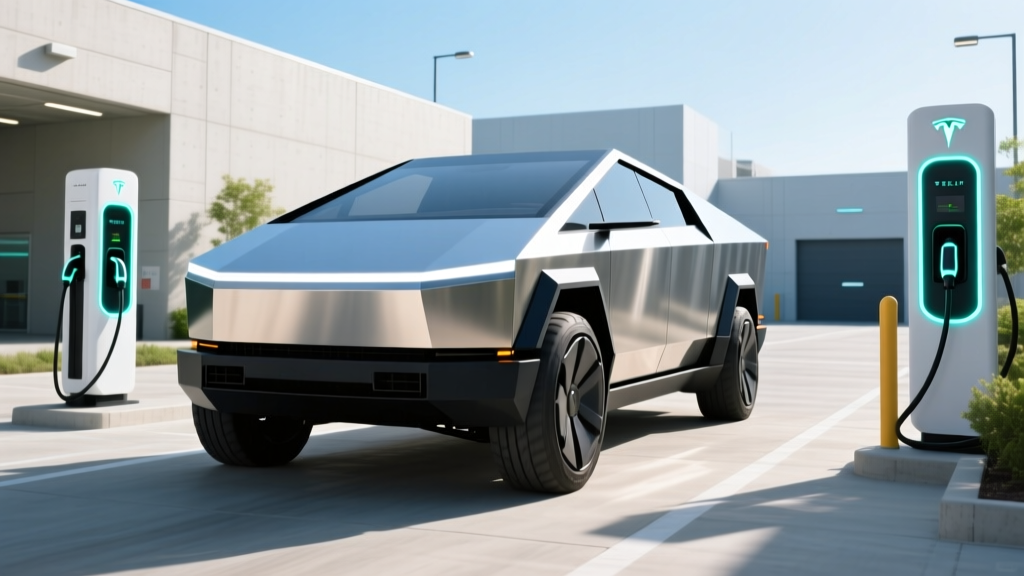
If you have spent any time on social media in the past year, you have likely encountered sensational headlines and viral clips about "Tesla trucks exploding." The phrase has become a search-trending shorthand for a handful of highly publicized Cybertruck incidents — from battery thermal events after high-speed crashes to the recall of early-production accelerator pedal assemblies. But how much of the concern is backed by data, and how much is internet amplification?
In this review, we separate the documented facts from the noise, examine NHTSA records, and deliver the complete 2026 Tesla Cybertruck buyer's profile — range, charging, performance, pricing, and tax credit eligibility — so you can make an informed decision about one of the most polarizing EVs on the road.
What the Data Actually Says About "Tesla Trucks Exploding"
Let's address the keyword directly. No production Tesla Cybertruck has spontaneously combusted while parked or under normal driving conditions as of early 2026. The incidents that fueled the "exploding" narrative fall into three categories:
- Post-crash thermal events: A small number of Cybertrucks involved in severe high-speed collisions experienced battery pack fires — a phenomenon not unique to Tesla. NHTSA data shows that EV battery fires remain statistically far rarer than internal-combustion-engine vehicle fires per 100,000 vehicles on the road.
- Accelerator pedal recall (NHTSA Recall 24V-267): In April 2024, Tesla recalled approximately 3,878 Cybertrucks because the accelerator pedal pad could dislodge and become trapped in the interior trim, potentially causing unintended acceleration. Tesla issued an over-the-air fix and a hardware replacement. No fatalities were attributed to this defect.
- Steering system concerns: A separate NHTSA investigation opened in late 2024 examined reports of steer-by-wire faults in early-build Cybertrucks. As of 2026, Tesla has pushed multiple firmware updates to address these reports, and the investigation status has been downgraded.
For authoritative safety data, the NHTSA recall database and IIHS remain the best sources. As of the 2026 model year, the Cybertruck has not yet been fully crash-tested by IIHS, which is a notable gap for a vehicle at this price point.
2026 Tesla Cybertruck: Full Spec Sheet
| Spec | AWD | Cyberbeast |
|---|---|---|
| EPA Range | 340 miles | 320 miles |
| Battery Capacity | ~123 kWh usable (NMC) | ~123 kWh usable (NMC) |
| Horsepower | 600 hp | 816 hp |
| 0–60 mph | 4.1 sec | 2.6 sec |
| Drivetrain | Dual-motor AWD | Tri-motor AWD |
| Max DC Fast Charge | 250 kW (V3 Supercharger) | 250 kW (V3 Supercharger) |
| 10–80% DC Charge | ~30 min | ~30 min |
| Level 2 Home Charge | 11.5 kW / ~34 mi/hr | 11.5 kW / ~34 mi/hr |
| Efficiency | ~68 MPGe / 50 kWh/100mi | ~65 MPGe / 52 kWh/100mi |
| Towing Capacity | 11,000 lbs | 11,000 lbs |
| Payload | 2,500 lbs | 2,500 lbs |
| Bed Volume | 74.3 cu ft | 74.3 cu ft |
| Base MSRP | $81,630 | $101,630 |
Sources: EPA / fueleconomy.gov, Tesla Cybertruck spec page. Specs reflect 2026 model year.
Real-World Range: What You Will Actually Get
🛣️ Real-World Highway (70 mph, 75°F): Expect ~265–285 miles. The Cybertruck's angular stainless-steel exoskeleton creates significantly more aerodynamic drag than a conventional truck, punishing highway efficiency.
❄️ Cold-Weather (30°F, mixed driving): Expect ~220–250 miles. The NMC pack loses roughly 25–30% of effective range in freezing conditions, even with Tesla's heat pump and battery preconditioning.
🏙️ City / Stop-and-Go: Closer to EPA — regenerative braking recovers energy effectively, yielding ~310–330 miles.
The Cybertruck's efficiency is its weakest competitive metric. At roughly 50 kWh/100 miles, it consumes substantially more energy per mile than the Rivian R1T (~42 kWh/100mi) or the Ford F-150 Lightning (~46 kWh/100mi). If you are a high-mileage driver, this translates to noticeably higher electricity costs over time — roughly $0.08–$0.12 per mile at average US utility rates, compared to $0.06–$0.09 for more aerodynamic EVs.
Charging Speed: DC Fast and Home Level 2
| Level | Power | Miles Added/Hour | Notes |
|---|---|---|---|
| Level 1 (120V) | ~1.4 kW | ~3 mi/hr | Emergency only; a full charge takes days |
| Level 2 (240V / 48A) | 11.5 kW | ~34 mi/hr | Full overnight charge in ~10 hours |
| DC Fast (V3 Supercharger) | 250 kW peak | ~200 mi in 15 min | 10–80% in ~30 min; tapers sharply above 80% |
The Cybertruck charges exclusively on the Tesla Supercharger network using the NACS connector — which, as of 2026, has become the de facto North American standard adopted by Ford, GM, Rivian, and others. This gives the Cybertruck a meaningful public-charging infrastructure advantage over CCS-equipped trucks.
However, the 250 kW peak charge rate is not sustained. In real-world testing, the Cybertruck holds roughly 200–250 kW between 10% and 40% SoC, then progressively tapers. From 60% to 80%, expect rates closer to 80–120 kW. Battery preconditioning (initiated when you navigate to a Supercharger) is essential — without it, cold-soaked charging can start as low as 40–60 kW and take over 50 minutes for a 10–80% session.
At home, you will need a 60-amp circuit and a Tesla Wall Connector to achieve the full 11.5 kW Level 2 rate. Expect $800–$1,500 for a professional installation if your electrical panel has capacity; a panel upgrade to 200A can add $2,000–$4,000.
Pricing, Trims, and Federal Tax Credit Eligibility
| Trim | Base MSRP | §30D Credit | Effective Price |
|---|---|---|---|
| AWD | $81,630 | $0 | $81,630 |
| Cyberbeast | $101,630 | $0 | $101,630 |
Here is the hard truth for Cybertruck shoppers: neither trim qualifies for the $7,500 federal EV tax credit under IRS §30D rules. The reason is the MSRP cap. Under current law, trucks and SUVs must have an MSRP at or below $80,000 to qualify. The AWD trim at $81,630 exceeds this threshold by $1,630, and the Cyberbeast is well above it.
- ✅ Vehicle must be a new, qualified plug-in EV with ≥7 kWh battery
- ❌ MSRP cap: Trucks/SUVs ≤ $80,000; sedans ≤ $55,000 — Cybertruck exceeds both
- ⚠️ Buyer income cap: AGI ≤ $150,000 (single) / $300,000 (joint) — must also meet this
- ⚠️ Battery sourcing: Critical minerals and component sourcing thresholds apply
- ✅ Point-of-sale transfer available for eligible vehicles (reduces purchase price at dealer)
Verify current rules at IRS.gov §30D. Rules are subject to legislative change.
Some buyers have attempted to qualify by purchasing an AWD model with no options and negotiating below $80,000 — but the IRS uses the manufacturer's base MSRP (before dealer discounts) for the cap calculation, so this strategy does not work. If the federal credit is a dealbreaker, the Rivian R1T Dual-Motor (starting ~$71,700 for qualifying configurations) and certain Ford F-150 Lightning trims remain eligible.
Performance, Cargo, and Daily Livability
On paper, the Cyberbeast's 2.6-second 0–60 mph time makes it one of the fastest production trucks ever built. The tri-motor setup delivers 816 hp with torque vectoring that makes the 6,800-pound vehicle feel improbably agile on a straight line. The AWD trim's 4.1-second run is still firmly in sports-sedan territory.
The steer-by-wire system — which eliminates the mechanical connection between the steering wheel and the front wheels — is the most debated feature. Proponents praise the variable ratio (fewer turns lock-to-lock at low speed); critics note the lack of road feel. After several firmware updates through 2025 and 2026, the system's responsiveness has improved substantially, though it remains an adjustment for drivers accustomed to traditional steering.
Cargo and space: The 6-foot bed offers 74.3 cubic feet of volume and a powered tonneau cover. The "frunk" (front trunk) provides an additional 7.1 cubic feet of lockable storage. Rear-seat legroom is 40.5 inches — adequate for adults on shorter trips but tighter than a full-size F-150 or Silverado crew cab. The 60/40-split rear seats fold flat for longer cargo runs.
Tech highlights:
- 18.5-inch center touchscreen running Tesla's latest UI with native navigation, streaming, and gaming
- 9.4-inch rear touchscreen for passengers
- Autopilot standard; Full Self-Driving (Supervised) available as a $8,000 option or $99/month subscription
- 120V and 240V bed outlets (up to 9.6 kW continuous output for job-site or camping use)
- Adaptive air suspension with 16 inches of ground clearance in Off-Road mode
Warranty Coverage
Tesla provides the following warranty for the 2026 Cybertruck:
- Basic vehicle: 4 years / 50,000 miles
- Battery and drive unit: 8 years / 120,000 miles (whichever comes first), with a minimum 70% capacity retention guarantee
- Restraint system: 5 years / 60,000 miles
The battery warranty's 70% retention threshold is industry-standard. Real-world degradation data for the Cybertruck's large NMC pack is still limited given the vehicle's late-2023 launch, but Tesla's historical fleet data across Model 3/Y suggests ~5–8% degradation over the first 100,000 miles. The stainless-steel body panels carry a separate corrosion warranty of 5 years / unlimited miles.
Cybertruck vs. the Competition: Is It Worth Buying?
| Attribute | Tesla Cybertruck AWD | Rivian R1T Dual-Motor | Ford F-150 Lightning Lariat |
|---|---|---|---|
| EPA Range | 340 mi | 352 mi | 320 mi |
| Base Price | $81,630 | $71,700 | $62,995 |
| §30D Credit | $0 | Up to $7,500* | Up to $7,500* |
| Towing | 11,000 lbs | 11,000 lbs | 10,000 lbs |
| DC Fast Charge | 250 kW | 220 kW | 150 kW |
| Efficiency | 50 kWh/100mi | 42 kWh/100mi | 46 kWh/100mi |
*Credit eligibility depends on trim, battery sourcing, and buyer income. Verify at IRS.gov.
- You want maximum Supercharger network access and the fastest DC charging in the EV truck segment
- You value the onboard 240V power outlet for job-site or overlanding use
- You prioritize straight-line performance (2.6s Cyberbeast) and unique design
- You want the best efficiency, a lower price, and federal tax credit eligibility
- You need a proper 4-door crew cab with more rear-seat comfort
- You prefer proven off-road capability with a quad-motor option
- Budget is the primary concern and you want a traditional truck form factor
- You value a full-size bed and crew-cab interior with familiar controls
Pros and Cons
- Class-leading DC fast-charge speed (250 kW peak)
- Massive Supercharger network access via NACS
- 9.6 kW onboard power output (120V/240V) — best in class
- Tri-motor Cyberbeast performance is extraordinary
- Stainless-steel body is dent- and corrosion-resistant
- OTA updates continuously improve the vehicle
- Does NOT qualify for $7,500 federal tax credit (MSRP cap)
- Poor aerodynamic efficiency (~50 kWh/100mi)
- Real-world highway range drops significantly vs. EPA
- Steer-by-wire lacks road feel; polarizing for many drivers
- No IIHS crash-test rating as of 2026
- Rear-seat space is tight for a $80K+ vehicle
- Early-production recalls (pedal, steering) raise quality concerns
Frequently Asked Questions
Are Tesla trucks actually exploding?
No. The "Tesla trucks exploding" narrative stems from a small number of post-crash battery fires (a risk shared by all EVs and far less common than gasoline vehicle fires), plus well-publicized recalls for the accelerator pedal and steering system. No Cybertruck has spontaneously combusted under normal operating conditions. Check NHTSA.gov for the latest recall and investigation data.
What is the real-world range of the Cybertruck?
The EPA rates the AWD at 340 miles and the Cyberbeast at 320 miles. In real-world highway driving at 70 mph, expect 265–285 miles. In freezing weather, plan for 220–250 miles. City driving with regenerative braking gets closest to the EPA sticker.
How fast does the Cybertruck charge?
At a V3 Supercharger, the Cybertruck peaks at 250 kW and charges from 10–80% in approximately 30 minutes, though the charge curve tapers significantly above 60% SoC. At home on a 240V/48A Level 2 charger, it adds about 34 miles of range per hour, requiring roughly 10 hours for a full charge.
Does the Cybertruck qualify for the federal EV tax credit?
No. The IRS §30D credit caps truck/SUV eligibility at $80,000 MSRP. The Cybertruck AWD starts at $81,630 and the Cyberbeast at $101,630, making neither eligible. Competitors like the Rivian R1T and Ford F-150 Lightning in qualifying trims do remain eligible. Always verify current rules at IRS.gov.
Is the Cybertruck safe?
Tesla claims the stainless-steel exoskeleton provides exceptional crash protection, but as of 2026, neither IIHS nor NHTSA has published official crash-test ratings for the Cybertruck. The vehicle's steer-by-wire system and early recalls have drawn scrutiny. Until independent testing is complete, buyers should weigh this gap against Tesla's internal safety claims.
Who is the Cybertruck best for?
The Cybertruck suits buyers who prioritize Supercharger infrastructure access, job-site power capability (240V/9.6 kW), and performance over efficiency and traditional truck practicality. It is less ideal for budget-conscious buyers (no tax credit, high MSRP), high-mileage commuters (poor efficiency), or those who prioritize rear-seat comfort and a proven crash-test record.