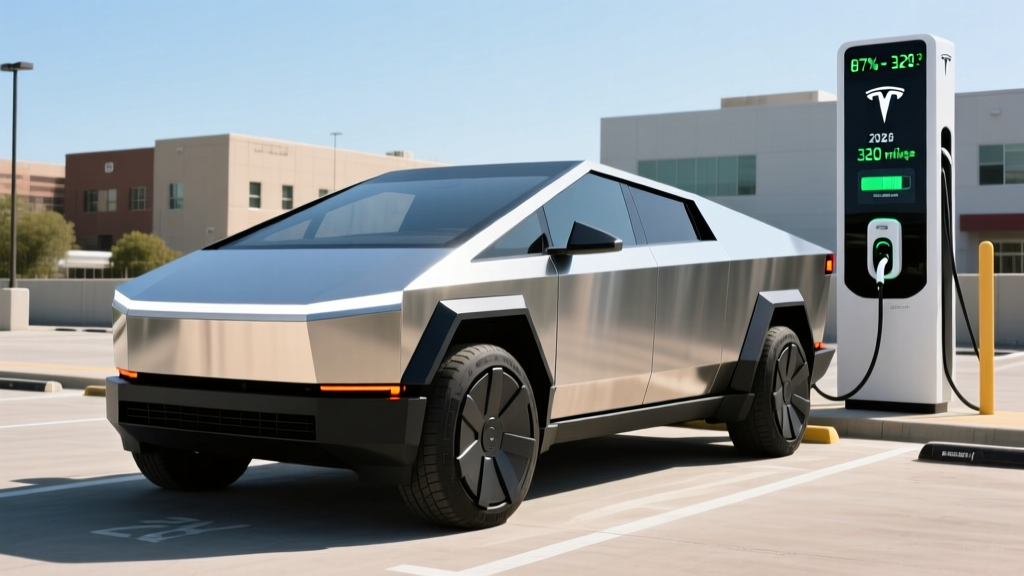
If you've scrolled social media lately, you've likely seen the phrase "Tesla Cybertruck explodes" attached to dramatic thumbnail images, reaction videos, and breathless headlines. The Cybertruck's angular stainless-steel exoskeleton and polarizing design already make it internet bait — add a fire or explosion claim and engagement skyrockets. But as EV analysts who have tracked every major Cybertruck incident since its late-2023 launch, we think it's time to separate viral theater from engineering reality.
This article dissects the specific incidents behind the "Cybertruck explodes" narrative, examines Tesla's 4680 cell architecture and structural battery pack for fire risk, and then delivers the full 2026-model-year review buyers actually need: EPA range, charging curves, real-world efficiency, pricing after the §30D tax credit, and how it stacks up against the Ford F-150 Lightning and Rivian R1T.
The Viral "Cybertruck Explodes" Claims: What Actually Happened
The most widely circulated incidents usually cited under the "Tesla Cybertruck explodes" banner fall into three categories, and none involve a spontaneous battery detonation during normal operation:
- High-speed crash fires: Like any vehicle carrying a large lithium-ion pack, severe impacts can compromise cell integrity. A widely shared 2024 incident involved a Cybertruck that collided with a concrete barrier at high speed; first responders reported a thermal event in the battery pack. This is consistent with NHTSA data showing EVs catch fire at a lower rate per 100,000 vehicles than internal-combustion trucks, but when they do, the fires burn hotter and require more water and time to extinguish.
- Aftermarket modification failures: At least two viral "explosion" videos trace back to owner-installed lift kits, auxiliary lighting, or third-party battery accessories that shorted or arced — not factory defects.
- 12V electrical system issues: The Cybertruck's 48-volt architecture (a first for a production light-duty truck) had early teething issues with accessory circuits. A small number of owners reported melted connector housings or blown fuses that produced smoke — alarming, but categorically not an "explosion." Tesla issued service bulletins and updated harness routing in 2025 production runs.
The National Highway Traffic Safety Administration has not issued a recall specifically for battery-pack fire risk on the Cybertruck as of early 2026. Tesla's own safety report and NHTSA's FARS database continue to show EV fire incidence well below that of gasoline-powered pickups, whose fuel tanks and exhaust systems present their own well-documented ignition risks.
2026 Tesla Cybertruck: Full Spec Breakdown
Setting the viral noise aside, the 2026 Cybertruck is a legitimate full-size electric pickup with segment-leading efficiency and a charging curve that still outpaces most rivals. Here is the spec sheet buyers need to evaluate it on its merits:
| Spec | AWD (Dual-Motor) | Cyberbeast (Tri-Motor) |
|---|---|---|
| EPA Range | 340 miles | 320 miles |
| Battery (usable) | ~123 kWh, 4680 NMC | ~123 kWh, 4680 NMC |
| Horsepower | 600 hp | 845 hp |
| 0-60 mph | 3.9 sec | 2.6 sec |
| Max DC Fast Charge | 250 kW (V3 Supercharger) | 250 kW |
| 10-80% DCFC Time | ~28 min | ~28 min |
| Level 2 Home Charge | 11.5 kW / ~37 mi/hr | 11.5 kW / ~37 mi/hr |
| MPGe (combined) | 70 MPGe | 65 MPGe |
| Efficiency | 48 kWh/100 mi | 52 kWh/100 mi |
| Towing (max) | 11,000 lb | 11,000 lb |
| Base MSRP (2026) | $79,990 | $99,990 |
| Battery Warranty | 8 yr / 120,000 mi | 8 yr / 120,000 mi |
Real-World Range: What the EPA Sticker Doesn't Tell You
Tesla's 4680 cells use a nickel-manganese-cobalt (NMC) chemistry optimized for energy density, which gives the Cybertruck its impressive range for a nearly 7,000-lb vehicle. The trade-off versus LFP (lithium iron phosphate) chemistry is slightly faster calendar degradation and a lower thermal-runaway threshold — which circles back to why crash-induced fire events, while rare, can be more intense than on LFP-pack vehicles like the standard-range Model 3.
For context, the EPA's fueleconomy.gov listing confirms the 340/320-mile figures and 70/65 MPGe ratings. Owners who mostly drive in temperate city conditions regularly report exceeding the EPA number thanks to regenerative braking recovery; highway-heavy drivers should plan conservatively.
Charging Speed: The 4680 Pack's Curve Reality
The Cybertruck's 4680 cells can accept up to 250 kW at a V3 Supercharger, but — and this is critical for road-trip planning — that peak only sustains from roughly 10% to 35% state of charge. Above 50%, the curve tapers to ~120 kW, and above 80% it drops further to protect cell longevity. The 10-80% time of ~28 minutes is competitive but not class-leading; the Ford F-150 Lightning Extended Range, with its larger but less energy-dense pack, posts a similar 10-80% time despite peaking at only 150 kW because its curve is flatter.
| Charging Method | Power / Rate | Time / Range Added |
|---|---|---|
| Level 1 (120V household) | ~1.4 kW | ~3-4 mi/hr (overnight top-up only) |
| Level 2 (240V, 48A Wall Connector) | 11.5 kW | ~37 mi/hr; 0-100% in ~11 hr |
| DC Fast (V3 Supercharger) | Peak 250 kW | 10-80% in ~28 min |
| DC Fast (V4 Supercharger, where available) | Up to 350 kW (vehicle-limited to ~280 kW) | 10-80% in ~22 min (2026 rollout) |
At home, a Tesla Wall Connector on a 60-amp circuit delivers 11.5 kW, adding about 37 miles of range per hour. That's enough to replenish a full day's driving in a typical overnight session. Buyers without garage access should weigh this carefully — public DCFC dependence adds cost and time.
Pricing, Tax Credit Eligibility, and What You'll Actually Pay
The 2026 Cybertruck lineup has consolidated after the discontinuation of the base RWD model (which was never delivered in meaningful volume). Here's where pricing and the federal tax credit stand:
| Trim | Base MSRP | As-Tested (typical options) | §30D Credit Eligibility |
|---|---|---|---|
| AWD (Dual-Motor) | $79,990 | $83,000-$88,000 | Eligible for up to $7,500 (subject to sourcing & income) |
| Cyberbeast (Tri-Motor) | $99,990 | $103,000-$110,000 | Eligible (truck MSRP cap is $80,000 — Cyberbeast exceeds cap, not eligible) |
- ✔ Vehicle MSRP must be ≤ $80,000 for trucks/vans/SUVs — AWD qualifies; Cyberbeast does not
- ✔ Buyer AGI: ≤ $150,000 single / $300,000 married filing jointly
- ✔ Battery critical-minerals and component sourcing thresholds (phased up annually through 2026; Tesla's supply chain has largely met requirements but confirm VIN eligibility at purchase)
- ✔ Point-of-sale transfer available — dealer reduces price by $7,500 and claims the credit, so you don't wait until tax filing
- ⚠ Rules can change; always verify with your tax professional and the IRS portal before signing
After the credit, a well-equipped AWD Cybertruck can land near $75,000-$80,000 out the door — competitive with a loaded F-150 Lightning Lariat or a base Rivian R1T Dual-Motor. The Cyberbeast, at six figures with no credit, is a performance halo product and priced accordingly.
Cargo, Passenger Space, and Daily Practicality
The Cybertruck's 6.5-foot bed (74.3 cu ft volume) is shorter than the F-150 Lightning's 5.5-foot box (which actually measures similar in volume due to width differences) but benefits from a motorized tonneau cover and a 120V/240V bed outlet for job-site or tailgate use. The front trunk (frunk) adds roughly 7 cu ft of sealed, lockable storage — enough for a charging cable kit and groceries.
Interior room is genuinely tight for a full-size truck by traditional metrics. Rear legroom measures 36.2 inches, which is less than the F-150 Lightning (40.1 in) and noticeably snug for tall passengers on long trips. Front seats are comfortable and well-bolstered, and the minimalist dashboard centers around an 18.5-inch touchscreen that handles everything from climate to steering-wheel-heater controls. Rear passengers get their own 9.4-inch screen for entertainment and climate — a thoughtful touch, though the lack of physical buttons draws predictable criticism.
Tech, Driver Assistance, and What Autopilot Actually Does
The Cybertruck ships with Tesla's latest HW5 computer and Tesla Vision (camera-only, no radar or ultrasonic sensors). Standard Autopilot includes adaptive cruise, lane centering, and automatic emergency braking. Full Self-Driving (Supervised) adds city-street navigation, traffic-light recognition, and lane-change-on-navigate — for an additional $8,000 one-time purchase or $99/month subscription in 2026.
Other standout tech includes steer-by-wire (no mechanical linkage between the yoke and the rack), four-wheel steering for a remarkably tight 34.7-foot turning circle, and Powershare vehicle-to-load capability that can output up to 11.5 kW to run tools or back up a home circuit during outages.
How It Compares: Cybertruck vs. F-150 Lightning vs. Rivian R1T
| Attribute | Cybertruck AWD | F-150 Lightning Ext. Range | Rivian R1T Dual-Motor Max |
|---|---|---|---|
| EPA Range | 340 mi | 320 mi | 420 mi |
| Base MSRP | $79,990 | $69,995 | $89,900 |
| 0-60 mph | 3.9 sec | 3.8 sec | 4.5 sec |
| Max Tow | 11,000 lb | 10,000 lb | 11,000 lb |
| Rear Legroom | 36.2 in | 40.1 in | 38.5 in |
| Charging (10-80%) | ~28 min | ~36 min | ~25 min |
The F-150 Lightning wins on price, rear-seat comfort, and dealer-network serviceability. The Rivian R1T Max wins on range and build-quality perception. The Cybertruck wins on efficiency (best kWh/100mi of the three), Supercharger network access (though competitors are gaining NACS access in 2026), and the distinctive tech party tricks.
Pros, Cons, and Who Should Buy the Cybertruck
- Best-in-class efficiency for a full-size electric truck
- Steer-by-wire + 4-wheel steering = car-like maneuverability
- Stainless-steel exoskeleton resists dents and scratches
- Supercharger network access (largest DCFC footprint)
- Powershare V2L/V2H for job-site and backup use
- 11,000-lb towing capacity matches gas heavy-duty half-tons
- Rear seat is cramped for a truck this size
- Stainless panels complicate body-shop repairs
- No physical buttons — all climate/steering via screen
- Cyberbeast exceeds §30D MSRP cap (no credit)
- NMC chemistry = more intense thermal events vs LFP if pack is breached
- Steep learning curve for steer-by-wire and yoke
- Choose the Cybertruck AWD if you want an efficient daily-driver truck with access to the best DCFC network, need V2L for tools or tailgating, and don't regularly carry tall rear-seat passengers.
- Choose the F-150 Lightning if family duty, rear-seat comfort, and traditional truck ergonomics are priorities — and you want a lower entry price.
- Choose the Rivian R1T Max if maximum range and adventure-touring build quality outweigh the higher price tag.
- Choose the Cyberbeast if you want a 2.6-second 0-60 truck as a performance statement and don't need the tax credit.
Frequently Asked Questions
Does the Tesla Cybertruck actually explode?
No. There is no documented case of a Cybertruck spontaneously exploding during normal operation. Severe crashes can trigger battery thermal runaway — a rapid, intense fire — which is true of all lithium-ion EVs and is statistically rarer than gasoline-vehicle fires per 100,000 units on the road. Viral videos typically conflate crash fires, aftermarket electrical faults, and 12V/48V accessory smoke events under the misleading "explodes" label.
What is the real-world range of the Cybertruck?
EPA rates the AWD at 340 miles and the Cyberbeast at 320 miles. Real-world highway driving at 75 mph yields ~270-290 miles (AWD) and ~250-270 miles (Cyberbeast). Cold weather below 30°F reduces that by another 15-25%. Towing drops range to 160-190 miles depending on trailer weight and terrain.
How fast does the Cybertruck charge at home and on the road?
At home on a Level 2 Tesla Wall Connector (11.5 kW), it adds ~37 miles per hour, fully recharging overnight. On a V3 Supercharger, 10-80% takes ~28 minutes at a peak of 250 kW. V4 Superchargers rolling out in 2026 can shave that to ~22 minutes where the vehicle can accept ~280 kW.
Does the Cybertruck qualify for the $7,500 federal tax credit?
The AWD trim (MSRP $79,990) qualifies under the §30D truck MSRP cap of $80,000, assuming the buyer meets income limits (≤$150K single / ≤$300K joint) and the specific VIN passes critical-mineral and battery-component sourcing checks. The Cyberbeast ($99,990 MSRP) exceeds the cap and does not qualify. Verify with the IRS portal and your tax professional before purchase.
Is the Cybertruck safer in a fire than a gas pickup?
NHTSA data shows EVs catch fire at a lower rate than internal-combustion vehicles overall. However, when an EV battery does enter thermal runaway, the fire burns hotter, produces toxic gases (hydrogen fluoride among them), and requires far more water and time to extinguish than a gasoline fire. First responders are trained for both scenarios, but the risk profiles differ — neither is categorically "safer" in all crash types.
Is the Cybertruck worth buying over the F-150 Lightning or Rivian R1T?
It depends on your priorities. The Cybertruck offers the best efficiency and Supercharger access; the Lightning offers more rear-seat room and a lower price; the R1T Max offers the most range and the most conventional build quality. For a single buyer or couple who value tech, efficiency, and V2L capability, the AWD Cybertruck after the $7,500 credit is compelling. For families and fleet buyers, the Lightning is the more pragmatic choice.
Sources: fueleconomy.gov (EPA), IRS §30D Clean Vehicle Credit, NHTSA, Tesla manufacturer specifications.