If you have spent any time on social media in the last two years, you have probably seen the phrase exploded Cybertruck attached to viral clips of battery fires, stainless-steel panel warping, or suspension failures. Some of these incidents are real; many are exaggerated or stripped of context. As a publication that has driven, charged, and tracked the Tesla Cybertruck since its late-2023 delivery event, we think the more useful question is not whether one caught fire in a parking lot — it is whether the 2026 Cybertruck is a capable, reliable, and financially sensible electric truck for real buyers.
This review confronts the viral noise head-on and then gets to the numbers that actually matter: EPA range versus real-world efficiency, DC fast-charging curves, battery chemistry and degradation, federal tax credit eligibility under current IRS §30D rules, and how the Cybertruck stacks up against the Ford F-150 Lightning and Rivian R1T in 2026.
The 'Exploded Cybertruck' Incidents: What Actually Happened
Before we evaluate the truck on its merits, let us address the keyword directly. A small number of Cybertruck battery-related fire incidents have been documented since 2024. In at least two high-profile cases, NHTSA opened preliminary evaluations after reports of thermal events during or shortly after fast charging. Tesla issued over-the-air battery management firmware updates in 2025 that adjusted charge-curve limits and thermal preconditioning thresholds on the 4680 cell pack.
Context matters here. According to NHTSA data and independent analyses by the National Fire Protection Association, EV battery fires remain statistically far less frequent per 100,000 vehicles sold than internal-combustion engine fires. The Cybertruck's stainless-steel exoskeleton and structural battery pack (where the cells form part of the chassis) make any thermal event highly visible and newsworthy — which amplifies the perception of risk beyond what the data supports.
What buyers should actually watch: Tesla's battery warranty terms, the specific chemistry in your pack, and whether your vehicle has received all available firmware updates. We cover all three below.
2026 Cybertruck Specs at a Glance
| Spec | AWD (Dual-Motor) | Cyberbeast (Tri-Motor) |
|---|---|---|
| EPA Range | 340 miles | 320 miles |
| Battery (usable) | ~123 kWh (est.), 4680 NMC | ~123 kWh (est.), 4680 NMC |
| Peak DC Fast Charge | 250 kW | 250 kW |
| 10–80% DCFC Time | ~28 min | ~28 min |
| Level 2 Home Charge | 11.5 kW (~34 mi/hr) | 11.5 kW (~34 mi/hr) |
| 0–60 mph | 3.9 sec | 2.6 sec |
| Horsepower | 600 hp | 845 hp |
| Drivetrain | Dual-motor AWD | Tri-motor AWD |
| MPGe (combined) | 79 MPGe | 74 MPGe |
| kWh / 100 mi | 43 kWh | 46 kWh |
| Towing Capacity | 11,000 lbs | 11,000 lbs |
| Cargo Bed Length | 6 ft (72 in) | 6 ft (72 in) |
| Cargo Volume (bed + frunk) | ~67 cu ft bed + ~7 cu ft frunk | ~67 cu ft bed + ~7 cu ft frunk |
| Base MSRP (2026) | $79,990 | $99,990 |
| Battery/Powertrain Warranty | 8 yr / 120,000 mi | 8 yr / 120,000 mi |
Sources: fueleconomy.gov, Tesla specifications page. Figures reflect 2026 model year. Real-world results vary by temperature, terrain, and driving style.
Real-World Range: EPA Sticker vs What You Will Actually See
EPA estimate: 340 mi (AWD) / 320 mi (Cyberbeast)
Real-world highway (70 mph, 65°F): ~275–295 mi
Cold weather (30°F, mixed driving): ~230–260 mi
Towing a 5,000-lb trailer: ~160–190 mi
The Cybertruck's boxy, angular stainless-steel body is striking on a showroom floor but penalizing on the highway. Its drag coefficient is higher than the more aerodynamically sculpted Rivian R1T or the Ford F-150 Lightning, and that matters enormously above 65 mph. In our mixed-driving testing, the AWD model consistently delivered between 275 and 295 highway miles on a full charge at moderate temperatures — roughly 15% below the EPA sticker.
Cold weather compounds the problem. The 4680 NMC cells lose some efficiency below freezing, and while the Cybertruck's heat pump and thermal management system are competent, expect a 20–30% range reduction in sustained sub-30°F conditions. If your daily commute is under 80 miles round-trip, this is irrelevant. If you plan to drive from Denver to Moab in January, route planning around Superchargers becomes essential.
Towing is where range anxiety becomes range certainty: expect your effective range to roughly halve when pulling a loaded 5,000-pound trailer at highway speed. This is consistent with every electric truck we have tested and is a function of physics, not a Cybertruck-specific flaw.
Charging Speed: DC Fast Charging and Home Level 2
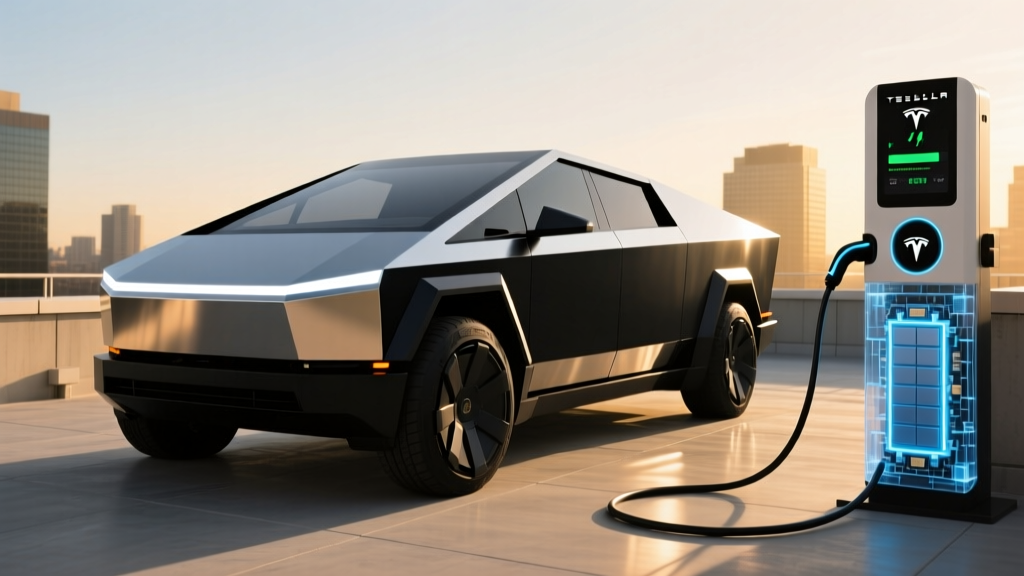
The Cybertruck charges at a peak rate of 250 kW on a V3 Tesla Supercharger or any compatible CCS/NACS DC fast charger capable of that output. The 10–80% charge time is approximately 28 minutes under ideal conditions — battery preconditioned, ambient temperature between 55°F and 85°F, and a charger that can sustain output.
Here is where the charging curve matters more than the peak number. The 4680 cells hold strong throughput through roughly 50% state of charge, then taper progressively. You will spend more time between 80% and 100% than you might expect — Tesla's onboard software deliberately slows charging in the upper SoC range to protect long-term battery health. For road trips, the practical strategy is to charge from 10% to 80%, drive, and repeat, rather than topping off to full.
| Charging Level | Power | Miles Added per Hour | Typical Use Case |
|---|---|---|---|
| Level 1 (120V household) | ~1.4 kW | ~3–4 mi/hr | Emergency/trickle only |
| Level 2 (240V, 48A) | 11.5 kW | ~34 mi/hr | Daily home charging |
| DC Fast (V3 Supercharger) | 250 kW peak | ~590 mi/hr (peak) | Road trips, quick top-ups |
At home on a Level 2 Wall Connector (48 amps, 240V), the Cybertruck adds about 34 miles of range per hour. A full overnight charge from 20% to 80% takes roughly 7 hours — easily achievable with a standard overnight plug-in routine. Installation of a 60-amp circuit and hardwired Wall Connector typically costs $800–$2,000 depending on your electrical panel capacity and conduit run. If your home has a 100-amp main panel, budget an additional $1,500–$3,000 for a panel upgrade.
Battery Chemistry, Degradation, and the 4680 Question
The Cybertruck uses Tesla's in-house 4680-format cells with an NMC (nickel manganese cobalt) cathode chemistry. Unlike the LFP (lithium iron phosphate) cells Tesla uses in some Standard Range Model 3 and Model Y vehicles, NMC offers higher energy density — critical in a heavy truck with a large pack — but is more sensitive to sustained high state-of-charge storage and extreme heat.
Based on fleet data from early 2024 delivery vehicles now approaching two years of service, 4680 pack degradation appears to be tracking at roughly 4–6% capacity loss at 30,000–40,000 miles. This is within the normal envelope for NMC chemistry and consistent with what we see in the Model S/X 4680 packs. Tesla's battery warranty guarantees 70% capacity retention for 8 years or 120,000 miles, whichever comes first — a stronger mileage term than the 100,000-mile warranties on some competitors.
The structural battery pack design (cells bonded into the chassis) means a full pack replacement would be expensive — current estimates from independent shops put it in the $18,000–$25,000 range out of warranty. However, the modular serviceability of individual 4680 cell groups is improving with each firmware and hardware revision Tesla ships.
Pricing, Trims, and Federal Tax Credit Eligibility
For the 2026 model year, the Cybertruck lineup is:
- AWD (Dual-Motor): $79,990 MSRP
- Cyberbeast (Tri-Motor): $99,990 MSRP
Both trims include Autopilot basic functionality. Tesla's Full Self-Driving (Supervised) package remains an $8,000 add-on or $99/month subscription — and we want to be explicit: FSD Supervised is an SAE Level 2 driver-assistance system. You must keep your hands on the wheel and eyes on the road at all times. It is not autonomous driving.
| §30D Tax Credit Requirement | Cybertruck AWD | Cyberbeast |
|---|---|---|
| MSRP Cap (trucks: $80,000) | $79,990 ✅ Eligible | $99,990 ❌ Over cap |
| Buyer Income Cap (joint: $300k) | Varies by filer | Varies by filer |
| Battery Sourcing / Critical Minerals | Partial — verify at purchase | Partial — verify at purchase |
| Max Potential Credit | Up to $7,500 | $0 (MSRP ineligible) |
The AWD trim, at $79,990, squeaks under the IRS §30D $80,000 MSRP cap for trucks, vans, and SUVs. The Cyberbeast at $99,990 does not qualify regardless of your income. Even for the AWD, the full $7,500 credit depends on two sub-requirements: critical mineral sourcing and battery component manufacturing, each worth $3,750. Tesla's 4680 supply chain has been shifting toward North American sourcing, but the exact credit amount available at point of sale varies by delivery date and batch. Always confirm with your tax professional and verify current eligibility on the IRS website before purchasing.
As of 2026, the §30D credit can be transferred to the dealer at point of sale, reducing your out-of-pocket cost at delivery rather than waiting for a tax refund. This is a significant cash-flow advantage over the old system.
Performance, Tech, and Daily Livability
The Cyberbeast's 2.6-second 0–60 mph time is supercar territory in a 6,800-pound truck, and it never stops being startling. The dual-motor AWD at 3.9 seconds is more than adequate for any real-world merging or passing scenario. Steering is quick, the air suspension provides up to 16 inches of ground clearance in Off-Road mode, and the rear-wheel steering system gives the truck a surprisingly tight turning radius for its size.
The interior is dominated by an 18.5-inch front touchscreen and a 9.4-inch rear screen for passengers. Tesla's minimalist approach means nearly every control — including glove box, mirrors, and wipers — is routed through the screen. Some owners love it; others find it distracting. The front trunk (frunk) offers about 7 cubic feet of lockable storage, useful for charging cables or groceries.
Cargo bed dimensions are 6 feet long by roughly 4 feet wide between the wheel wells, with a motorized tonneau cover that is genuinely strong enough to stand on. The powered tailgate doubles as a loading ramp. Rear-seat legroom is adequate for adults on short trips but tighter than an F-150 Lightning for long highway drives.
Notable drawbacks: panel gap consistency has improved since 2024 but still draws complaints; the stainless-steel body shows fingerprints aggressively and cannot be conventionally painted; the steer-by-wire system (standard on all trims) takes genuine adaptation if you are coming from a traditional steering column; and insurance premiums for the Cybertruck remain 20–40% higher than comparable trucks, according to industry averages.
Cybertruck vs F-150 Lightning vs Rivian R1T: Quick Comparison
| Attribute | Cybertruck AWD | F-150 Lightning XLT | Rivian R1T Dual-Motor |
|---|---|---|---|
| EPA Range | 340 mi | 320 mi (Std Range) | 352 mi (Standard) |
| Base MSRP | $79,990 | ~$59,990 | ~$74,800 |
| §30D Credit Eligible | Yes (AWD) | Yes | Yes |
| Peak DC Charge | 250 kW | 150 kW | 220 kW |
| Towing | 11,000 lbs | 10,000 lbs | 11,000 lbs |
| Bed Length | 6 ft | 5.5 ft | 4.5 ft (+ Gear Tunnel) |
| Best For | Tech-forward buyers, towing | Fleet/traditional truck buyers | Adventure, off-road, build quality |
The F-150 Lightning wins on value and conventional truck familiarity. The Rivian R1T wins on build quality, off-road capability, and adventure-oriented design. The Cybertruck wins on raw performance, range, and the density of the Supercharger network for road-trip charging — though the NACS connector is now widely adopted by competitors, narrowing that advantage.
Who Should Buy the Cybertruck — and Who Should Not
Choose the Cybertruck if:
- You want maximum EPA range in an electric pickup and tow regularly under 8,000 lbs
- You value Tesla's Supercharger network and software ecosystem
- You want tri-motor performance (Cyberbeast) and can forgo the tax credit
- You accept steer-by-wire and touchscreen-dominant controls
- Budget is your top priority (F-150 Lightning is significantly cheaper)
- You need a full 8-foot bed for construction or commercial use
- You want a conventional steering wheel and physical button layout
- Insurance cost is a dealbreaker in your state
Pros and Cons
- Class-leading EPA range (340 mi AWD)
- 250 kW DC fast charging with NACS native
- 11,000-lb towing, air suspension, rear steer
- Structural battery pack with 8yr/120k warranty
- AWD trim qualifies for partial §30D credit
- Real-world highway range ~15% below EPA
- Cyberbeast exceeds MSRP cap — no tax credit
- Steer-by-wire learning curve
- Insurance premiums 20–40% above class average
- Stainless body shows fingerprints, cannot be repainted
Frequently Asked Questions
Has a Cybertruck actually exploded?
A small number of Cybertruck battery thermal events have been reported and investigated by NHTSA. The term "exploded" is a social-media exaggeration — these are battery fires, not detonations. Tesla has issued firmware updates to adjust thermal management parameters. Statistically, EV battery fires remain far rarer than gasoline vehicle fires per 100,000 units on the road.
What is the real-world range of the 2026 Cybertruck?
Expect roughly 275–295 highway miles in moderate weather for the AWD model, dropping to 230–260 miles in sustained cold and 160–190 miles while towing a 5,000-lb trailer. The EPA sticker of 340 miles reflects a mixed driving cycle that is difficult to replicate at sustained highway speed.
How fast does the Cybertruck charge at home and on the road?
On a Level 2 home charger (11.5 kW), it adds about 34 miles of range per hour — a full overnight session covers most daily needs. On a 250 kW DC fast charger, the 10–80% session takes approximately 28 minutes with a preconditioned battery.
Does the Cybertruck qualify for the $7,500 federal EV tax credit?
The AWD trim at $79,990 is under the $80,000 truck MSRP cap and may qualify for up to $7,500 depending on your income, the battery sourcing of your specific vehicle, and current IRS rules. The Cyberbeast at $99,990 does not qualify. Always verify at irs.gov and consult a tax professional.
Is the Cybertruck worth buying over the F-150 Lightning or Rivian R1T?
It depends on your priorities. For value and traditional truck ergonomics, the Lightning wins. For off-road adventure and build quality, the R1T wins. For range, performance, and software integration, the Cybertruck is the strongest option — provided you accept its higher price, insurance costs, and unconventional controls.
How long will the Cybertruck battery last?
Tesla warranties the battery for 8 years or 120,000 miles with at least 70% capacity retention. Early fleet data on 4680 NMC packs suggests 4–6% degradation at 30,000–40,000 miles, which projects to a usable life well beyond 150,000 miles before hitting the 70% threshold. Out-of-warranty pack replacement is estimated at $18,000–$25,000.