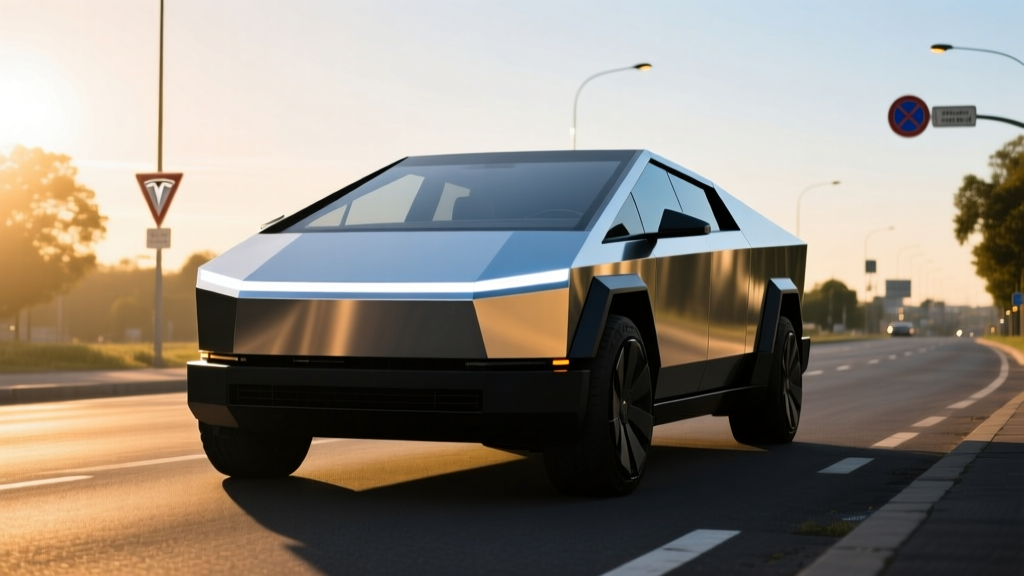
If you've seen headlines about the Tesla Cybertruck Europe import ban and wondered whether it signals trouble for US buyers, the short answer is no. The European Union's General Safety Regulation (GSR2), enforced since July 2024, effectively bars the Cybertruck from being sold or registered in EU member states due to pedestrian-safety compliance failures. Tesla has confirmed it will not produce a Europe-spec variant. But in the United States, the Cybertruck remains on sale, and for 2026 it continues to be one of the most polarizing — and capable — electric pickups on the market.
This review covers everything US buyers need to know: real-world range, charging speeds, pricing after federal tax credits, and whether the Cybertruck actually makes sense versus the Ford F-150 Lightning and Rivian R1T.
Why Europe Banned the Cybertruck (And Why It Doesn't Affect You)
The EU's GSR2 regulation mandates strict pedestrian-impact standards, including requirements for front-end crumple zones, head-impact clearance, and external protrusion limits. The Cybertruck's stainless-steel exoskeleton and angular geometry fail multiple GSR2 crash-test protocols. According to Reuters reporting from June 2024, Tesla acknowledged it cannot redesign the truck's core architecture without fundamentally changing the vehicle.
For US buyers, this is a non-issue. NHTSA regulations differ from EU standards, and the Cybertruck is fully street-legal in all 50 states. The import ban only means you won't be able to ship one to Germany or France — a niche concern at best. What does matter is whether the Cybertruck's specs and ownership economics justify its $79,990 starting price for the AWD trim.
Range, Battery, and Efficiency: The Real Numbers
The 2026 Tesla Cybertruck is available in three trims, all built on a 48-volt electrical architecture with a structural battery pack:
| Spec | AWD | Cyberbeast | RWD (announced) |
|---|---|---|---|
| EPA Range | 340 miles | 320 miles | ~250 miles (est.) |
| Battery Capacity (usable) | ~123 kWh | ~123 kWh | TBD |
| Chemistry | NMC (nickel manganese cobalt) | NMC | TBD |
| MPGe (combined) | 67 MPGe | 64 MPGe | TBD |
| Efficiency (kWh/100 mi) | 50 kWh/100mi | 53 kWh/100mi | TBD |
The NMC chemistry provides high energy density but means you should avoid regularly charging to 100% for daily use — Tesla recommends 80% for battery longevity, which gives you roughly 272 usable miles (AWD) for everyday driving.
Charging Speed: DC Fast and Home Level 2
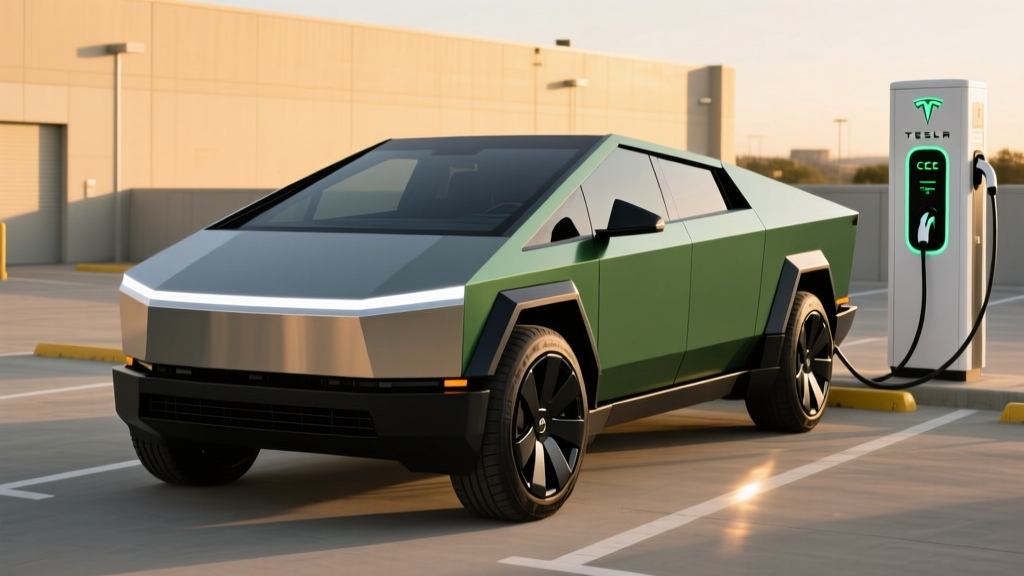
Charging speed is where the Cybertruck's 800-volt-class architecture shows its worth. Here's the full breakdown:
| Charging Level | Power / Rate | Speed / Time |
|---|---|---|
| Level 1 (120V household) | ~1.4 kW | ~3 miles per hour |
| Level 2 (240V home / Wall Connector) | 11.5 kW (48A) | ~34 miles per hour; full charge in ~11 hours |
| DC Fast Charge (V4 Supercharger) | Peak 250 kW | 10–80% in ~28 minutes |
| DC Fast Charge (third-party CCS) | Up to 200 kW (via adapter) | 10–80% in ~35 minutes |
A few practical notes on the charging curve: the Cybertruck peaks at 250 kW only at low states of charge (below ~35%). Above 60% SoC, the rate tapers significantly — typical of NMC packs with large capacities. Plan for roughly 28 minutes for a 10–80% session at a V4 Supercharger, but expect 40+ minutes if you need to push past 90%.
For home charging, Tesla's Wall Connector at 48 amps adds about 34 miles per hour of charging — enough to fully replenish overnight. You'll need a NEMA 14-50 outlet or a hardwired 60-amp circuit. Installation costs typically run $800–$2,000 depending on your electrical panel's capacity and the distance from panel to charger.
Performance and Drivetrain
| Spec | AWD | Cyberbeast |
|---|---|---|
| Drivetrain | Dual-motor AWD | Tri-motor AWD |
| Horsepower | 600 hp | 845 hp |
| 0–60 mph | 4.1 seconds | 2.6 seconds |
| Top Speed | 112 mph | 130 mph |
| Towing Capacity | 11,000 lbs | 11,000 lbs |
| Payload | 2,500 lbs | 2,500 lbs |
The Cyberbeast's 2.6-second 0–60 time makes it one of the quickest production vehicles on the road, period. But the dual-motor AWD's 4.1 seconds is already supercar-rivaling for a 6,800-pound truck. Both trims feature adaptive air suspension with up to 16 inches of ground clearance in Extract mode, and steer-by-wire with four-wheel steering that gives the Cybertruck a surprisingly tight 35-foot turning circle.
Pricing, Tax Credits, and Ownership Cost
| Trim | Base MSRP | Federal Tax Credit (§30D) | Effective Price |
|---|---|---|---|
| AWD | $79,990 | $0 (exceeds MSRP cap) | $79,990 |
| Cyberbeast | $99,990 | $0 (exceeds MSRP cap) | $99,990 |
| RWD (announced, est. 2026–2027) | ~$60,990 (est.) | Potentially eligible | ~$53,490 (est.) |
Here's the critical detail many buyers miss: under current IRS §30D rules, the federal EV tax credit has an MSRP cap of $80,000 for trucks. The Cybertruck AWD at $79,990 squeaks under — but only before destination fees and any options. Add a single option or the $1,995 destination charge and you exceed the cap, losing the full $7,500 credit.
The Cyberbeast at $99,990 is categorically ineligible. Additionally, §30D imposes buyer income caps ($300,000 joint / $150,000 individual AGI) and battery critical-mineral sourcing requirements that change annually. Consult a tax professional before assuming eligibility.
The point-of-sale transfer option (available since 2024) lets dealers apply the credit as an instant discount — but only if the specific VIN qualifies. Always verify on the IRS clean vehicle report before signing.
Cargo, Interior, and Daily Usability
The Cybertruck's dimensions are imposing but the usable space is surprisingly practical:
- Bed length: 6 feet (with tailgate closed); extends to 8 feet with tailgate down
- Bed volume: ~67 cu ft (tailgate closed)
- Frunk (front trunk): ~7 cu ft with drain — usable as a cooler
- Cabin seating: 5 passengers, 3-across rear bench
- Rear legroom: ~38 inches (adequate for adults on shorter trips)
- Vault (bed) tonneau: Power-operated stainless steel, lockable
The interior is minimalist by design: an 18.5-inch center touchscreen handles virtually all vehicle controls, navigation, and entertainment. There's no traditional instrument cluster — speed and range info display on the left portion of the main screen. A rear 9.4-inch touchscreen serves back-seat passengers. The yoke-style steering wheel (standard on Cyberbeast, optional on AWD) takes genuine adjustment; most drivers adapt within a week, but it's not universally loved.
Notable drawbacks: the stainless-steel body shows fingerprints relentlessly, the bed lacks built-in tie-downs in some configurations (aftermarket solutions help), and rear visibility is compromised by the sail-pillar design — you'll rely heavily on the camera-based rearview mirror.
Tech, Driver Assistance, and Safety
The Cybertruck ships with Tesla's HW4 (Hardware 4) computer and includes Basic Autopilot standard — adaptive cruise control and lane-keeping on marked roads. Tesla's Full Self-Driving (Supervised) is available as a $8,000 add-on or $99/month subscription.
Other standout tech includes:
- Steer-by-wire with variable ratio — fewer hand movements for parking, more precision at highway speed
- Four-wheel steering (rear wheels turn up to 10°) for a compact turning radius
- Powershare — bidirectional charging: 11.5 kW of vehicle-to-home (V2H) or vehicle-to-load (V2L) capability, enough to run power tools or back up essential home circuits during an outage
- Armor glass — laminated composite glass (yes, it survived the updated demo, unlike the 2019 reveal)
Safety ratings: as of early 2026, the Cybertruck has not been crash-tested by NHTSA or IIHS. Tesla claims the exoskeleton structure exceeds conventional pickup safety benchmarks, but without independent testing data, buyers should note this gap.
Cybertruck vs. F-150 Lightning vs. Rivian R1T
| Attribute | Cybertruck AWD | F-150 Lightning Lariat | Rivian R1T Dual-Motor |
|---|---|---|---|
| EPA Range | 340 mi | 320 mi (ext. range) | 352 mi (Max Pack) |
| Base MSRP | $79,990 | ~$69,995 | ~$75,900 |
| Max DC Charge | 250 kW | 150 kW | 220 kW |
| 10–80% Time | ~28 min | ~41 min | ~30 min |
| 0–60 mph | 4.1 sec | ~4.5 sec | ~4.5 sec |
| Towing | 11,000 lbs | 10,000 lbs | 11,000 lbs |
| Tax Credit (§30D) | Borderline eligible | Eligible (under cap) | Eligible (under cap) |
| Bed Length | 6 ft | 5.5 ft | 4.5 ft (+ Gear Tunnel) |
Choose the Cybertruck if you prioritize maximum range, the fastest DC charging in the segment, bidirectional Powershare capability, and don't mind the polarizing design or steer-by-wire learning curve.
Choose the F-150 Lightning if you want a conventional truck experience, proven dealer service network, easier tax credit eligibility, and don't need exotic performance.
Choose the Rivian R1T if you want the most refined interior, the clever Gear Tunnel for adventure gear, and best-in-class off-road capability with quad-motor options.
Warranty and Long-Term Ownership
Tesla's warranty coverage for the 2026 Cybertruck:
- Basic vehicle: 4 years / 50,000 miles
- Battery and drive units: 8 years / 120,000 miles (whichever comes first), with a minimum 70% capacity retention threshold
- Roadside assistance: 4 years / 50,000 miles
The 120,000-mile battery warranty is competitive with the F-150 Lightning (8yr/100,000mi) and slightly better than Rivian (8yr/120,000mi for Max Pack). If the battery degrades below 70% within the warranty window, Tesla will repair or replace it. Real-world degradation data for the Cybertruck's specific NMC pack is still limited given the truck's late-2023 launch, but Tesla's structural pack architecture in the Model Y has shown roughly 8–10% degradation at 100,000 miles based on fleet data — a reasonable benchmark to expect.
Pros and Cons
- 340-mile EPA range (best in electric truck segment)
- 250 kW peak DC charging with V4 Supercharger access
- 11.5 kW Powershare bidirectional capability
- Four-wheel steering and air suspension standard
- 11,000-lb towing with integrated trailer brake controller
- Stainless-steel body resists dents and corrosion
- AWD MSRP barely clears $80K tax credit cap — options push it over
- No NHTSA/IIHS crash test ratings as of 2026
- Steer-by-wire and yoke are divisive — not for everyone
- Stainless body shows smudges and is difficult to repair
- 6-foot bed is shorter than conventional full-size trucks
- Europe import ban limits resale to US-only market
Frequently Asked Questions
What is the real-world range of the Tesla Cybertruck?
The EPA rates the AWD Cybertruck at 340 miles, but expect 270–290 miles at highway speeds (70–75 mph) and 220–250 miles in cold weather below 30°F. The Cyberbeast delivers roughly 20 fewer miles in real-world conditions.
How fast does the Cybertruck charge?
At a Tesla V4 Supercharger, the Cybertruck peaks at 250 kW and charges from 10–80% in approximately 28 minutes. On a home Level 2 charger at 11.5 kW, it adds about 34 miles per hour, fully recharging overnight in roughly 11 hours.
Does the Cybertruck qualify for the federal EV tax credit?
The AWD trim at $79,990 MSRP is technically under the $80,000 truck cap for §30D — but adding destination fees or any option pushes it over, eliminating the $7,500 credit. The Cyberbeast at $99,990 is ineligible. Buyer income caps and battery-sourcing rules also apply. Check the IRS clean vehicle credit page for current eligibility.
Is the Cybertruck worth buying versus the F-150 Lightning?
If range, charging speed, and bidirectional power are your top priorities, the Cybertruck wins on specs. If you want a conventional truck layout, easier tax credit eligibility, and a broader dealer service network, the F-150 Lightning is the more pragmatic choice.
Why can't I buy a Cybertruck in Europe?
The EU's General Safety Regulation (GSR2) requires pedestrian-impact compliance that the Cybertruck's stainless-steel exoskeleton cannot meet. Tesla has confirmed it will not produce a modified version for the European market. This ban does not affect US sales or availability.
How long will the Cybertruck battery last?
Tesla warranties the battery for 8 years or 120,000 miles with a 70% minimum capacity retention. Based on similar Tesla NMC structural packs, expect roughly 8–10% degradation at 100,000 miles under normal use — meaning the battery should remain functional well beyond 200,000 miles with gradual capacity loss.