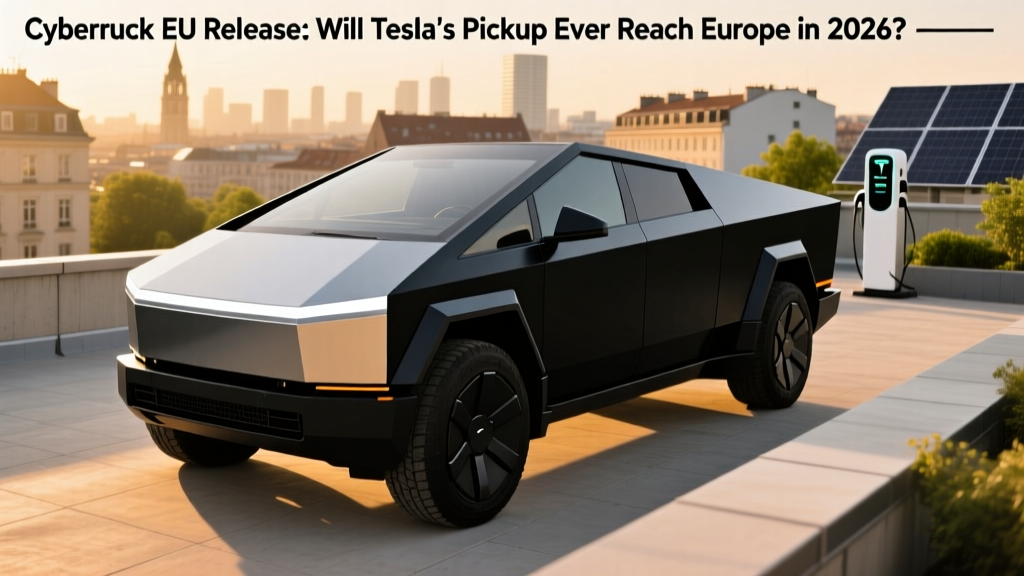
The Cybertruck EU Question: What European Buyers Need to Know
Search forums, Reddit threads, or Tesla fan sites for "Cybertruck EU" and you'll find years of speculation, reservation holders waiting in limbo, and a stark reality: as of early 2026, the Tesla Cybertruck remains unavailable for purchase in the European Union, the United Kingdom, or any European market. Tesla has not announced a European launch date, and the regulatory, engineering, and commercial barriers are substantial.
This article breaks down what we know about the Cybertruck's specifications based on the U.S.-market models currently in production, the homologation challenges blocking its European arrival, the realistic timeline for any potential EU launch, and what European EV truck buyers should consider instead.
Cybertruck U.S. Specs: What Tesla Is Building
Before assessing EU viability, here's what the current U.S.-market Cybertruck delivers. These figures apply to the 2025/2026 model-year vehicles Tesla is producing at Giga Texas and would form the baseline for any future European variant.
| Specification | AWD | Cyberbeast |
|---|---|---|
| EPA Range | 340 miles | 320 miles |
| Battery Capacity | ~123 kWh usable (NMC) | ~123 kWh usable (NMC) |
| 0-60 mph | 4.1 seconds | 2.6 seconds |
| Horsepower | 600 hp | 845 hp |
| Drivetrain | Dual-motor AWD | Tri-motor AWD |
| Max DC Fast Charge | 250 kW (peak) | 250 kW (peak) |
| 10-80% DC Charge Time | ~28 minutes | ~28 minutes |
| Level 2 Charge Rate | 11.5 kW (~34 mi/hr) | 11.5 kW (~34 mi/hr) |
| Towing Capacity | 7,500 lbs | 7,500 lbs |
| MPGe (Combined) | 67 MPGe | 63 MPGe |
| Base MSRP (U.S.) | $79,990 | $99,990 |
Sources: fueleconomy.gov, Tesla spec sheets. Real-world figures may vary by conditions.
The EPA rates the AWD Cybertruck at 340 miles and the Cyberbeast at 320 miles. In real-world highway driving at 70-75 mph, expect roughly 260-290 miles from the AWD and 240-270 miles from the Cyberbeast. The Cybertruck's angular stainless-steel body creates significant aerodynamic drag (estimated Cd ~0.38-0.42), which disproportionately reduces range at highway speeds compared to sleeker EVs. In cold weather (below 32°F / 0°C), range can drop an additional 15-25%, potentially bringing effective highway range down to 200-240 miles in winter conditions. The 48-volt architecture and heat pump help mitigate cold-weather losses, but physics wins.
Why the Cybertruck Isn't Sold in Europe (Yet)
The absence of the Cybertruck from the EU market isn't a simple oversight — it's a convergence of regulatory, physical, and commercial obstacles that Tesla has shown no urgency in solving.
Homologation and Pedestrian Safety Standards
European vehicle type-approval under UNECE regulations imposes strict pedestrian impact standards that the Cybertruck's flat, rigid stainless-steel exoskeleton was not designed to meet. The sharp leading edges of the front fascia, the angular fender lines, and the lack of traditional crumple-zone geometry in the nose present fundamental compliance challenges. Redesigning these structures for EU certification would require significant re-engineering, not just minor tweaks.
Weight and Dimensional Limits
The Cybertruck's curb weight exceeds 6,600 lbs (~3,000 kg) for the AWD and approaches 6,800 lbs for the Cyberbeast. While EU regulations don't impose a hard weight limit on passenger vehicles, the gross vehicle weight and axle-load distributions must comply with type-approval standards. More practically, the Cybertruck's width (including mirrors, approximately 95 inches / 241 cm) makes it extremely challenging on narrow European roads, in compact parking structures, and in multi-story garages with tight turning radii.
Tax and Import Cost Realities
Even if Tesla achieved EU type-approval, the Cybertruck would face the EU's 10% import tariff on U.S.-built vehicles (assuming no trade agreement changes) plus 19-25% VAT depending on the member state. A $79,990 U.S. Cybertruck AWD would likely land at €85,000-€95,000+ before any local incentives — pricing it directly against premium European SUVs and well above most European pickup alternatives. Tesla has not indicated plans to produce the Cybertruck at Giga Berlin, which would avoid tariffs but requires a production-line investment Tesla hasn't committed to.
Charging: What European Infrastructure Would Offer
If the Cybertruck did arrive in Europe, its charging experience would differ from the U.S. in key ways.
| Charging Level | Power | Connector | Speed / Notes |
|---|---|---|---|
| Level 1 (120V/230V) | ~1.4-2.3 kW | Schuko (EU) / NEMA (US) | ~4-7 mi/hr — emergency only |
| Level 2 (Home/Public AC) | 11.5 kW (max onboard) | Type 2 (EU) / J1772+NACS (US) | ~34 mi/hr; full charge in ~11 hrs |
| DC Fast Charge | 250 kW peak | CCS2 (EU) / NACS (US) | 10-80% in ~28 min; tapers above 80% |
The Cybertruck's 123 kWh battery is one of the largest in any consumer EV, which means even at 250 kW peak DC charging, a 10-80% session takes around 28 minutes. The charge curve tapers significantly above 80% SoC — expect 80-100% to take an additional 25-35 minutes. For European buyers with access to 350 kW Ionity or Fastned stations, the Cybertruck would not utilize the full station capacity due to its 250 kW peak limit.
At home, an 11 kW three-phase wallbox (standard in many EU countries) would deliver roughly 32-34 miles of range per hour, fully replenishing the battery overnight in about 11-12 hours. Single-phase 7.4 kW installations would extend that to roughly 16-17 hours.
Pricing and Tax Credits: U.S. vs. Hypothetical EU Cost
| Item | U.S. AWD | U.S. Cyberbeast | Hypothetical EU AWD (est.) |
|---|---|---|---|
| Base MSRP | $79,990 | $99,990 | ~€89,000-€95,000 |
| Federal Tax Credit (§30D) | $0 (exceeds MSRP cap) | $0 (exceeds MSRP cap) | N/A — varies by country |
| Estimated Out-the-Door | ~$83,000-$87,000 | ~$104,000-$108,000 | ~€95,000-€110,000 (incl. VAT) |
A critical point for U.S. buyers: the Cybertruck does not qualify for the $7,500 federal EV tax credit under IRS §30D rules. The credit's MSRP cap for vans, SUVs, and pickup trucks is $80,000 — and while the AWD trim's $79,990 base technically clears this, destination charges and any options push it over. The Cyberbeast at $99,990 exceeds it entirely. Additionally, battery-sourcing and critical-minerals requirements add further eligibility uncertainty. Always verify current-year rules with a tax professional before purchasing.
For European buyers, individual country incentives vary widely. Germany's Umweltbonus was significantly reduced in 2024 and ended for new registrations; France's bonus écologique has income and price caps (typically excluding vehicles above €47,000); Norway's VAT exemption was scaled back for vehicles above 500,000 NOK. The Cybertruck would likely fall outside most EU incentive programs due to its price.
Cargo, Interior, and Daily Practicality
The Cybertruck offers a 6.5-foot (1.98 m) bed with a powered tonneau cover rated for 300 lbs of distributed load. The bed volume is approximately 67 cubic feet with the cover closed. The front trunk (frunk) provides additional sealed storage, though Tesla has not published an official cubic-foot figure — expect roughly 5-7 cu ft of usable space.
Interior passenger space is generous in the front row (estimated 41+ inches of legroom) but the rear seat, while fitting three adults, has a relatively upright seatback and limited under-seat storage due to the 48-volt battery architecture beneath. Rear legroom is approximately 36-38 inches — adequate but not class-leading compared to a Ford F-150 Lightning's rear cabin.
The 18.5-inch front touchscreen runs Tesla's latest infotainment software with native navigation, streaming, and vehicle controls. A rear 9.4-inch touchscreen serves back-seat passengers. The steer-by-wire system (no mechanical connection between the yoke and wheels) is a first in a mass-production vehicle and delivers variable steering ratios — fewer turns lock-to-lock at low speeds, more stability at highway speeds. However, it requires an adjustment period and remains polarizing among reviewers.
Warranty and Long-Term Ownership
Tesla provides the following warranty coverage for the Cybertruck:
- Basic Vehicle Limited Warranty: 4 years / 50,000 miles
- Battery and Drive Unit Warranty: 8 years / 120,000 miles (whichever comes first), with a minimum 70% capacity retention threshold
- Stainless Steel Body: Covered under the basic warranty; corrosion and panel alignment issues reported by early owners have been handled under warranty claims
The NMC battery chemistry in the Cybertruck offers high energy density but is more susceptible to long-term degradation from frequent 100% charging or sustained high-SoC storage compared to LFP chemistries. Tesla recommends daily charging to 80-90% for routine use and 100% only before long trips. With the 123 kWh pack, a 10-15% degradation over 8 years would still leave roughly 105-110 kWh usable — adequate for most use cases.
Insurance costs are a notable concern. Early Cybertruck insurance quotes in the U.S. have run 30-60% higher than comparable trucks, driven by repair complexity (stainless-steel panel replacement, steer-by-wire components) and limited aftermarket parts availability. European insurance, if available, would likely follow a similar pattern.
Should You Wait? Cybertruck EU Alternatives
Wait for the Cybertruck EU launch if: You specifically need a full-size electric pickup, have no timeline pressure, and are willing to accept a likely €90,000+ price with no confirmed delivery date.
Consider alternatives now if: You need a vehicle in the next 12-24 months, want local dealer support and service, or prioritize EU type-approval compliance and warranty infrastructure.
The honest assessment: there is no confirmed Cybertruck EU launch date, and Tesla's leadership has made ambiguous statements about European availability. Elon Musk suggested in late 2023 that a European version might come "eventually" but cited the regulatory challenges. As of 2026, no EU type-approval application has been publicly confirmed, and Tesla's Giga Berlin is focused on Model Y production.
European buyers seeking an electric pickup today have limited but growing options:
- Ford F-150 Lightning: Available through select European importers (not officially through Ford EU); CCS2 charging, ~320-mile EPA range, more conventional design that meets EU safety norms
- Rivian R1T: Not officially sold in EU; private import possible but service support is nonexistent
- Maxus T90 EV: A Chinese-built electric pickup available in several EU markets, though significantly smaller and less powerful than the Cybertruck
- Wait for the VW/Scout or Stellantis electric pickups: Announced concepts targeting the European market, but likely 2027+ for production
Frequently Asked Questions
Can I import a Cybertruck to Europe myself?
Technically, yes — through a parallel import process. However, the vehicle would not have EU type-approval, meaning registration in most member states requires individual vehicle approval (IVA), which is expensive, time-consuming, and may still fail on pedestrian-safety and lighting grounds. You'd also pay import duties (10%), VAT (19-25%), and shipping costs (~$3,000-$5,000), bringing the total landed cost well above €100,000.
Will Tesla build the Cybertruck at Giga Berlin?
There is no announced plan to produce the Cybertruck at Giga Berlin. The facility is currently configured for Model Y production, and retooling for a vehicle with fundamentally different manufacturing processes (stainless-steel exoskeleton, 48-volt architecture, steer-by-wire) would require significant capital investment that Tesla has not committed to.
What's the real-world range of the Cybertruck on European motorways?
Based on U.S. testing data, at sustained Autobahn speeds of 130 km/h (81 mph), expect roughly 420-460 km (260-290 miles) from the AWD variant. At higher speeds (150+ km/h), range drops sharply due to the poor aerodynamic profile. In Scandinavian or Alpine winter conditions, subtract another 15-25%.
Does the Cybertruck have CCS2 charging for European stations?
U.S.-spec Cybertrucks use the NACS (Tesla) connector. A European-spec model would require CCS2 for compatibility with Ionity, Fastned, and most EU public DC networks. Tesla has not confirmed whether a future EU variant would use CCS2 or rely on the NACS-to-CCS2 adapter ecosystem, though CCS2 is the EU regulatory standard and would be the expected choice for any homologated vehicle.
Is the Cybertruck worth buying over the Ford F-150 Lightning?
For U.S. buyers: the Cybertruck offers more distinctive design, faster performance (Cyberbeast's 2.6-second 0-60), and Tesla's Supercharger network. The F-150 Lightning provides more conventional truck utility, better rear-seat comfort, a larger frunk (14.1 cu ft), and broader dealer service coverage. For European buyers, neither is officially available, but the Lightning's conventional design makes individual import and registration somewhat more feasible.
What's the biggest drawback of the Cybertruck?
Beyond the polarizing design, the primary practical drawbacks are: (1) highway efficiency is poor due to aerodynamics — 67 MPGe combined is low for a modern EV; (2) the steer-by-wire system, while innovative, is unproven at scale and raises service-complexity concerns; (3) the stainless-steel body, while dent-resistant, is difficult and expensive to repair if damaged; and (4) at nearly 7,000 lbs curb weight, tire wear is accelerated and energy consumption is high relative to payload.