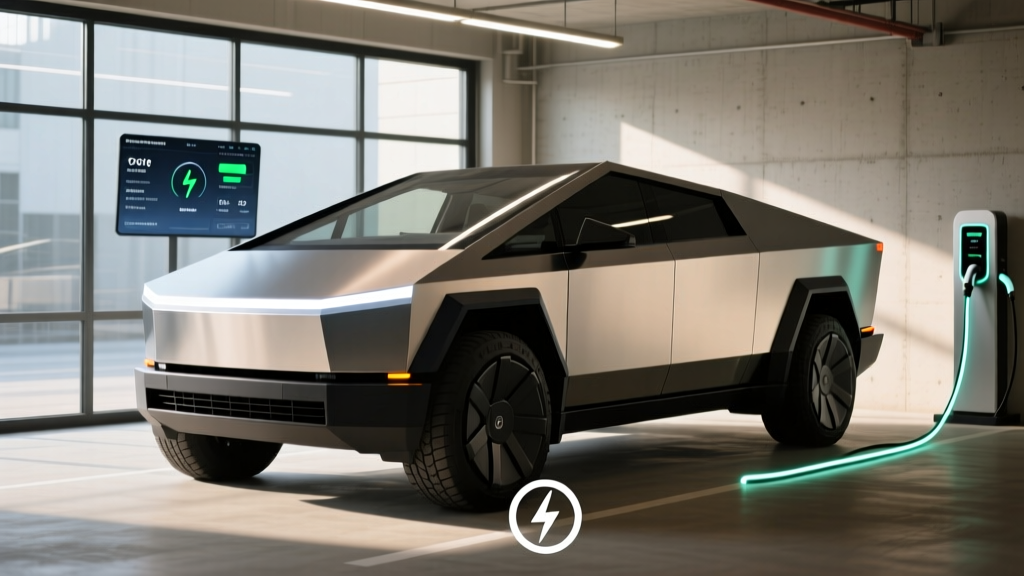
The Real Story Behind Tesla Cybertruck Discounts in 2026
If you've been searching for a Tesla Cybertruck discount financing deal, the short answer is: Tesla doesn't do traditional dealership incentives, but inventory pressure, financing rate promotions, and federal tax credit eligibility create real savings opportunities if you know where to look. The Cybertruck remains one of the most polarizing EVs on the road — a stainless-steel angular pickup that delivers genuine utility alongside head-turning design. But at a starting price near $80,000 for the Long Range AWD, buyers need to understand exactly what they're paying for, what incentives apply, and whether a financing deal actually moves the needle on total cost of ownership.
This guide cuts through the noise with hard numbers: EPA range, real-world efficiency, DC fast-charging curves, battery chemistry, §30D tax credit rules, and a clear-eyed look at who should — and shouldn't — buy a Cybertruck in 2026.
Cybertruck Pricing, Trims, and Where Discounts Actually Exist
Tesla sells direct-to-consumer, which means no dealer markups to negotiate down — but also no dealer discounts in the traditional sense. Here's what the 2026 lineup looks like:
| Trim | Drivetrain | Base MSRP | Est. After §30D Credit* |
|---|---|---|---|
| Long Range AWD | Dual-Motor AWD | $79,990 | $72,490 |
| Cyberbeast | Tri-Motor AWD | $99,990 | $99,990 (over MSRP cap) |
*§30D credit eligibility depends on MSRP caps, buyer income limits, and battery sourcing requirements. See the tax credit section below for full rules.
Where real savings emerge:
- Tesla financing rate promotions: Tesla periodically offers reduced APR financing (sometimes as low as 0.99%–2.99% for well-qualified buyers) on existing inventory. These are the closest thing to a "Cybertruck discount financing deal" and can save $3,000–$6,000 in interest over a 72-month term compared to standard bank rates.
- Inventory vehicles: Tesla occasionally discounts existing inventory units (already built, specific configurations) by $2,000–$5,000 to clear stock. Check the Tesla inventory page and filter by Cybertruck in your region.
- Point-of-sale credit transfer: Under current IRS rules, eligible buyers can transfer the §30D credit to Tesla at purchase, reducing the cash-out-of-pocket price immediately rather than waiting for a tax refund.
- Trade-in value: Tesla's trade-in offers vary, but competitive third-party offers from Carvana or CarMax can sometimes beat Tesla's number by $1,000–$3,000.
Range, Battery, and Real-World Efficiency
Long Range AWD: EPA-estimated 340 miles | Real-world highway (70 mph): ~280–310 miles | Cold weather (below 32°F): ~230–270 miles
Cyberbeast: EPA-estimated 320 miles | Real-world highway: ~260–290 miles | Cold weather: ~210–250 miles
The Cybertruck's massive frontal area and angular stainless-steel body create significant aerodynamic drag, which hits highway efficiency harder than most EVs. City driving with regenerative braking recovers more energy, so urban commuters will see results closer to the EPA sticker.
| Spec | Long Range AWD | Cyberbeast |
|---|---|---|
| Battery Capacity (usable) | ~123 kWh | ~123 kWh |
| Chemistry | NMC (Nickel Manganese Cobalt) | NMC |
| EPA Efficiency | ~58 MPGe / ~58 kWh/100mi | ~54 MPGe / ~62 kWh/100mi |
| Horsepower | 600 hp | 845 hp |
| 0–60 mph | 4.1 seconds | 2.6 seconds |
The NMC chemistry delivers higher energy density than LFP, which is necessary given the Cybertruck's weight and the range targets Tesla set. However, NMC batteries benefit from daily charge limits around 80–90% for longevity, unlike LFP packs that tolerate regular 100% charges. Tesla's battery management system handles this automatically, but owners should set their daily charge limit accordingly.
Charging Speed: DC Fast Charge and Home Level 2
Charging speed is where the Cybertruck's 800-volt-class architecture shows its advantage. Here's the full breakdown:
| Charging Level | Max Rate | Speed / Time |
|---|---|---|
| DC Fast Charge (Tesla Supercharger V4) | Peak ~350 kW | 10–80% in ~20 minutes; ~200+ miles added in 15 min |
| DC Fast Charge (CCS adapter, non-Tesla networks) | Up to ~250 kW (adapter-dependent) | 10–80% in ~28–35 minutes |
| Level 2 Home (Tesla Wall Connector, 48A / 11.5 kW) | 11.5 kW | ~30–34 miles of range per hour; full charge in ~11–12 hours |
| Level 1 (120V standard outlet) | ~1.4 kW | ~3–4 miles per hour (emergency/trickle only) |
Charging curve reality check: The Cybertruck peaks near 350 kW at a V4 Supercharger, but that peak is short-lived. Sustained charging from 10–50% SoC averages closer to 250–280 kW, and the curve tapers significantly above 80% to protect the battery. On a road trip, plan stops around 15–20 minutes for a 10–80% session — don't expect to sit at 350 kW the entire charge.
For home charging, a 48-amp Tesla Wall Connector on a 60-amp circuit is the practical minimum for daily Cybertruck ownership. Given the ~123 kWh battery, a full Level 2 charge from near-empty takes 11–12 hours. Most owners charge nightly from 30–80% SoC, which takes roughly 5–6 hours and fits easily within an overnight window. If your home electrical panel is older or at capacity, budget $1,500–$3,000 for a panel upgrade — consult a licensed electrician for a site assessment before purchasing the truck.
Federal Tax Credit Eligibility: The §30D Breakdown
- Maximum credit: Up to $7,500 ($3,750 for critical minerals + $3,750 for battery components)
- MSRP cap for trucks/vans/SUVs: $80,000 — the Long Range AWD qualifies at $79,990; the Cyberbeast at $99,990 does NOT qualify
- Buyer income caps (MAGI): $300,000 joint / $225,000 head of household / $150,000 single
- Battery sourcing requirements: Critical minerals and battery components must meet escalating domestic/free-trade-partner sourcing thresholds; Tesla has worked to qualify North American supply chains, but verify current-year eligibility on fueleconomy.gov before purchasing
- Point-of-sale transfer: Eligible buyers can transfer the credit to Tesla at purchase for an immediate price reduction, rather than claiming it on their tax return
- One vehicle per taxpayer per year; no lifetime cap but annual limit applies
Source: IRS.gov — Clean Vehicle Credits. Tax rules are subject to change. Consult a tax professional for personal eligibility.
The critical takeaway: only the Long Range AWD at $79,990 slips under the $80,000 truck MSRP cap. The Cyberbeast is disqualified by price alone. If your modified adjusted gross income exceeds the caps, the credit is unavailable regardless of the vehicle. And battery sourcing requirements tighten annually — always confirm the specific VIN's eligibility at the point of sale.
Utility, Interior, and Daily Ownership
The Cybertruck is a full-size pickup, and its utility credentials are legitimate:
- Bed length: 6 feet (with tailgate up); extendable with the powered tonneau cover retracted
- Cargo bed volume: ~67 cu ft
- Frunk (front trunk): ~7 cu ft, lockable
- Towing capacity: 11,000 lbs (Long Range AWD and Cyberbeast)
- Payload capacity: ~2,500 lbs
- Seating: 5 passengers; rear legroom ~38 inches (adequate for adults on shorter trips, tighter than an F-150 Lightning or Rivian R1T)
- Ground clearance: Up to 16 inches (adaptive air suspension in Off-Road/Extract mode)
Standout tech: The 18.5-inch center touchscreen runs Tesla's latest software with native navigation, streaming, and gaming. Rear passengers get a dedicated 9.4-inch touchscreen. The steer-by-wire system eliminates the mechanical connection between yoke and wheels, enabling variable steering ratios (fewer turns lock-to-lock at low speed). The 48-volt electrical architecture is an industry first for a production vehicle, reducing wiring harness weight and enabling higher-power accessories.
Notable drawbacks: The stainless-steel exoskeleton is fingerprint-prone and can show surface scratches. Rear visibility is limited (the camera-based rearview mirror helps). The yoke steering demands a learning curve, especially during low-speed parking maneuvers. Panel gap consistency has improved but still draws scrutiny. Insurance premiums tend to run 20–40% higher than comparable trucks due to repair costs for the stainless-steel body and specialized components.
Warranty Coverage
| Coverage | Term |
|---|---|
| Basic Vehicle Limited Warranty | 4 years / 50,000 miles |
| Battery & Drive Unit Warranty | 8 years / 120,000 miles (whichever comes first, with minimum 70% capacity retention) |
Tesla's battery warranty guarantees the pack retains at least 70% of its original capacity over 8 years or 120,000 miles. For a $80,000+ vehicle, this is competitive but not class-leading — Rivian offers 8 years/175,000 miles on the R1T battery. Out-of-warranty battery replacement for a pack this size would likely cost $18,000–$25,000+ based on current industry pricing, though degradation data on the Cybertruck's NMC pack is still accumulating given the vehicle's 2024 launch.
Cybertruck vs. Competitors: Is It Worth Buying?
| Spec | Tesla Cybertruck LR AWD | Ford F-150 Lightning Ext. Range | Rivian R1T Dual-Motor Max |
|---|---|---|---|
| Base MSRP | $79,990 | ~$76,995 | ~$87,000 |
| EPA Range | 340 mi | 320 mi | 410 mi |
| 0–60 mph | 4.1 sec | ~3.8 sec | ~3.5 sec |
| Towing | 11,000 lbs | 10,000 lbs | 11,000 lbs |
| Max DC Charge | ~350 kW | ~150 kW | ~220 kW |
| Bed Length | 6 ft | 5.5 ft | 4.5 ft (+ Gear Tunnel) |
| §30D Eligible | Yes (LR AWD) | Yes (select trims) | Yes (select trims) |
- You prioritize DC fast-charging speed for frequent road trips (350 kW peak crushes the Lightning's 150 kW)
- You want the lowest possible price among premium electric trucks (the LR AWD at ~$72,500 after credit is compelling)
- Steer-by-wire and tech-forward design appeal to you
- You primarily drive solo or with one passenger (rear seat is tighter than rivals)
- You need a traditional truck experience with familiar ergonomics and a full-size back seat
- Pro Power Onboard (V2H/V2L) for job-site or emergency power is a priority
- You prefer a proven dealer service network over Tesla's mobile-ranger model
- Maximum range (410 miles with Max Pack) is non-negotiable
- You want the Gear Tunnel for secure, lockable cross-body storage
- Off-road capability and build quality are top priorities, and you're willing to pay a premium
Pros, Cons, and Final Verdict
- Class-leading 350 kW peak DC fast charging at V4 Superchargers
- Long Range AWD qualifies for §30D credit (under $80K MSRP cap)
- 11,000-lb towing capacity matches conventional heavy-duty trucks
- Access to Tesla Supercharger network (most reliable public charging in the US)
- Distinctive design; stainless-steel body is dent-resistant
- 48V architecture and steer-by-wire represent genuine engineering advancement
- Highway range drops significantly due to aerodynamic drag (~280 mi real-world at 70 mph)
- Cold-weather range loss of 20–30% is pronounced with the large NMC pack
- Rear seat legroom is tight for a full-size truck
- Insurance premiums run 20–40% above comparable trucks
- Yoke steering and steer-by-wire have a steep learning curve
- Cyberbeast trim exceeds the §30D MSRP cap — no federal credit
- Stainless-steel body repair requires specialized facilities; collision repair turnaround can be long
Verdict: A Tesla Cybertruck discount financing deal in 2026 is less about haggling and more about stacking legitimate savings: the $7,500 §30D point-of-sale credit on the Long Range AWD, any available Tesla promotional financing rate, and potential inventory discounts. A buyer who qualifies for the full credit, secures a 1.99% APR promotion, and finds a $3,000 inventory discount could effectively pay ~$69,500 for a 340-mile, 600-hp electric truck with 11,000-lb towing — a genuinely strong value in the premium EV truck segment. But go in with eyes open about real-world range, insurance costs, and the learning curve of steer-by-wire. This is a truck for tech-forward buyers who road-trip often and charge at home, not for fleet-duty work truck buyers who need maximum back-seat space and traditional controls.
Frequently Asked Questions
What is the real-world range of the Tesla Cybertruck?
The EPA rates the Long Range AWD at 340 miles and the Cyberbeast at 320 miles. In real-world highway driving at 70 mph, expect 280–310 miles (LR AWD) and 260–290 miles (Cyberbeast). In cold weather below freezing, range drops to roughly 230–270 miles for the LR AWD due to battery heating demands and increased air density. City driving with regenerative braking returns results closer to the EPA estimate.
How fast does the Cybertruck charge?
At a Tesla V4 Supercharger, the Cybertruck peaks at ~350 kW and charges from 10–80% in approximately 20 minutes. On non-Tesla DC fast chargers using the CCS adapter, expect peak rates around 200–250 kW and 10–80% in 28–35 minutes. At home on a 48-amp Level 2 Tesla Wall Connector (11.5 kW), the truck gains roughly 30–34 miles of range per hour, with a full charge taking 11–12 hours.
How much does the Cybertruck cost after tax credits?
The Long Range AWD starts at $79,990 MSRP. If you meet all §30D requirements (income under $300K joint / $150K single, and the vehicle's battery sourcing qualifies), you can receive up to $7,500 as a point-of-sale reduction, bringing the effective price to ~$72,490 before destination or options. The Cyberbeast at $99,990 exceeds the $80,000 truck MSRP cap and does not qualify for the federal credit.
Does the Cybertruck qualify for the federal EV tax credit?
The Long Range AWD qualifies — it's priced at $79,990, just under the $80,000 MSRP cap for trucks under IRS §30D. The Cyberbeast does not. Buyer income must be under $300,000 (joint) / $225,000 (head of household) / $150,000 (single) based on modified AGI. Battery critical-mineral and component sourcing must meet 2026 thresholds; verify at fueleconomy.gov or with Tesla at purchase. Always consult a tax professional for personal eligibility.
Is the Cybertruck worth buying vs. the F-150 Lightning or Rivian R1T?
It depends on your priorities. The Cybertruck LR AWD wins on DC fast-charging speed (350 kW vs. 150 kW for the Lightning) and offers the lowest effective price after the §30D credit in the premium electric truck segment. The F-150 Lightning wins on back-seat space, traditional truck ergonomics, and dealer service access. The Rivian R1T wins on maximum range (410 mi with Max Pack), off-road capability, and the Gear Tunnel storage system. Test-drive all three if possible — the Cybertruck's steer-by-wire and yoke are love-it-or-hate-it features that demand seat time.
What are the biggest ownership costs beyond the purchase price?
Insurance is the standout: Cybertruck premiums run 20–40% higher than comparable trucks, often $3,000–$5,000/year depending on your profile and state. Home charging installation (240V, 48-amp circuit) typically costs $1,000–$2,500, potentially more if your panel needs upgrading. Electricity costs for charging average $0.13–$0.16/kWh nationally, making a full ~123 kWh charge roughly $16–$20 at home — dramatically cheaper than fueling a gas truck, but public DC fast charging at $0.35–$0.50/kWh can approach gas-truck fuel costs per mile.