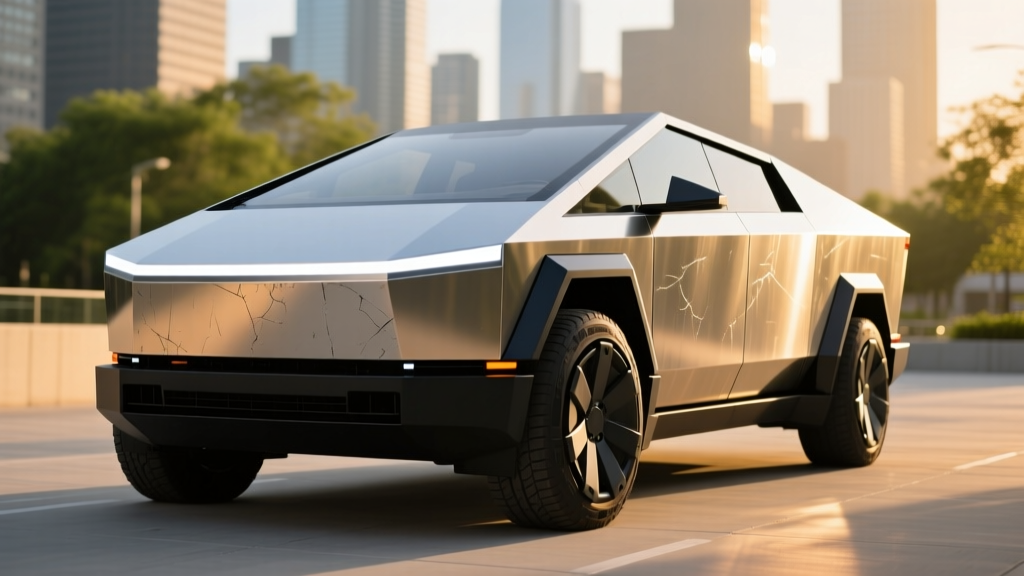
If you bought a Tesla Cybertruck at its 2024–2025 launch pricing and tried to sell it in 2026, you likely took a financial hit. The angular stainless-steel pickup has become one of the most polarizing vehicles in the EV market — and its resale trajectory reflects that. But depreciation is only one slice of the ownership equation. To understand whether the Cybertruck makes financial sense today, you need to weigh its retained value against its specs, efficiency, charging performance, tax-credit eligibility, and real-world usability.
This review breaks down the 2026 Tesla Cybertruck lineup — the Long Range AWD and the Cyberbeast — with the hard numbers buyers and current owners need: EPA range, battery chemistry, DC fast-charge curves, Level 2 home charging rates, 0-60 times, cargo dimensions, warranty coverage, and the federal §30D tax credit math that reshapes the true cost of ownership.
2026 Tesla Cybertruck: Spec Snapshot
| Specification | Long Range AWD | Cyberbeast (Tri-Motor) |
|---|---|---|
| Base MSRP (2026) | $79,990 | $99,990 |
| EPA Range | 340 miles | 320 miles |
| Battery (usable, est.) | ~123 kWh, NMC | ~123 kWh, NMC |
| Max DC Fast Charge | 250 kW | 250 kW |
| 10–80% DC Charge Time | ~30 min | ~30 min |
| Level 2 Home Charge Rate | 11.5 kW (~37 mi/hr) | 11.5 kW (~37 mi/hr) |
| 0–60 mph | 4.1 sec | 2.6 sec |
| Horsepower | 600 hp | 845 hp |
| Drivetrain | Dual-Motor AWD | Tri-Motor AWD |
| MPGe (combined) | 66 MPGe | 63 MPGe |
| Efficiency (kWh/100 mi) | 51 kWh/100 mi | 53 kWh/100 mi |
| Towing Capacity | 11,000 lbs | 11,000 lbs |
| Battery Warranty | 8 yr / 120,000 mi | 8 yr / 120,000 mi |
Tesla has not published exact usable kWh figures for the Cybertruck's battery pack, but teardown analyses and EPA efficiency calculations place it in the 120–125 kWh usable range. The chemistry is NMC (nickel manganese cobalt), which offers higher energy density than LFP but comes with different thermal management and long-term degradation characteristics. For a truck this heavy — curb weight exceeds 6,700 lbs on the Cyberbeast — that large pack is necessary to hit the 300+ mile EPA targets.
Real-World Range: What the EPA Sticker Doesn't Tell You
Real-World Highway Expectation: ~260–290 miles at 70–75 mph
Cold-Weather (Below 32°F): ~220–260 miles, depending on cabin heat usage and preconditioning
The Cybertruck's aerodynamics are the elephant in the room — or rather, the stainless-steel wedge in the wind tunnel. Despite its angular design, Tesla optimized the underbody and bed cover to manage drag, but the truck's frontal area is enormous. At highway speeds above 70 mph, energy consumption climbs sharply. In mixed driving, owners report efficiency between 48 and 55 kWh/100 mi depending on terrain, speed, and climate control usage.
Cold weather hits the Cybertruck harder than lighter, more aerodynamic EVs. The massive battery pack takes longer to precondition, and the energy required to heat the cabin and battery in sub-freezing temperatures can reduce range by 20–30%. If you're in the Upper Midwest or Northeast and regularly drive highway miles in winter, plan for roughly 230 miles of usable range before needing to charge. Tesla's heat pump helps mitigate this compared to resistive heating, but physics wins in extreme cold.
For daily commuting under 60 miles round-trip with home charging, range is a non-issue on either trim. The problem surfaces on road trips and towing — where efficiency can drop below 2.0 mi/kWh when pulling a heavy trailer, cutting effective range to under 200 miles.
Charging Performance: 250 kW Peak, but Watch the Curve
| Charging Level | Power | Rate / Time | Notes |
|---|---|---|---|
| Level 1 (120V) | ~1.4 kW | ~4 mi/hr | Emergency/trickle only |
| Level 2 (240V, 48A) | 11.5 kW | ~37 mi/hr | Full charge in ~10 hrs |
| DC Fast Charge (V3 Supercharger) | 250 kW peak | 10–80% in ~30 min | Peak rate sustained to ~50% SoC, then tapers |
| DC Fast Charge (V4 Supercharger) | Up to 250 kW | Similar to V3 | Newer stall hardware, same vehicle-side limit |
The Cybertruck charges at a maximum of 250 kW on Tesla's Supercharger network using the NACS connector (native — no adapter needed). That peak rate holds roughly from 10% to 45–50% State of Charge (SoC), after which the charge curve tapers progressively. By 80%, you're typically pulling 80–100 kW, and above 90% the rate drops sharply to protect the NMC cells.
This is a critical point for road-trip planning: the ~30-minute 10–80% figure assumes you arrive at the charger with a low battery and leave at 80%. Charging from 80% to 100% can add another 25–35 minutes. Tesla's navigation system accounts for this automatically when routing through Superchargers, preconditioning the battery before arrival to maximize charge speed.
At home, a Level 2 Wall Connector on a 60-amp circuit delivers 11.5 kW, adding roughly 37 miles of range per hour. A full overnight charge (10 hours) replenishes the entire pack. If your electrical panel can't support a 60-amp circuit, a 40-amp setup (9.6 kW, ~31 mi/hr) is a practical alternative — though you'll want to budget $800–$2,500 for professional installation depending on panel capacity and conduit runs. Always consult a licensed electrician for final specifications.
Depreciation in Focus: Why the Cybertruck Loses Value Fast
The keyword that brought you here — Tesla Cybertruck depreciation value — deserves direct analysis. Since deliveries began in late 2023, the Cybertruck has experienced steeper-than-average depreciation for several converging reasons:
- Launch premium collapse: Early buyers paid well above MSRP through dealer markups and the high-priced Foundation Series ($120,000+). As Tesla normalized production and eliminated the Foundation Series, those inflated purchase prices evaporated on the used market.
- MSRP adjustments: Tesla repriced the lineup multiple times through 2024 and 2025, undercutting early buyers who paid more for the same vehicle.
- Niche appeal: The Cybertruck's polarizing design, large footprint, and limited garage compatibility restrict its buyer pool. It doesn't fit in many standard residential garages due to its ~80-inch width (mirrors out) and ~224-inch length.
- Competition: The Rivian R1T, Ford F-150 Lightning, and Chevrolet Silverado EV offer comparable or superior utility in more conventional packages with broader market appeal.
- Build quality variability: Early production units reported panel-gap inconsistencies, stainless-steel fingerprint and dent issues, and software bugs that dampened used-market confidence.
Industry data from sources like iSeeCars and Kelley Blue Book indicate that the Cybertruck lost approximately 30–40% of its value within the first 12–18 months for non-Foundation-Series trims, and even more for Foundation Series buyers who paid over $120,000. For comparison, the Ford F-150 Lightning depreciated roughly 20–25% over a similar period, and the Rivian R1T held value somewhat better due to limited supply and strong enthusiast demand.
However, depreciation is only one factor in total cost of ownership. The Cybertruck's fuel savings versus a gas truck (at 51 kWh/100 mi vs. a comparable F-150 at 18 MPG), minimal maintenance costs, and potential tax-credit benefits narrow the gap — especially if you bought at current MSRP rather than launch-inflated prices.
Pricing, Tax Credits, and True Cost
| Trim | Base MSRP | Federal §30D Credit | Effective Price |
|---|---|---|---|
| Long Range AWD | $79,990 | Up to $7,500* | ~$72,490* |
| Cyberbeast | $99,990 | $0 (MSRP cap exceeded) | $99,990 |
*Federal tax credit eligibility under IRS §30D is subject to multiple conditions as of 2026:
- MSRP Cap: Trucks, vans, and SUVs must have an MSRP of $80,000 or less. The Long Range AWD qualifies; the Cyberbeast does not.
- Buyer Income Cap: Modified AGI must not exceed $150,000 (single), $225,000 (head of household), or $300,000 (joint). Exceed these thresholds and the credit phases out entirely.
- Battery Sourcing: The $7,500 credit splits into two halves — $3,750 for critical-mineral sourcing and $3,750 for battery-component manufacturing. Tesla's North American supply chain has progressively qualified for both halves on the Cybertruck, but buyers should verify current eligibility on the fueleconomy.gov credit lookup tool before purchase.
- Point-of-Sale Transfer: As of 2024, buyers can transfer the credit to the dealer at purchase, reducing the upfront price rather than waiting for a tax refund. This requires the dealer to be IRS-registered.
The Cyberbeast's $99,990 MSRP disqualifies it from §30D entirely, regardless of buyer income. If you're cross-shopping the two trims, the Long Range AWD's effective post-credit price of roughly $72,490 represents a dramatically better value proposition — and you sacrifice only 20 miles of EPA range and the third motor.
Performance, Utility, and Daily Livability
The Cyberbeast's 2.6-second 0–60 mph time makes it one of the quickest production pickups ever built. The Long Range AWD's 4.1-second run is hardly slow. Both trims deliver instant electric torque that makes highway merging and passing effortless, and the low center of gravity (battery pack under the floor) keeps body roll surprisingly controlled for a vehicle of this mass.
Cargo and Space:
- Bed length: 6 feet (with tailgate closed); extends to ~8 feet with tailgate down
- Bed volume: ~67 cu ft (tailgate closed)
- Front trunk (frunk): ~7 cu ft — useful for groceries or charging cables, not for serious cargo
- Seating: 5 passengers, 60/40 split rear bench
- Rear legroom: ~41 inches — competitive with full-size crew cabs
- Towing: 11,000 lbs rated (both trims)
The 11,000-lb tow rating is impressive on paper, but towing near that limit will crush efficiency to 1.5–2.0 mi/kWh, cutting range to 150–200 miles. Plan charging stops accordingly. The integrated trailer brake controller and tow mode with trailer light check are practical additions.
Notable Drawbacks:
- The stainless-steel exoskeleton shows fingerprints, smudges, and water spots relentlessly. Tesla sells a protective film, but it's an added cost.
- The yoke-style steering wheel (standard on Cyberbeast, optional on Long Range) requires a learning period and complicates low-speed maneuvering for some drivers.
- Rear visibility is limited by the sloped bed design; the camera-based rearview mirror is essential.
- No Apple CarPlay or Android Auto — Tesla's proprietary infotainment only.
- Width and length make tight parking structures and narrow urban streets genuinely challenging.
Driver Assistance and Tech: Autopilot and FSD (Supervised)
The Cybertruck ships with Tesla's latest Hardware 4 (HW4) sensor suite, including high-resolution cameras and enhanced processing. Autopilot (included) handles adaptive cruise control and lane centering on highways. FSD (Supervised), available as a $8,000 one-time purchase or $99/month subscription as of 2026, adds city-street navigation, stop-sign and traffic-light recognition, and automatic lane changes.
FSD (Supervised) has improved substantially through 2025–2026 neural-net updates, but it still requires vigilant oversight. Construction zones, faded lane markings, and complex intersections demand immediate driver intervention. NHTSA continues to monitor Tesla's driver-assist systems, and buyers should treat FSD as a convenience feature, not a replacement for attention.
The Cybertruck's 18.5-inch center touchscreen controls virtually every vehicle function — from glove-box release to mirror adjustment. This minimalist approach divides opinion: some owners appreciate the clean cabin, others miss physical buttons for climate and volume. A rear 9.4-inch touchscreen serves back-seat passengers.
Is the Cybertruck Worth Buying vs. Competitors?
- You want access to the Tesla Supercharger network (the most reliable DC fast-charging infrastructure in North America)
- You value acceleration and tech-forward features over conventional truck utility
- You're buying the Long Range AWD to capture the $7,500 federal credit
- You have a large garage or outdoor parking and don't need to fit a standard single-car bay
- Resale value and depreciation stability are top priorities
- You need a conventional truck bed with standard accessories and wider aftermarket support
- You prefer physical controls and Apple CarPlay/Android Auto integration (Rivian and GM offer these)
- You want a more proven track record on build quality and service-center accessibility
The Cybertruck's strongest competitive advantage remains the Supercharger network. While NACS adoption by Ford, GM, and Rivian has opened access to Superchargers for non-Tesla EVs, Tesla vehicles still benefit from native integration, automatic billing, and preconditioning that optimizes charge speed. For frequent road-trippers, this ecosystem advantage is tangible.
But if depreciation is your primary concern — and given the search that brought you here, it likely is — the F-150 Lightning and Rivian R1T have demonstrated more stable resale trajectories. The Lightning benefits from fleet and commercial demand that underpins used values, while the R1T's limited production volumes and strong brand loyalty support its secondary market.
Warranty Coverage
Tesla covers the Cybertruck with the following warranties:
- Basic Vehicle: 4 years / 50,000 miles
- Battery & Drive Units: 8 years / 120,000 miles (whichever comes first), with a minimum 70% capacity retention guarantee over the warranty period
- Corrosion: 12 years with no mileage limit (relevant for the stainless-steel body, though stainless is inherently corrosion-resistant)
The 120,000-mile battery warranty is competitive. The 70% retention threshold means Tesla will repair or replace the pack if it drops below that capacity within the warranty window. Real-world degradation data for the Cybertruck specifically is still limited given its 2023 launch, but Tesla's NMC packs in the Model S and Model X have historically retained 85–90% capacity at 100,000 miles under normal charging habits (avoiding frequent 100% charges and deep discharges).
Frequently Asked Questions
What is the real-world range of the Tesla Cybertruck?
The EPA rates the Long Range AWD at 340 miles and the Cyberbeast at 320 miles. In real-world highway driving at 70–75 mph, expect 260–290 miles. In cold weather below freezing, plan for 220–260 miles. Towing a heavy trailer can drop effective range below 200 miles.
How fast does the Cybertruck charge at home and on the road?
On a Level 2 home charger (11.5 kW), the Cybertruck adds approximately 37 miles of range per hour, with a full charge taking about 10 hours. On a Tesla V3 or V4 Supercharger, it peaks at 250 kW and charges from 10% to 80% in roughly 30 minutes. Charge speed tapers significantly above 80% SoC.
Does the Cybertruck qualify for the federal EV tax credit?
The Long Range AWD ($79,990 MSRP) qualifies for up to $7,500 under IRS §30D, provided the buyer meets income caps ($150K single / $300K joint) and the vehicle meets battery-sourcing requirements. The Cyberbeast ($99,990 MSRP) exceeds the $80,000 truck MSRP cap and does not qualify. Verify current eligibility at fueleconomy.gov before purchasing.
How much has the Cybertruck depreciated since launch?
Early buyers, especially those who paid Foundation Series prices ($120,000+), have seen 30–45% depreciation through 2026. Non-Foundation-Series trims purchased closer to MSRP have depreciated roughly 25–35% in the first 12–18 months. Depreciation is steeper than the F-150 Lightning (~20–25%) and Rivian R1T, driven by production normalization, MSRP repricing, niche design appeal, and variable early build quality.
Is the Cybertruck practical for daily driving?
For commuters with home charging and adequate parking space, the Cybertruck is comfortable and quiet with strong acceleration and a smooth ride. Its challenges are size (it won't fit many standard garages), stainless-steel maintenance (fingerprints and smudges), and the absence of CarPlay/Android Auto. For urban dwellers with tight parking, the width and length are genuine daily frustrations.
What's the biggest risk of buying a Cybertruck in 2026?
Depreciation risk remains elevated. If Tesla introduces a refresh or a more affordable variant, current used values could drop further. Additionally, Tesla's service-center network is strained in many regions, and body repair for the stainless-steel exoskeleton requires specialized facilities — potentially complicating insurance claims and increasing repair wait times after collision damage.
- Supercharger network access with native integration
- Class-leading acceleration (Cyberbeast: 2.6 sec 0–60)
- 11,000-lb tow rating with integrated trailer controls
- Long Range AWD eligible for $7,500 federal tax credit
- 8-year/120,000-mile battery warranty
- Distinctive design with stainless-steel durability
- Steep depreciation — 30–40% in first 12–18 months
- Cyberbeast ineligible for §30D credit (MSRP cap)
- Real-world highway range significantly below EPA estimate
- Too large for many standard garages and parking structures
- Stainless-steel body shows fingerprints and is costly to repair
- No Apple CarPlay or Android Auto
- Yoke steering requires adaptation