If you placed a $100 refundable deposit on the Tesla Cybertruck years ago and are now staring at a delivery notification — or a price tag that has nothing to do with the "affordable pickup" Elon Musk originally teased — you are not alone. Thousands of reservation holders are now asking the same question: should I request a Tesla Cybertruck deposit refund, or is the 2026 Cybertruck actually worth the money?
This is not a simple yes-or-no call. The Cybertruck has evolved from a $39,900 concept into a $80,000–$100,000+ stainless-steel reality with genuine capability but also real compromises. Below, we break down every number that matters — range, charging, pricing, tax credit eligibility, and ownership economics — so you can decide whether to keep your reservation or take the refund and walk away.
2026 Tesla Cybertruck: At-a-Glance Specs
| Spec | AWD (Dual Motor) | Cyberbeast (Tri-Motor) |
|---|---|---|
| Base MSRP | $79,990 | $99,990 |
| EPA Range | 340 miles | 320 miles |
| Battery (usable est.) | ~123 kWh, NMC | ~123 kWh, NMC |
| Peak DC Fast Charge | ~250 kW | ~250 kW |
| 10–80% DC Time | ~30 min | ~30 min |
| Level 2 Home Charge | 11.5 kW (~37 mi/hr) | 11.5 kW (~37 mi/hr) |
| 0–60 mph | 3.9 sec | 2.6 sec |
| Horsepower | 600 hp | 845 hp |
| Drivetrain | Dual-Motor AWD | Tri-Motor AWD |
| Towing Capacity | 11,000 lbs | 11,000 lbs |
| Battery/Drive Warranty | 8 yr / 120,000 mi | 8 yr / 120,000 mi |
Real-World Range: What the EPA Sticker Doesn't Tell You
EPA Estimated: 340 miles (AWD) / 320 miles (Cyberbeast)
Real-World Expectation: Plan for roughly 270–300 miles on sustained highway driving at 70–80 mph. In cold weather (below 32°F), expect a further 15–25% reduction, putting usable winter highway range closer to 220–260 miles before you need to stop.
The Cybertruck's angular stainless-steel exoskeleton creates more aerodynamic drag than a rounded body, and at highway speeds, that drag dominates energy consumption. According to fueleconomy.gov, the AWD model achieves roughly 2.0–2.2 kWh/mile (about 48–50 MPGe combined). That is competitive for a full-size electric pickup but far from the efficiency of a sedan or crossover.
For daily commuting under 60 miles round-trip with home charging, range is a non-issue. For road trips, you will use the Supercharger network — and the Cybertruck's charging speed (below) means stops are reasonable but not class-leading.
Charging Speed: DC Fast and Home Level 2
| Charging Level | Power / Rate | Speed (approx.) |
|---|---|---|
| Level 1 (120V) | ~1.4 kW | ~4–5 miles per hour |
| Level 2 (240V, 48A) | 11.5 kW | ~37 miles per hour |
| DC Fast Charge | Peak ~250 kW | 10–80% in ~30 min |
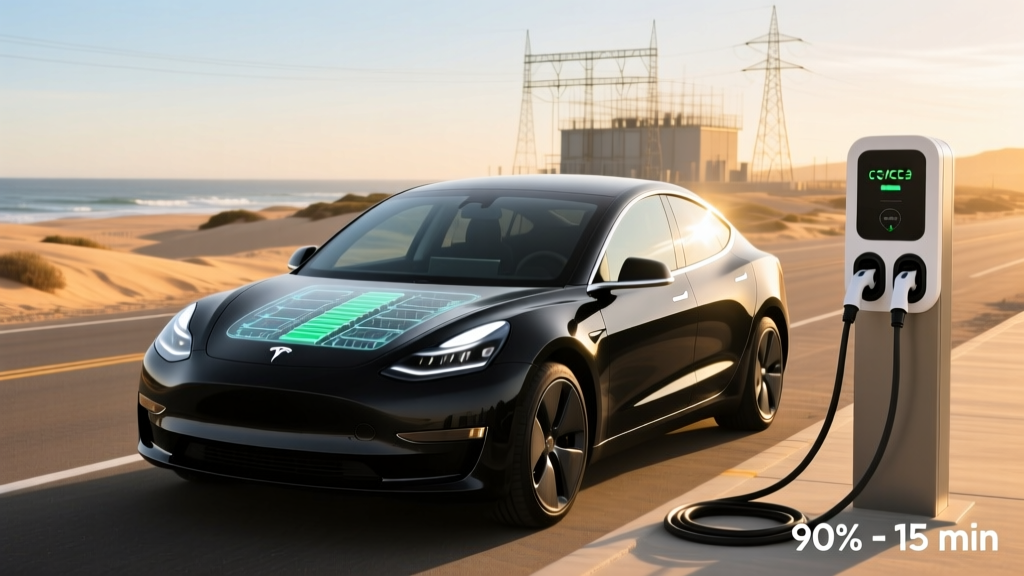
The Cybertruck charges at up to 250 kW on V3 Superchargers. In practice, the charge curve peaks near 250 kW only at low state-of-charge (below 30–35%) and tapers significantly above 60%. Expect an average sustained rate closer to 130–150 kW across the full 10–80% session, which is why the 30-minute figure is realistic.
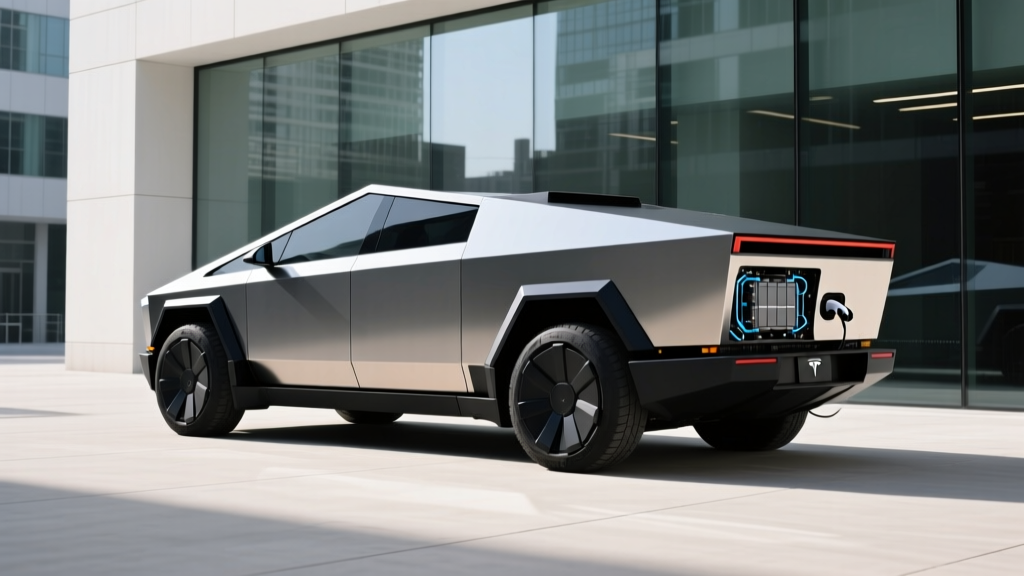
At home, a Level 2 wall connector on a 60A circuit delivers 11.5 kW, replenishing roughly 37 miles of range per hour. A full overnight charge (8 hours) adds about 296 miles — enough to refill the battery completely. Installation typically costs $800–$2,000 depending on panel capacity and run length; if your home has a 200A panel with spare capacity, expect the lower end.
Note: The Cybertruck uses the NACS (Tesla) connector natively, giving it first-party access to the entire Supercharger network without adapters — a genuine advantage over CCS-equipped competitors still relying on third-party networks with spotty reliability.
Pricing, Trims, and the Federal Tax Credit Reality
This is where most deposit holders experience sticker shock. The Cybertruck that Tesla originally hinted at under $40,000 does not exist. Here is the 2026 lineup:
| Trim | Base MSRP | Federal §30D Credit | Effective Price |
|---|---|---|---|
| AWD (Dual Motor) | $79,990 | $0 (exceeds MSRP cap) | $79,990 |
| Cyberbeast (Tri-Motor) | $99,990 | $0 (exceeds MSRP cap) | $99,990 |
Under current IRS §30D rules, the federal EV tax credit caps at $80,000 MSRP for pickup trucks and SUVs. The AWD Cybertruck at $79,990 technically squeezes under the cap, but destination fees, mandatory options, and paint/protection packages routinely push the out-the-door MSRP above $80,000 — disqualifying it. The Cyberbeast at $99,990 is ineligible regardless.
Additionally, §30D has buyer income caps ($150,000 single / $300,000 joint AGI) and critical-mineral and battery-component sourcing requirements that change annually. As of 2026, the battery-sourcing rules have tightened further, making credit qualification even more uncertain. Consult a tax professional before assuming eligibility — and do not count on the credit to justify the purchase.
A previously announced "Rear-Wheel Drive" base model at ~$60,990 was limited to fleet sales and has not been offered to retail reservation holders as of early 2026.
Who Should Keep Their Reservation — and Who Should Take the Refund
Keep your reservation if:
- You need an 11,000-lb towing electric pickup and value Supercharger network access for towing road trips
- You want a stainless-steel, dent-resistant bed for work-site or ranch use
- The Cyberbeast's 2.6-second 0–60 time and 845 hp appeal to you as a performance vehicle
- You have reliable home Level 2 charging and your daily driving is under 150 miles
Request your Tesla Cybertruck deposit refund if:
- You were banking on a sub-$50,000 electric pickup — that vehicle does not exist here
- You need a rear seat that comfortably fits three adults on long trips (the Cybertruck's rear cabin is tight)
- You want proven long-term reliability data — the Cybertruck's stainless-steel body, steer-by-wire system, and 48V architecture are all first-generation
- A Rivian R1T, Ford F-150 Lightning, or Chevrolet Silverado EV better fits your budget or use case
Cargo, Interior, and Tech: The Daily Ownership Picture
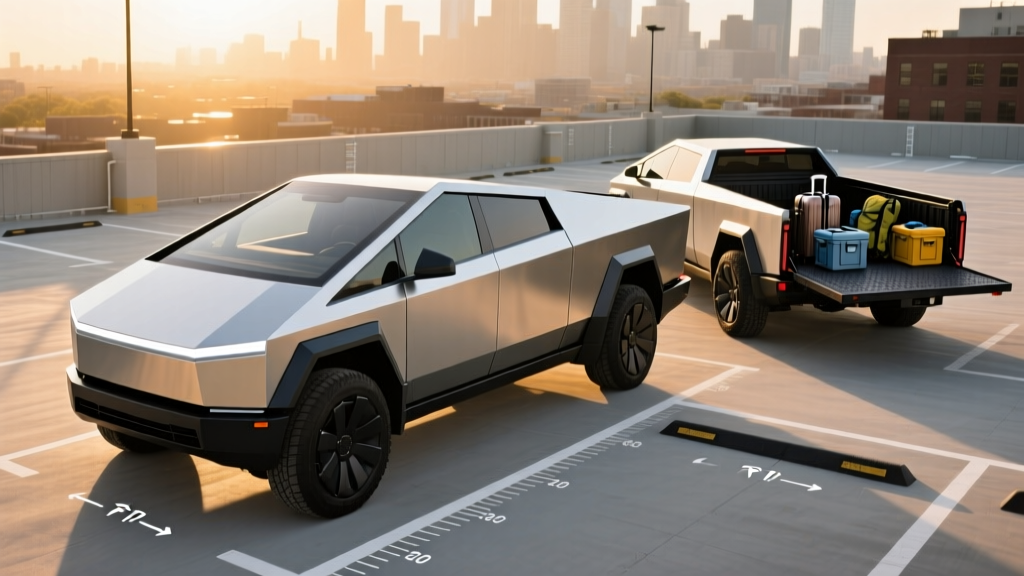
The Cybertruck's 6-foot bed offers ~67 cubic feet of cargo volume with the tonneau cover closed. The powered retractable cover is standard and genuinely useful — it seals the bed from weather and locks automatically. The vault-style bed with integrated ramp is a standout for loading ATVs or motorcycles.
Inside, the cabin seats five but the rear seat is best for two adults or children. Rear legroom is roughly 38.4 inches — adequate but not generous for a full-size pickup. The minimalist interior centers on an 18.5-inch front touchscreen and a 9.4-inch rear screen. There are no physical stalks; turn signals and wipers are controlled via the yoke steering wheel, which has a steep learning curve.
Notable tech includes:
- Steer-by-wire: No mechanical connection between yoke and wheels. Provides variable ratio steering (fewer turns lock-to-lock at low speed) but zero road feel feedback
- Tesla Autopilot / FSD (Supervised): This is an SAE Level 2 driver-assistance system — you must remain fully engaged and ready to take over at all times. It is not self-driving
- 48-volt electrical architecture: Replaces the traditional 12V system, enabling thinner wiring harnesses and more power-dense accessories — innovative but unproven at scale
- Bioweapon Defense Mode: HEPA filtration system, standard
- Powershare: Up to 11.5 kW of vehicle-to-load (V2L) and vehicle-to-home (V2H) power output — enough to run tools on a job site or essential circuits during an outage
Competitor Comparison: Cybertruck vs. R1T vs. F-150 Lightning
| Attribute | Tesla Cybertruck AWD | Rivian R1T Dual-Motor | Ford F-150 Lightning Lariat |
|---|---|---|---|
| Base MSRP | $79,990 | $69,900 | $69,995 |
| EPA Range | 340 mi | ~270 mi (Standard) / ~352 mi (Max) | ~230 mi (Std) / ~320 mi (Ext) |
| Towing | 11,000 lbs | 11,000 lbs | 10,000 lbs |
| 0–60 mph | 3.9 sec | 4.5 sec | ~4.0 sec |
| §30D Credit Eligible | Unlikely (MSRP cap) | Yes (qualifying trims) | Yes (qualifying trims) |
| Charging Network | Tesla Supercharger (native) | Tesla (adapter) + CCS | Tesla (adapter) + CCS |
The Rivian R1T and Ford F-150 Lightning both offer more conventional truck ergonomics, available §30D credit eligibility on mid-tier trims, and longer track records. The Cybertruck's advantages are raw performance (Cyberbeast), Supercharger-native access, and the stainless-steel body. Choose based on which trade-offs you can live with.
Warranty, Longevity, and Battery Chemistry
Tesla covers the Cybertruck's battery and drive unit for 8 years or 120,000 miles (whichever comes first), with a minimum 70% capacity retention threshold. The limited vehicle warranty is 4 years / 50,000 miles.
The battery pack uses NMC (nickel manganese cobalt) chemistry, which offers higher energy density than LFP but is more sensitive to sustained high-state-of-charge storage. For maximum longevity, Tesla recommends daily charging to 80–90% and only charging to 100% before long trips.
Long-term degradation data specific to the Cybertruck is not yet available (deliveries began late 2023), but Tesla's NMC packs in the Model 3 and Model Y have historically shown 10–15% degradation over 100,000 miles based on fleet data — well within warranty thresholds.
Frequently Asked Questions
How do I get a Tesla Cybertruck deposit refund?
Log into your Tesla account, navigate to your reservation, and select "Cancel Order." The $100 deposit is fully refundable to your original payment method. Processing typically takes 5–10 business days. There is no penalty, no phone call required, and no time limit — you can cancel at any point before taking delivery.
Is the Cybertruck eligible for the $7,500 federal EV tax credit in 2026?
Almost certainly not in practice. While the AWD trim's base MSRP of $79,990 is technically under the $80,000 pickup cap, any added destination charges, packages, or accessories push it over. The Cyberbeast at $99,990 is far above the cap. Additionally, you must meet IRS income limits ($150K single / $300K joint) and the vehicle must satisfy critical-mineral and battery-component sourcing rules. Verify current eligibility at IRS.gov before relying on the credit.
What is the real-world highway range of the Cybertruck?
Expect approximately 270–300 miles at highway speeds (70–80 mph) in moderate temperatures. In cold weather (below freezing), plan for 220–260 miles. The EPA's 340-mile rating for the AWD assumes a mix of city and highway driving under ideal conditions.
How fast does the Cybertruck charge on a road trip?
At a Tesla V3 Supercharger (250 kW peak), the Cybertruck charges from 10–80% in approximately 30 minutes. However, peak speed only holds at low battery states; above 60% SoC, the rate tapers significantly. Plan for 30–40 minute stops on road trips, similar to a gas stop plus a short break.
Is the Cybertruck worth buying over the Rivian R1T or F-150 Lightning?
It depends on your priorities. The Cybertruck wins on performance (Cyberbeast: 2.6s 0–60), native Supercharger access, and the stainless-steel body. The R1T and F-150 Lightning win on interior space, conventional ergonomics, tax credit eligibility on mid-tier trims, and proven reliability. If budget matters and you want the credit, the R1T or Lightning on a qualifying trim is the stronger financial play.
What are the biggest drawbacks of the Cybertruck?
The most common owner complaints center on the yoke steering with steer-by-wire (no road feel, steep learning curve), tight rear-seat space for a full-size truck, panel-gap inconsistencies on early builds, the sheer size making parking difficult, and the high price relative to the original promise. Insurance premiums also tend to run 20–40% higher than comparable pickups due to the stainless-steel body repair complexity.
Verdict: Refund or Ride?
Pros
- Cyberbeast performance is supercar-rivaling in a truck body
- Native Supercharger access — best road-trip charging network
- Stainless-steel body resists dents, scratches, and corrosion
- 11,000-lb towing + Powershare V2L/V2H capability
- 8 yr / 120,000 mi battery warranty
Cons
- $80K–$100K price is 2x the original promise
- Effectively ineligible for the §30D federal tax credit
- Yoke + steer-by-wire is polarizing and takes real adaptation
- Rear seat is tight for three adults
- First-gen platform: limited long-term reliability data
- High insurance and potential body-repair costs
The Tesla Cybertruck deposit refund is there for the taking — no strings, no deadline. If the 2026 pricing, the tax credit reality, and the compromises align with what you actually need in a truck, the Cybertruck is a genuinely capable and unique vehicle. If you were counting on an affordable electric pickup, the truck Tesla promised never arrived, and your $100 is better applied toward a Rivian R1T, an F-150 Lightning, or simply back in your bank account.