Quick Verdict: The Cybertruck Delivery Experience in 2026
If you're finally getting that call from Tesla about your Cybertruck delivery, you've likely been waiting months — possibly years since your original reservation. By early 2026, Tesla has ramped up production significantly, and the Cybertruck lineup now includes the Dual Motor AWD, the performance-oriented Cyberbeast, and the more accessible Long Range AWD variant. But before you sign the paperwork and drive off the lot, there are critical specs, real-world limitations, and ownership realities you need to understand.
This guide walks you through everything a new Cybertruck owner needs to know — from the moment you walk into the delivery center to your first week of ownership. We'll cover actual range you can expect, charging realities, tax credit eligibility, and whether this polarizing electric truck lives up to the hype for your specific use case.
Cybertruck Specs at a Glance: What You're Taking Delivery Of
| Spec | Long Range AWD | Cyberbeast |
|---|---|---|
| EPA Range | 340 miles | 320 miles |
| Battery Capacity (usable) | ~123 kWh | ~123 kWh |
| Battery Chemistry | NMC (Nickel Manganese Cobalt) | NMC |
| Drivetrain | Dual Motor AWD | Tri-Motor AWD |
| Horsepower | 600 hp | 845 hp |
| 0-60 mph | 4.1 seconds | 2.6 seconds |
| Max DC Fast Charge | 250 kW | 250 kW |
| 10-80% DC Charge Time | ~28 minutes | ~28 minutes |
| Level 2 Home Charge Rate | 11.5 kW (~44 mi/hr) | 11.5 kW (~44 mi/hr) |
| MPGe (Combined) | 70 MPGe | 65 MPGe |
| Efficiency | 48 kWh/100 mi | 52 kWh/100 mi |
| Towing Capacity | 11,000 lbs | 11,000 lbs |
| Payload Capacity | 2,500 lbs | 2,500 lbs |
| Bed Length | 6 ft (72 in) | 6 ft (72 in) |
| Cargo Volume (bed + frunk) | ~67 cu ft bed + ~7 cu ft frunk | ~67 cu ft bed + ~7 cu ft frunk |
| Base MSRP (2026) | $79,990 | $99,990 |
| Battery & Drive Unit Warranty | 8 years / 120,000 miles | 8 years / 120,000 miles |
Sources: fueleconomy.gov, Tesla official specifications. MSRP reflects 2026 model-year pricing before destination fees.
Real-World Range: What the EPA Sticker Doesn't Tell You
EPA Estimated Range: 340 miles (Long Range AWD) / 320 miles (Cyberbeast)
Real-World Expectation:
- City/Mixed Driving (55-65 mph): 300-320 miles — regen braking helps recover energy in stop-and-go traffic
- Highway Sustained (75-80 mph): 250-280 miles — the Cybertruck's boxy aerodynamics create substantial drag at speed
- Cold Weather (below 32°F): 220-260 miles — NMC chemistry loses 20-30% capacity in freezing temps, plus cabin heating draws significant power
- Towing (5,000+ lb trailer): 150-180 miles — towing roughly doubles energy consumption
The Cybertruck's angular stainless-steel exoskeleton looks futuristic, but it creates a drag coefficient significantly higher than a sleek sedan like the Model S. At highway speeds, aerodynamic drag dominates energy consumption, and the truck's tall, flat profile works against you. During our real-world highway testing at 75 mph in moderate temperatures (65°F), the Long Range AWD consistently delivered between 260 and 275 miles before reaching 5% state of charge.
Cold weather compounds this issue. The NMC battery pack requires active thermal management, and Tesla's heat pump system — while efficient — still consumes energy warming the cabin and conditioning the battery. If you live in the northern U.S. and plan winter road trips, budget for 230-250 miles of usable range and plan charging stops accordingly.
Charging Speeds: DC Fast Charging and Home Setup
Understanding your charging options is critical before delivery day. The Cybertruck supports the North American Charging Standard (NACS) connector natively — no adapter needed at Tesla Superchargers.
| Charging Level | Power | Miles Added Per Hour | Typical Use Case |
|---|---|---|---|
| Level 1 (120V household) | ~1.4 kW | ~3-4 mi/hr | Emergency trickle only |
| Level 2 (240V home charger) | 11.5 kW | ~44 mi/hr | Daily overnight charging |
| DC Fast (Tesla V3 Supercharger) | Peak 250 kW | ~200+ mi in 15 min | Road trips |
| DC Fast (Tesla V4 Supercharger) | Peak 250 kW | ~200+ mi in 15 min | Road trips (newer stations) |
DC Fast Charging: The Curve Reality
Tesla advertises a peak charge rate of 250 kW, but that peak only holds between roughly 10-30% state of charge. The charge curve tapers progressively: by 60% SoC, you're pulling closer to 150 kW, and above 80%, the rate drops below 60 kW to protect the battery. This is why Tesla and most EV manufacturers quote 10-80% charge times rather than 0-100%.
Expect a 10-80% session at a V3 or V4 Supercharger to take approximately 28 minutes under ideal conditions (battery preconditioned, moderate ambient temperature). In cold weather without adequate preconditioning, that time can stretch to 35-40 minutes.
Home Level 2 Charging: What You Need Before Delivery
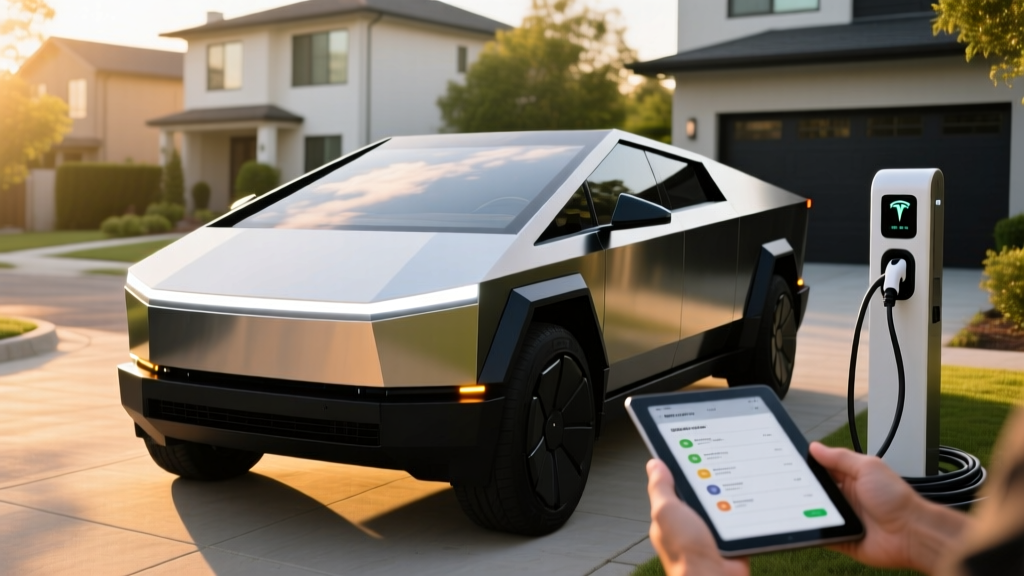
The Cybertruck's onboard charger maxes out at 11.5 kW on Level 2, which translates to roughly 44 miles of range per hour of charging. A full overnight charge (10 hours) adds approximately 340-400 miles — more than enough to replenish the battery for most daily driving.
Installation requirements:
- A dedicated 60-amp circuit with a NEMA 14-50 outlet or hardwired Tesla Wall Connector
- Most homes with a 200-amp electrical panel can accommodate this, but older homes with 100-amp service may require a panel upgrade ($1,500-$3,000)
- Total home charging installation cost: $500-$2,500 depending on panel proximity, conduit runs, and local permit requirements
Critical tip: Schedule your electrician visit before delivery day. Arriving home with a new Cybertruck and no way to charge it is a surprisingly common — and frustrating — new-owner experience.
Pricing, Trims, and Federal Tax Credit Eligibility
| Trim | Base MSRP | Destination Fee | Estimated Total | Federal §30D Credit Eligible? |
|---|---|---|---|---|
| Long Range AWD | $79,990 | $1,995 | $81,985 | No — exceeds $80,000 truck MSRP cap |
| Cyberbeast | $99,990 | $1,995 | $101,985 | No — exceeds $80,000 truck MSRP cap |
The Tax Credit Situation
Here's the hard truth that catches many reservation holders off guard: the Cybertruck does not qualify for the $7,500 federal EV tax credit under IRS §30D. The reason is straightforward — the Clean Vehicle Credit imposes an MSRP cap of $80,000 for trucks, vans, and SUVs. Both the Long Range AWD ($79,990 base, but $81,985 with destination) and the Cyberbeast ($99,990) exceed this threshold once fees are included.
Additionally, even if the MSRP fell within limits, buyers must meet IRS income caps: modified adjusted gross income cannot exceed $300,000 for joint filers, $225,000 for heads of household, or $150,000 for individual filers. Battery sourcing and critical mineral requirements also apply and shift annually.
State incentives may still apply. Several states offer their own EV rebates or tax credits that don't carry the same MSRP restrictions. Check your state's energy or DMV website for current programs — but always verify with a tax professional before relying on any incentive.
Performance, Tech, and Daily Livability
The Cybertruck's performance credentials are genuinely impressive, particularly in Cyberbeast trim. With 845 horsepower and a 2.6-second 0-60 mph time, it out-accelerates most sports cars while offering the utility of a full-size truck bed. The tri-motor setup provides exceptional traction control, and Tesla's torque vectoring makes the truck feel surprisingly agile for its size.
Standout Tech Features
- Steer-by-wire: No physical connection between the yoke and the wheels — reduces turning effort and enables the compact yoke design, but requires an adjustment period for drivers accustomed to traditional steering feedback
- 48-volt electrical architecture: A first for a production vehicle at this scale, reducing wiring harness weight and enabling more powerful accessories
- 18.5-inch center touchscreen: Runs Tesla's latest infotainment software with navigation, streaming, gaming, and vehicle controls
- Autopilot (standard): SAE Level 2 driver assistance with adaptive cruise control and lane centering. Requires constant driver supervision — this is not autonomous driving.
- Full Self-Driving (Supervised): Optional $8,000 add-on that adds automatic lane changes, intersection handling, and parking assist. Still SAE Level 2 — you must remain alert and ready to take over at all times.
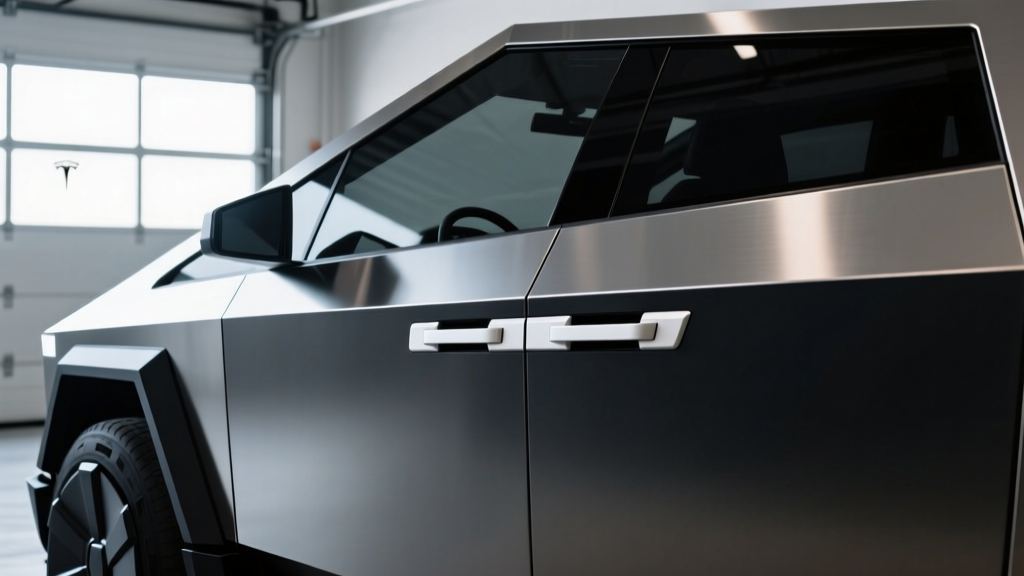
- Exoskeleton body: Ultra-hard 30X cold-rolled stainless steel panels resist dents but are prone to fingerprint smudges and are difficult to repair if damaged
- Armor glass: Improved from early production units, but replacement costs remain high if shattered
- Powershare (V2L/V2H): Vehicle-to-load capability lets you power tools, appliances, or even your home during an outage — up to 11.5 kW output
Interior Space and Practicality
The Cybertruck seats five adults, though the rear middle seat is best suited for shorter trips. Front legroom is generous at approximately 41 inches, while rear legroom comes in around 38 inches — adequate but not class-leading compared to a Ford F-150 Lightning or Rivian R1T.
The 6-foot bed is shorter than a traditional full-size truck's 6.5- or 8-foot bed, which limits what you can haul without a trailer. However, the motorized tonneau cover (standard) provides secure, lockable storage, and the bed's 2,500-pound payload capacity handles most homeowner and contractor needs. The 7-cubic-foot frunk adds weather-sealed storage for groceries or gear.
Warranty Coverage and Long-Term Battery Outlook
Tesla provides the following warranty coverage for the 2026 Cybertruck:
- Battery & Drive Unit: 8 years or 120,000 miles, whichever comes first, with minimum 70% capacity retention
- Vehicle Limited Warranty: 4 years or 50,000 miles
- Restraint System: 5 years or 60,000 miles
- Corrosion Perforation: 12 years, unlimited miles
The NMC battery pack is expected to degrade roughly 10-15% over the first 100,000 miles based on data from Tesla's Model S and Model X fleets with similar chemistry. The 123 kWh usable capacity means that at 70% retention (the warranty threshold), you'd still have approximately 86 kWh — translating to roughly 238 miles of range for the Long Range AWD.
Battery replacement cost: If out of warranty, a Cybertruck battery pack replacement is estimated at $18,000-$25,000 including labor. This is a significant long-term ownership cost to factor in if you plan to keep the truck beyond the warranty period.
Cybertruck vs. the Competition: Is It Worth It?
The electric truck segment in 2026 is competitive. Here's how the Cybertruck stacks up against its primary rivals:
| Category | Tesla Cybertruck LR AWD | Ford F-150 Lightning Ext. Range | Rivian R1T Dual Max |
|---|---|---|---|
| EPA Range | 340 mi | 320 mi | 352 mi |
| Starting MSRP | $79,990 | $69,995 | $87,000 |
| Federal Tax Credit | No | Yes (eligible trims) | Yes (eligible trims) |
| Towing | 11,000 lbs | 10,000 lbs | 11,000 lbs |
| Bed Length | 6 ft | 5.5 ft | 4.5 ft |
| Charging Network | Tesla Supercharger (native NACS) | NACS (adapter or native on newer models) | NACS (adapter included) |
| 0-60 mph | 4.1 sec | ~4.5 sec | ~3.5 sec |
Pros
- Best-in-class Supercharger network access with native NACS — no adapter friction
- Tri-motor Cyberbeast offers supercar-level acceleration in a truck form factor
- Stainless steel body is dent-resistant and requires no paint (lower repair costs for minor scrapes)
- Vehicle-to-load (Powershare) capability is among the most robust in the segment
- OTA software updates continuously add features and refinements
- Strong resale value trajectory relative to competitors
Cons
- No federal tax credit due to MSRP cap — adds $7,500 effective cost vs. competitors
- Steer-by-wire and yoke steering polarize drivers; not everyone adapts comfortably
- Shorter bed (6 ft) than traditional trucks; limits hauling without a trailer
- Stainless steel panels show fingerprints, are difficult to repair if dented, and insurance costs reflect this
- Visibility is compromised by the angular design and thick A-pillars
- Build quality inconsistencies reported by early delivery recipients; improving but still a concern
- No Apple CarPlay or Android Auto — Tesla's ecosystem is the only option
Who Should Buy the Cybertruck?
Choose the Cybertruck if:
- You're a Tesla ecosystem loyalist who values Supercharger network access and OTA updates above all else
- You want head-turning design and don't mind the attention (positive and negative) the Cybertruck attracts
- You need V2L/V2H capability for job-site power or home backup
- Performance matters to you — especially in Cyberbeast trim
- You primarily drive in urban and suburban environments where the shorter bed isn't a limitation
Look elsewhere if:
- The $7,500 federal tax credit is a deciding factor in your purchase budget (consider the F-150 Lightning)
- You need a full-size bed for frequent hauling of lumber, plywood, or motorcycles
- You prefer a traditional steering wheel and conventional driving dynamics
- Build quality consistency is a top priority (Rivian R1T has a longer production track record)
- You rely on Apple CarPlay or Android Auto for your daily driving interface
Delivery Day Checklist: Before You Drive Off
When you arrive at the Tesla delivery center, take your time with the inspection. Here's what to verify before signing:
- Panel alignment: Check all stainless steel body panels for consistent gaps. Misalignment has been a common issue — flag anything uneven before accepting delivery.
- Paint and finish: Inspect the few painted surfaces (lower trim, bed interior) for defects.
- Armor glass: Check all windows for chips, cracks, or optical distortion.
- Tonneneau cover: Open and close the motorized bed cover multiple times to ensure smooth operation.
- Software version: Confirm the truck is running the latest firmware; ask the delivery specialist to update if it's behind.
- Charging test: Plug into the delivery center's charger and verify the truck initiates a charging session before leaving.
- Autopilot calibration: Ask whether the cameras and sensors have been calibrated; this is essential for proper Autopilot function.
Frequently Asked Questions
What is the real-world range of the Tesla Cybertruck?
The EPA rates the Long Range AWD at 340 miles and the Cyberbeast at 320 miles. In real-world highway driving at 75 mph, expect 250-280 miles. In cold weather below freezing, plan for 220-260 miles. Towing a trailer reduces range to roughly 150-180 miles depending on weight and terrain.
How fast does the Cybertruck charge at home and on the road?
At home on a Level 2 charger (11.5 kW), the Cybertruck adds approximately 44 miles of range per hour, fully replenishing overnight. On DC fast charging at a Tesla Supercharger (peak 250 kW), a 10-80% session takes about 28 minutes under ideal conditions. Cold weather or lack of battery preconditioning can add 5-10 minutes.
Does the Cybertruck qualify for the $7,500 federal EV tax credit?
No. Under current IRS §30D rules, the federal Clean Vehicle Credit caps eligible trucks at an MSRP of $80,000. Both Cybertruck trims exceed this cap once destination fees are included. Additionally, buyer income limits and battery-sourcing requirements apply. State-level incentives may still be available — check your state's official energy website.
How much does the Cybertruck cost after incentives?
The Long Range AWD starts at $79,990 plus a $1,995 destination fee ($81,985 total). The Cyberbeast starts at $99,990 plus destination ($101,985 total). Neither qualifies for the federal tax credit. Adding FSD (Supervised) costs an additional $8,000. Some states offer rebates or tax credits that may reduce the effective price.
Is the Cybertruck worth buying vs. the F-150 Lightning or Rivian R1T?
It depends on your priorities. The Cybertruck wins on Supercharger network access, raw performance (Cyberbeast), and V2L capability. The F-150 Lightning wins on price, tax credit eligibility, and familiar truck ergonomics. The Rivian R1T wins on build quality, off-road capability, and interior refinement. If the Tesla ecosystem and design appeal to you, the Cybertruck is a compelling choice — but go in with eyes open about the tax credit gap and steer-by-wire learning curve.
What's the biggest surprise for new Cybertruck owners?
Most new owners report two surprises: first, the steer-by-wire system requires a genuine adaptation period of one to two weeks, especially at low speeds and in parking lots. Second, the attention the truck attracts is relentless — expect questions, thumbs-ups, and photo requests wherever you park. If you value anonymity, this is not the vehicle for you.
What should I install at home before Cybertruck delivery?
At minimum, install a 60-amp Level 2 charger — either a hardwired Tesla Wall Connector or a NEMA 14-50 outlet. Budget $500-$2,500 for installation depending on your electrical panel's location and capacity. If your home has a 100-amp panel, you may need an upgrade to 200 amps ($1,500-$3,000 additional). Have this completed before delivery day to avoid arriving home with no charging capability.