Cybertruck Safety Under the Microscope
Since deliveries began in late 2023, the Tesla Cybertruck has been one of the most polarizing vehicles on American roads. Its angular stainless-steel exoskeleton, steer-by-wire steering, and 845-horsepower tri-motor powertrain make it unlike any pickup before it. But alongside the fascination, a darker search trend has emerged: queries around "Tesla Cybertruck death" — reflecting public concern over fatal crashes, pedestrian safety, and the vehicle's structural philosophy. As of early 2026, the Cybertruck has been involved in several high-profile collisions, and its unique design raises questions that standard crash-test data hasn't fully answered yet.
This review examines what we know about Cybertruck safety — fatal incidents, structural design trade-offs, the current state of crash testing — while also delivering the complete ownership picture: real-world range, charging speeds, pricing after tax credits, and how it stacks up against the Ford F-150 Lightning and Rivian R1T.
Fatal Incidents and Safety Concerns: What the Data Shows
The Cybertruck's safety record is still maturing. With limited units on the road relative to mainstream pickups, the statistical sample is small, but several incidents have drawn national attention:
- Pedestrian and cyclist vulnerability: The Cybertruck's flat, hard stainless-steel front end and sharp leading edges have drawn criticism from safety advocates. Unlike conventional pickups with deformable bumper covers and energy-absorbing crumple zones designed to mitigate pedestrian impact, the Cybertruck's exoskeleton prioritizes occupant protection in ways that may transfer more force to vulnerable road users.
- High-speed loss-of-control incidents: The Cyberbeast variant's 2.6-second 0-60 mph time, combined with the vehicle's ~6,800-pound curb weight, creates physics challenges. Multiple reported single-vehicle crashes have involved high-speed impacts where the truck's mass and velocity overwhelmed available crumple-zone engineering.
- Steer-by-wire concerns: The Cybertruck is the first mass-market vehicle sold in the U.S. with a fully steer-by-wire system (no mechanical connection between yoke and wheels). While Tesla touts redundancy, any electronic failure mode in a steering system at speed is a serious consideration.
- Fire risk post-collision: Like all EVs with large lithium-ion packs, severe impacts can compromise the battery enclosure. The Cybertruck's 123 kWh (usable) pack sits low in the skateboard chassis, and while Tesla uses structural battery packaging, post-crash thermal events remain a known EV risk category.
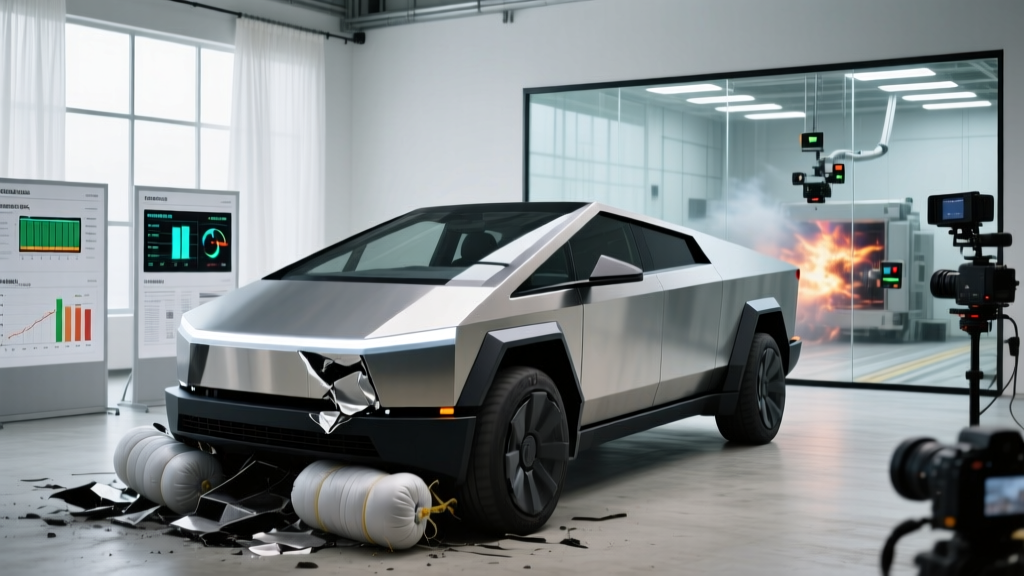
As of this writing, the National Highway Traffic Safety Administration (NHTSA) has not issued a recall specific to the Cybertruck's structural crashworthiness, but investigations into certain incidents have been opened. The Insurance Institute for Highway Safety (IIHS) has not yet published full crash-test ratings for the Cybertruck — a notable gap for a vehicle now in its third model year.
The Cybertruck has not been crash-tested by NHTSA (star ratings) or IIHS (Top Safety Pick evaluation) as of early 2026. Its stainless-steel exoskeleton and unconventional geometry make standardized testing complex. Buyers should weigh this absence of independent safety validation against the vehicle's other attributes.
Real-World Range, Efficiency, and Battery Specs
| Specification | AWD (Dual-Motor) | Cyberbeast (Tri-Motor) |
|---|---|---|
| EPA Range | 340 miles | 320 miles |
| Real-World Highway (~70 mph) | ~260-280 miles | ~245-265 miles |
| Real-World Cold Weather (30°F) | ~220-250 miles | ~210-235 miles |
| Battery (Usable) | ~123 kWh, NMC | ~123 kWh, NMC |
| Efficiency | 56 MPGe / 56 kWh/100mi | 54 MPGe / 58 kWh/100mi |
| 0-60 mph | 4.1 seconds | 2.6 seconds |
| Horsepower | 600 hp | 845 hp |
| Drivetrain | Dual-Motor AWD | Tri-Motor AWD |
| Towing Capacity | 11,000 lbs | 11,000 lbs |
The Cybertruck AWD's 340-mile EPA estimate drops to roughly 260-280 miles at sustained highway speeds (70-75 mph) due to its 6,800-lb mass and brick-like aerodynamic profile (Cd ~0.38). In freezing temperatures, expect a further 15-25% reduction as battery heating draws energy and cabin demand rises. The heat pump helps, but physics is physics — this is a heavy, tall, angular truck. Towing cuts range dramatically: plan on 150-180 miles with a 7,000-lb trailer on a flat route.
Charging Speed: DC Fast, Level 2, and the Supercharger Advantage
| Charging Method | Power | Speed (Miles Added) | Notes |
|---|---|---|---|
| DC Fast Charge (V4 Supercharger) | Peak 250 kW | ~128 miles in 15 min | 10-80% in ~30-35 min; tapers above 60% |
| DC Fast Charge (CCS via adapter) | Up to 250 kW | Similar to above | Depends on station capability |
| Level 2 (Tesla Wall Connector, 48A) | 11.5 kW | ~34 miles/hour | Full charge in ~11-12 hours |
| Level 2 (Generic J1772/NACS, 32A) | 7.7 kW | ~23 miles/hour | Full charge in ~16-17 hours |
| Level 1 (120V household) | ~1.4 kW | ~3-4 miles/hour | Not viable for daily use on 123 kWh pack |
The Cybertruck's 800-volt-class architecture enables strong DC fast-charging performance, but the massive 123 kWh battery means even at 250 kW peak, a 10-80% session takes roughly 30-35 minutes. The charge curve is aggressive: peak 250 kW holds from roughly 10-40% SoC, then steps down to ~170 kW through 60%, and further to ~80-100 kW above 70%. Preconditioning via the navigation system is essential — arriving at a Supercharger without battery preconditioning can cut peak rates by 30-50% in cool weather.
At home, the 48-amp Tesla Wall Connector on a 60-amp circuit delivers 11.5 kW, adding roughly 34 miles per hour of charging. Most owners will wake up to a full battery daily. Installation typically runs $800-$2,000 depending on panel proximity and whether a 200-amp service upgrade is needed.
Pricing, Tax Credit Eligibility, and Total Cost
| Trim | Base MSRP (2025/2026) | Est. Federal Credit (§30D) | Effective Price (if eligible) |
|---|---|---|---|
| AWD (Dual-Motor) | $79,990 | $0 (exceeds MSRP cap) | $79,990 |
| Cyberbeast (Tri-Motor) | $99,990 | $0 (exceeds MSRP cap) | $99,990 |
Critical tax-credit note: Under current IRS §30D rules, the federal EV tax credit caps eligible trucks at an $80,000 MSRP. The Cybertruck AWD at $79,990 technically sits at the threshold — but with any factory options or destination charges pushing it above $80,000, it loses eligibility. The Cyberbeast at $99,990 is firmly ineligible. Additionally, buyers must meet income caps ($150,000 single / $300,000 joint MAGI) and the vehicle must satisfy battery-component and critical-mineral sourcing requirements. Tesla's battery supply chain has shifted significantly, but buyers should verify current-year eligibility on the IRS clean vehicle credit page before assuming any credit applies.
The point-of-sale transfer option (effective 2024) allows eligible buyers to apply the credit as an immediate discount — but only if the vehicle qualifies. For the Cybertruck, most configurations will not.
Interior, Tech, and Standout Features
The Cybertruck's cabin is minimalist even by Tesla standards: an 18.5-inch center touchscreen handles nearly all vehicle functions, with a 9.4-inch rear screen for passengers. There are no physical stalks (turn signals are on the yoke), no traditional instrument cluster, and no Apple CarPlay or Android Auto. The yoke steering — paired with steer-by-wire — takes significant adaptation, particularly in parking lots and low-speed maneuvering.
Standout features:
- Stainless-steel exoskeleton: Ultra-hard 30X cold-rolled stainless steel eliminates the need for paint (though "paint protection film" wraps are popular to prevent water-spot staining).
- Armor glass: Laminated glass with polymer interlayer; more resistant to impacts than conventional auto glass, though early production units showed stress-cracking issues.
- Bioweapon Defense Mode: HEPA-grade cabin air filtration, effective in wildfire smoke zones.
- Powershare (V2L/V2H): Up to 11.5 kW of bidirectional power output — enough to run tools at a job site or provide limited home backup during outages.
- Autopilot / FSD (Supervised): Tesla's Level 2 driver-assistance suite. Requires continuous driver engagement — this is not autonomous driving.
Notable drawbacks:
- Bed access: The motorized tonneau cover and high bed sides (no traditional tailgate step on early models) make loading awkward. The "vault" bed is 6 feet long but only ~4 feet wide between wheel wells.
- Rear visibility: The sloped roofline and small rear camera mirror (replacing a traditional mirror) create significant blind spots.
- Panel gaps and build quality: Early production Cybertrucks exhibited inconsistent panel alignment; Tesla has improved this, but it remains a consideration at this price point.
- No Apple CarPlay: For a $80K-$100K vehicle, the omission frustrates many buyers accustomed to phone-mirroring.
Tesla's Full Self-Driving (Supervised) and Autopilot are Level 2 driver-assistance systems under SAE classification. The driver must remain fully engaged, hands on the yoke, eyes on the road. These systems do not make the Cybertruck self-driving. Level 4 autonomy (no driver required) exists only in geofenced robotaxi services like Waymo.
Cargo, Passenger Space, and Practicality
The Cybertruck seats five across two rows. Rear legroom measures approximately 36.5 inches — adequate but not generous for a vehicle of this exterior footprint. The rear seatback angle is fairly upright due to the bed floor sitting directly behind it.
- Bed ("Vault"): ~67 cu ft with tonneau closed; 6 ft long, ~4 ft wide between wells, 11,000-lb towing capacity.
- Frunk: ~7 cu ft — enough for a charging cable kit and a small bag.
- Interior cargo (behind rear seats): Limited; no traditional in-cabin storage cubbies beyond the center console.
- Ground clearance: Up to 17.4 inches (adaptive air suspension), competitive with off-road-oriented trucks.
Cybertruck vs. F-150 Lightning vs. Rivian R1T
| Spec | Tesla Cybertruck AWD | Ford F-150 Lightning (Ext. Range) | Rivian R1T (Dual-Motor Max) |
|---|---|---|---|
| EPA Range | 340 mi | 320 mi | 410 mi |
| Battery | 123 kWh NMC | 131 kWh NMC | 149 kWh NMC |
| Peak DC Charge | 250 kW | 150 kW | 220 kW |
| 10-80% DC Time | ~30-35 min | ~41 min | ~35-40 min |
| 0-60 mph | 4.1 sec | 3.8 sec | 3.5 sec |
| Towing | 11,000 lbs | 10,000 lbs | 11,000 lbs |
| Base MSRP | $79,990 | $69,995 | $79,900 |
| IIHS/NHTSA Rated | No | Yes (IIHS Top Safety Pick) | Yes (IIHS rated) |
| Fed. Tax Credit | Likely $0 (MSRP cap) | Up to $7,500 | Up to $7,500 (varies) |
The F-150 Lightning remains the pragmatic choice: proven crash-test credentials, a conventional truck layout familiar to contractors, lower starting price, and strong tax-credit eligibility. The Rivian R1T delivers the best real-world range (410 miles EPA with the Max Pack), a more refined interior, and genuine off-road chops with quad-motor options. The Cybertruck wins on charging speed, head-turning design, and raw Cyberbeast performance — but it loses on verified safety data, tax-credit access, and conventional truck practicality.
Warranty and Long-Term Ownership
- Basic Vehicle: 4 years / 50,000 miles
- Battery & Drive Units: 8 years / 120,000 miles (whichever comes first), with minimum 70% capacity retention over the warranty period
- Corrosion: Limited — stainless steel doesn't rust conventionally, but surface staining and fastener corrosion have been reported
Tesla's 8-year/120,000-mile battery warranty is competitive, though the 70% retention threshold means a Cybertruck with 91 kWh remaining out of 123 kWh is considered "within spec." Given the large pack size, even at 70% health, usable range would be roughly 238 miles — still functional but noticeably reduced from new.
Insurance costs for the Cybertruck run significantly higher than comparable trucks. Early quotes averaged $3,500-$5,000 annually, driven by repair-cost concerns (stainless-steel body panels require specialized techniques), high performance, and limited crash-test data. Shop multiple insurers before committing.
- Class-leading DC fast-charge speed (250 kW peak)
- Cyberbeast performance: 2.6s 0-60 in a pickup
- 11,000-lb towing, Powershare V2L/V2H capability
- Stainless-steel body: no paint to chip or fade
- Access to Tesla Supercharger network (most reliable in U.S.)
- Adaptive air suspension with up to 17.4" ground clearance
- No NHTSA or IIHS crash-test ratings (as of 2026)
- Federal tax credit ineligible at most trims (MSRP cap)
- Real-world highway range ~260 mi, far below EPA 340 mi
- Steer-by-wire and yoke require significant adaptation
- High insurance premiums ($3,500-$5,000/yr average)
- Pedestrian safety concerns with rigid front-end design
- Build-quality inconsistencies persist at this price point
Who Should (and Shouldn't) Buy the Cybertruck
Choose the Cybertruck if: You prioritize charging speed, want head-turning design, need V2L/V2H capability for job sites or backup power, and accept the safety-data gap and high insurance costs. The Cyberbeast variant suits performance enthusiasts who want supercar acceleration in a truck.
Choose the F-150 Lightning or Rivian R1T if: Verified crash-test safety is a priority, you want federal tax-credit eligibility, you need conventional truck ergonomics, or you regularly carry rear-seat passengers who need more legroom and a traditional cabin layout.
Frequently Asked Questions
Has the Tesla Cybertruck been involved in fatal accidents?
Yes. The Cybertruck has been involved in multiple reported crashes since late 2023, including incidents resulting in serious injuries and fatalities. The combination of high performance (845 hp in Cyberbeast), heavy curb weight (~6,800 lbs), and the vehicle's rigid stainless-steel structure contribute to crash dynamics that differ from conventional pickups. NHTSA has opened investigations into certain incidents.
Is the Cybertruck safe for pedestrians?
This is an active area of concern. The Cybertruck's flat, angular stainless-steel front end lacks the deformable structures and rounded edges that modern vehicles use to mitigate pedestrian injuries. Independent safety researchers have flagged the design as potentially more dangerous to pedestrians and cyclists than conventional truck designs. No official pedestrian-safety rating exists for the U.S. market.
Does the Cybertruck qualify for the $7,500 federal EV tax credit?
Almost certainly not. The IRS §30D credit caps eligible trucks at $80,000 MSRP. The Cybertruck AWD starts at $79,990, but any options or destination charges push it over the cap. The Cyberbeast at $99,990 is well above the threshold. Additionally, buyers must meet income limits and battery-sourcing requirements. Verify current eligibility at irs.gov.
What is the real-world range of the Cybertruck?
Expect roughly 260-280 miles on the highway for the AWD variant (EPA 340 mi), and 245-265 miles for the Cyberbeast. Cold weather (below freezing) reduces these figures by 15-25%. Towing cuts range to 150-180 miles depending on trailer weight and terrain.
How fast does the Cybertruck charge at home and on the road?
At a V4 Supercharger, it peaks at 250 kW and charges 10-80% in approximately 30-35 minutes. At home on a 48-amp Level 2 Wall Connector (11.5 kW), it adds ~34 miles per hour, fully charging overnight in ~11-12 hours.
Is the Cybertruck worth buying over the F-150 Lightning or Rivian R1T?
It depends on your priorities. The Lightning offers lower pricing, verified safety ratings, and tax-credit eligibility. The R1T delivers the longest range and a more refined interior. The Cybertruck wins on charging speed, Supercharger network access, and performance — but its lack of crash-test data and high ownership costs are meaningful trade-offs.