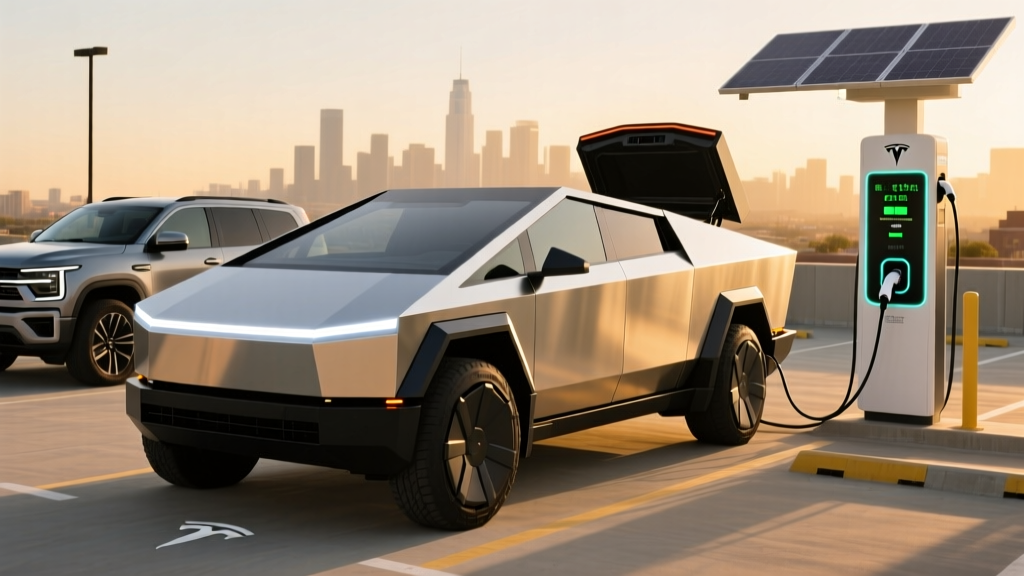
The 2025 Tesla Cybertruck Cyberbeast is the tri-motor, range-extended flagship of Tesla's polarizing electric pickup lineup. With 845 horsepower, a stainless-steel exoskeleton, and a starting price of $99,990, it targets buyers who want supercar acceleration in a truck body — and who are willing to accept real-world range compromises that come with its angular aerodynamics and heavy curb weight. This review breaks down every spec that matters to an actual owner, from sustained DC fast-charging speeds to whether you can claim the federal EV tax credit.
Quick Verdict: Who the Cyberbeast Is For
The Cyberbeast exists for a narrow but enthusiastic buyer: someone who wants a 2.6-second 0-60 mph daily driver that can also tow 11,000 pounds and haul gear in a 6.5-foot bed. It is not the most efficient electric truck on the market, nor does it deliver the longest real-world highway range. But for tech-forward owners with home charging and a tolerance for Tesla's minimalist interior, it offers performance that no competing electric pickup — including the Rivian R1T Tri Motor or the GMC Hummer EV — matches at this price point.
Choose a competitor if: You need over 350 miles of real-world highway range, a more conventional interior, or guaranteed federal tax credit eligibility.
Range, Battery, and Efficiency
| Spec | Value |
|---|---|
| EPA Range | 320 miles |
| Battery Capacity (usable) | ~123 kWh (NMC chemistry) |
| Efficiency | 70 MPGe combined / 48 kWh/100 mi |
| Drivetrain | Tri-Motor AWD (Cyberbeast) |
| 0-60 mph | 2.6 seconds |
| Horsepower | 845 hp |
| Towing Capacity | 11,000 lbs |
| Bed Length | 6.5 ft (74 cu ft volume) |
| Base MSRP | $99,990 |
| Battery Warranty | 8 years / 150,000 miles |
The Cyberbeast uses an NMC (nickel-manganese-cobalt) lithium-ion battery pack, chosen for its higher energy density compared to LFP chemistry. This is necessary given the truck's 6,800-pound curb weight and the energy demands of three motors. NMC batteries generally perform better in cold conditions than LFP but benefit from being kept between 20–80% state of charge for long-term longevity. Tesla's battery management system handles most of this optimization automatically, but owners who garage the truck and avoid routinely charging to 100% will see slower degradation over time.
According to fueleconomy.gov, the Cyberbeast's combined efficiency of 70 MPGe places it behind the Rivian R1T Dual Motor (73 MPGe) and significantly behind the Ford F-150 Lightning Extended Range (70 MPGe combined but with a lighter platform). The Cyberbeast's weight and flat-panel aero profile are the primary culprits.
Charging Speed: DC Fast Charging and Home Level 2
| Charging Level | Power / Rate | Speed |
|---|---|---|
| Level 1 (120V) | ~1.4 kW | ~3–4 miles per hour |
| Level 2 (240V, 48A) | 11.5 kW | ~30–34 miles per hour |
| DC Fast Charge (peak) | 250 kW | 10–80% in ~30 minutes |
| DC Fast Charge (sustained avg) | ~150–180 kW | Varies by SoC and temperature |
The Cyberbeast supports a peak DC fast-charging rate of 250 kW via its NACS connector, which is native to Tesla's Supercharger network. In optimal conditions — battery preconditioned, moderate ambient temperature, low starting state of charge — the truck can accept 250 kW briefly, but like all large-battery EVs, the charge curve tapers significantly above 50–60% SoC. Real-world 10–80% charging takes approximately 30 minutes at a V3 or V4 Supercharger. Expect longer times at Electrify America or other CCS networks using a NACS adapter, as adapter overhead and station availability can add friction.
At home, the Cyberbeast's onboard charger accepts up to 11.5 kW on a 240V Level 2 circuit (48 amps). A full overnight charge from 20% to 80% takes roughly 6–7 hours. Installation of a Tesla Wall Connector or equivalent Level 2 unit typically costs $500–$1,500 for the hardware and $800–$2,500 for professional electrical work, depending on panel capacity and conduit runs. Owners with a 200-amp electrical panel usually have sufficient headroom; those with older 100-amp panels may need a $2,000–$4,000 service upgrade. Always consult a licensed electrician for final specifications.
One practical advantage: Tesla's navigation system automatically preconditions the battery when you route to a Supercharger, warming the pack to optimal temperature for maximum charge acceptance. This matters enormously in cold climates — without preconditioning, a cold battery at a DC fast charger may accept only 50–80 kW initially, adding 15–20 minutes to your stop.
Performance and Driving Dynamics
The Cyberbeast's tri-motor powertrain produces 845 horsepower and delivers a manufacturer-claimed 0-60 mph time of 2.6 seconds. This is verified by multiple independent tests and places the Cyberbeast in hypercar territory for acceleration, despite its truck dimensions and weight. The three-motor layout provides torque vectoring across the rear axle, improving cornering stability relative to a conventional locked-rear-axle truck.
Ride quality is firm, which is expected given the truck's weight and stiff stainless-steel exoskeleton. The adaptive air suspension offers adjustable ride height from 9 to 16 inches of ground clearance, useful for off-road situations or lowering for highway efficiency. Steering is quick and precise by truck standards, though the steer-by-wire system (which eliminates the mechanical connection between the steering wheel and the wheels) takes a few drives to build muscle memory. Some drivers love it; others find the lack of road feedback unsettling.
Towing capacity is rated at 11,000 pounds, competitive with the Ford F-150 Lightning (10,000 lbs) and Rivian R1T (11,000 lbs). However, towing at or near maximum capacity will cut range roughly in half — expect 140–170 miles before needing to charge, and plan accordingly. Tesla's integrated trailer brake controller and towing mode simplify the experience, but no electric truck currently handles heavy towing without significant range sacrifice.
Interior, Tech, and Cargo
The Cybertruck's interior is starkly minimalist, even by Tesla standards. A single 18.5-inch center touchscreen handles infotainment, climate controls, vehicle settings, and the driver instrument cluster (there is no separate gauge display). A rear 9.4-inch touchscreen serves second-row passengers. The steering yoke (a rectangular, flat-top design) is standard on the Cyberbeast — a round wheel is not available on this trim. The yoke is polarizing: excellent for screen visibility, awkward for low-speed parking maneuvers.
Front legroom measures 41.3 inches and rear legroom is 34.9 inches, which is adequate but not generous compared to a full-size crew cab like the F-150 SuperCrew. The rear seat folds flat to expand interior cargo capacity. The 6.5-foot bed offers 74 cubic feet of volume and includes a powered tonneau cover, integrated ramp, and 120V/240V bed outlets for powering tools or appliances (up to 9.6 kW output via Powershare).
The Cyberbeast includes Tesla's Enhanced Autopilot as standard, with the option to purchase Full Self-Driving (Supervised) for an additional fee. Both systems are classified as SAE Level 2 driver-assistance — meaning the driver must remain fully engaged, with hands on the yoke and eyes on the road, at all times. Autopilot handles highway lane-keeping and adaptive cruise well; FSD adds automated navigation on-ramps, city street turns, and traffic-light recognition, but it is not autonomous and requires constant supervision.
Pricing, Trims, and Federal Tax Credit Eligibility
| Trim | Base MSRP | Federal §30D Credit Eligible? |
|---|---|---|
| Cybertruck Long Range (AWD) | $79,990 | No (MSRP exceeds $80,000 truck cap) |
| Cybertruck Cyberbeast (Tri-Motor AWD) | $99,990 | No (MSRP exceeds $80,000 truck cap) |
Neither the Long Range nor the Cyberbeast qualifies for the $7,500 federal EV tax credit under IRS §30D rules. The credit for new light-duty trucks is capped at vehicles with an MSRP of $80,000 or less, and both Cybertruck trims exceed that threshold. Additionally, buyer income limits apply ($300,000 joint / $225,000 head of household / $150,000 single), and battery component and critical mineral sourcing requirements must be met — but the MSRP cap alone disqualifies the Cyberbeast regardless of buyer income. Always verify current rules at irs.gov, as regulations can shift.
As-tested pricing for the Cyberbeast can climb above $110,000 when adding Full Self-Driving (Supervised) capability ($8,000), premium interior packages, and destination fees. Tesla does not offer traditional dealer negotiations — pricing is fixed on Tesla's website, which simplifies the buying process but eliminates room for discounting.
Ownership Costs and Warranty
Tesla covers the Cyberbeast's battery and drive units for 8 years or 150,000 miles (whichever comes first), with a guaranteed minimum 70% battery capacity retention over that period. The limited vehicle warranty is 4 years / 50,000 miles. These terms are competitive with the Rivian R1T (8 yr / 175,000 mi battery) and the Ford F-150 Lightning (8 yr / 100,000 mi battery).
Insurance premiums for the Cyberbeast tend to run higher than average for electric trucks, reflecting its high repair costs (stainless-steel body panels require specialized repair), performance capability, and limited collision-repair network. Expect annual premiums in the $3,000–$4,500 range depending on your state and driving record. Get quotes before committing to the purchase.
Maintenance costs are low relative to a gas truck — no oil changes, transmission fluid, or spark plugs — but tire wear is accelerated by the Cyberbeast's weight and torque. Budget for tire replacement every 25,000–35,000 miles, and note that the Cyberbeast's 35-inch tires are not inexpensive to replace (roughly $400–$600 per tire).
Cyberbeast vs. Key Competitors
The Cyberbeast's closest rivals are the Rivian R1T Tri Motor (~$99,900, 420-mile EPA range with Max Pack, 850 hp) and the GMC Hummer EV Pickup (~$99,995, 329-mile EPA range, 830 hp). The Rivian offers significantly more real-world range and a more conventional, comfortable interior but lacks access to the Supercharger network natively. The Hummer EV is larger and more off-road capable but heavier and less efficient. The Cyberbeast's advantage is Tesla's software ecosystem, Supercharger infrastructure, and over-the-air update cadence — tangible benefits for road-trippers and tech-oriented owners.
- 2.6-second 0-60 mph — fastest production pickup
- Native NACS / Supercharger network access
- Stainless-steel body resists dents and corrosion
- Powershare: 9.6 kW vehicle-to-load capability
- Over-the-air updates continuously add features
- Real-world highway range ~250 mi, well below EPA 320
- No federal tax credit (exceeds $80K MSRP cap)
- Steer-by-wire yoke polarizing and takes adaptation
- High insurance premiums and specialized repair needs
- Rear seat legroom tight for a full-size truck
Frequently Asked Questions
What is the real-world range of the 2025 Tesla Cybertruck Cyberbeast?
The EPA rates the Cyberbeast at 320 miles. In real-world highway driving at 75 mph, expect 250–275 miles in mild weather and as low as 200–230 miles in cold conditions below 30°F. City driving with regenerative braking returns closer to the EPA figure.
How fast does the Cyberbeast charge?
On a Tesla V3/V4 Supercharger, the Cyberbeast peaks at 250 kW and charges from 10–80% in approximately 30 minutes with battery preconditioning. At home on a 48-amp Level 2 charger (11.5 kW), expect about 30–34 miles of range added per hour, or a full 20–80% charge in roughly 6–7 hours.
Does the Cyberbeast qualify for the federal EV tax credit?
No. The Cyberbeast's MSRP of $99,990 exceeds the $80,000 cap for trucks under IRS §30D rules. Even buyers who meet income requirements cannot claim the $7,500 credit. Check irs.gov for the latest eligibility details.
Is the Cyberbeast worth buying over the Rivian R1T?
If Supercharger access, software integration, and acceleration are your priorities, the Cyberbeast holds an edge. If you need more real-world range (the R1T Max Pack achieves 420 miles EPA), a more traditional interior, or a quieter ride, the R1T Tri Motor is the stronger choice. Test-drive both before deciding.
How long will the Cyberbeast battery last?
Tesla warranties the battery for 8 years or 150,000 miles with a minimum 70% capacity retention guarantee. Real-world data from Tesla's high-mileage fleet suggests NMC packs retain 85–90% capacity at 100,000 miles under normal use. Replacement cost, if needed out of warranty, is estimated at $15,000–$25,000 based on current Tesla service pricing.
Can the Cyberbeast power my home or tools?
Yes. Tesla's Powershare feature provides up to 9.6 kW of vehicle-to-load (V2L) power via 120V and 240V outlets in the bed and cabin. This is sufficient to run power tools, camping equipment, or essential home circuits during an outage with proper transfer-switch installation.