The Safety Question Hovering Over the Cybertruck
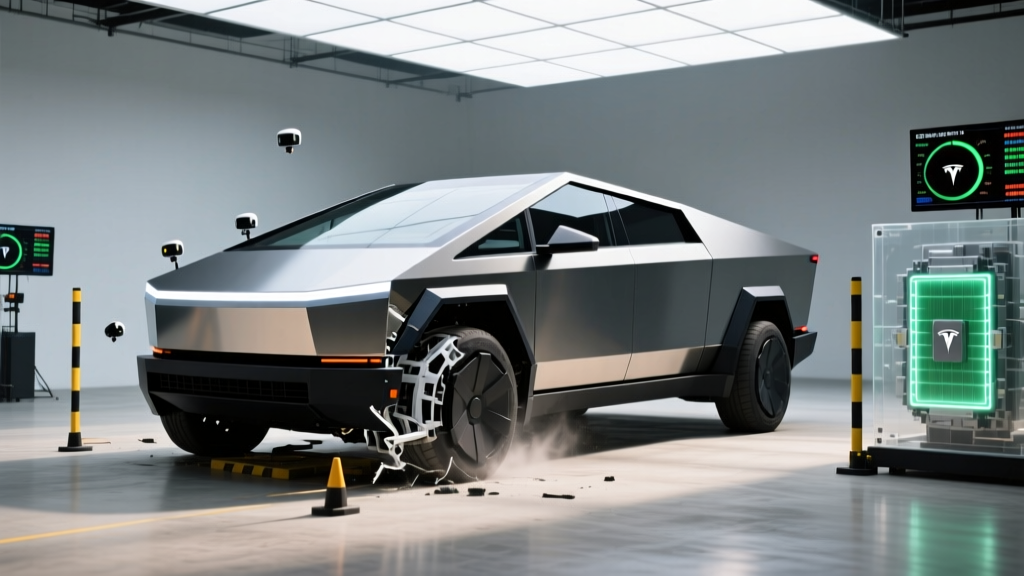
The Tesla Cybertruck's polarizing stainless-steel exoskeleton was marketed as virtually indestructible — but marketing demos involving sledgehammers and handgun rounds don't substitute for standardized crash testing. For buyers researching a Tesla Cybertruck crash test profile before committing to a $80,000-plus electric pickup, the distinction matters enormously. As of early 2026, the Cybertruck occupies a frustrating middle ground: NHTSA has not published a full 5-star safety rating for the vehicle, and the IIHS has not yet completed its comprehensive evaluation protocol. What we do have are structural engineering details, partial data, Tesla's own safety claims, and enough real-world incident footage to draw some informed conclusions.
This review covers everything a prospective buyer needs: the available crash-safety picture, real-world range and charging behavior, pricing after federal tax credits, and whether the Cybertruck earns a spot in your garage versus a Ford F-150 Lightning or Rivian R1T.
Crash Test Status: What NHTSA and IIHS Have (and Haven't) Published
The National Highway Traffic Safety Administration (NHTSA) conducts frontal, side, and rollover crash tests and assigns an overall 1-to-5-star rating. As of the 2026 model year, the Cybertruck has not received a full NHTSA rating. NHTSA's database lists the vehicle but shows no completed crash-test results — a situation not uncommon for low-volume or newly introduced platforms, though the Cybertruck has been in customer hands since late 2023.
The Insurance Institute for Highway Safety (IIHS) similarly has not published a complete evaluation. IIHS testing is more rigorous in areas like the updated moderate overlap front test (which now evaluates rear-seat occupant protection) and pedestrian front-end geometry — both areas where the Cybertruck's blunt, angular nose could face challenges.
What Tesla Claims About Structural Safety
Tesla engineered the Cybertruck around a cold-rolled stainless-steel exoskeleton (up to 3mm thick in certain panels) mounted on a unibody architecture rather than a traditional body-on-frame layout. The company claims this structure provides exceptional occupant-cell rigidity. Tesla has pointed to internal sled testing and computer simulations showing favorable intrusion metrics, but these are not independently verified substitutes for NHTSA or IIHS physical crash tests.
The angular front-end geometry also raises pedestrian-safety questions. IIHS has increasingly weighted pedestrian protection in its Top Safety Pick criteria, and the Cybertruck's flat, vertical leading edge presents a larger, harder impact surface than the sloped hoods of conventional pickups.
Active Safety and Driver Assistance
Every Cybertruck ships with Tesla's Autopilot suite as standard, which includes automatic emergency braking, lane-departure warning, lane-keeping assist, and adaptive cruise control. This is a SAE Level 2 driver-assistance system — the driver must remain fully engaged and supervise at all times. It is not autonomous driving.
Full Self-Driving (Supervised) is available as a $8,000 add-on or $99/month subscription and adds features like automatic lane changes, traffic-light recognition, and city-street navigation. However, FSD's safety record remains under ongoing NHTSA scrutiny, including investigations into crashes involving Tesla vehicles operating under Autopilot/FSD.
Range, Efficiency, and Real-World Expectations
The Cybertruck is offered in three configurations for 2026: the base Rear-Wheel-Drive (slated for 2026 production), the Dual Motor All-Wheel Drive, and the tri-motor Cyberbeast. Range varies significantly by trim.
| Spec | Dual Motor AWD | Cyberbeast (Tri-Motor) |
|---|---|---|
| EPA Range | 340 miles | 320 miles |
| Battery (usable) | ~123 kWh (NMC) | ~123 kWh (NMC) |
| MPGe (combined) | ~70 MPGe | ~65 MPGe |
| kWh/100 mi | ~48 | ~52 |
| 0-60 mph | 3.9 seconds | 2.6 seconds |
| Horsepower | 600 hp | 845 hp |
| Drivetrain | Dual Motor AWD | Tri-Motor AWD |
| Towing Capacity | 11,000 lbs | 11,000 lbs |
The Cybertruck's 48–52 kWh/100 mi consumption is notably thirstier than the Ford F-150 Lightning Extended Range (~48 kWh/100 mi combined) and far less efficient than a sedan like the Tesla Model S (~28 kWh/100 mi). The stainless-steel body is heavy (curb weight exceeds 6,600 lbs for the Cyberbeast), and the angular shape creates substantial drag at highway speeds.
Charging Speed: DC Fast Charge and Home Level 2
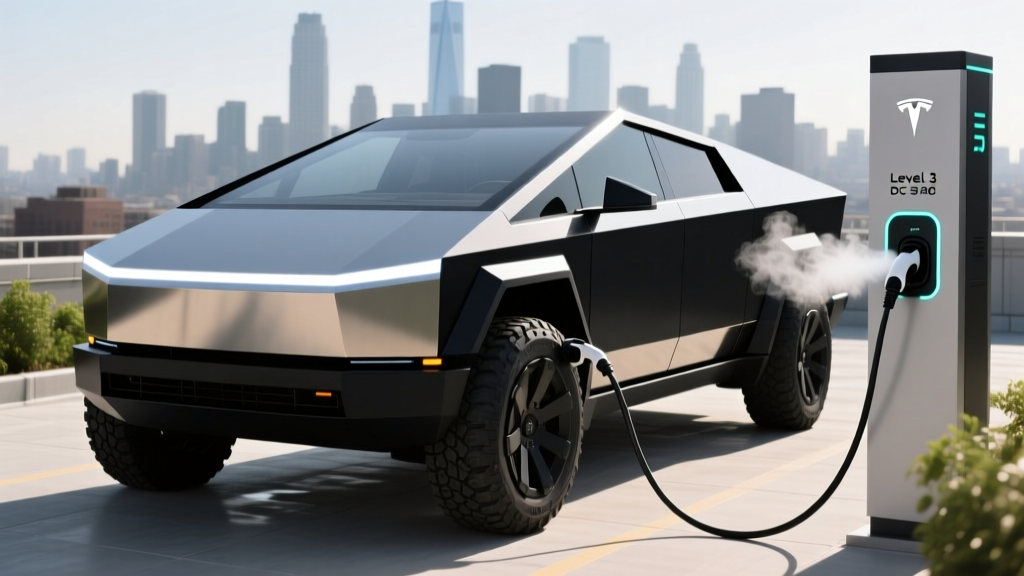
The Cybertruck uses an 800-volt architecture, which enables strong DC fast-charging performance — though, as with all EVs, peak kW is not sustained across the entire session.
| Charging Level | Power / Rate | Speed |
|---|---|---|
| Level 1 (120V household) | ~1.4 kW | ~3 miles/hour |
| Level 2 (240V home, 48A) | 11.5 kW | ~23 miles/hour (~13 hrs 10–100%) |
| DC Fast Charge (peak) | Up to 350 kW | 10–80% in ~15–17 minutes (V4 Supercharger) |
Charging-curve reality: The Cybertruck can peak near 350 kW on Tesla's V4 Supercharger cabinets, but sustained rates taper significantly above 50% state of charge. Expect an average rate closer to 150–180 kW across a full 10–80% session, which still translates to a competitive ~15–17 minute wait. On non-Tesla 350 kW chargers (with a NACS adapter or at stations that now natively support NACS), performance depends on the station's actual power delivery and the Cybertruck's preconditioning state.
Preconditioning matters. Navigate to a Supercharger using the built-in navigation and the Cybertruck will warm or cool its battery pack en route, ensuring you hit peak charge rates on arrival. Skipping preconditioning (e.g., driving to a charger without nav routing) can add several minutes to your session, particularly in cold weather.
At home on a 48-amp Level 2 Wall Connector, the 11.5 kW charge rate adds roughly 23 miles per hour. A full overnight charge (8 hours) restores approximately 180 miles — sufficient for most daily driving but not enough to fully replenish the massive ~123 kWh pack from empty. Plan for 12–14 hours for a complete 0–100% home charge.
Pricing, Trims, and Federal Tax Credit Eligibility
The Cybertruck's pricing has shifted since its 2023 unveiling, and the federal tax-credit picture is complicated by the truck's MSRP and IRS §30D sourcing rules.
| Trim | Base MSRP | §30D Credit Eligible? | Effective Price (est.) |
|---|---|---|---|
| Rear-Wheel Drive | ~$60,990 | Potentially (under $80K cap) | ~$53,490* |
| Dual Motor AWD | ~$79,990 | Borderline (at $80K cap) | ~$72,490* |
| Cyberbeast | ~$99,990 | No (exceeds $80K MSRP cap) | $99,990 |
*Effective price assumes full $7,500 §30D credit eligibility. Actual eligibility depends on buyer income, battery component sourcing, and critical-mineral requirements.
- MSRP cap: Pickup trucks must have an MSRP at or below $80,000 (the Cyberbeast at ~$99,990 is disqualified).
- Buyer income cap: Modified AGI must not exceed $150,000 (single), $225,000 (head of household), or $300,000 (joint).
- Battery sourcing: Increasingly strict percentages of battery components must be manufactured or assembled in North America, and critical minerals must be sourced from the U.S. or free-trade-agreement partners.
- Point-of-sale transfer: Eligible buyers can transfer the credit to the dealer for an immediate price reduction at purchase.
Consult the IRS clean vehicle credit page and a tax professional before assuming eligibility. Rules tighten annually.
Interior, Cargo, Technology, and Drawbacks
The Cybertruck seats five across two rows. Rear-seat legroom measures approximately 38 inches — adequate for adults but not class-leading compared to a crew-cab F-150 Lightning (43.6 inches rear legroom). The vault (bed) measures 6 feet long with the tailgate up and offers 67 cubic feet of lockable storage. The front trunk (frunk) provides an additional ~7 cubic feet.
Technology highlights include:
- 18.5-inch center touchscreen running Tesla's latest infotainment software
- Rear-seat 9.4-inch touchscreen for passengers
- 15-speaker premium audio system
- Powered tonneau cover with integrated bed lighting
- 120V and 240V bed outlets (PowerShare) for job-site or camping use
- Steer-by-wire system with four-wheel steering (rear wheels turn up to 10 degrees for a tight 34-foot turning circle)
- Adaptive air suspension with up to 16 inches of ground clearance in Extract mode
Notable drawbacks:
- The steer-by-wire system requires an adjustment period — there is no mechanical connection between the yoke and the wheels, and feedback feels synthetic to many drivers.
- The yoke-style steering wheel (standard, no round-wheel option) is controversial, especially for low-speed maneuvers and parking despite the variable-ratio rack.
- Visibility is compromised by the thick A-pillars, small rear window, and bed-mounted camera dependency for rearward sightlines.
- Panel-gap inconsistency and early-build quality issues have been widely documented by owners and reviewers.
- The stainless-steel exterior shows fingerprints and smudges constantly and is difficult to repair if dented.
Ownership: Warranty, Insurance, and Total Cost
Tesla covers the Cybertruck with a 4-year/50,000-mile basic warranty and an 8-year/120,000-mile battery and drive-unit warranty. The battery warranty guarantees retention of at least 70% of original capacity during the coverage period — consistent with industry norms but worth noting given the Cybertruck's large, expensive NMC pack.
Insurance premiums for the Cybertruck run significantly higher than average. Early owner reports and insurance-agency data place annual premiums in the $3,500–$5,500 range depending on state, driving record, and coverage level. The stainless-steel body's repair complexity, high replacement-part costs, and the vehicle's performance profile all contribute. Get quotes before purchasing — insurance can add $2,000+ per year versus a conventional pickup.
Charging costs vary by region and method. At the national average residential electricity rate of ~$0.17/kWh, fully charging the ~123 kWh pack at home costs roughly $21. At DC fast-charger rates of $0.35–$0.50/kWh, a 10–80% session costs approximately $30–$43. For a driver covering 12,000 miles annually at the Cybertruck's ~50 kWh/100 mi consumption, annual electricity costs run approximately $1,020 (home charging) to $2,400–$3,000 (primarily public fast charging).
Who Should Buy the Cybertruck — and Who Shouldn't
- You want a distinctive, high-performance electric pickup with strong towing capability (11,000 lbs).
- You have reliable home Level 2 charging and mostly drive under 250 miles daily.
- You value Tesla's Supercharger network access and over-the-air update ecosystem.
- The steer-by-wire system and yoke appeal to you rather than concern you.
- Verified crash-test ratings are a non-negotiable for your purchase decision (look at the F-150 Lightning, which has earned IIHS Top Safety Pick+ status).
- You regularly drive 300+ miles in cold weather or tow long distances where real-world range drops below 200 miles.
- You need a conventional steering wheel, easy repairability, or lower insurance costs.
- You want a proven work truck with fleet-service infrastructure — Rivian R1T and F-150 Lightning have more established service networks.
- Tri-motor Cyberbeast delivers supercar-level 2.6-second 0-60
- Up to 350 kW DC fast charging; 10–80% in ~15–17 min
- 11,000-lb towing capacity
- Four-wheel steer-by-wire gives a remarkably tight turning circle
- Tesla Supercharger network reliability
- Lockable 6-foot vault with 240V outlet
- No NHTSA or IIHS crash-test ratings published
- Real-world highway range falls 15–25% below EPA sticker
- High insurance premiums ($3,500–$5,500/yr)
- Steep price — Cyberbeast ineligible for §30D credit
- Yoke and steer-by-wire polarize drivers
- Build-quality inconsistencies reported
- Poor efficiency (~50 kWh/100 mi) raises charging costs
Frequently Asked Questions
Has the Tesla Cybertruck been crash tested by NHTSA or IIHS?
As of early 2026, neither NHTSA nor IIHS has published full crash-test ratings for the Cybertruck. NHTSA lists the vehicle but has not released star ratings, and IIHS has not completed its evaluation protocol. This is a significant data gap for safety-conscious buyers.
What is the real-world range of the Tesla Cybertruck?
The EPA rates the Dual Motor AWD at 340 miles and the Cyberbeast at 320 miles. Real-world highway driving at 70–80 mph typically yields 260–290 miles for the Dual Motor and 245–270 miles for the Cyberbeast. Cold weather can reduce range an additional 15–25%, dropping winter highway range to roughly 200–240 miles.
How fast does the Cybertruck charge?
On a Tesla V4 Supercharger, the Cybertruck peaks near 350 kW and charges from 10–80% in approximately 15–17 minutes with proper battery preconditioning. At home on a 48-amp Level 2 charger, it adds about 23 miles per hour (11.5 kW), requiring 12–14 hours for a full charge.
Does the Cybertruck qualify for the $7,500 federal EV tax credit?
It depends on the trim and your situation. The base Rear-Wheel Drive (~$60,990) falls under the $80,000 MSRP cap for pickups. The Dual Motor AWD (~$79,990) is borderline. The Cyberbeast (~$99,990) exceeds the cap and is ineligible. You must also meet IRS income caps ($150K single / $300K joint) and the vehicle must satisfy battery-sourcing requirements. Verify current rules at IRS.gov and consult a tax professional.
Is the Cybertruck worth buying over the F-150 Lightning or Rivian R1T?
The Cybertruck excels in acceleration, fast-charging speed, and Tesla's software ecosystem. However, the F-150 Lightning offers verified IIHS Top Safety Pick+ ratings, a more conventional driving experience, greater rear-seat space, and a broader dealer-service network. The Rivian R1T provides a more refined interior, quad-motor performance, and adventure-oriented features. If crash-test validation and traditional truck ergonomics matter most, the Lightning or R1T may be stronger choices.
What is the Cybertruck's battery chemistry and warranty?
The Cybertruck uses an NMC (nickel-manganese-cobalt) lithium-ion battery pack with approximately 123 kWh of usable capacity. Tesla covers the battery and drive unit for 8 years or 120,000 miles, whichever comes first, guaranteeing at least 70% capacity retention during that period.