The Contractor's Electric Pickup: Does the Cybertruck Fit the Bill?
Searches for tesla contractors parking have surged as tradespeople, fleet managers, and independent contractors weigh whether Tesla's angular stainless-steel pickup can survive the daily grind of jobsite staging areas, tight urban parking structures, and long highway commutes between client locations. The 2026 Tesla Cybertruck is unlike any work truck on the road — for better and for worse. This review dissects the specs, charging logistics, bed utility, and ownership economics that matter most to professionals who need a truck to earn money, not just make a statement.
| Spec | AWD (Dual-Motor) | Cyberbeast (Tri-Motor) |
|---|---|---|
| EPA Range | 340 miles | 320 miles |
| Battery (usable) | ~123 kWh (NMC) | ~123 kWh (NMC) |
| Peak DC Fast Charge | 250 kW | 250 kW |
| 10–80% DC Charge Time | ~28 min | ~28 min |
| Level 2 Home Charge (max) | 11.5 kW (~37 mi/hr) | 11.5 kW (~37 mi/hr) |
| 0–60 mph | 4.1 sec | 2.6 sec |
| Horsepower | 600 hp | 845 hp |
| Drivetrain | Dual-Motor AWD | Tri-Motor AWD |
| Towing Capacity | 11,000 lbs | 11,000 lbs |
| Payload Capacity | 2,500 lbs | 2,500 lbs |
| Bed Length | 6 ft (72 in) | 6 ft (72 in) |
| Bed Width (between wells) | ~48 in | ~48 in |
| MPGe (combined) | 79 MPGe | 76 MPGe |
| Base MSRP | $79,990 | $99,990 |
Source: fueleconomy.gov, Tesla specifications.
Real-World Range: What Contractors Actually Get on the Road
EPA Estimated Range: 340 miles (AWD) / 320 miles (Cyberbeast)
Real-World Expectation: Expect 260–290 miles at sustained 75 mph highway speeds; 220–250 miles in freezing weather with cabin heat; 290–320 miles in mixed city/suburban driving at moderate speeds.
The Cybertruck's ~123 kWh usable NMC (nickel manganese cobalt) battery pack is one of the largest in any consumer EV, and it needs to be — the truck's 6,800-pound curb weight and brick-like aerodynamic profile (despite the angular "low-drag" marketing) consume energy quickly at highway speed. On a 250-mile round-trip between a suburban office and a rural jobsite, an AWD Cybertruck in mild weather will return with roughly 15–20% state of charge remaining, which is comfortable. Load the 6-foot bed with 1,500 pounds of tools and lumber, add a roof rack or ladder rack, and that buffer shrinks by another 5–8%.
For contractors who drive primarily in city and suburban stop-and-go traffic — plumbers, electricians, HVAC techs making multiple local calls — regenerative braking recovers significant energy, and real-world efficiency often beats the EPA sticker. The Cybertruck's efficiency of roughly 47–49 kWh/100 miles (combined) is poor by EV sedan standards but competitive for a full-size electric pickup. For context, the Rivian R1T achieves approximately 42–48 kWh/100 miles depending on configuration.
Charging Speed: Jobsite Downtime and Depot Logistics
| Charging Level | Power (kW) | Miles Added per Hour | Notes |
|---|---|---|---|
| Level 1 (120V standard outlet) | ~1.4 kW | ~4–5 mi/hr | Emergency/trickle only; impractical for daily use |
| Level 2 (240V, 48A Wall Connector) | 11.5 kW | ~37 mi/hr | Full charge in ~10–11 hours; ideal overnight at depot |
| Level 2 (240V, 32A mobile connector) | 7.7 kW | ~25 mi/hr | Slower; good for NEMA 14-50 outlets on jobsites |
| DC Fast Charge (V3 Supercharger) | 250 kW peak | ~180 mi in 15 min | 10–80% in ~28 min; tapers significantly above 80% |
| DC Fast Charge (CCS via adapter) | ~150–175 kW typical | Varies | Non-Tesla networks; adapter included with new trucks |
For a contractor, the charging question is really two questions: Can I charge overnight at my home or depot? and How long am I stuck at a fast charger mid-workday if I need a top-up?
Overnight Level 2 charging is the backbone of electric truck ownership. A Tesla Wall Connector on a 60-amp circuit delivers 11.5 kW, adding roughly 37 miles of range per hour. A Cybertruck arriving home at 20% state of charge will be back to 90% by morning — approximately 10 hours. Contractors with a dedicated garage or fleet yard can install a Wall Connector for roughly $500–$800 (equipment) plus $800–$2,500 for electrician labor, depending on panel capacity and run distance. A 200-amp home panel is usually sufficient; a 100-amp panel may require an upgrade ($1,500–$3,500).
For mid-day fast charging, Tesla's Supercharger network remains the most reliable option. At a V3 Supercharger (250 kW), the Cybertruck peaks near 250 kW at low state of charge but tapers to roughly 100 kW by 60% and drops further above 80%. A 10–80% session takes approximately 28 minutes — enough time for a lunch break, but not a quick gas-station-style stop. Contractors who can schedule a fast-charge during a planned break (supply house run, client lunch) can integrate it without losing billable time.
One practical note: the Cybertruck uses the NACS (North American Charging Standard) connector natively. As of 2026, Electrify America, EVgo, and most major networks have deployed NACS cables alongside CCS, reducing adapter dependency. However, some older public chargers at municipal lots and workplace parking structures still use CCS only — Tesla includes a CCS adapter, but it caps charging speed lower than native NACS.
Parking, Dimensions, and Jobsite Practicality
The keyword driving this review — tesla contractors parking — reflects a real concern. The Cybertruck measures 226.2 inches long, 79.8 inches wide (excluding mirrors), and 70.5 inches tall. That's shorter than a Ford F-150 SuperCrew (231.7 in) but wider than many expect. In a standard 8.5-foot-wide parking space, the Cybertruck fits with inches to spare on each side, but opening doors fully in tight urban garages can be challenging.
Height is the bigger issue for contractors who use parking structures. At 70.5 inches (5 feet 10.5 inches), the Cybertruck clears most modern garages (typically 6'8" or 7'0" minimum clearance). However, older downtown parking structures, some hospital garages, and underground municipal lots post 6'6" or even 6'0" limits — the Cybertruck will not fit. Always check posted clearance before entering.
The 360-degree camera system and rearview camera are essential for maneuvering this wide vehicle in tight spaces. Tesla's ultrasonic-sensor-free "Tesla Vision" parking assist works adequately in well-lit conditions but can struggle in heavy rain or low-light underground garages — a consideration for contractors arriving at predawn jobsites.
Bed and Cargo
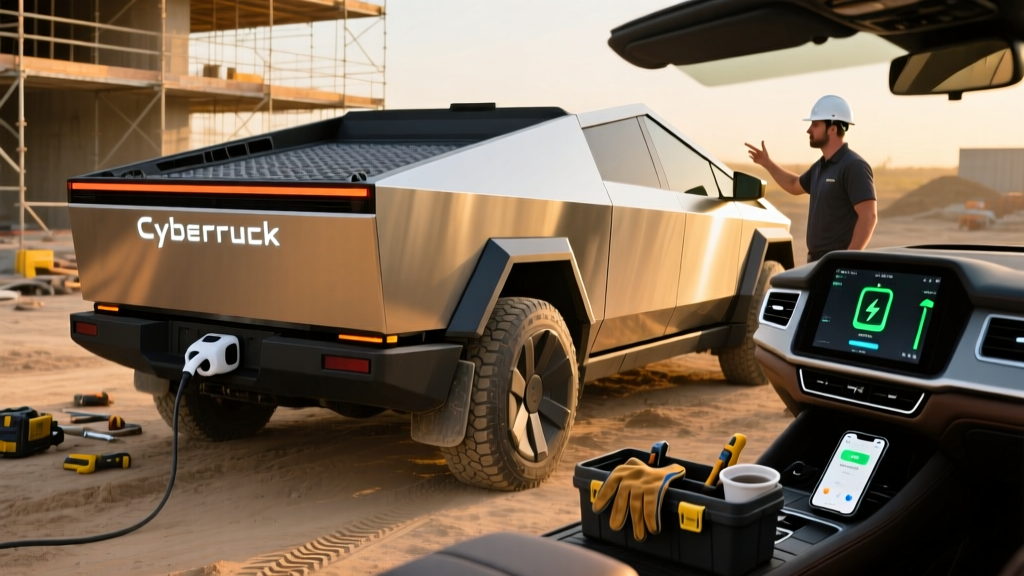
The 6-foot bed (72 inches long, approximately 48 inches between the wheel wells) is shorter than the 6.5-foot beds common on competing midsize and full-size trucks. It accommodates standard 4x8 sheets of plywood only diagonally, which is a significant drawback for carpenters and framers. The motorized tonneau cover (included) is lockable and weather-sealed — a genuine advantage for contractors hauling power tools and sensitive materials. The bed offers 120V and 240V outlets (up to 9.6 kW of vehicle-to-load power), which can run a chop saw, charge cordless tool batteries, or power a jobsite radio without a separate generator.
The front trunk (frunk) provides approximately 7 cubic feet of lockable, weather-sealed storage — useful for smaller tool bags, PPE, or client documents. Rear passenger space offers 41.2 inches of legroom, sufficient for crew members or clients, though the rear bench is firmer than a luxury sedan's.
Pricing, Tax Credits, and Total Cost for Contractors
| Trim | Base MSRP | As-Tested (typical options) | §30D Federal Credit Eligible? |
|---|---|---|---|
| AWD (Dual-Motor) | $79,990 | $84,000–$88,000 | No — exceeds $80,000 truck MSRP cap |
| Cyberbeast (Tri-Motor) | $99,990 | $105,000–$112,000 | No — exceeds $80,000 truck MSRP cap |
This is the critical pain point for contractor buyers. Under IRS §30D rules, the federal clean vehicle credit for trucks, SUVs, and vans is capped at vehicles with an MSRP of $80,000 or less. The Cybertruck AWD at $79,990 sits exactly at the threshold — however, adding any factory option (paint, Full Self-Driving capability, accessories) pushes the as-tested price above the cap, and destination charges may also be included in the MSRP calculation depending on IRS interpretation for the model year. As of early 2026, the base AWD Cybertruck with no options may qualify for up to $7,500 in federal tax credits, but only if the buyer also meets income caps ($150,000 single / $300,000 joint modified adjusted gross income) and the vehicle satisfies critical-mineral and battery-component sourcing requirements, which Tesla's supply chain has partially met.
Contractors should consult a tax professional before relying on the credit. The point-of-sale transfer option (allowing the $7,500 to be applied as a down-payment reduction at the dealer) is available for qualifying purchases, but eligibility is not guaranteed and changes with IRS guidance updates.
Operating Cost Advantage
Where the Cybertruck claws back value is in operating costs. At the U.S. average electricity rate of ~$0.17/kWh, charging the Cybertruck's 123 kWh battery from empty costs roughly $21. A comparable gasoline F-150 (18 mpg combined) covering the same 340 miles at $3.40/gallon costs approximately $64. Over 20,000 miles per year, a contractor could save $2,500–$3,500 in fuel alone. Maintenance savings (no oil changes, fewer brake replacements due to regenerative braking, no transmission fluid) add another $500–$800 annually. Insurance, however, runs 15–25% higher than a comparable gas pickup — factor in $2,400–$3,600/year depending on your state and driving record.
Performance, Tech, and Driver Assistance
The Cybertruck AWD's 4.1-second 0–60 mph time is irrelevant to most contractor use cases, but the 600 hp and instant torque are genuinely useful when merging onto highways with a loaded bed or pulling an 11,000-pound trailer. The steer-by-wire system (no mechanical connection between steering wheel and wheels) takes approximately 20 minutes of driving to feel natural and offers remarkably tight low-speed maneuvering — a 35.5-foot turning circle is competitive with shorter-bed gas pickups.
The 18.5-inch center touchscreen runs Tesla's latest software and includes navigation with real-time Supercharger routing, a built-in trip planner that accounts for payload and elevation, and over-the-air updates. The 9.4-inch rear touchscreen controls rear climate and media. Wireless phone charging, heated and ventilated front seats, and a 15-speaker audio system are standard.
Driver Assistance — SAE Level 2: Tesla's Autopilot (standard) and Full Self-Driving Supervised ($8,000 option or $99/month subscription) are SAE Level 2 systems. The driver must remain fully engaged, hands on the wheel (or providing steering-torque input), and eyes on the road at all times. These are not autonomous driving systems. FSD Supervised can navigate highway interchanges, stop lights, and some city streets, but it makes errors and requires constant oversight. Do not rely on it for fatigue-free long-haul driving.
Warranty, Battery Longevity, and Fleet Considerations
Tesla covers the Cybertruck's battery and drive units with an 8-year / 120,000-mile warranty (whichever comes first), with a guaranteed minimum 70% battery capacity retention over that period. The limited vehicle warranty is 4 years / 50,000 miles. For contractors driving 20,000–30,000 miles per year, the powertrain warranty provides coverage through approximately 4–6 years of heavy use.
The NMC battery chemistry in the Cybertruck offers high energy density but is more sensitive to sustained high state-of-charge storage than LFP (lithium iron phosphate) packs. Best practice for longevity: charge to 80–90% for daily use and only charge to 100% when you need the full range for a long trip. Avoid leaving the truck parked at 100% for extended periods, especially in hot climates. Battery replacement cost, if needed out of warranty, is estimated at $15,000–$22,000 based on current Tesla service pricing — a figure contractors should factor into long-term ownership models.
For fleet buyers, Tesla offers a commercial account program with volume purchasing and dedicated service support, but availability and pricing are negotiated directly. The Rivian R1T and Ford F-150 Lightning (if production resumes or via used market) remain the primary electric-pickup alternatives for contractors. The NHTSA has awarded the Cybertruck a 5-star overall safety rating, and the IIHS testing results are pending for the 2026 model year.
Pros and Cons for Contractor Buyers
Pros
- Massive 123 kWh battery delivers genuine 260+ mile real-world range even loaded
- 9.6 kW vehicle-to-load power runs tools directly from the bed — replaces a generator
- Lockable, weather-sealed tonneau cover and frunk secure tools without a cap or canopy
- 11,000-lb towing capacity handles most contractor trailers (equipment, dump, boat)
- Low operating cost: ~$0.06/mile electricity vs ~$0.19/mile gasoline equivalent
- Supercharger network reliability exceeds third-party networks for route-dependent work
Cons
- 6-foot bed is too short for flat 4x8 plywood — a real limitation for carpenters and framers
- Base MSRP near $80K; most configurations exceed the §30D tax credit cap
- 70.5-inch height excludes some older parking garages (check 6'6" and lower clearances)
- Steer-by-wire and Tesla Vision (no ultrasonic sensors) have a learning curve and occasional quirks
- Insurance premiums run 15–25% higher than comparable gas pickups
- 28-minute 10–80% fast charge requires schedule planning vs. a 5-minute gas stop
- Only 5 passengers (no crew-cab 6-seat option)
Who Should Buy the Cybertruck — And Who Shouldn't
Choose the Cybertruck if: You're an electrical, plumbing, or HVAC contractor who makes local calls, values secure lockable storage for expensive tools, can charge overnight at home or a depot, and rarely hauls full 4x8 sheet goods. The V2L bed power is a genuine generator replacement, and the low per-mile operating cost adds up fast at 20,000+ miles/year.
Look elsewhere if: You're a framing or drywall contractor who needs a 6.5-foot or 8-foot bed for sheet materials, you regularly tow over 8,000 pounds on long highway routes (range drops sharply under heavy tow), your daily parking includes sub-6'8" garages, or your budget requires the $7,500 federal tax credit to make the math work. Consider the Rivian R1T (shorter but more traditionally configured), a used Ford F-150 Lightning, or a PHEV work truck for mixed-use flexibility.
Frequently Asked Questions
What is the real-world range of the Tesla Cybertruck for a contractor?
Expect 260–290 miles at highway speed in mild weather, 290–320 miles in city driving, and 220–250 miles in freezing temperatures. Adding payload, towing, or a roof rack reduces range by 5–15% depending on load.
How fast does the Cybertruck charge at home and on the road?
At home on a Level 2 Tesla Wall Connector (11.5 kW), you get approximately 37 miles of range per hour, with a full charge taking 10–11 hours. On a V3 Supercharger (250 kW peak), a 10–80% charge takes approximately 28 minutes, though charging slows significantly above 80%.
Does the Cybertruck qualify for the $7,500 federal EV tax credit?
The base AWD Cybertruck at $79,990 MSRP sits exactly at the §30D truck cap of $80,000. Adding any options likely pushes it above the limit. Buyers must also meet income caps ($150K single / $300K joint) and the vehicle must satisfy battery-sourcing requirements. Consult a tax professional and check the latest IRS guidance before relying on the credit.
Can the Cybertruck power tools on a jobsite?
Yes. The bed offers 120V and 240V outlets with up to 9.6 kW of continuous vehicle-to-load power — enough to run a table saw, charge multiple cordless tool batteries simultaneously, power LED work lights, and run a small compressor all at once, without a separate generator.
Is the Cybertruck worth buying vs. a Rivian R1T or gas F-150 for contractors?
The Cybertruck wins on range (340 miles vs. R1T's ~270–350 miles depending on pack), Supercharger network access, and V2L power output. The R1T offers a more traditional truck layout, a gear tunnel for extra storage, and a slightly lower starting price. A gas F-150 costs less upfront, tows longer distances without range concern, and fits any parking structure — but costs significantly more per mile to operate. Your choice depends on daily mileage, parking constraints, and whether you can charge overnight.
Does the Cybertruck fit in standard parking spaces and garages?
It fits standard 8.5-foot-wide spaces (79.8 inches wide without mirrors). Height is the constraint: at 70.5 inches (5'10.5"), it clears most modern garages but will not fit structures with 6'6" or lower clearance. Always check posted height limits before entering older or underground parking facilities.