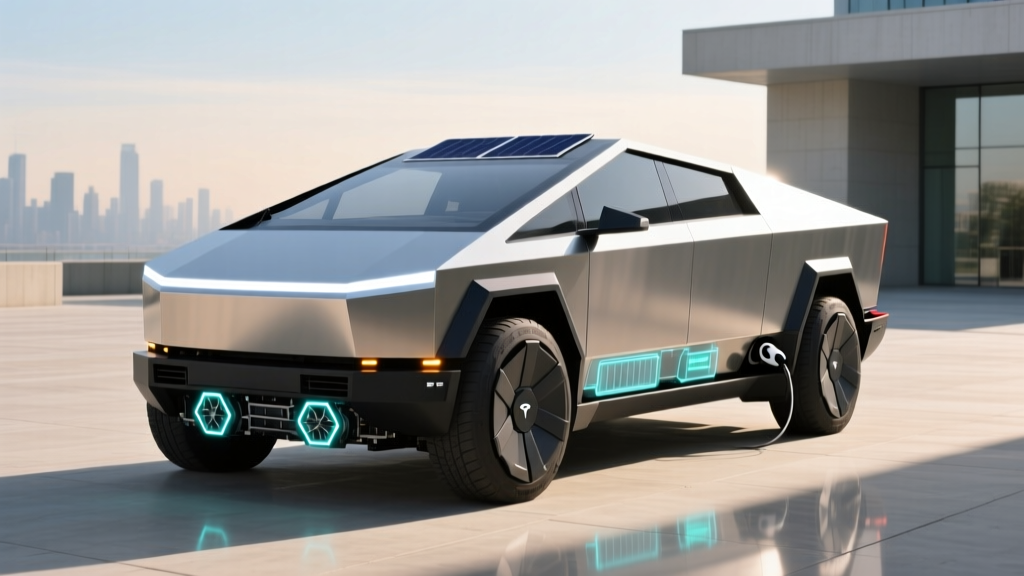
When Tesla unveiled the Cybertruck concept in November 2019, the angular stainless-steel pickup looked like a rendering that would never reach production. Six years later, the Cybertruck is firmly on American roads — and the production reality diverges from that original concept in ways that matter for real buyers. This review examines the 2026 Tesla Cybertruck lineup with the hard numbers owners need: actual range under load, 800V charging behavior, towing efficiency penalties, and whether any trim still qualifies for the federal §30D tax credit.
From Cybertruck Concept to Production: What Changed
The original Cybertruck concept promised a 500-mile range, a sub-$40,000 starting price, and a tri-motor "Plaid" variant with sports-car acceleration. The production truck that launched in late 2023 and carries into the 2026 model year tells a different, more grounded story. Tesla offers three configurations: the Rear-Wheel Drive (base), the All-Wheel Drive (mid-tier), and the Cyberbeast (tri-motor performance). None hit the concept's 500-mile target without the optional — and heavy — range extender pack, which occupies a portion of the bed.
Dimensionally, the production truck is slightly smaller than the concept's 231.7-inch length, landing at 223.6 inches long, 79.7 inches wide (mirrors folded), and 70.5 inches tall on its tallest air-suspension setting. The stainless-steel exoskeleton remains, as does the vault-style tonneau bed cover, but the steer-by-wire system, 48-volt electrical architecture, and ethereal yoke steering are production-first features the concept only hinted at.
Range, Battery, and Real-World Efficiency
The 2026 Cybertruck uses a structural battery pack with an estimated 123 kWh usable capacity on AWD and Cyberbeast trims, utilizing Tesla's 4680-format cells in a structural pack that doubles as a stressed chassis member. The chemistry is NMC (nickel-manganese-cobalt), optimized for energy density over cycle life — a trade-off appropriate for a heavy, aerodynamically challenged pickup.
| Spec | RWD (Base) | AWD | Cyberbeast |
|---|---|---|---|
| EPA Range | ~250 mi | 340 mi | 320 mi |
| Battery (usable) | ~123 kWh (est.) | ~123 kWh | ~123 kWh |
| Drivetrain | Rear-Wheel Drive | Dual-Motor AWD | Tri-Motor AWD |
| Horsepower | ~600 hp | 600 hp | 845 hp |
| 0–60 mph | 6.2 sec | 3.9 sec | 2.6 sec |
| Peak DC Charge | ~250 kW | ~350 kW | ~350 kW |
| 10–80% DC Time | ~35 min | ~20 min | ~20 min |
| Towing Capacity | 7,500 lb | 11,000 lb | 11,000 lb |
| Base MSRP | $60,990 | $79,990 | $99,990 |
The AWD's 340-mile EPA sticker is achievable in mild weather at suburban speeds (45–55 mph). On a 75-mph highway run at 70°F, expect ~270–290 miles before hitting a low-SoC taper. In winter conditions (30°F or below) with cabin heat active, highway range drops to ~220–240 miles. Towing a 6,000-lb trailer at 65 mph collapses range to roughly 150–170 miles — the Cybertruck's brick-like drag coefficient (~0.34 Cd) punishes high-speed and high-load driving more than a Rivian R1T or Ford F-150 Lightning.
Efficiency on the combined EPA cycle lands around 56 MPGe for the AWD trim, or roughly 58–60 kWh per 100 miles — among the least efficient EVs on the market, a direct consequence of the Cybertruck's 6,600–6,800 lb curb weight and flat-panel aero. For context, a Rivian R1T Dual-Motor achieves roughly 73 MPGe combined.
Charging Speed: 800V Architecture in Practice
The Cybertruck uses an 800-volt electrical architecture, a first for Tesla, which allows higher charge power at lower current — reducing cable weight and thermal losses. The AWD and Cyberbeast trims peak at approximately 350 kW on V4 Superchargers, though sustained rates tell a more nuanced story.
| Charge Level | Power / Rate | Miles Added per Hour |
|---|---|---|
| Level 1 (120V, 12A) | ~1.4 kW | ~2 mi/hr |
| Level 2 (240V, 48A Wall Connector) | 11.5 kW | ~19 mi/hr |
| DC Fast (250 kW V3 Supercharger) | Peak 250 kW | ~180 mi in 15 min |
| DC Fast (350 kW V4 Supercharger) | Peak 350 kW | ~200 mi in 15 min |
The 10–80% claim of roughly 20 minutes applies only at V4 Superchargers under ideal conditions (pack preconditioned via navigation routing, battery temperature ~95°F, low ambient heat soak). On a 250 kW V3 cabinet, expect 10–80% in 28–32 minutes. Above 80% SoC, the charge curve tapers aggressively — a 80–100% top-off can add another 25+ minutes, so plan stops around the 80% mark on road trips.
At home, the Tesla Wall Connector at 48A/240V delivers roughly 19 miles of range per hour — meaning a full 10–100% charge from near-empty takes approximately 17–18 hours. Most owners charging overnight from 20–80% will wake to a full daily-ready battery in under 7 hours.
Performance, Towing, and the Cyberbeast Question
The Cyberbeast's 845 hp and 2.6-second 0–60 time are legitimately supercar territory in a vehicle that weighs over three tons. The torque-vectoring tri-motor system delivers cornering composure that defies the Cybertruck's mass, though the steer-by-wire yoke demands a learning curve — particularly at low-speed parking maneuvers where the variable ratio feels unintuitive for the first ~500 miles of ownership.
Towing is where the Cybertruck's physics bite. The 11,000-lb max rating on AWD and Cyberbeast is competitive with the F-150 Lightning (10,000 lb) and Rivian R1T (11,000 lb), but real-world towing range is the limiting factor. On a 5,000-lb enclosed trailer test at 65 mph, the AWD Cybertruck consumed roughly 1.8 kWh per mile — effectively halving its range versus unloaded driving. Tesla's integrated trailer brake controller and tow-hitch camera view are well-executed, but the range penalty remains the Cybertruck's Achilles heel for anyone planning regular trailer duty.
Interior, Cargo, and the Six-Foot Bed Vault
The Cybertruck seats five across two rows, with 41.0 inches of front legroom and 38.5 inches rear — adequate for adults but tighter than an F-150 SuperCrew. Rear-seat comfort is compromised by a relatively upright seatback and a firm cushion, making it better suited for children or short trips.
The 6-foot bed (74.3 inches long with the tailgate up) offers ~67 cu ft of volume with the powered vault cover closed, expanding to roughly ~120 cu ft with the cover retracted and tailgate down. The lockable, weather-sealed vault is a genuine advantage over open-bed pickups for secure urban cargo. The front trunk (frunk) adds ~7 cu ft — enough for a charging cable kit and small soft bags, but smaller than the Lightning's massive 14.1 cu ft frunk.
The 18.5-inch center touchscreen runs Tesla's current infotainment stack with wireless CarPlay now supported (added via OTA in 2025). The rear passengers get their own 9.4-inch touchscreen for climate and media — a useful addition given the minimalist cabin with no physical buttons.
Pricing, Trims, and Federal Tax Credit Eligibility
The 2026 Cybertruck pricing structure has stabilized after the early-production "Foundation Series" premiums. Current MSRPs stand at $60,990 (RWD), $79,990 (AWD), and $99,990 (Cyberbeast), plus a $1,995 destination fee.
| Trim | MSRP | §30D Credit Eligibility | Est. Net Price |
|---|---|---|---|
| RWD (Base) | $60,990 | Eligible (truck MSRP cap $80k) | ~$53,490* |
| AWD | $79,990 | Eligible (truck MSRP cap $80k) | ~$72,490* |
| Cyberbeast | $99,990 | Exceeds $80k truck cap | $99,990 |
*Estimates assume buyer meets IRS §30D income caps ($150k single / $300k MFJ AGI), battery-sourcing requirements are met, and the credit is applied at point-of-sale. Verify current-year rules at IRS.gov.
Critical nuance: the Cyberbeast's $99,990 sticker exceeds the §30D MSRP cap for trucks ($80,000), making it ineligible regardless of buyer income. The RWD and AWD trims fall under the cap, but eligibility still hinges on buyer AGI limits, North American assembly (Cybertruck is built in Austin, TX — qualifies), and critical-mineral/battery-component sourcing thresholds that tighten annually. Tesla's 4680 cell supply chain has progressively domesticated, but buyers should confirm current-year sourcing compliance before counting on the credit. Point-of-sale transfer to the dealer is available, reducing the out-of-pocket cost at delivery rather than waiting for a tax refund.
Warranty, Driver Assists, and Standout Tech
Tesla covers the Cybertruck with a 4-year / 50,000-mile limited vehicle warranty and an 8-year / 120,000-mile battery and drive unit warranty, with a guaranteed minimum 70% capacity retention over that period. Given the 4680 cells' relatively limited long-term field data compared to the older 2170 format, the 70% threshold is a meaningful backstop — though Tesla's degradation curves on prior chemistries suggest most packs will exceed this floor substantially.
Both Autopilot (standard) and Full Self-Driving (Supervised) ($8,000 option or $99/mo subscription) are SAE Level 2 systems. The driver must remain engaged, hands on the yoke (or torque-applied), and eyes on the road at all times. FSD Supervised handles highway lane changes, on-ramps, and many city intersections impressively — but it is not autonomous driving. Only Level 4 robotaxi services (Waymo, Zoox) operate without a driver-in-the-loop requirement.
Standout tech features include the steer-by-wire system with variable steering ratio (eliminating the need to hand-over-hand during parking), the 48-volt low-voltage architecture (replacing the legacy 12V system and enabling thinner wiring harnesses), bioweapon defense mode HEPA filtration, and the power-retractable bed vault cover with integrated LED lighting. The stainless-steel body requires no paint — a durability advantage for trail use but a fingerprint magnet in daily urban life.
Who Should Buy the Cybertruck — and Who Shouldn't
- Class-leading DC fast-charge speed on V4 Superchargers (~350 kW peak)
- Secure, lockable 6-foot vault bed with powered cover
- Cyberbeast performance is genuinely exotic (2.6s 0–60)
- 48V architecture and steer-by-wire are production firsts
- 11,000-lb tow rating with integrated trailer tech
- Austin-built; RWD and AWD trims under §30D MSRP cap
- Real-world highway range falls 50–70 mi below EPA sticker
- Towing collapses range to ~150–170 mi under moderate loads
- Poor efficiency (~58 kWh/100 mi) raises per-mile charging cost
- Rear seat comfort and legroom trail full-size competitors
- Cyberbeast trim ineligible for §30D credit (over $80k cap)
- Steer-by-wire yoke has a steep learning curve
- Stainless body shows smudges; panel gaps remain inconsistent
Best for: Tech-forward buyers who prioritize secure urban cargo, fast Supercharger stops on road trips, and don't regularly tow heavy loads over long distances. The AWD trim at ~$72,490 after the credit (if eligible) is the value sweet spot.
Look elsewhere if: You tow a 7,000+ lb trailer more than a few times a year (Rivian R1T or F-150 Lightning offer better towing range predictability), need a comfortable rear seat for adults on long trips, or prioritize efficiency and low per-mile energy cost over statement design.
Frequently Asked Questions
What is the real-world range of the 2026 Tesla Cybertruck?
The AWD's 340-mile EPA rating translates to roughly 270–290 miles at 75 mph in mild weather, 220–240 miles in freezing conditions, and 150–170 miles when towing a moderate trailer. The Cyberbeast's lower EPA figure (320 mi) reflects its tri-motor consumption penalty.
How fast does the Cybertruck charge at home and on the road?
At home on a 48A Level 2 Wall Connector, expect ~19 miles of range per hour (11.5 kW). On a V4 Supercharger, the AWD and Cyberbeast peak at ~350 kW for a 10–80% charge in roughly 20 minutes under ideal conditions; V3 Superchargers extend that to 28–32 minutes.
Does the Cybertruck qualify for the $7,500 federal EV tax credit?
The RWD and AWD trims fall under the §30D truck MSRP cap ($80,000) and are potentially eligible, subject to buyer AGI limits ($150k single / $300k MFJ), North American assembly (Austin-built qualifies), and annual battery-sourcing requirements. The Cyberbeast ($99,990) exceeds the cap and is ineligible. Always verify current rules at IRS.gov.
Is the Cybertruck worth buying versus the Rivian R1T or F-150 Lightning?
The Cybertruck wins on DC charge speed, secure bed storage, and Cyberbeast performance. The Rivian R1T offers better real-world efficiency, a more refined interior, and a quad-motor option. The F-150 Lightning provides superior rear-seat space, a larger frunk, and more predictable towing range. Your choice depends on whether you prioritize tech-novelty and Supercharger access (Cybertruck), efficiency and refinement (R1T), or traditional truck utility (Lightning).
What are the biggest ownership surprises with the Cybertruck?
Three recurring owner notes: the steer-by-wire yoke requires ~500 miles of adaptation; the stainless-steel body shows fingerprints aggressively (Tesla sells a proprietary cleaning cloth for a reason); and real-world energy consumption is higher than the EPA sticker implies — budget roughly 20% more kWh per month than the sticker suggests if your driving is predominantly highway.