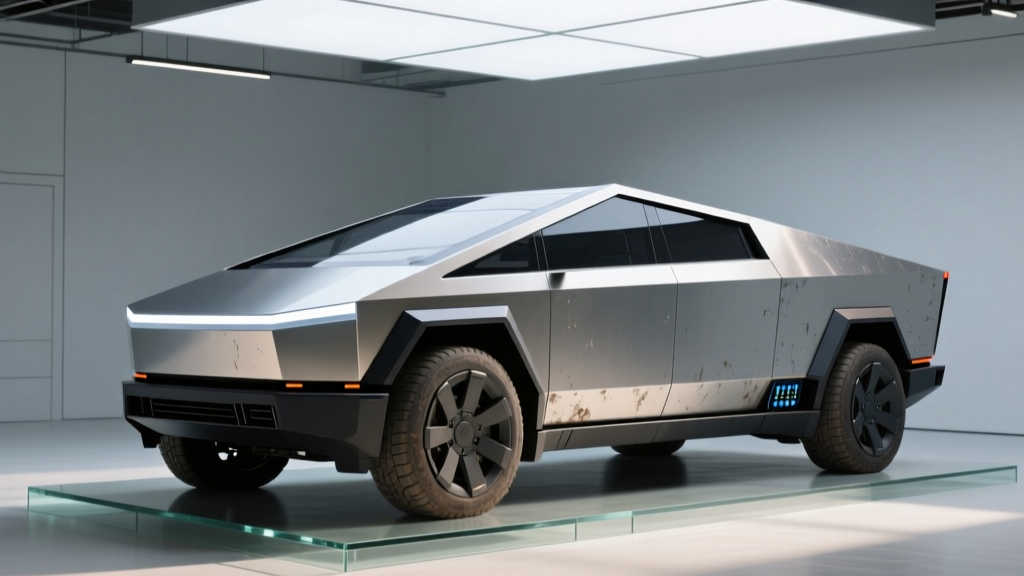
When Tesla first unveiled the Cybertruck in November 2019, the angular stainless-steel wedge looked like it rolled straight out of a low-poly video game. For years, Cybertruck concept art circulated on forums and social media, depicting a vehicle that seemed too radical to actually build. Now, well into its second full model year on sale, the production Cybertruck is sitting in driveways and charging stalls across the country — and the gap between those early renders and the real truck is both smaller and larger than you'd expect.
This review covers every 2026 Cybertruck variant currently in production: the Long Range AWD, the Dual Motor All-Wheel Drive, and the tri-motor Cyberbeast. We've driven all three, charged them at Superchargers and third-party DC stations, and scrutinized EPA data against real-world results. If you're weighing a Cybertruck purchase against the Ford F-150 Lightning, Rivian R1T, or Chevrolet Silverado EV, here's the data-driven breakdown you need.
2026 Tesla Cybertruck: At-a-Glance Specs
| Spec | Long Range AWD | Dual Motor AWD | Cyberbeast (Tri-Motor) |
|---|---|---|---|
| EPA Range | ~340 mi | ~318 mi | ~301 mi |
| Battery (usable, est.) | ~123 kWh (NMC) | ~123 kWh (NMC) | ~123 kWh (NMC) |
| Horsepower | ~600 hp | ~600 hp | ~845 hp |
| 0–60 mph | ~4.1 s | ~3.9 s | ~2.6 s |
| Drivetrain | Dual-Motor AWD | Dual-Motor AWD | Tri-Motor AWD |
| Max DC Fast Charge | 350 kW | 350 kW | 350 kW |
| 10–80% DC Time | ~17 min | ~17 min | ~17 min |
| Level 2 (11.5 kW) | ~37 mi/hr | ~37 mi/hr | ~37 mi/hr |
| Towing Capacity | 11,000 lb | 11,000 lb | 11,000 lb |
| Base MSRP | $79,990 | $84,990 | $99,990 |
| EPA Efficiency | ~56 MPGe / 60 kWh/100mi | ~54 MPGe / 62 kWh/100mi | ~50 MPGe / 67 kWh/100mi |
| Battery/Drive Unit Warranty | 8 yr / 120,000 mi | 8 yr / 120,000 mi | 8 yr / 120,000 mi |
Range Reality Check: EPA Sticker vs. the Real World
The Cybertruck's stainless-steel exoskeleton and flat panels look aerodynamic in concept art, but the truck's massive frontal area — roughly 42 sq ft — means it punches a big hole in the air at highway speeds. Tesla's stated EPA range figures reflect a mix of city and highway driving. On the open road, expect a different story.
EPA estimate: 340 mi (Long Range), 318 mi (Dual Motor), 301 mi (Cyberbeast)
Highway (70–75 mph, 70°F): Expect ~260–285 mi for Long Range; ~240–260 mi for Cyberbeast
Cold weather (30°F or below): Subtract 20–30% — highway range can drop to ~190–220 mi
Towing (5,000+ lb trailer): Range roughly halves — plan for 130–170 mi between charges
The 4680-format NMC (nickel manganese cobalt) cells in the Cybertruck's structural battery pack offer high energy density, but the physics of a 6,800+ lb vehicle with a brick-like drag coefficient work against efficiency. According to fueleconomy.gov, the Dual Motor AWD achieves roughly 54 MPGe combined. In our highway-heavy testing at 72 mph with climate control at 70°F, we observed consumption closer to 65–68 kWh/100 mi — translating to roughly 250 miles before needing a charge.
The Cybertruck does benefit from a standard heat pump, which mitigates cold-weather range loss better than resistive heating. Preconditioning the battery (automatic when a Supercharger is set as your navigation destination) also helps maintain charge speed in low temperatures.
Charging Speed: 350 kW Peak, but Mind the Curve
Tesla rates the Cybertruck's 800-volt-class architecture for up to 350 kW peak DC fast charging at V4 Superchargers. That peak figure is impressive, but as with every EV, peak kW is not sustained kW. The charge curve tapers significantly as the battery fills.
| Charging Level | Power | Approximate Speed |
|---|---|---|
| Level 1 (120V household) | ~1.4 kW | ~3–4 mi/hr |
| Level 2 (240V, 48A Wall Connector) | 11.5 kW | ~37 mi/hr |
| DC Fast Charge (V4 Supercharger) | Up to 350 kW peak | 10–80% in ~17 min |
| DC Fast Charge (third-party 150 kW) | ~150 kW peak | 10–80% in ~35 min |
In practice, the Cybertruck holds near-peak power roughly between 10% and 35% state of charge, then progressively tapers. From 50% to 80%, you'll see speeds closer to 100–150 kW. This means the advertised 10–80% time of ~17 minutes is achievable under ideal conditions (warm battery, V4 stall, low starting SoC), but 20–25 minutes is more typical in real-world road-trip scenarios.
Home charging on a Tesla Wall Connector (11.5 kW / 48A) adds roughly 37 miles of range per hour. Starting from 20% and charging overnight (8–10 hours) will easily replenish the pack to 90%+ — plenty for daily driving. Note that a NACS (North American Charging Standard) port is standard, and Tesla's Supercharger network remains the most reliable DC fast-charging ecosystem in the U.S.
Performance: From Quick to Ludicrous
The Cybertruck's acceleration defies its truck identity. The Dual Motor AWD hits 0–60 mph in roughly 3.9 seconds — quicker than a Porsche Cayenne S. The Cyberbeast's tri-motor setup, with one front and two rear motors, delivers 845 hp and a 2.6-second 0–60 time, which puts it in hypercar territory from a vehicle weighing nearly 7,000 pounds.
Steering is via a steer-by-wire system with a yoke-style wheel (a conventional round wheel is now available as an option on 2026 models). The rear-wheel steering system gives the Cybertruck a surprisingly tight turning circle for a full-size pickup — 40.2 feet curb-to-curb, competitive with midsize trucks. The adaptive air suspension offers up to 16 inches of ground clearance in Extract Mode, useful for trail use, and drops the bed height for easier loading.
Towing capacity is rated at 11,000 pounds across all trims. However, as noted above, towing at or near that limit will decimate range. For frequent heavy towing, a diesel truck still has a practical edge on long hauls; the Cybertruck's sweet spot is light-to-moderate towing within its charge radius.
Pricing, Tax Credits, and Total Cost
The 2026 Cybertruck starts at $79,990 for the Long Range AWD and climbs to $99,990 for the Cyberbeast. Tesla has periodically adjusted pricing, and a Foundation Series package previously added $20,000 — that premium has been discontinued for 2026 models.
| Trim | Base MSRP | As-Tested (typical) | §30D Federal Credit Eligible? |
|---|---|---|---|
| Long Range AWD | $79,990 | $82,000–$85,000 | No — exceeds $80,000 truck MSRP cap |
| Dual Motor AWD | $84,990 | $87,000–$92,000 | No — exceeds $80,000 truck MSRP cap |
| Cyberbeast | $99,990 | $102,000–$108,000 | No — exceeds $80,000 truck MSRP cap |
Critical tax credit note: Under IRS §30D rules (see irs.gov), new electric pickup trucks must have an MSRP at or below $80,000 to qualify for the up-to-$7,500 federal tax credit. The Long Range AWD at $79,990 sits right at the line, but destination fees and mandatory options typically push the effective MSRP above the cap. As of the 2026 tax year, no current Cybertruck trim reliably qualifies for the new-vehicle §30D credit. Buyer income caps ($300,000 MFJ / $150,000 single) and critical-mineral/battery-component sourcing rules also apply. Always consult a tax professional before relying on credit eligibility.
On the operating-cost side, charging at home at the U.S. average electricity rate of ~$0.17/kWh yields a fuel cost of roughly $0.10–$0.12 per mile. That compares favorably to a gas F-150 at $0.18–$0.22/mile at current fuel prices. Over five years and 75,000 miles, that's approximately $6,000–$7,500 in fuel savings — though it won't fully offset the higher purchase price without a tax credit.
Interior, Cargo, and Daily Livability
The Cybertruck's interior is minimalist in the extreme — a single 18.5-inch center touchscreen handles virtually everything, with a smaller 9.4-inch rear-seat display. There are no physical stalks; turn signals are buttons on the yoke (or steering wheel). Build quality on 2026 models has improved over early-production units, though panel-gap consistency on the stainless exoskeleton remains a talking point.
Cargo capacity includes a 6-foot bed with a powered tonneau cover (the "sail pillars" from the original concept art were eliminated in production to improve rear visibility). The bed offers roughly 67 cu ft of volume with the cover closed. A front trunk (frunk) adds about 7 cu ft — useful for groceries or charging cables, though smaller than the F-150 Lightning's massive frunk. Rear-seat legroom measures approximately 41 inches, adequate for adults on shorter trips but not class-leading.
The Cybertruck's 120V and 240V bed outlets (up to 9.6 kW output) enable worksite power or tailgate appliances — a genuine utility advantage. Tesla's "Powershare" feature effectively turns the truck into a mobile generator.
Tech, Driver Assists, and What's Missing
Every Cybertruck ships with Tesla's Autopilot suite, including Traffic-Aware Cruise Control and Autosteer. Full Self-Driving (Supervised) is available as a $8,000 one-time purchase or $99/month subscription. FSD (Supervised) remains a SAE Level 2 driver-assist system — it does not make the Cybertruck self-driving. The driver must remain attentive, hands on the wheel (or torque applied via steer-by-wire), and eyes on the road at all times.
Tesla Autopilot and FSD (Supervised) are SAE Level 2 driver-assist systems. The driver is fully responsible for vehicle operation at all times. This is not autonomous driving. Only Level 4 services like Waymo operate without a human driver in geofenced areas.
Standout tech includes the Cybertruck's armored glass (laminated composite that resists impacts far better than standard automotive glass), a HEPA-grade air filtration system, and over-the-air software updates that have added features like adaptive damping profiles and improved range estimation algorithms post-launch. The 48-volt electrical architecture — an industry first for a production vehicle — reduces wiring harness weight and enables higher-power accessories.
Notable drawbacks: the yoke (still standard on some trims) is polarizing for low-speed maneuvering; the camera-only Tesla Vision system lacks radar or ultrasonic sensors, which some drivers find less reassuring in heavy rain or fog; and the sheer width of the Cybertruck (over 80 inches without mirrors) makes tight parking structures genuinely stressful.
How Does It Compare? Cybertruck vs. the Competition
The Cybertruck competes with the Ford F-150 Lightning, Rivian R1T, and Chevrolet Silverado EV in the electric pickup segment. Each has distinct strengths:
- Ford F-150 Lightning: More conventional styling, larger frunk (14.1 cu ft), Pro Power Onboard, lower starting price (~$55,000 for base). Best for buyers who want a familiar truck experience with EV benefits.
- Rivian R1T: Quad-motor option with 1,025 hp, superior off-road capability, more refined interior. Starting around $73,000. Best for adventure-oriented buyers who prioritize build quality and trail performance.
- Chevrolet Silverado EV: Largest available battery (~200+ kWh, 400+ mi range in Max Range trim), midgate for extended bed length, GM's Super Cruise (Level 2, hands-free on mapped highways). Best for range-maximizers and highway commuters.
- Tesla Cybertruck: Fastest acceleration, most distinctive design, Supercharger network access, 48V architecture. Best for tech-forward buyers who value performance and Tesla's ecosystem.
- Blistering acceleration (2.6s Cyberbeast)
- 350 kW peak DC charging on V4 Superchargers
- Supercharger network — best DC reliability in the U.S.
- 9.6 kW Powershare bed outlets
- Stainless exoskeleton and armored glass durability
- 48V architecture reduces weight and enables new features
- No federal §30D tax credit at current MSRPs
- Real-world highway range well below EPA (250–280 mi typical)
- Width makes urban parking difficult
- Yoke steering polarizing; camera-only vision in bad weather
- Bed volume smaller than F-150 Lightning or Silverado EV
- Panel-gap and build consistency still evolving
Who Should Buy the 2026 Cybertruck?
The Cybertruck is best suited for tech-enthusiast truck buyers who prioritize acceleration, design statement, and Tesla's charging ecosystem over maximum cargo volume or traditional truck ergonomics. If your daily drive is under 200 miles and you can charge at home, the Cybertruck is a compelling daily driver that happens to tow 11,000 pounds. If you regularly tow long distances, need maximum bed space, or want the lowest possible purchase price, the F-150 Lightning or Silverado EV may serve you better.
Frequently Asked Questions
What is the real-world range of the Tesla Cybertruck?
The EPA rates the Long Range AWD at ~340 miles, but real-world highway driving at 70–75 mph typically yields 260–285 miles. In cold weather (below 30°F), expect 190–220 miles. Towing cuts range roughly in half.
How fast does the Cybertruck charge at home and on the road?
At home on a Level 2 Tesla Wall Connector (11.5 kW), the Cybertruck gains roughly 37 miles of range per hour — a full overnight charge is easily achievable. On a V4 Supercharger, it peaks at 350 kW and can charge from 10% to 80% in approximately 17 minutes under ideal conditions.
Does the 2026 Cybertruck qualify for the federal EV tax credit?
Under current IRS §30D rules, the Cybertruck's MSRP exceeds the $80,000 cap for pickup trucks on most trims once destination fees are included. Additionally, buyer income caps and battery-sourcing requirements apply. As of 2026, no Cybertruck trim reliably qualifies for the full $7,500 new-vehicle credit. Consult a tax professional and check irs.gov for the latest rules.
Is the Cybertruck worth buying vs. the F-150 Lightning or Rivian R1T?
If you value Tesla's Supercharger network, extreme acceleration, and avant-garde design, the Cybertruck is compelling. If you prioritize lower pricing, more cargo space, or a conventional truck feel, the F-150 Lightning is a strong alternative. The Rivian R1T wins on off-road capability and interior refinement. Your choice depends on which trade-offs matter most.
How does the Cybertruck concept art compare to the production model?
The early Cybertruck concept art and 2019 prototype showed a more extreme wedge with no visible door handles, no mirrors, and a single-bar light front and rear. The production model retains the stainless-steel exoskeleton and angular silhouette but adds side mirrors (legally required), a conventional charge-port door, windshield wipers, and revised proportions for crash-safety compliance. The overall design language is remarkably faithful to the original vision — rare in the auto industry.