If you are researching Tesla Cybertruck colors options before placing an order, you have probably noticed that Tesla keeps the palette deliberately narrow compared with legacy truck makers. The Cybertruck's stainless-steel exoskeleton is unlike any other production vehicle, and that construction choice directly limits what can be applied at the factory. This review covers every official exterior color available for the 2026 model year, the paint-versus-wrap economics that Cybertruck owners actually face, and the full technical profile — range, charging, performance, pricing, and federal tax-credit eligibility — so you can make a spec-complete buying decision.
Official 2026 Tesla Cybertruck Colors Options
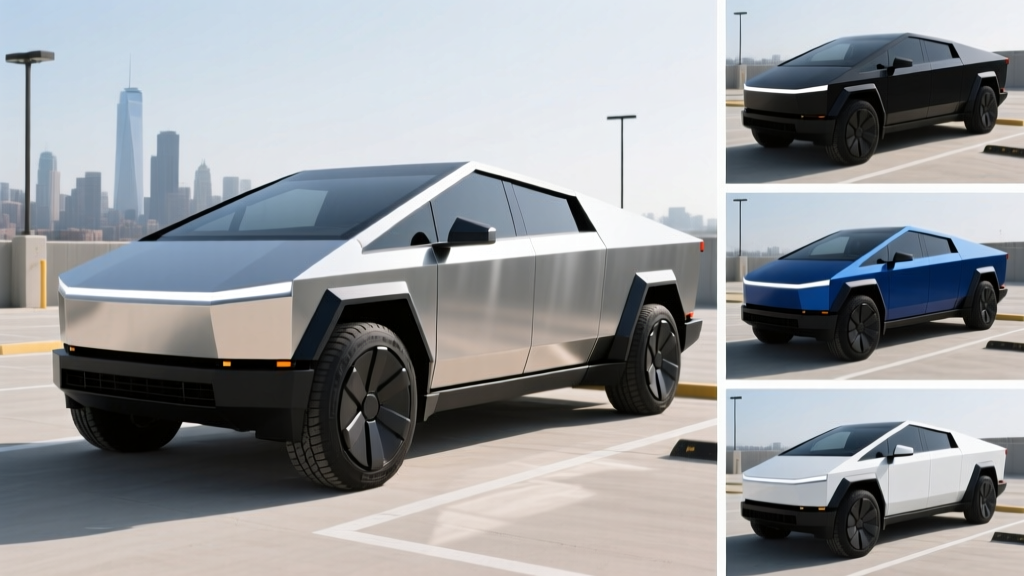
For the 2026 model year, Tesla offers the Cybertruck in a limited set of factory finishes. The stainless-steel body panels cannot be painted using conventional automotive processes because the alloy is formed and bent after stamping, which would crack traditional paint. Instead, Tesla uses a PVD (Physical Vapor Deposition) process for its colored trims and offers factory wraps for broader color selection.
| Option | Type | Price Adder | Availability |
|---|---|---|---|
| Stainless Steel (Raw) | Uncoated exoskeleton | $0 (included) | All trims |
| Satin Black (PVD) | Physical Vapor Deposition coating | ~$3,000 | Foundation Series / select trims |
| Satin White (PVD) | Physical Vapor Deposition coating | ~$3,000 | Foundation Series / select trims |
| Stealth Gray Wrap | Factory-applied vinyl | ~$5,000 | All trims via Tesla |
| Satin Black Wrap | Factory-applied vinyl | ~$5,000 | All trims via Tesla |
| Satin White Wrap | Factory-applied vinyl | ~$5,000 | All trims via Tesla |
The PVD coatings on the Foundation Series (and higher trims) produce a muted, metallic sheen that is far more durable than a standard clear coat. However, PVD cannot be touched up locally — a scratch requires panel replacement or full re-coating. Factory wraps, by contrast, are replaceable section-by-section and generally last 5–7 years before UV degradation becomes visible.
Aftermarket Wraps and Custom Colors
Most Cybertruck owners who want a unique color go the aftermarket route. A full-body PPF (Paint Protection Film) or color-change vinyl wrap from a reputable installer typically runs $4,500–$8,000 depending on film quality (3M, Avery Dennison, XPEL). Because the Cybertruck's panels are flat and angular, wrap installation is relatively straightforward compared to curved vehicles, but the sheer surface area (including the tonneau cover) pushes costs higher than a typical sedan wrap. Popular aftermarket choices include matte olive green, satin chrome, and color-shift films.
Range, Battery, and Real-World Efficiency
The 2026 Cybertruck is offered in dual-motor AWD and tri-motor (Cyberbeast) configurations. Both use Tesla's 4680-format NMC (nickel-manganese-cobalt) battery cells manufactured at Giga Texas.
| Trim | Battery (Usable) | Chemistry | EPA Range | Real-World Highway | Cold Weather (20°F) |
|---|---|---|---|---|---|
| Dual Motor AWD | ~123 kWh | NMC (4680) | 340 mi | ~280–300 mi | ~230–260 mi |
| Cyberbeast (Tri-Motor) | ~123 kWh | NMC (4680) | 320 mi | ~260–280 mi | ~215–245 mi |
Real-world figures based on 70-mph highway driving with climate control active. Cold-weather estimates assume 20°F ambient, seat heaters on, and cabin preheating. The Cybertruck's 6,600+ lb curb weight and 0.38 Cd drag coefficient work against highway efficiency. Source: fueleconomy.gov, Tesla specifications.
The NMC chemistry provides high energy density — necessary given the Cybertruck's mass — but requires more careful thermal management than LFP. Tesla's heat pump and octovalve system precondition the battery for both cabin comfort and fast charging. Efficiency for the Dual Motor AWD is rated at approximately 56 MPGe combined (roughly 59 kWh/100 mi), which is on the higher consumption side among EVs but expected for a 6,600-lb truck.
Charging Speed: DC Fast, Level 2, and Charge Curve Reality
The Cybertruck uses Tesla's NACS connector natively and accesses the full Supercharger network without adapters. Its 800-volt architecture enables competitive peak charge rates, though the massive battery means total charge time is longer than smaller EVs.
| Charging Level | Connector | Max Rate | Speed (Approx.) |
|---|---|---|---|
| Level 1 (120V) | NACS | 1.4 kW | ~3 mi/hr |
| Level 2 (240V, 48A) | NACS / J1772 adapter | 11.5 kW | ~28 mi/hr |
| DC Fast Charge | NACS (Supercharger) | 350 kW peak | 10–80% in ~28 min |
| V4 Supercharger | NACS | Up to 350 kW sustained | 10–80% in ~25 min |
Charge curve reality check: The Cybertruck peaks at ~350 kW only between roughly 10–30% state of charge (SoC). From 30–60%, the rate tapers to approximately 200–250 kW, and above 80% it drops sharply to under 80 kW to protect the NMC cells. On a V4 Supercharger with the integrated CCS-to-NACS adapter support, sustained speeds are slightly better than legacy V3 stalls. For daily home charging, a 48-amp Level 2 wall connector (11.5 kW) replenishes the full 123 kWh battery in roughly 11 hours — plan overnight sessions accordingly.
Performance, Drivetrain, and Towing
The Cybertruck's performance numbers are staggering for a vehicle of its size, but the tri-motor Cyberbeast exists in a category of its own.
| Specification | Dual Motor AWD | Cyberbeast (Tri-Motor AWD) |
|---|---|---|
| Horsepower | 600 hp | 845 hp |
| 0–60 mph | 3.9 sec | 2.6 sec |
| Top Speed | 112 mph | 130 mph |
| Drivetrain | Dual-motor AWD | Tri-motor AWD (torque vectoring) |
| Max Towing Capacity | 11,000 lbs | 11,000 lbs |
| Payload Capacity | 2,500 lbs | 2,500 lbs |
| Bed Length | 6 ft (72 in) | 6 ft (72 in) |
| Cargo Volume (Bed) | 67 cu ft | 67 cu ft |
| Frunk Volume | ~7 cu ft | ~7 cu ft |
| Rear Legroom | ~38.4 in | ~38.4 in |
Towing at or near the 11,000-lb limit will reduce range by roughly 40–50%, a figure consistent with other full-size electric trucks. The Cyberbeast's torque-vectoring rear axle (two independent rear motors) provides sharper cornering and better traction on loose surfaces, though the performance advantage over the Dual Motor is most noticeable in straight-line acceleration rather than daily driving.
Pricing, Trims, and Federal Tax Credit Eligibility
The Cybertruck's pricing has stabilized since its initial Foundation Series launch, but it remains a premium product. Federal tax credit eligibility is a major consideration at this price point.
| Trim | Base MSRP | §30D Credit Eligible? | Effective Price (w/ credit) |
|---|---|---|---|
| Dual Motor AWD | $79,990 | No (exceeds $80,000 truck MSRP cap) | $79,990 |
| Cyberbeast (Tri-Motor) | $99,990 | No (exceeds $80,000 truck MSRP cap) | $99,990 |
Under IRS §30D rules, the MSRP cap for vans, SUVs, and pickup trucks is $80,000. The Dual Motor AWD at $79,990 sits at the razor's edge — any added factory options (PVD color, wrap, FSD license) push the effective MSRP above the cap and disqualify the credit. Additionally, buyer income caps apply ($300K MFJ / $150K single) and battery critical-mineral sourcing requirements must be met. Always verify eligibility with a tax professional before purchasing.
In practice, most Cybertruck buyers will not qualify for the federal §30D credit because adding any color option, FSD, or accessories pushes the Dual Motor above $80,000, and the Cyberbeast exceeds the cap regardless. Some state-level incentives (California, Colorado, etc.) may still apply — check your local DMV or energy office for current programs.
Tech, Driver Assistance, and Interior
The Cybertruck cabin follows Tesla's minimalist philosophy but includes several truck-specific features. The 18.5-inch center touchscreen runs Tesla's latest infotainment software with integrated navigation, streaming, and a dedicated off-road mode display showing pitch/roll angles, tire pressure, and suspension height.
Driver assistance: The Cybertruck ships with Tesla's Basic Autopilot (adaptive cruise control + lane centering). Full Self-Driving (Supervised) is available as a $8,000 one-time purchase or $99/month subscription. FSD Supervised is a SAE Level 2 system — it does not make the Cybertruck self-driving, and the driver must remain attentive with hands on the yoke at all times. Tesla's steer-by-wire system (no mechanical linkage between yoke and wheels) takes some acclimation but provides variable steering ratios that reduce lock-to-lock turns at low speeds.
Notable interior features: Rear-seat touchscreen for passengers, powered tonneau cover with 300-lb load rating, built-in air compressor in the bed, 120V/240V bed outlets (up to 11.5 kW output for tools or camping), and bioweapon defense mode (HEPA cabin filtration).
Warranty and Long-Term Ownership
| Component | Coverage |
|---|---|
| Basic Vehicle | 4 years / 50,000 miles |
| Battery & Drive Unit | 8 years / 120,000 miles (min 70% retention) |
| Stainless-Steel Body | 5 years / unlimited miles (corrosion perforation) |
The 8-year/120,000-mile battery warranty guarantees at least 70% capacity retention. Given the Cybertruck's 340-mile EPA range, a 70% retention threshold means roughly 238 miles of range at warranty end — still adequate for most use cases. NMC cells in Tesla's 4680 format have shown approximately 10–12% degradation over 100,000 miles in Model Y data, suggesting the Cybertruck should retain 88–90% at the 120K mark under normal use. Battery replacement cost, if needed out of warranty, is estimated at $18,000–$25,000 based on current 4680 pack pricing.
Who the Cybertruck Suits Best — and Who Should Look Elsewhere
The Cybertruck occupies a unique position: it is a high-performance electric truck that excels as a technology statement, a towing platform for boat and horse trailers, and an off-road-capable adventure vehicle. However, it is not a practical first EV for most buyers.
Choose the Cybertruck if:
- You need 11,000-lb towing capacity with electric drivetrain benefits (instant torque, no turbo lag)
- You have reliable Level 2 home charging (48A / 11.5 kW minimum recommended)
- You value performance and technology over traditional truck practicality
- You can absorb the ~$80K–$100K price without relying on the federal tax credit
Look elsewhere if:
- You need a sub-$60K electric truck (consider the Ford F-150 Lightning or Rivian R1T dual-motor)
- You regularly park in tight urban spaces (the Cybertruck is 231.7 inches long and 80.6 inches wide with mirrors)
- You prioritize rear-seat comfort for adult passengers on long trips
- You need the federal §30D tax credit to make the purchase financially viable
Pros, Cons, and Competitor Comparison
Pros
- Tri-motor Cyberbeast delivers supercar-level 2.6-sec 0–60 in a 6,600-lb truck
- 11,000-lb towing with integrated trailer brake controller and sway control
- Stainless-steel exoskeleton resists dents and corrosion; no traditional paint to chip
- 240V bed outlet (11.5 kW) powers tools, camping gear, or emergency home backup
- Access to Tesla Supercharger network (17,000+ stalls in North America)
Cons
- MSRP exceeds §30D tax credit cap on most configurations
- Steer-by-wire yoke requires significant driver adaptation
- Limited factory color options; wraps add $5,000+ to the purchase price
- Rear-seat headroom is tight for passengers over 6'2"
- Highway efficiency (~59 kWh/100 mi) means expensive long road trips on public charging
- Insurance premiums 30–50% higher than comparable ICE trucks
Against the Ford F-150 Lightning (EPA range up to 320 mi, starting ~$55K), the Cybertruck trades practicality and tax-credit eligibility for performance and tech. The Rivian R1T (EPA up to 410 mi with Max Pack, starting ~$70K) offers more range and a conventional steering wheel but lacks the Cybertruck's raw acceleration and Supercharger access. The Chevrolet Silverado EV (EPA up to 440 mi, starting ~$55K) leads on range and price but trails on performance.
Frequently Asked Questions
What is the real-world range of the 2026 Tesla Cybertruck?
The Dual Motor AWD carries an EPA rating of 340 miles. In real-world 70-mph highway testing, expect 280–300 miles in moderate temperatures and 230–260 miles in sub-freezing conditions. The Cyberbeast's more aggressive motors reduce real-world range to roughly 260–280 miles on the highway.
How fast does the Cybertruck charge at home and on the road?
At home on a 48-amp Level 2 charger (11.5 kW), the Cybertruck gains approximately 28 miles of range per hour, fully recharging in about 11 hours. On DC fast charging, it peaks at 350 kW and reaches 10–80% in approximately 25–28 minutes on a V4 Supercharger, though sustained rates taper significantly above 60% SoC.
Does the Cybertruck qualify for the federal EV tax credit?
In most configurations, no. The §30D credit caps truck MSRP at $80,000. The Dual Motor AWD at $79,990 barely qualifies at base, but adding any factory color option, wrap, or FSD pushes it over the limit. The Cyberbeast at $99,990 is ineligible regardless. Buyer income limits ($300K joint / $150K single) and battery-sourcing rules also apply. Consult a tax professional and verify current rules at IRS.gov.
What Cybertruck colors are available from the factory?
The 2026 Cybertruck is available in raw stainless steel (no cost), Satin Black PVD coating (~$3,000), and Satin White PVD coating (~$3,000) on select trims. Tesla also offers factory-applied vinyl wraps in Stealth Gray, Satin Black, and Satin White for approximately $5,000. Aftermarket wraps provide the widest color selection at $4,500–$8,000.
Is the Cybertruck worth buying over the F-150 Lightning or Rivian R1T?
It depends on your priorities. The Cybertruck wins on acceleration, towing tech, and Supercharger network access. The F-150 Lightning wins on price, tax-credit eligibility, and conventional truck ergonomics. The Rivian R1T wins on range (with Max Pack), ride quality, and adventure features. Test-drive all three before deciding — the Cybertruck's yoke steering and firm ride are polarizing and not for everyone.
How long will the Cybertruck's battery last?
Tesla warrants the battery for 8 years / 120,000 miles with a minimum 70% capacity retention guarantee. Based on 4680 NMC cell data from other Tesla vehicles, expect approximately 10–12% degradation at 100,000 miles under normal charging habits (20–80% daily, occasional 100% for trips). Out-of-warranty replacement is estimated at $18,000–$25,000.