Quick Verdict: The Cybertruck's Color Is Its Identity
The Tesla Cybertruck doesn't follow the automotive paint playbook. Its cold-rolled stainless-steel exoskeleton arrives in a single unpainted silver finish, making "Tesla Cybertruck color" one of the most searched customization questions in the EV space. For 2026, Tesla offers limited factory color options alongside a thriving aftermarket wrap ecosystem that lets owners personalize without compromising the steel. This review covers every color pathway available, then dives deep into the specs that actually matter: range, charging, towing, and whether the Cybertruck earns its $80,000+ price tag against the Rivian R1T and Ford F-150 Lightning.
EPA estimated range: 340 miles (AWD, 20" wheels). Real-world expectation: 270–300 miles at sustained 70-mph highway speeds; 230–260 miles in freezing temperatures with cabin heating. The angular, flat-panel body creates more aerodynamic drag than a curved truck like the R1T, hitting efficiency harder at highway speed. Towing a 5,000-lb trailer cuts range roughly in half.
Every Tesla Cybertruck Color Option Explained
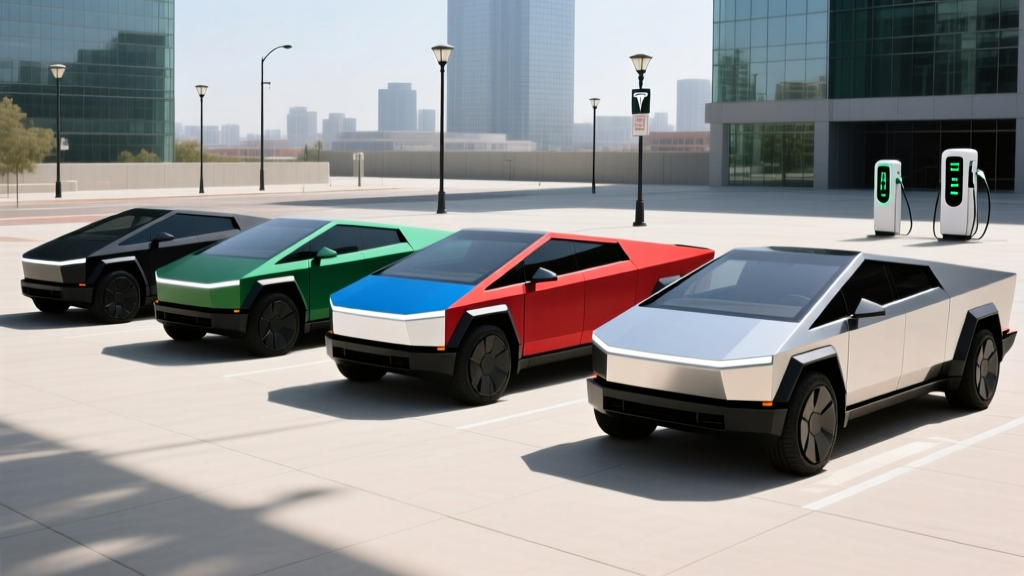
The stainless-steel body panels are the Cybertruck's signature, but they aren't your only option. Here's how Tesla Cybertruck color choices break down for the 2026 model year:
Factory Options from Tesla
- Raw Stainless Steel (standard): The default finish. Cold-rolled, ultra-hard 30X-grade stainless steel that resists dents but shows fingerprints, water spots, and fine scratches. Tesla recommends cleaning with a microfiber cloth and mild detergent.
- Satin Stainless Steel: A factory-applied satin finish that reduces fingerprint visibility and gives the truck a muted, brushed-metal look. Available as a no-cost option at order time on AWD and Cyberbeast trims.
Tesla's Official Color Wraps
Tesla sells factory-installed paint protection film (PPF) wraps through its design studio:
- Satin Black: The most popular dealer-installed wrap. Matte black finish with PPF protection. Adds approximately $3,000 to the vehicle price.
- Satin White: A pearlescent white film that dramatically changes the truck's character. Also ~$3,000 added.
- Stealth PPF (clear): Transparent film that protects the bare steel from water spots and light scratches without altering the silver appearance. ~$2,500.
Aftermarket Wraps and Ceramic Coatings
The aftermarket wrap industry has embraced the Cybertruck's flat panels — they're the easiest truck body to wrap. Full-vehicle vinyl wraps from reputable shops (3M, Avery Dennison materials) run $3,500–$6,000 depending on finish complexity. Ceramic coatings designed for bare stainless steel ($800–$1,500) add hydrophobic protection and reduce fingerprint adhesion without changing color.
Pro tip: Never paint the stainless steel panels. Paint adhesion to 30X stainless is poor, voids the body warranty, and reduces resale value. A high-quality vinyl wrap is removable and reversible — paint is not.
Spec Table: 2026 Tesla Cybertruck at a Glance
| Specification | AWD | Cyberbeast |
|---|---|---|
| EPA Range | 340 mi | 320 mi |
| Battery (usable) | ~123 kWh, NMC | ~123 kWh, NMC |
| Drivetrain | Dual-motor AWD | Tri-motor AWD |
| Horsepower | 600 hp | 845 hp |
| 0–60 mph | 4.1 sec | 2.6 sec |
| Max DC Fast Charge | 250 kW | 250 kW |
| 10–80% Charge Time | ~28 min | ~28 min |
| Level 2 Home Charging | 11.5 kW (~37 mi/hr) | 11.5 kW (~37 mi/hr) |
| Efficiency | 66 MPGe / 51 kWh/100mi | 62 MPGe / 54 kWh/100mi |
| Towing Capacity | 11,000 lbs | 11,000 lbs |
| Payload | 2,500 lbs | 2,500 lbs |
| Bed Length | 6 ft (72 in) | 6 ft (72 in) |
| Cargo Volume (bed) | ~67 cu ft | ~67 cu ft |
| Front Trunk (frunk) | ~7 cu ft | ~7 cu ft |
| Rear Legroom | 38.5 in | 38.5 in |
| Battery/Drive Warranty | 8 yr / 120,000 mi | 8 yr / 120,000 mi |
| Base MSRP | $79,990 | $99,990 |
Source: fueleconomy.gov and Tesla Cybertruck design studio.
Charging Speed: DC Fast, Level 2, and the Charge Curve Reality
The Cybertruck uses the NACS (North American Charging Standard) connector natively — Tesla's own plug, now adopted industry-wide. Here's what charging looks like across all three levels:
| Level | Power | Miles Added / Hour | Notes |
|---|---|---|---|
| Level 1 (120V) | 1.4 kW | ~4 mi/hr | Emergency/top-up only; a full charge takes 80+ hours |
| Level 2 (240V, 48A) | 11.5 kW | ~37 mi/hr | Overnight home charging; 0–100% in ~11 hours |
| DC Fast (Supercharger) | Peak 250 kW | ~150 mi in 15 min | 10–80% in ~28 min; tapers significantly above 80% |
Charge curve reality check: The Cybertruck peaks near 250 kW only between roughly 10–30% state of charge. From 30–60%, it sustains around 150–170 kW. Above 80%, speed drops to under 50 kW as the battery management system protects the NMC cells from lithium plating. If you're road-tripping, plan to charge from 10–80% and skip topping off — the last 20% takes almost as long as the first 70%.
For home charging, a Tesla Wall Connector on a 60-amp circuit delivers the full 11.5 kW (48 amps continuous). Expect to pay $800–$2,500 for professional installation depending on panel proximity and whether your home needs a 200-amp service upgrade. Always use a licensed electrician and pull permits — the Cybertruck's high charge rate demands proper wire gauge and breaker sizing.
Performance and Efficiency: 845 HP Meets a 5,000-lb Curb Weight
The Cyberbeast's tri-motor, 845-horsepower powertrain delivers a 2.6-second 0–60 mph time — making it one of the fastest production trucks ever built. The dual-motor AWD at 600 hp still hits 4.1 seconds. But performance comes with an efficiency cost.
At 51–54 kWh per 100 miles, the Cybertruck is among the least efficient EVs on the market. For comparison, the Rivian R1T dual-motor uses about 48 kWh/100mi and the Ford F-150 Lightning extended-range uses about 47 kWh/100mi. The Cybertruck's flat, angular body creates a high drag coefficient (estimated ~0.40+), and its ~6,800-lb curb weight means more energy spent accelerating mass.
On a 300-mile highway road trip at 75 mph with air conditioning, expect to arrive with roughly 15–20% battery remaining in ideal conditions. In 30°F weather with the heater running, that margin shrinks to near zero without a mid-trip charge stop. The Cybertruck's large battery provides a buffer, but its poor efficiency means you'll visit Superchargers more often than an F-150 Lightning driver on the same route.
Pricing, Tax Credits, and Total Cost
The 2026 Tesla Cybertruck lineup has consolidated into two trims after the base RWD model was discontinued:
| Trim | Base MSRP | As-Tested (typical) | §30D Federal Credit | Effective Price |
|---|---|---|---|---|
| AWD | $79,990 | $83,500 | $0 | $79,990+ |
| Cyberbeast | $99,990 | $104,000 | $0 | $99,990+ |
Federal Tax Credit Eligibility
The Cybertruck does not qualify for the $7,500 federal EV tax credit under IRS §30D. The reason: the credit's MSRP cap for trucks is $80,000, and the AWD trim starts at $79,990 — technically within the cap, but destination fees and any dealer-installed options (including color wraps) push the transaction price above the threshold. The Cyberbeast at $99,990 is far above the limit. Additionally, buyer income caps apply ($150,000 single / $300,000 joint filing) and battery critical-mineral sourcing requirements must be met. Consult a tax professional and review current rules at IRS.gov before purchasing.
- ❌ MSRP cap: $80,000 for trucks — AWD barely qualifies before options; Cyberbeast excluded
- ⚠️ Buyer AGI cap: $150K single / $225K head of household / $300K joint
- ⚠️ Battery sourcing: Critical minerals and components must meet phased-in domestic/FTA-country thresholds
- ✅ Point-of-sale transfer: If eligible, credit can be applied at purchase rather than at tax filing
- ⚠️ Verify current-year rules at irs.gov — requirements change annually
Tech, Interior, and the Stainless-Steel Cabin Experience
The Cybertruck's interior is minimalist even by Tesla standards. A single 18.5-inch touchscreen dominates the dash, running Tesla's latest vehicle software with integrated navigation, media, and vehicle controls. Rear passengers get a 9.4-inch touchscreen for climate and entertainment. There are no physical buttons — not even for the glovebox, which opens via the touchscreen.
Standout features:
- Steer-by-wire: No mechanical connection between the yoke and the wheels. Enables variable steering ratio (fewer turns lock-to-lock at low speed, more stability at highway speed). Takes adjustment but works well once familiar.
- 48-volt electrical architecture: The first production vehicle to use a full 48V system, reducing wiring harness weight and enabling higher-power accessories.
- Bioweapon Defense Mode: HEPA filtration system that pressurizes the cabin against outside air pollutants.
- Powershare (V2L/V2H): Vehicle-to-load capability provides up to 11.5 kW of AC power output — enough to run power tools at a job site or essential home circuits during an outage.
- Autopilot (standard): SAE Level 2 adaptive cruise and lane-centering. Full Self-Driving (Supervised) is a $8,000 add-on but remains Level 2 — you must keep your hands on the yoke and eyes on the road at all times.
Notable drawbacks:
- The yoke steering is polarizing and makes low-speed parking maneuvers less intuitive for some drivers.
- Rear visibility is compromised by the small rear window and bed-wall design; the digital rearview camera mirror is essential.
- Panel gap consistency has improved since 2024 launch vehicles but still draws scrutiny.
- The stainless-steel exterior shows smudges constantly — carry a microfiber cloth.
- Class-leading 11,000-lb towing capacity
- Tri-motor Cyberbeast: 2.6-sec 0–60 is supercar territory
- Stainless steel body is dent- and corrosion-resistant
- 11.5 kW Powershare V2L for job sites and outages
- Native NACS connector; full Supercharger network access
- Unique design — nothing else looks like it
- Poor efficiency (51–54 kWh/100mi) means frequent charging
- No federal tax credit at realistic transaction prices
- Yoke steering has a steep learning curve
- 6-foot bed is shorter than most full-size competitors
- Rear visibility is limited
- Fingerprint-prone exterior demands constant upkeep
- Insurance premiums run 20–40% above comparable trucks
Cybertruck vs. R1T vs. F-150 Lightning: Is It Worth Buying?
The Cybertruck competes in a tight electric truck segment. Here's how it stacks up against the two key rivals:
| Metric | Cybertruck AWD | Rivian R1T Dual-Motor | F-150 Lightning Ext. Range |
|---|---|---|---|
| EPA Range | 340 mi | 352 mi | 320 mi |
| Base MSRP | $79,990 | $69,900 | $67,995 |
| Towing | 11,000 lbs | 11,000 lbs | 10,000 lbs |
| Bed Length | 6 ft | 4.5 ft (+ Gear Tunnel) | 5.5 ft |
| Efficiency | 51 kWh/100mi | 48 kWh/100mi | 47 kWh/100mi |
| §30D Credit | Unlikely | Eligible (qualifying trims) | Eligible (qualifying trims) |
- Choose Cybertruck if: You want maximum towing, V2L Powershare for job-site or backup power, the longest Tesla Supercharger network access, and a design that turns every parking lot into a car show. The stainless body appeals if you're tired of paint chips and door dings.
- Choose Rivian R1T if: You want a more conventional truck experience, better efficiency, a lower starting price with potential tax credit eligibility, and the Gear Tunnel for enclosed storage. Better for off-road adventures with quad-motor option.
- Choose F-150 Lightning if: You need a familiar full-size truck form factor, a traditional dealer network for service, the lowest entry price, and a 5.5-foot bed with a massive front trunk ("Mega Power Frunk"). Best for fleet buyers and traditional truck upgraders.
Battery, Warranty, and Long-Term Ownership
The Cybertruck uses an NMC (nickel-manganese-cobalt) lithium-ion battery pack with approximately 123 kWh of usable capacity. Tesla does not publish exact pack chemistry details, but the energy density and range figures align with their latest 4680-format NMC cells manufactured at Giga Texas.
Tesla's battery and drive unit warranty covers 8 years or 120,000 miles, whichever comes first, with a minimum 70% capacity retention threshold over that period. This is competitive with Rivian's 8-year/120,000-mile warranty and Ford's 8-year/100,000-mile coverage.
Based on Tesla's fleet degradation data across Model 3 and Model Y vehicles with similar NMC chemistry, owners can expect approximately 10–12% total degradation over 150,000 miles, with the steepest drop occurring in the first 20,000 miles before leveling off. The Cybertruck's large 123-kWh pack provides a buffer: even at 12% degradation, you'd retain roughly 299 miles of range (AWD) — still very usable.
Ownership costs to budget for:
- Insurance: Expect $2,800–$4,200 annually depending on state and driving record — significantly above gas full-size trucks.
- Tires: The 35×8.5R20 all-terrain tires are unique and costly (~$400–$500 each); expect 30,000–40,000 miles per set given the vehicle's weight and torque.
- Home charger installation: $800–$2,500 one-time cost for a Tesla Wall Connector.
- Electricity: At the US average of $0.16/kWh, "fueling" the Cybertruck costs approximately $0.08 per mile — about half the per-mile cost of a gas F-150 at $3.50/gallon.
Frequently Asked Questions
What is the real-world range of the Tesla Cybertruck?
The EPA rates the AWD at 340 miles and the Cyberbeast at 320 miles. In real-world highway driving at 70 mph, expect 270–300 miles. In cold weather (below 32°F), range drops to 230–260 miles. Towing a trailer cuts range to roughly 150–180 miles depending on weight and aerodynamics.
How fast does the Cybertruck charge?
On a V3 or V4 Tesla Supercharger, the Cybertruck peaks at 250 kW and charges from 10–80% in approximately 28 minutes. At home on a Level 2 Tesla Wall Connector (11.5 kW / 48 amps), you gain about 37 miles of range per hour, fully charging overnight in roughly 11 hours.
Does the Tesla Cybertruck qualify for the federal EV tax credit?
Practically, no. The §30D credit caps truck MSRP at $80,000. While the AWD starts at $79,990, destination fees and any options push it over. The Cyberbeast at $99,990 is far above the cap. Buyer income limits and battery-sourcing rules add further restrictions. Verify current eligibility at IRS.gov.
Can I paint the Cybertruck's stainless steel body?
Technically possible but strongly discouraged. Paint does not adhere well to 30X-grade stainless steel, will chip and peel, voids the body warranty, and hurts resale value. A vinyl wrap ($3,500–$6,000 aftermarket, ~$3,000 through Tesla) is the correct approach for color customization. It's removable, protective, and reversible.
What Tesla Cybertruck color options does Tesla offer?
For 2026, Tesla offers raw stainless steel (standard), satin stainless steel (no-cost option), and dealer-installed wraps in satin black, satin white, and clear stealth PPF. The aftermarket wrap industry offers virtually unlimited color and finish options including matte, gloss, metallic, and color-shift films.
Is the Cybertruck good for towing?
Yes — its 11,000-lb max tow rating matches the Rivian R1T and exceeds the F-150 Lightning's 10,000-lb rating. However, towing any heavy trailer cuts EV range dramatically. Expect 150–180 miles of range with a 5,000–7,000-lb trailer, requiring careful route planning around Supercharger locations.
How does steer-by-wire feel?
The variable-ratio steering means less than one full turn lock-to-lock at parking speeds (no hand-over-hand) and a more traditional feel at highway speeds. Most owners adapt within a few days, but it can feel unnerving during the first drive. The yoke complements the system by never requiring you to cross your arms.
What's the biggest drawback of owning a Cybertruck?
Efficiency. At 51–54 kWh/100mi, the Cybertruck uses more electricity per mile than any competitor, which means higher charging costs and more frequent stops on road trips. Combined with no federal tax credit eligibility, the total cost of ownership is meaningfully higher than the Rivian R1T or F-150 Lightning for equivalent use cases.