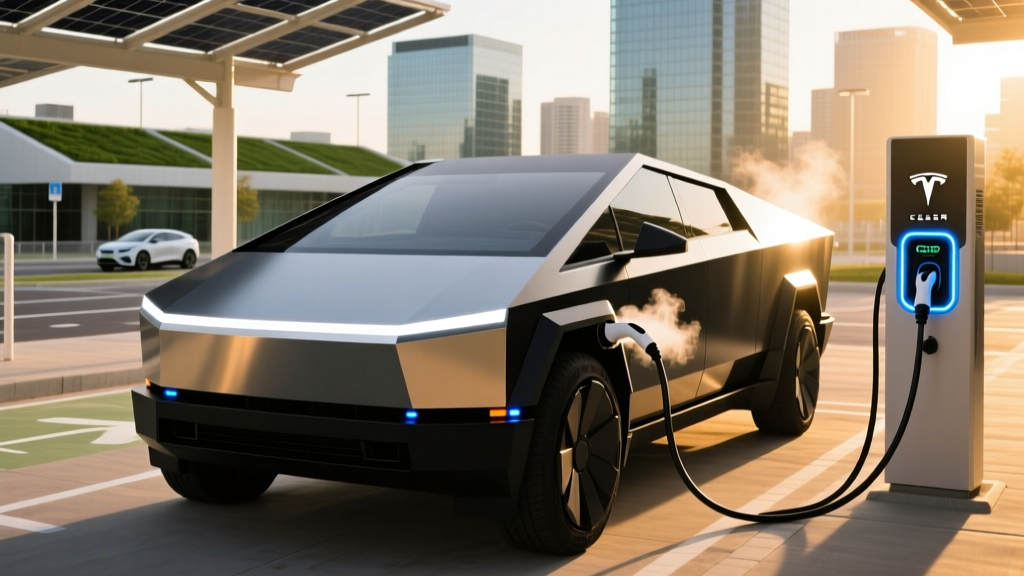
If you've searched "how long does it take to charge a Tesla truck" you're likely weighing whether the Cybertruck fits your daily driving and road-trip routine. The answer depends on which charging method you use, which trim you buy, and how you drive. Below, we break down every charging scenario for the 2026 Tesla Cybertruck — from 15-minute highway pit stops to overnight home replenishment — alongside real-world range data, pricing, and ownership economics.
Tesla Cybertruck Charging Times: DC Fast, Level 2, and Level 1
The 2026 Cybertruck uses Tesla's NACS (North American Charging Standard) connector natively, meaning it plugs directly into the Tesla Supercharger network without an adapter. Tesla rates the Cybertruck's peak DC fast-charge acceptance at 250 kW on V3 Superchargers and up to 350 kW on the latest V4 Supercharger cabinets with integrated CCS/NACS power electronics.
Peak rate, however, is not sustained rate. Lithium-ion charge curves taper significantly above 50% State of Charge (SoC), and more aggressively above 80%. Here's what actual charging sessions look like:
| Charging Method | Power (kW) | Miles Added per Hour | 10–80% Time | Notes |
|---|---|---|---|---|
| V4 Supercharger (DC) | Peak 350 kW | ~550 mi/hr (peak) | ~15 minutes | Requires preconditioning; sustained rate tapers above 50% SoC |
| V3 Supercharger (DC) | Peak 250 kW | ~400 mi/hr (peak) | ~18 minutes | Most common Tesla highway charger |
| Non-Tesla DC (Electrify America, etc.) | Peak 250 kW | ~400 mi/hr (peak) | ~20 minutes | NACS-native; no adapter needed at most networks by 2026 |
| Home Level 2 (Tesla Wall Connector, 48A) | 11.5 kW | ~34 mi/hr | ~9 hours (full) | Requires 60A circuit; ideal overnight charge |
| Home Level 2 (Mobile Connector, 32A) | 7.7 kW | ~23 mi/hr | ~13.5 hours (full) | Uses NEMA 14-50 outlet on 40A circuit |
| Level 1 (120V household) | ~1.4 kW | ~3–4 mi/hr | N/A (emergency only) | Adds ~35 miles overnight — sufficient only for low-mileage days |
Preconditioning matters. When you navigate to a Supercharger using the Cybertruck's built-in navigation, the thermal management system warms or cools the battery pack to its optimal charging temperature. Skip preconditioning — for instance, by driving to a charger without setting it as your navigation destination — and your peak charge rate can drop by 30–50%, especially in cold weather.
2026 Cybertruck Range: EPA Sticker vs. Real-World Driving
EPA range estimates are a starting point, not a guarantee. The Cybertruck's angular stainless-steel exoskeleton creates more aerodynamic drag than a sleek sedan, and its 6,600+ lb curb weight demands more energy per mile, especially at highway speeds and in cold temperatures.
| Trim | Battery (kWh, usable) | Chemistry | EPA Range | Real-World Highway (~75 mph) | Cold Weather (~20°F) |
|---|---|---|---|---|---|
| Rear-Wheel Drive (RWD) | ~100 kWh | NMC (Nickel Manganese Cobalt) | 250 mi | ~210–225 mi | ~170–190 mi |
| All-Wheel Drive (AWD) | ~112 kWh | NMC | 340 mi | ~280–300 mi | ~220–245 mi |
| Cyberbeast (Tri-Motor AWD) | ~123 kWh | NMC | 320 mi | ~265–285 mi | ~210–230 mi |
The AWD trim delivers the best range-to-weight balance. The Cyberbeast's third motor adds performance but costs roughly 20 miles of EPA range compared to the dual-motor AWD. Cold weather reduces range across all trims by 20–30% due to battery resistance and cabin heating demands — though the Cybertruck's heat pump mitigates some of this loss compared to resistive heaters.
For towing, expect a 40–55% range reduction depending on trailer weight and aerodynamics. Tesla rates the AWD and Cyberbeast at 11,000 lbs max towing. A 7,000-lb enclosed trailer at highway speed will compress a 340-mile EPA range to roughly 150–180 miles — plan your Supercharger stops accordingly.
Cybertruck Specs: Battery, Performance, and Efficiency
The Cybertruck uses an NMC (nickel manganese cobalt) battery architecture across all trims. NMC offers higher energy density than LFP (lithium iron phosphate), which matters in a heavy truck where every pound of battery must deliver maximum range. The trade-off: NMC degrades slightly faster than LFP over thousands of cycles, and Tesla recommends daily charging to 80% rather than 100% for longevity (reserve 100% for road trips).
| Spec | RWD | AWD | Cyberbeast |
|---|---|---|---|
| Horsepower | ~600 hp | ~845 hp | ~845 hp |
| 0–60 mph | ~4.8 sec | ~3.9 sec | ~2.6 sec |
| Drivetrain | Single motor RWD | Dual motor AWD | Tri-motor AWD |
| MPGe (combined) | ~70 MPGe | ~67 MPGe | ~64 MPGe |
| kWh / 100 mi | ~48 kWh | ~50 kWh | ~53 kWh |
| Top Speed | 112 mph | 130 mph | 130 mph |
Efficiency in the mid-40s to low-50s kWh per 100 miles is typical for full-size electric trucks. For comparison, the EPA lists the Cybertruck AWD at roughly 67 MPGe combined, which translates to about $0.14–$0.18 per mile on the national average electricity rate of $0.17/kWh — roughly half the per-mile fuel cost of a comparable gas truck getting 18 MPG at $3.50/gallon.
Interior, Cargo, and Technology
The Cybertruck seats five across two rows, with a 6.5-foot bed and a front trunk (frunk) for additional enclosed storage. Interior dimensions prioritize function over luxury:
- Bed length: 72 inches (6 ft) with tailgate closed; extendable with tailgate down
- Bed width (between wheel wells): ~49 inches — does not fit standard 4×8 plywood flat
- Frunk volume: ~7 cu ft
- Rear legroom: ~38 inches
- Towing capacity: 7,500 lbs (RWD) / 11,000 lbs (AWD & Cyberbeast)
- Payload capacity: ~2,500 lbs
Standout tech: The 18.5-inch center touchscreen runs Tesla's latest software with native trip planning that factors in elevation, wind, temperature, and trailer load when estimating range and routing to Superchargers. Steer-by-wire replaces the mechanical steering column — a first for a production truck — and enables a yoke-style steering wheel with variable ratio (fewer hand-over-hand turns at low speed). The stainless-steel exoskeleton eliminates the need for paint, though it is fingerprint-prone.
Driver assistance: Tesla's Autopilot comes standard (SAE Level 2), with Full Self-Driving (Supervised) available as a paid upgrade. Both require continuous driver attention — hands on the yoke, eyes on the road. This is not autonomous driving; it is an advanced cruise-and-lane-keeping system.
2026 Cybertruck Pricing and Federal Tax Credit Eligibility
The Cybertruck's pricing has shifted since its 2023 launch as Tesla scales production and adjusts to demand. Here are the 2026 model-year MSRPs and estimated out-of-pocket costs:
| Trim | Base MSRP | As-Tested (common options) | Est. Federal Credit (§30D) | Effective Price |
|---|---|---|---|---|
| RWD | $60,990 | $62,990 | Up to $7,500* | ~$55,490 |
| AWD | $79,990 | $83,990 | Up to $7,500* | ~$76,490 |
| Cyberbeast | $99,990 | $104,990 | $0 (exceeds MSRP cap) | ~$104,990 |
*Federal tax credit caveats: Under IRS §30D rules, the Cybertruck qualifies as a light truck, so the MSRP cap is $80,000. The RWD and AWD trims fall under that cap; the Cyberbeast does not. Additionally, the buyer must meet income limits ($150,000 single / $300,000 joint AGI), and the vehicle must satisfy critical-mineral and battery-component sourcing requirements that shift annually. As of 2026, Tesla's North American battery sourcing partially qualifies — the exact credit amount may be $3,750 or $7,500 depending on the specific build date and supply-chain compliance. The credit can be transferred to the dealer as a point-of-sale discount. Always verify current eligibility at fueleconomy.gov and consult a tax professional.
Cybertruck vs. Competitors: Ford F-150 Lightning and Rivian R1T
The electric truck segment in 2026 has three primary contenders. Here's how they stack up on the metrics that matter most:
| Spec | Tesla Cybertruck AWD | Ford F-150 Lightning (Ext. Range) | Rivian R1T (Dual-Motor Max) |
|---|---|---|---|
| EPA Range | 340 mi | 320 mi | 352 mi |
| Peak DC Charge | 250–350 kW | 150 kW | 200+ kW |
| 10–80% DC Time | ~18 min | ~41 min | ~28 min |
| 0–60 mph | 3.9 sec | ~5.0 sec | ~4.5 sec |
| Towing | 11,000 lbs | 10,000 lbs | 11,000 lbs |
| Base MSRP | $79,990 | ~$69,995 | ~$79,900 |
| Bed Length | 6 ft | 5.5 ft | 4.5 ft (standard) |
| Frunk | 7 cu ft | 14.1 cu ft | 11 cu ft |
The Cybertruck's charging speed advantage is clear — its 250–350 kW peak rate shaves 10–20 minutes off a highway stop compared to the Lightning. The Rivian R1T offers the best EPA range and a more conventional truck aesthetic, but charges slower than the Tesla. The F-150 Lightning wins on practicality (largest frunk, familiar truck layout, lowest starting price) but trails significantly on charging speed.
Cybertruck Pros
- Fastest DC charging in the electric truck segment
- Tri-motor Cyberbeast offers supercar-level acceleration
- Tesla Supercharger network reliability (20,000+ stalls in North America)
- Stainless-steel exoskeleton resists dents and eliminates paint
- Over-the-air updates continuously add features
- Heat pump standard for better cold-weather efficiency
Cybertruck Cons
- Bed too narrow between wheel wells for standard plywood
- Steer-by-wire and yoke feel unfamiliar to traditional truck buyers
- No rear cargo box (bed) lock — tonneau cover only
- Cyberbeast exceeds $80K MSRP cap for federal tax credit
- Visibility challenged by thick A-pillars and flat rear window
- Real-world highway and cold-weather range drops 15–30% vs. EPA
Battery Warranty and Long-Term Ownership
Tesla covers the Cybertruck's battery and drive unit for 8 years or 120,000 miles (whichever comes first), with a minimum 70% capacity retention threshold. If the battery degrades below 70% within that window, Tesla replaces or refurbishes it at no cost. The vehicle limited warranty runs 4 years or 50,000 miles.
NMC batteries typically degrade 10–15% over the first 150,000 miles based on Tesla's fleet data. For an AWD Cybertruck starting at 340 EPA miles, that means ~290–305 miles of usable range at 150K miles. Best practices for longevity: charge to 80% daily, avoid repeated 100% charges, minimize DC fast-charging in extreme heat, and use scheduled departure preconditioning when possible.
Who Should Buy the 2026 Tesla Cybertruck?
Choose the Cybertruck AWD if: You need fast highway charging for road trips, want 340 miles of EPA range, tow occasionally (under 8,000 lbs in practice for range comfort), and have home Level 2 charging. It's the best all-around trim.
Choose the Cyberbeast if: Performance is a priority, you rarely tow heavy loads, and the $100K+ price without a tax credit doesn't deter you.
Choose the RWD if: Budget matters most, you live in a mild climate, and 250 miles covers your daily needs with home charging.
Look elsewhere if: You need a full 8-foot bed for construction work (consider the F-150 Lightning with the 8-ft bed option), you want a conventional steering wheel, or you frequently tow over 8,000 lbs long-distance (range becomes impractical for all current EV trucks).
Frequently Asked Questions
How long does it take to charge a Tesla Cybertruck at a Supercharger?
At a V3 Supercharger (250 kW), the Cybertruck charges from 10% to 80% in approximately 18 minutes with battery preconditioning enabled. At a V4 Supercharger (350 kW), that drops to roughly 15 minutes. Charging above 80% slows significantly — a full 80–100% top-off can add another 20+ minutes.
Can I charge a Cybertruck at home overnight?
Yes. With a Tesla Wall Connector on a 60-amp circuit delivering 11.5 kW (48 amps), the Cybertruck gains about 34 miles of range per hour. A full charge from near-empty takes roughly 9 hours, so overnight charging easily replenishes a day's driving. A standard NEMA 14-50 outlet at 7.7 kW takes about 13.5 hours for a full charge.
Does the Tesla Cybertruck qualify for the $7,500 federal tax credit?
The RWD ($60,990) and AWD ($79,990) trims fall under the $80,000 MSRP cap for trucks and may qualify for up to $7,500 under IRS §30D, subject to buyer income limits ($150K single / $300K joint), battery sourcing requirements, and point-of-sale transfer availability. The Cyberbeast ($99,990) exceeds the MSRP cap and does not qualify. Verify current rules at irs.gov.
What is the real-world range of the Cybertruck on the highway?
Expect roughly 280–300 miles at 75 mph in mild weather for the AWD trim (EPA-rated 340 mi). In cold weather (20°F or below), range drops to approximately 220–245 miles. Towing a 7,000-lb trailer compresses range to 150–180 miles regardless of weather.
Is the Cybertruck worth it compared to the Ford F-150 Lightning?
The Cybertruck charges roughly twice as fast on DC and offers more EPA range in the AWD trim, but it costs more, has a smaller bed, and lacks the Lightning's massive frunk. If charging speed and tech appeal are priorities, the Cybertruck wins. If you want a practical work truck at a lower price, the Lightning is the stronger choice.
What battery chemistry does the Cybertruck use?
All 2026 Cybertruck trims use NMC (nickel manganese cobalt) chemistry for its superior energy density. Unlike LFP batteries, NMC performs best when charged to 80% for daily use rather than 100%. Tesla's battery management system includes a buffer to protect against deep discharge and overcharge degradation.