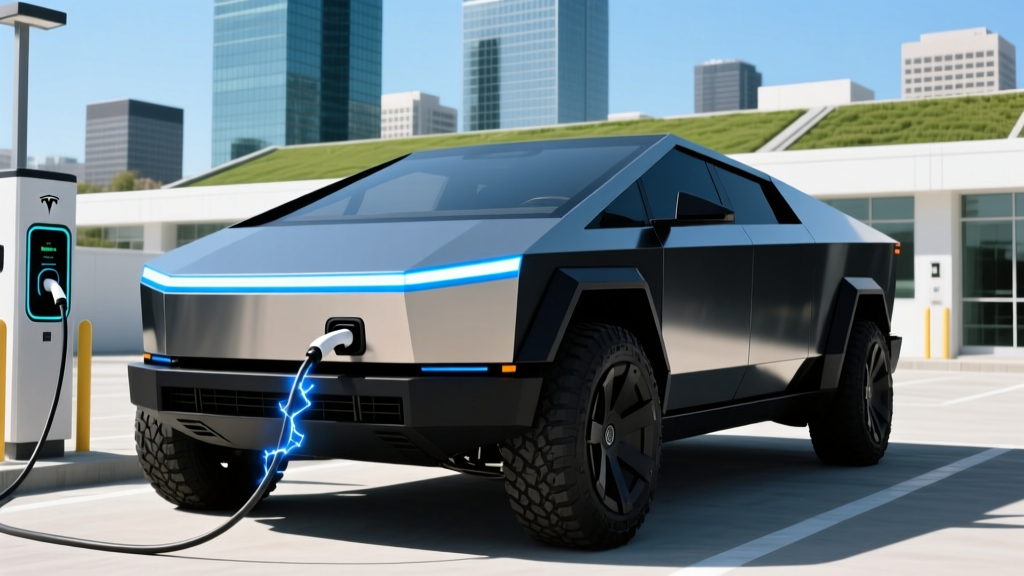
The Tesla Cybertruck is unlike anything else on the road — a stainless-steel, angular pickup that polarizes onlookers but delivers serious capability. But for buyers and owners, the practical questions always come back to charging. How long does it take to charge a Tesla Cybertruck in the real world? Whether you're plugged into a Supercharger on a road trip or topping off at home overnight, the answer depends on which model you drive, what charger you're using, and how you manage the battery.
This review covers every charging scenario, pairs EPA range estimates with real-world expectations, and evaluates whether the Cybertruck's electrified truck proposition holds up against competitors like the Ford F-150 Lightning and Rivian R1T in 2026.
Tesla Cybertruck: Core Specs at a Glance
Before we dig into charging specifics, here's the full spec breakdown for the 2026 Tesla Cybertruck lineup. Tesla currently offers the Long Range AWD and the Cyberbeast tri-motor variant. The previously announced base RWD model has been pushed to a later production window and remains unavailable for purchase.
| Spec | Long Range AWD | Cyberbeast (Tri-Motor AWD) |
|---|---|---|
| EPA Range | 340 miles | 320 miles |
| Battery Capacity (usable) | ~123 kWh (estimated, NMC) | ~123 kWh (estimated, NMC) |
| Max DC Fast Charge | 250 kW (V3 Supercharger) | 250 kW (V3 Supercharger) |
| 10–80% DC Fast Charge | ~28 minutes | ~28 minutes |
| Level 2 Home Charge Rate | 11.5 kW (~34 mi/hr) | 11.5 kW (~34 mi/hr) |
| 0–60 mph | 4.1 seconds | 2.6 seconds |
| Horsepower | 600 hp | 845 hp |
| Drivetrain | Dual-Motor AWD | Tri-Motor AWD |
| MPGe (combined) | 67 MPGe | 63 MPGe |
| Efficiency (kWh/100 mi) | 50 kWh/100 mi | 53 kWh/100 mi |
| Towing Capacity | 11,000 lbs | 11,000 lbs |
| Bed Length | 6 ft (72 in) | 6 ft (72 in) |
| Cargo Volume (bed + frunk) | ~67 cu ft bed + ~7 cu ft frunk | ~67 cu ft bed + ~7 cu ft frunk |
| Base MSRP | $79,990 | $99,990 |
| Battery/Drive Unit Warranty | 8 years / 120,000 miles | 8 years / 120,000 miles |
Sources: fueleconomy.gov, Tesla official specifications. Real-world figures may vary by conditions.
How Long Does It Take to Charge a Tesla Cybertruck?
This is the question that dominates Cybertruck forums and buyer research. The answer varies dramatically based on the charging level you're using. Here's a comprehensive breakdown of every charging scenario you'll encounter as a Cybertruck owner.
| Charging Level | Power (kW) | Miles of Range Added per Hour | Typical Use Case |
|---|---|---|---|
| Level 1 (120V household outlet) | ~1.4 kW | ~3–4 miles/hr | Emergency trickle; not practical for daily use |
| Level 2 (240V, 48A Wall Connector) | 11.5 kW | ~34 miles/hr | Primary home charging; full charge in ~11 hours |
| DC Fast Charge (Tesla V3 Supercharger) | Up to 250 kW | ~200+ miles in 15 min | Road trips; 10–80% in ~28 minutes |
| DC Fast Charge (Tesla V4 Supercharger) | Up to 350 kW (cable-limited to ~250 kW for Cybertruck) | Similar to V3 for current Cybertruck | Newer Supercharger stations; same vehicle-side limit applies |
Understanding the DC Fast-Charging Curve
The Cybertruck's ~123 kWh battery pack (estimated usable capacity, NMC chemistry) can accept a peak charge rate of 250 kW at Tesla V3 Superchargers. However, peak kW is not sustained kW. The charging curve tapers significantly as the state of charge (SoC) rises:
- 10–30% SoC: The Cybertruck sustains close to its 250 kW peak, adding range rapidly.
- 30–60% SoC: Charge rate gradually tapers to ~180–200 kW.
- 60–80% SoC: Further taper to ~100–130 kW.
- Above 80% SoC: Dramatic slowdown to protect the battery; charging from 80–100% can add another 20–30 minutes.
This is why the 10–80% time of approximately 28 minutes is the standard benchmark. If you need a full 100% charge before a long towing day, budget for roughly 50–55 minutes total at a Supercharger.
Home Level 2 Charging: What You Need to Know
For daily use, the Tesla Wall Connector on a 60-amp circuit (delivering 48 amps / 11.5 kW to the truck) is the gold standard. At this rate, you'll recover roughly 34 miles of range per hour, meaning a full 0–100% charge takes about 11 hours. Most owners who plug in each evening with 40–60% remaining will reach full charge by morning without issue.
Home charging installation cost: Expect to pay $500–$1,500 for a standard Wall Connector install if your electrical panel has capacity. If you need a panel upgrade (common in older homes with 100-amp service), costs can climb to $2,500–$4,500. Always get a quote from a licensed electrician before committing.
The Cybertruck Long Range AWD carries an EPA-estimated 340 miles of range. However, real-world results diverge based on conditions:
- Highway driving (75 mph, moderate temps): Expect ~270–300 miles. The Cybertruck's brick-like aerodynamics (despite Tesla's claims) hit efficiency hard at sustained highway speeds.
- City/mixed driving: Closer to the EPA figure, around 310–330 miles, thanks to regenerative braking recapturing energy in stop-and-go traffic.
- Cold weather (below 32°F): Range drops 20–30%, putting realistic winter range at ~230–270 miles. The Cybertruck's heat pump helps mitigate cabin energy draw, but battery chemistry still suffers in the cold.
- Towing: When pulling a 7,000–10,000 lb trailer, expect range to roughly halve — around 150–180 miles. Plan Supercharger stops accordingly.
Efficiency: MPGe and Energy Consumption
The Cybertruck is not an efficiency champion, and that's expected for a 6,800+ pound stainless-steel pickup. The Long Range AWD achieves an EPA-rated 67 MPGe combined (50 kWh per 100 miles), while the Cyberbeast drops to 63 MPGe (53 kWh/100 mi). For comparison, the Ford F-150 Lightning Extended Range rates at 66 MPGe combined, so the Cybertruck is in the same ballpark despite its unconventional shape.
At the national average electricity rate of ~$0.17/kWh (as of early 2026), charging the Cybertruck's full battery costs roughly $21 at home — or about $0.06–0.07 per mile. That's dramatically cheaper than a gas-powered F-150 at ~$0.18–0.22/mile, though public DC fast-charging at $0.35–0.50/kWh narrows the gap significantly on road trips.
Performance and Driving Experience
The Cybertruck's performance figures are extraordinary for a pickup. The Long Range AWD's dual-motor setup delivers 600 horsepower and a 4.1-second 0–60 mph time — quicker than most sports sedans. The Cyberbeast's tri-motor layout pushes 845 hp and a 2.6-second 0–60, placing it in supercar territory.
Beyond straight-line speed, the Cybertruck features:
- 4-wheel steering: The rear wheels turn up to 10 degrees, giving the truck a surprisingly tight turning circle (approx. 40.2 ft curb-to-curb) and improved low-speed maneuverability.
- Adaptive air suspension: Up to 17 inches of ground clearance in Off-Road mode; lowers for highway efficiency and ease of entry.
- Steer-by-wire: No physical connection between the yoke and the wheels. This takes adjustment but enables the variable ratio that makes the yoke viable at all speeds.
- Exoskeleton body: Ultra-hard 30X cold-rolled stainless steel panels that resist dents but make body repair complex and expensive.
Driver Assistance: Autopilot and FSD (Supervised)
Tesla's Autopilot and Full Self-Driving (Supervised) are SAE Level 2 driver-assistance systems. The driver must remain fully engaged, hands on the yoke (or torque-applied), and eyes on the road at all times. The Cybertruck is not a self-driving vehicle. Only Level 4 services like Waymo operate without a human driver in defined areas.
The Cybertruck ships with Tesla's latest hardware suite and supports FSD (Supervised) for $8,000 (one-time purchase) or $99/month as of 2026. FSD handles highway lane changes, city street navigation, and parking maneuvers, but requires constant supervision. Real-world reliability varies by region and road complexity.
Pricing, Trims, and Federal Tax Credit Eligibility
| Trim | Base MSRP | Federal §30D Credit Eligible? | Est. Price After Credit |
|---|---|---|---|
| Long Range AWD | $79,990 | No (exceeds $80,000 truck MSRP cap) | $79,990 |
| Cyberbeast | $99,990 | No (exceeds $80,000 truck MSRP cap) | $99,990 |
This is a critical point for buyers researching incentives: the Tesla Cybertruck does not qualify for the $7,500 federal EV tax credit under IRS §30D. The reason is the MSRP cap. Under current rules, trucks (which the Cybertruck is classified as by the IRS) must have an MSRP at or below $80,000 to be eligible. The Long Range AWD at $79,990 technically sits at the threshold, but destination fees and any dealer-installed options push it over. The Cyberbeast at $99,990 is well above the cap.
Additional §30D requirements — even if the MSRP were met — include buyer income limits ($150,000 single / $300,000 joint AGI), battery critical-mineral sourcing thresholds, and North American assembly rules. The Cybertruck is assembled in Austin, Texas, satisfying the assembly requirement, but the MSRP cap is the disqualifying factor. Always verify current rules at IRS.gov before making a purchase decision.
State incentives may still apply. Some states offer their own EV rebates or HOV-lane access regardless of federal eligibility. Check your state's energy or DMV website for current programs.
Cargo, Passenger Space, and Practicality
The Cybertruck is a crew-cab pickup with seating for five. Interior dimensions are competitive with midsize trucks, though the sloping roofline compromises rear headroom for taller passengers:
- Front headroom: ~40.2 inches
- Rear headroom: ~37.8 inches (tight for 6'2"+ passengers)
- Front legroom: ~41.5 inches
- Rear legroom: ~38.2 inches
- Bed length: 6 feet (72 inches) with the tonneau cover closed; the motorized cover retracts into the bed wall
- Bed width (between wheel wells): ~49 inches
- Frunk (front trunk): ~7 cu ft — useful for groceries or charging cables but smaller than the F-150 Lightning's massive 14.1 cu ft frunk
- Towing capacity: 11,000 lbs (both trims)
- Payload capacity: ~2,500 lbs
The motorized stainless-steel tonneau cover is a standout feature, providing secure, lockable bed storage. However, it limits the ability to carry tall items that extend above the bed walls — a real tradeoff vs. conventional open-bed trucks.
Cybertruck vs. Competitors: Is It Worth Buying?
The Cybertruck competes against the Ford F-150 Lightning, Rivian R1T, and the Chevrolet Silverado EV. Here's how it stacks up on the metrics that matter:
| Spec | Tesla Cybertruck LR AWD | Ford F-150 Lightning Ext. Range | Rivian R1T Dual-Motor Max |
|---|---|---|---|
| EPA Range | 340 mi | 320 mi | 410 mi |
| Max DC Charge | 250 kW | 150 kW | 220 kW |
| 10–80% Time | ~28 min | ~41 min | ~30 min |
| 0–60 mph | 4.1 sec | 3.8 sec | 4.5 sec |
| Towing | 11,000 lbs | 10,000 lbs | 11,000 lbs |
| Base MSRP | $79,990 | $76,995 | $89,900 |
| Federal Tax Credit | No | Yes (select trims) | No |
Decision Framework
Choose the Cybertruck if: You prioritize Supercharger network access, want tri-motor performance (Cyberbeast), value the stainless-steel exoskeleton durability, and don't need federal tax credit eligibility.
Choose the F-150 Lightning if: You want a more conventional truck experience, need the largest frunk, want potential §30D tax credit eligibility on qualifying trims, and prefer Ford dealer service infrastructure.
Choose the Rivian R1T if: Maximum range is your top priority, you value premium interior materials and off-road capability, and you're willing to pay a premium for the Max Pack.
Pros and Cons
Pros
- Class-leading DC fast-charging speed (250 kW, ~28 min 10–80%)
- Access to Tesla's Supercharger network — the most reliable public charging infrastructure in the US
- Extraordinary performance, especially Cyberbeast's 2.6-sec 0–60
- 4-wheel steering makes it surprisingly maneuverable
- Stainless-steel body resists dents and corrosion
- Strong towing capacity (11,000 lbs) with integrated trailer brake controller
- Over-the-air updates continuously add features
Cons
- No federal tax credit eligibility (MSRP exceeds §30D cap)
- Polarizing design — not universally appealing
- Steer-by-wire and yoke require significant adaptation
- Real-world highway range falls well short of EPA, especially while towing
- Stainless-steel body panels are expensive and difficult to repair after collision damage
- Rear headroom is tight for tall passengers
- Small frunk compared to F-150 Lightning
- Insurance costs are above average for the segment
Warranty and Long-Term Ownership
Tesla covers the Cybertruck's battery pack and drive units for 8 years or 120,000 miles, whichever comes first, with a minimum 70% capacity retention guarantee. The limited vehicle warranty is 4 years / 50,000 miles. This battery warranty is competitive with Ford (8 yr / 100,000 mi for the Lightning) and Rivian (8 yr / 175,000 mi for the R1T — a notable advantage).
The Cybertruck uses an estimated 123 kWh NMC (nickel-manganese-cobalt) battery pack. NMC chemistry offers high energy density, which is necessary to achieve 340 miles in a heavy truck, but is more susceptible to long-term degradation than LFP (lithium iron phosphate). To maximize battery longevity:
- Set daily charge limit to 80–90% for routine use.
- Avoid leaving the truck at 100% SoC for extended periods.
- Use preconditioning before DC fast-charging (the Cybertruck does this automatically when you navigate to a Supercharger).
- In extreme cold, plug in when possible to let the thermal management system maintain battery temperature.
Frequently Asked Questions
What is the real-world range of the Tesla Cybertruck?
The Long Range AWD has an EPA-estimated 340 miles, but expect 270–300 miles in real-world highway driving, 230–270 miles in freezing temperatures, and as low as 150–180 miles when towing near max capacity. The Cyberbeast rates at 320 miles EPA with similar real-world reductions.
How fast does the Cybertruck charge at home?
On a Tesla Wall Connector (48A / 11.5 kW Level 2), the Cybertruck adds approximately 34 miles of range per hour. A full charge from near-empty takes about 11 hours. Most owners who charge nightly from 40–60% SoC wake up to a full battery every morning.
Does the Tesla Cybertruck qualify for the $7,500 federal EV tax credit?
No. Under IRS §30D rules, trucks must have an MSRP at or below $80,000. The Cybertruck Long Range AWD starts at $79,990 but destination fees push it above the cap, and the Cyberbeast at $99,990 is well above it. Always check IRS.gov for the most current eligibility rules, as they can change.
Can the Cybertruck use non-Tesla chargers?
Yes. The Cybertruck uses the NACS (North American Charging Standard) connector natively, which is the Tesla standard. As of 2025–2026, most major automakers have adopted NACS, and networks like Electrify America, EVgo, and ChargePoint are deploying NACS cables. You can also use a NACS-to-CCS adapter at legacy CCS stations if needed.
Is the Cybertruck good for towing long distances?
The 11,000-lb towing capacity is impressive, but range while towing drops dramatically — expect roughly 150–180 miles between charges with a heavy trailer. Supercharger stations with pull-through spots are expanding but still limited in some regions. Plan routes carefully and expect longer trip times when towing.
How much does it cost to charge a Cybertruck?
At the national average home electricity rate (~$0.17/kWh), a full charge costs roughly $21. At public DC fast chargers ($0.35–$0.50/kWh), a full charge runs $43–$62. Per-mile costs range from ~$0.06 at home to ~$0.12–0.16 on public fast chargers — still less than gas in most scenarios.
Who is the Cybertruck best suited for?
The Cybertruck is best for tech-forward buyers who want a high-performance electric truck, have reliable home charging access, value the Supercharger network for road trips, and don't rely on the federal tax credit to make the math work. It's less ideal for buyers who need maximum passenger space, prefer conventional styling and controls, or frequently tow long distances in cold climates.