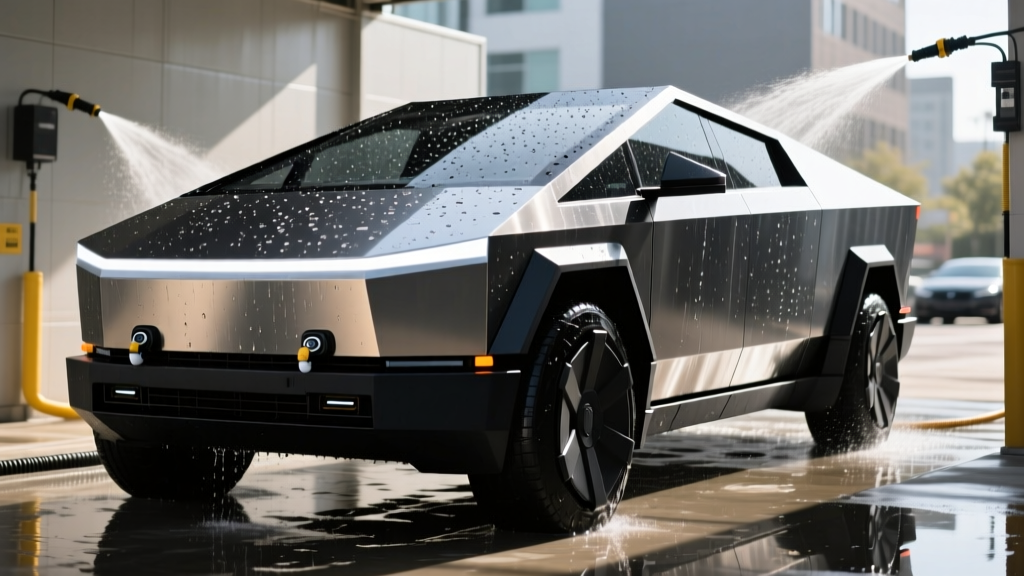
The Tesla Cybertruck is unlike anything else on the road — a stainless-steel exoskeleton, steer-by-wire steering, and a 48-volt electrical architecture that rewrites pickup truck engineering. But beyond the polarizing design and headline-grabbing performance, Cybertruck owners face a very practical question: how do you wash this thing without damaging its electronics or triggering sensor errors? That's where Cybertruck Car Wash Mode comes in — a software feature that locks charge ports, disables wipers, and mutes parking sensors so you can run the truck through a touchless wash without a cascade of warnings.
This review covers everything a prospective or current Cybertruck owner needs to know: real-world range, charging speeds, Car Wash Mode functionality, pricing after tax credits, and whether this electric pickup actually makes sense for your daily life.
Cybertruck Car Wash Mode: What It Does and Why It Matters
Car Wash Mode is accessible from the Cybertruck's 18.5-inch center touchscreen under Controls > Service. When activated, it performs several critical functions simultaneously:
- Charge port door lock: Prevents the charge port from opening mid-wash, which could allow water intrusion into high-voltage components.
- Automatic wiper disable: Stops the rain-sensing wipers from activating when water hits the windshield — a common annoyance that can damage wiper blades against dry glass in some automated washes.
- Parking sensor and camera mute: Suppresses ultrasonic sensor alerts and proximity warnings that would otherwise trigger continuously from wash equipment and water spray.
- Suspension lock: Prevents the adaptive air suspension from self-leveling during the wash cycle, which could shift the vehicle on a conveyor track.
- Window and vent close: Ensures all windows are fully sealed and the HVAC intake is set to recirculate.
Car Wash Mode is not unique to the Cybertruck — Tesla offers it across its fleet — but it's particularly important here because the truck's angular geometry, exposed panel gaps, and sensor placement make it more prone to false alerts and water-pathway concerns than a Model Y or Model S.
Range, Efficiency, and Real-World Expectations
The Cybertruck is available in two primary trims for the 2025-2026 model years: the Dual Motor All-Wheel Drive and the tri-motor Cyberbeast. A base Rear-Wheel Drive variant has been announced but remains limited in availability.
| Spec | AWD Dual Motor | Cyberbeast (Tri-Motor) |
|---|---|---|
| EPA Range | 340 miles | 320 miles |
| Battery Capacity (usable) | ~123 kWh | ~123 kWh |
| Battery Chemistry | NMC (Nickel Manganese Cobalt) | NMC (Nickel Manganese Cobalt) |
| Efficiency | 66 MPGe / 51 kWh/100mi | 63 MPGe / 54 kWh/100mi |
| 0-60 mph | 3.9 seconds | 2.6 seconds |
| Horsepower | 600 hp | 845 hp |
| Drivetrain | Dual Motor AWD | Tri-Motor AWD |
| Towing Capacity | 11,000 lbs | 11,000 lbs |
| Base MSRP | $79,990 | $99,990 |
The Cybertruck's 51-54 kWh per 100 miles efficiency figure is among the highest of any current EV — meaning it consumes more energy per mile than nearly every other electric vehicle on the market. For context, a Tesla Model Y uses roughly 28 kWh/100mi. This isn't a flaw so much as physics: the Cybertruck weighs over 6,600 pounds and pushes air like a brick. If your commute is mostly city driving under 45 mph, you'll see range closer to the EPA sticker. Highway-heavy drivers should plan charging stops accordingly.
Charging Speed: DC Fast Charge and Home Level 2
Charging a 123 kWh battery is a significant undertaking. The Cybertruck supports up to 350 kW peak DC fast charging on V4 Superchargers, but as with all EVs, peak rate is not sustained rate.
| Charging Level | Power | Speed / Time | Notes |
|---|---|---|---|
| Level 1 (120V household) | ~1.4 kW | ~3 miles per hour | Emergency only; 123 kWh battery takes days |
| Level 2 (240V home) | 11.5 kW (48A) | ~22 miles per hour | Full charge in ~11 hours; ideal overnight |
| DC Fast (V3 Supercharger) | 250 kW peak | 10-80% in ~28 minutes | Widely available; tapers significantly above 60% |
| DC Fast (V4 Supercharger) | 350 kW peak | 10-80% in ~22 minutes | Limited V4 availability as of early 2026 |
The charge curve tells the real story. The Cybertruck can accept roughly 250-350 kW between 10-40% state of charge, then tapers progressively. Between 60-80%, you're typically seeing 80-120 kW. This means the last 20% of charging takes nearly as long as the first 40%. For road trips, the optimal strategy is to charge from 10-60% and hop to the next Supercharger rather than waiting for a full 80% fill.
At home, the Cybertruck's onboard charger maxes out at 11.5 kW on a Level 2 circuit (requiring a 60-amp breaker). A full charge from empty takes roughly 11 hours, making overnight charging practical if you return home with 30-40% remaining. Installation of a Tesla Wall Connector typically costs $500-$1,500 for the unit plus $800-$3,000 for electrician labor, depending on panel proximity and whether a service upgrade is needed.
Pricing, Tax Credits, and Ownership Costs
| Trim | Base MSRP | Federal §30D Credit | Effective Price |
|---|---|---|---|
| AWD Dual Motor | $79,990 | $0 (exceeds MSRP cap) | $79,990 |
| Cyberbeast Tri-Motor | $99,990 | $0 (exceeds MSRP cap) | $99,990 |
This is a critical point for buyers: the Cybertruck does not qualify for the $7,500 federal EV tax credit under IRS §30D. The law caps eligible pickups and SUVs at an $80,000 MSRP (and sedans at $55,000). Even the base AWD Cybertruck at $79,990 sits right at the threshold, but destination fees and mandatory options typically push the as-delivered price above $80,000, disqualifying it. The Cyberbeast at $99,990 is well above the cap regardless. See the full rules at IRS.gov §30D guidelines.
Additionally, §30D imposes buyer income caps ($150,000 single / $300,000 joint modified AGI) and battery critical-mineral sourcing requirements that change annually. Even if a future trim dropped below the MSRP cap, buyers should verify current-year sourcing compliance before counting on the credit.
Insurance costs for the Cybertruck run notably higher than average. Expect annual premiums of $3,500-$5,500 depending on state, driving record, and coverage level — roughly 40-60% more than a comparable Ford F-150 Lightning, driven by the stainless steel body repair complexity and high replacement part costs.
Interior, Cargo, and Practicality
The Cybertruck seats five (six in a pinch with the optional front bench) in a cabin dominated by the 18.5-inch center touchscreen. Rear passengers get a dedicated 9.4-inch touchscreen for climate and entertainment controls. Legroom measures 41.0 inches front and 38.4 inches rear — adequate for adults but tighter than a full-size F-150 or Silverado crew cab.
Cargo capacity is where the Cybertruck diverges from conventional pickups:
- Bed (vault): 6.5 feet long, ~67 cubic feet of volume with the tonneau closed
- Front trunk (frunk): ~7.1 cubic feet — enough for a charging cable kit and a small bag
- Sail pillars / bed walls: The angled stainless steel sail pillars limit overhead clearance for tall items but provide integrated tie-down points
- Towing: 11,000 lbs rated, though towing at capacity reduces range by approximately 40-50%
The powered tonneau cover is a standout feature — it retracts into the bed wall, is lockable, and can support up to 300 pounds of distributed weight on top. However, the bed is shorter than a standard 6.5-foot conventional truck bed in usable width between the wheel wells, and the sloped bed walls make aftermarket bed accessories (liners, racks, toolboxes) more limited.
Performance, Tech, and Driver Assistance
The Cyberbeast's 2.6-second 0-60 mph time makes it the quickest production pickup ever built. The dual-motor AWD achieves 3.9 seconds — still supercar territory from a decade ago. Both trims feature rear-wheel steering (up to 10 degrees), which shrinks the turning circle to a surprisingly manageable 34.2 feet despite the truck's 223.7-inch overall length.
The steer-by-wire system eliminates the mechanical connection between the yoke (or optional round wheel) and the wheels. At low speeds, the ratio is extremely quick — roughly one turn lock-to-lock. At highway speeds, it lengthens for stability. Most drivers adapt within a few days, but it remains a polarizing feature that some buyers love and others reject outright.
Notable tech features include:
- 48-volt electrical architecture (industry-first for a production vehicle) — reduces wiring harness weight by ~70%
- Adaptive air suspension with 16 inches of travel and up to 17.4 inches of ground clearance in Extraction Mode
- Bioweapon Defense Mode HVAC with HEPA filtration
- Powered frunk and vault with proximity unlock
- Over-the-air software updates that continue to add features post-purchase
Warranty and Battery Longevity
Tesla provides the following warranty coverage for the Cybertruck:
- Basic Vehicle: 4 years / 50,000 miles
- Battery & Drive Unit: 8 years / 120,000 miles (whichever comes first), with a minimum 70% capacity retention guarantee over the warranty period
- Stainless Steel Body: 5 years / 60,000 miles against corrosion perforation
The Cybertruck uses NMC (nickel manganese cobalt) battery chemistry, which offers higher energy density than LFP (lithium iron phosphate) but is more sensitive to sustained high state-of-charge. Tesla recommends daily charging to 80-90% for NMC packs and reserving 100% charges for road trips. Based on Tesla's fleet data from Model S/X vehicles with similar NMC packs, expect approximately 8-12% degradation over the first 100,000 miles, with the curve flattening significantly after the initial break-in period.
Out-of-warranty battery replacement for a pack of this size currently costs $20,000-$30,000 — a figure prospective buyers should factor into long-term ownership calculations, even though most packs outlast the vehicle itself.
Pros, Cons, and Who Should Buy
Pros
- Class-leading acceleration (2.6s Cyberbeast, 3.9s AWD)
- Rear-wheel steering gives sedan-like maneuverability
- Powered lockable tonneau is best-in-class security
- 48V architecture and steer-by-wire are genuinely innovative
- 350 kW peak charging on V4 Superchargers
- Over-the-air updates add features continuously
- 11,000-lb towing capacity
Cons
- No federal tax credit eligibility (MSRP cap)
- Real-world highway range significantly below EPA (260-290 mi)
- Very high energy consumption (51-54 kWh/100mi)
- Insurance premiums 40-60% above comparable trucks
- Stainless steel body repair is specialized and expensive
- Steer-by-wire and yoke are polarizing — not for everyone
- Touchless-only car wash requirement limits convenience
- Bed width and aftermarket accessory ecosystem is limited
- Choose the Cybertruck AWD if: You want an electric daily-driver pickup with strong range, need towing capability for weekend toys, value the security of the powered vault, and have home Level 2 charging. Ideal for tech-forward owners who prioritize innovation over traditional truck utility.
- Choose the Cyberbeast if: Performance is your priority, budget is flexible, and you want the fastest production truck ever built. Best as a second vehicle or lifestyle truck rather than a workhorse.
- Look elsewhere if: You need maximum real-world range (Rivian R1T or F-150 Lightning Extended Range), require a conventional truck bed for work use, depend on the $7,500 tax credit, or frequently use brush-style car washes.
Cybertruck vs. Competitors: Quick Comparison
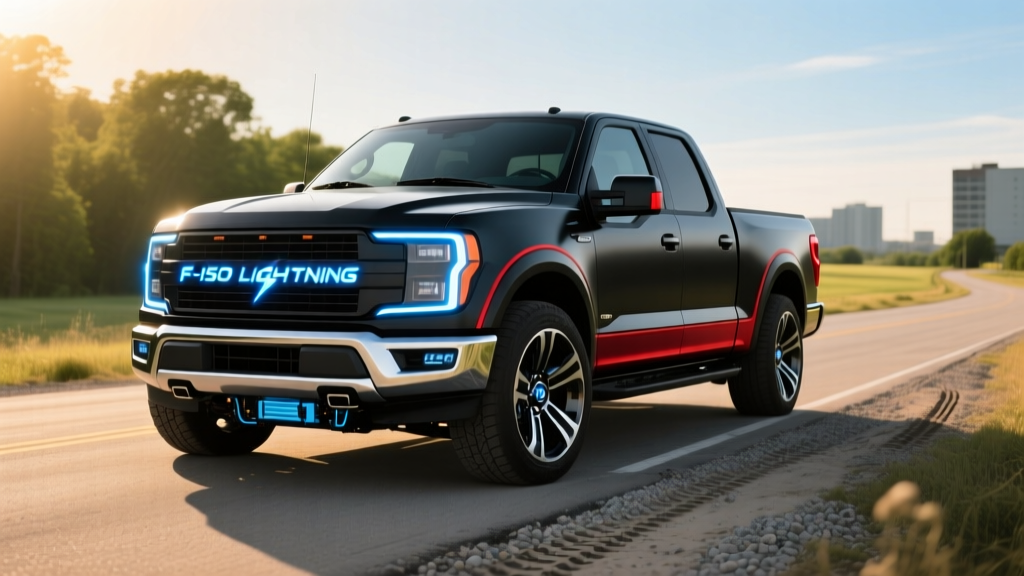
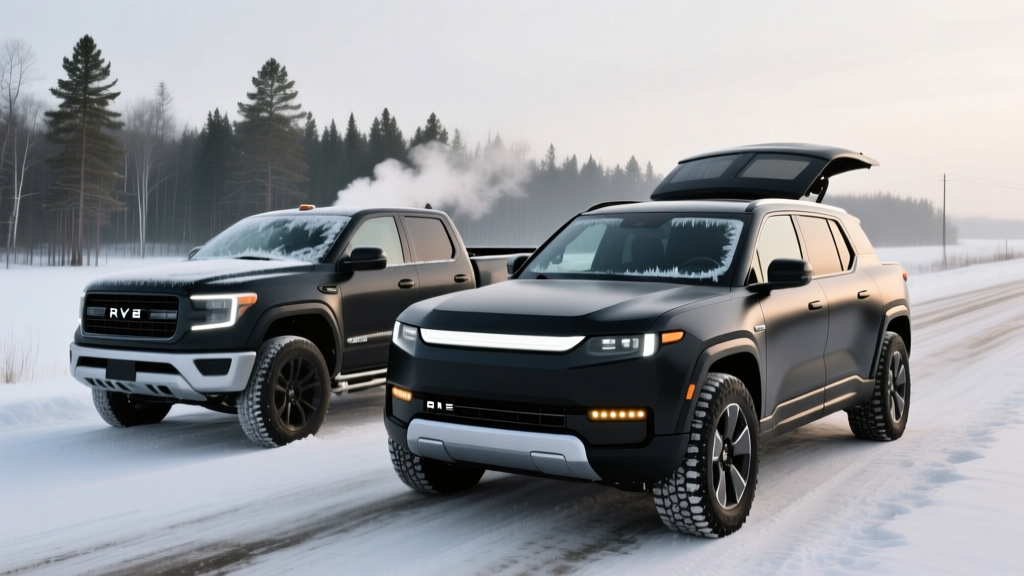
The Cybertruck competes with the Ford F-150 Lightning (EPA 230-320 mi, starting ~$55,000, tax-credit eligible on select trims), the Rivian R1T (EPA 270-410 mi depending on pack, starting ~$69,900), and the Chevrolet Silverado EV (EPA 390-440 mi, starting ~$55,000 on base trims). The Cybertruck wins on acceleration and tech innovation but loses on energy efficiency, tax credit access, and conventional truck practicality. See NHTSA safety ratings for crash-test comparisons as they become available.
Frequently Asked Questions
What is the real-world range of the Tesla Cybertruck?
The EPA rates the AWD at 340 miles and the Cyberbeast at 320 miles. In real-world highway driving at 70-75 mph, expect 260-290 miles (AWD) and 240-270 miles (Cyberbeast). Cold weather below freezing can reduce this by an additional 20-30%.
How fast does the Cybertruck charge?
On a V4 Supercharger at 350 kW peak, the Cybertruck charges 10-80% in approximately 22 minutes. On widely available V3 Superchargers (250 kW), expect 10-80% in about 28 minutes. Home Level 2 charging adds roughly 22 miles of range per hour at 11.5 kW.
Does the Cybertruck qualify for the federal EV tax credit?
No. The IRS §30D tax credit caps eligible pickups at $80,000 MSRP. The Cybertruck AWD starts at $79,990 but destination fees and options typically push it above the cap. The Cyberbeast at $99,990 far exceeds it. Always verify current-year rules at IRS.gov.
Can I take the Cybertruck through an automatic car wash?
Tesla recommends touchless car washes only. Enable Car Wash Mode from Controls > Service on the touchscreen before entering. Brush-style washes can scratch and mar the stainless steel panels. Hand washing is the safest option for preserving the finish.
Is the Cybertruck worth buying over an F-150 Lightning or Rivian R1T?
The Cybertruck excels in acceleration, tech innovation, and bed security. It falls short on energy efficiency, real-world highway range, tax credit eligibility, and aftermarket accessory support. If you prioritize performance and novelty, the Cybertruck is unmatched. If you need work-truck practicality, maximum range, or tax credit savings, the Lightning or R1T are stronger choices.
What are the biggest Cybertruck ownership costs?
Beyond the purchase price, expect elevated insurance ($3,500-$5,500/year), higher electricity costs due to poor efficiency (51-54 kWh/100mi means roughly $0.07-$0.10/mile at home charging rates), and premium tire replacement costs ($400-$600 per tire for the 35-inch all-terrains). Budget $8,000-$12,000 annually for total operating costs including insurance, electricity, and maintenance.