If you have ever stood at a touchless car wash watching the brushes spin and wondered whether a stainless-steel, angular electric pickup can survive the tunnel, you are not alone. The Tesla Cybertruck car wash question has dominated owner forums since the truck launched. The short answer: Tesla built a dedicated Car Wash Mode into the Cybertruck's software specifically to address this. The longer answer involves understanding how the truck's range, charging speed, battery architecture, and daily practicality hold up far beyond the wash bay.
This review covers the 2026 Tesla Cybertruck lineup — the Long Range AWD and the Cyberbeast — with exact EPA figures, real-world range expectations, DC fast-charging curves, tax-credit eligibility under current IRS §30D rules, and the ownership realities that spec sheets leave out.
Cybertruck Car Wash Mode: What It Does and Why It Matters
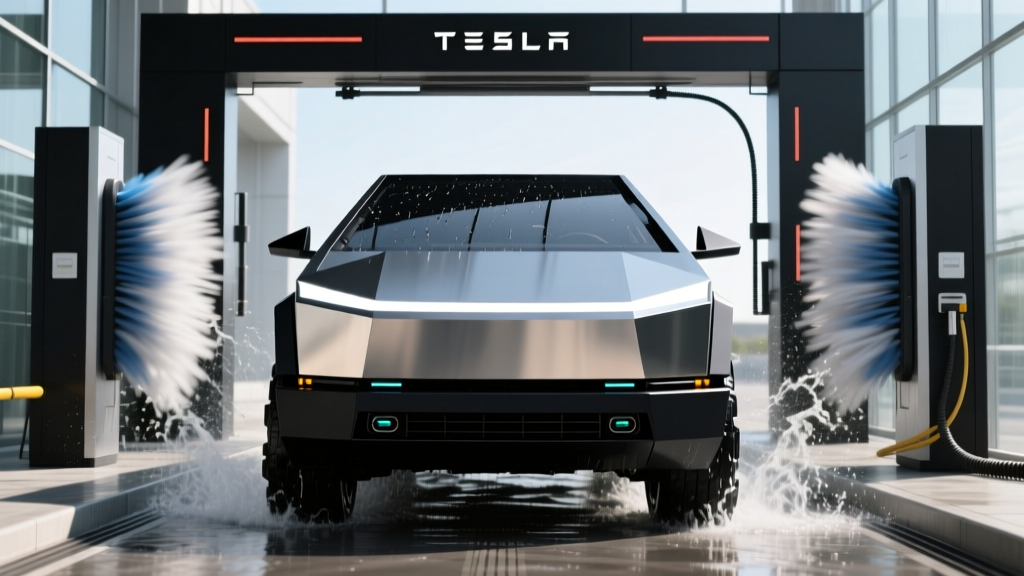
Before diving into the drivetrain, let's address the keyword on everyone's mind. The Cybertruck's exterior is made of ultra-hard 30X cold-rolled stainless steel, which resists dents but shows swirl marks from abrasive brushes. Tesla's Car Wash Mode (activated via the Controls menu or a quick voice command) does the following:
- Locks all doors, the frunk, the tonneau cover, and the charge port door
- Disables walk-away auto-lock and automatic wipers
- Closes all windows fully and disables the window auto-open-on-approach feature
- Sets HVAC to recirculate to prevent water and soap ingress through vents
- Disables parking sensors and Sentry Mode to avoid phantom alerts from brushes
- On models with the steer-by-wire system, locks the yoke/wheel to prevent unintended movement on conveyor tracks
Touchless vs. soft-touch: Tesla officially recommends touchless (high-pressure water and air only) car washes for the Cybertruck. Soft-touch brush washes can leave micro-scratches on the stainless panels and may catch on the sharp body creases. Hand washing or rinseless waterless wash products remain the safest option for preserving the finish.
⚡ Real-World Range Reality Check
EPA-estimated range: 320 miles (Long Range AWD, 20-inch wheels) | 340 miles (RWD, expected late 2026)
Expect in the real world: ~260–285 miles at sustained 75 mph highway speeds in moderate weather. In freezing temperatures (below 30°F), plan for 210–240 miles of usable range. The Cybertruck's brick-like 0.38 drag coefficient hits efficiency hard above 65 mph. The Cyberbeast tri-motor variant drops to an EPA 320 miles and delivers ~250–270 real-world highway miles.
Specs at a Glance: 2026 Tesla Cybertruck
| Specification | Long Range AWD | Cyberbeast (Tri-Motor) |
|---|---|---|
| EPA Range | 320 mi | 320 mi |
| Battery (usable) | ~123 kWh (estimated, NMC) | ~123 kWh (estimated, NMC) |
| Drivetrain | Dual-Motor AWD | Tri-Motor AWD |
| Horsepower | 600 hp | 845 hp |
| 0–60 mph | 3.9 sec | 2.6 sec |
| Top Speed | 112 mph | 130 mph |
| Max DC Fast Charge | 250 kW | 250 kW |
| 10–80% DC Charge | ~30 min | ~30 min |
| Level 2 Charge Rate | 11.5 kW (~37 mi/hr) | 11.5 kW (~37 mi/hr) |
| MPGe (combined) | 67 MPGe | 64 MPGe |
| Efficiency | 50 kWh/100 mi | 53 kWh/100 mi |
| Towing Capacity | 11,000 lbs | 11,000 lbs |
| Payload | 2,500 lbs | 2,500 lbs |
| Bed Length | 6 ft (72 in) | 6 ft (72 in) |
| Cargo (bed + frunk) | ~67 cu ft bed + ~7 cu ft frunk | ~67 cu ft bed + ~7 cu ft frunk |
| Base MSRP | $79,990 | $99,990 |
| Federal Tax Credit (§30D) | $7,500 (if eligible) | $7,500 (if eligible) |
| Battery/Drive Warranty | 8 yr / 120,000 mi | 8 yr / 120,000 mi |
Sources: fueleconomy.gov, Tesla Cybertruck specs.
Charging Speed: DC Fast, Level 2, and the Curve Reality
The Cybertruck uses the NACS (North American Charging Standard) connector natively — no adapter needed for Tesla Superchargers. It can also access CCS-equipped networks like Electrify America with a NACS-to-CCS adapter (included with some trims, sold separately otherwise).
| Charging Level | Power / Voltage | Speed | Notes |
|---|---|---|---|
| Level 1 (120V) | ~1.4 kW | ~4–5 mi/hr | Emergency trickle; not practical for daily use on a 123 kWh pack |
| Level 2 (240V, 48A) | 11.5 kW | ~37 mi/hr | Full overnight charge in ~10–11 hours from 10% (Tesla Wall Connector) |
| DC Fast (Supercharger V3/V4) | Peak 250 kW | 10–80% in ~30 min | Peak rate sustained to ~50% SoC, then tapers to ~120 kW by 70%, ~50 kW above 85% |
| DC Fast (350 kW CCS w/ adapter) | Peak ~250 kW (truck-limited) | 10–80% in ~32 min | Adapter adds slight overhead; not all CCS stations handshake reliably |
Charging-curve insight: The Cybertruck's massive ~123 kWh battery means even a "tapered" charge rate still delivers meaningful miles. At 50 kW above 85%, you are still adding roughly 60 miles per hour — faster than many smaller-battery EVs at peak. However, charging from 10–80% takes noticeably longer than a Model Y (~20 min) because there is simply more energy to push. Plan road-trip stops around 30-minute breaks rather than 15-minute dashes.
Home charging: A Tesla Wall Connector on a 60A circuit delivers the full 11.5 kW / 48A. Expect a 10–90% charge in roughly 9 hours — enough to wake up full every morning if you plug in after work. For a battery this large, a Level 2 home charger is essentially mandatory; Level 1 would take over 3 days from empty.
Performance, Efficiency, and the Physics of a 6,800-lb Triangle
The Cybertruck Long Range AWD hits 60 mph in 3.9 seconds with 600 hp. The Cyberbeast drops that to 2.6 seconds with 845 hp — supercar territory in a vehicle that weighs roughly 6,800 pounds. Acceleration is violently quick in both trims, and the steer-by-wire system (no mechanical linkage between the yoke and wheels) takes about 15 minutes of driving to feel natural, then becomes intuitive.
Efficiency is the Cybertruck's Achilles' heel. At 50 kWh/100 miles (Long Range), it consumes roughly 40% more energy per mile than a Tesla Model Y Long Range (~28 kWh/100 mi). The angular design and enormous frontal area create a drag coefficient around 0.38 — poor by EV standards. At 75 mph on the highway, expect efficiency to worsen to 55–60 kWh/100 mi, which is why real-world highway range drops to ~260–285 miles despite the 320-mile EPA sticker.
Towing range hit: Pulling a 7,000-lb trailer cuts range roughly in half. Plan for 140–170 miles between charges when towing near capacity. The integrated trailer brake controller and Hitch View camera are excellent, but Supercharger stalls with pull-through lanes are still limited — check PlugShare or the Tesla app for trailer-friendly stops.
Interior, Cargo, and Daily Livability
The Cybertruck seats five, though the rear bench is tighter than an F-150 Lightning or Rivian R1T. Legroom is adequate for adults on shorter trips but not class-leading. The minimalist interior centers on an 18.5-inch touchscreen with no physical buttons — climate, mirrors, glovebox, and even the windshield wipers are controlled through the screen or yoke buttons.
Cargo highlights:
- 6-foot bed with a powered retractable tonneau cover (supports 300 lbs of distributed weight on top)
- ~67 cu ft of bed volume with the tailgate closed; the tailgate extends to an 8-foot flat load floor when lowered
- Front trunk (frunk): ~7 cu ft — enough for a charging cable bag and a small cooler
- Vault storage: lockable under-bed compartment behind the rear axle
- 240V bed outlets (two 120V, one 240V NEMA 14-50) — capable of powering tools, a campsite, or limited V2L (vehicle-to-load) applications
Standout tech: The steer-by-wire system enables variable steering ratios — just 340 degrees of yoke rotation from lock to lock, meaning no hand-over-hand in parking lots. Rear-wheel steering (up to 10 degrees) shrinks the turning circle to 40.3 feet, competitive with a midsize sedan. The 48-volt electrical architecture (an industry first for a production vehicle) reduces wiring harness weight by roughly 70% and enables the powerful linear actuators for the tonneau and tailgate.
Notable drawbacks: The stainless-steel body shows fingerprints aggressively. Panel gaps remain inconsistent across early production units. Visibility rearward is compromised by the bed walls and small rear window — you will rely heavily on the backup camera. The yoke steering is polarizing; some drivers never adapt. And at 82+ inches wide (excluding mirrors), the Cybertruck does not fit comfortably in older parking garages or tight urban lanes.
Pricing, Trims, and Federal Tax Credit Eligibility
| Trim | Base MSRP | As-Tested (typical config) | After §30D Credit* |
|---|---|---|---|
| Long Range AWD | $79,990 | $83,490 (w/ FSD, paint) | $72,490 – $75,990 |
| Cyberbeast | $99,990 | $104,490 (w/ FSD, accessories) | $92,490 – $96,990 |
| RWD (announced, late 2026) | $59,990 (est.) | TBD | $52,490 (est.) |
*Federal tax credit amounts assume full §30D eligibility. See checklist below.
The IRS §30D Clean Vehicle Credit offers up to $7,500 for qualifying new EVs, but eligibility is not automatic. The Cybertruck is classified as a light truck, so the MSRP cap is $80,000. The Long Range AWD at $79,990 clears this threshold; the Cyberbeast at $99,990 does not — the Cyberbeast does not qualify for the federal credit.
§30D Eligibility Checklist for the Cybertruck Long Range AWD
- MSRP cap: ≤ $80,000 for trucks — Long Range AWD qualifies at $79,990 base; Cyberbeast does not
- Buyer income cap: MAGI ≤ $150,000 (single) / $225,000 (head of household) / $300,000 (married filing jointly)
- Battery sourcing: Critical minerals and battery components must meet phased-in percentage thresholds from US or FTA-partner countries — verify current-year compliance on fueleconomy.gov
- Point-of-sale transfer: You can transfer the credit to the dealer at purchase for an immediate price reduction, or claim it on your tax return (Form 8936)
- Final assembly: Must be in North America — Cybertruck is built in Austin, TX ✓
Bottom line on price: If you qualify for the full $7,500 credit, the Long Range AWD drops to approximately $72,490 — competitive with a well-equipped F-150 Lightning Lariat or a Rivian R1T Dual-Motor. Always consult a tax professional to confirm your personal eligibility.
Pros and Cons
✅ Pros
- 2.6–3.9 sec 0–60 in a full-size truck; tri-motor Cyberbeast is absurdly fast
- 11,000-lb towing capacity with integrated brake controller and trailer cameras
- Stainless-steel exoskeleton resists dents and corrosion; no paint to chip
- Rear-wheel steering yields a surprisingly tight turning radius
- 240V bed outlets enable real jobsite and campsite utility
- Car Wash Mode, Sentry Mode, and OTA updates keep improving post-purchase
- Native NACS connector — best charging network access in the US
❌ Cons
- Poor efficiency (50–53 kWh/100 mi) limits real-world highway range to ~260–285 mi
- Towing cuts range roughly in half; Supercharger pull-through stalls remain scarce
- Cyberbeast exceeds $80K MSRP cap — no federal tax credit
- 82+ inch width is problematic in tight garages and urban streets
- Rear-seat space and visibility trail the F-150 Lightning and Rivian R1T
- Yoke steering and screen-only controls are polarizing and require adaptation
- Stainless panels show fingerprints and water spots; hand-wash recommended over automatic car washes
How Does the Cybertruck Stack Up Against Key Competitors?
The Cybertruck competes in the full-size electric pickup segment against the Ford F-150 Lightning, Rivian R1T, and Chevrolet Silverado EV. Here is how the decision breaks down:
Choose the Cybertruck if: You prioritize acceleration, angular design, stainless durability, and the Tesla Supercharger network. The steer-by-wire system and 48V architecture offer genuinely novel engineering. If you want a truck that turns heads and hits 60 in under 3 seconds, nothing else in the segment competes.
Choose the F-150 Lightning if: You need a conventional truck experience with maximum interior space, Pro Power Onboard (up to 9.6 kW V2L/V2H), and a proven dealer network. The Lightning's 320-mile Extended Range battery and ~$55K–$75K pricing (with credit) make it the pragmatic work truck.
Choose the Rivian R1T if: You want a more refined interior, a quad-motor option with tank turns, the Gear Tunnel for extra cargo, and a dedicated adventure-vehicle platform. The R1T Dual-Motor Max Pack delivers ~352 miles of range at a comparable price.
Choose the Silverado EV if: You need the longest range in the segment (the 4WT trim targets 400+ miles EPA) and GM's Ultium platform with access to a growing DC fast-charging network via the NACS adapter.
Battery, Warranty, and Long-Term Ownership
Tesla has not officially published the Cybertruck's exact battery capacity, but teardown data and energy-consumption calculations point to a usable capacity of approximately 123 kWh using an NMC (nickel manganese cobalt) chemistry in a structural battery pack. The pack serves as a stressed chassis member, increasing torsional rigidity.
Warranty coverage:
- Battery and Drive Unit: 8 years / 120,000 miles (whichever comes first), with a minimum 70% capacity retention guarantee
- Vehicle Limited Warranty: 4 years / 50,000 miles
- Restraint System: 5 years / 60,000 miles
- Corrosion: 12 years, unlimited miles (relevant for the stainless body, though stainless is inherently corrosion-resistant)
Degradation expectations: Based on Tesla's historical NMC pack data from the Model S/X fleet, expect roughly 8–12% capacity loss over the first 100,000 miles, with the curve flattening significantly afterward. The 70% retention threshold at 120,000 miles is conservative — most Tesla NMC packs retain 85%+ at that mileage. Daily charging to 80–90% (rather than 100%) and avoiding repeated DC fast charges above 90% SoC will extend longevity.
Insurance costs: The Cybertruck carries higher-than-average insurance premiums due to its repair complexity (stainless panels require specialized body shops), high MSRP, and performance. Expect $2,800–$4,200/year depending on your profile — get quotes before ordering.
Frequently Asked Questions
Can I take a Tesla Cybertruck through an automatic car wash?
Yes, but Tesla recommends touchless car washes only. Engage Car Wash Mode from the Controls menu before entering — it locks all openings, disables sensors, and prevents the tonneau or charge port from opening. Avoid soft-touch brush washes, as the bristles can scratch the stainless-steel panels and catch on the sharp body edges. Hand washing with a microfiber mitt and dedicated stainless-steel cleaner is the safest method.
What is the real-world range of the Cybertruck on a road trip?
Expect 260–285 miles at 75 mph in 60–80°F weather. In freezing conditions, that drops to 210–240 miles due to battery heating demands and denser air. Towing a 7,000-lb trailer cuts range to roughly 140–170 miles. Plan charging stops every 200–230 miles to stay in the efficient 20–80% SoC window.
How long does it take to charge the Cybertruck at home?
On a Level 2 Tesla Wall Connector (11.5 kW / 48A), a full 10–90% charge takes approximately 9 hours. Level 1 (120V) adds only 4–5 miles per hour and is impractical for daily use on a 123 kWh battery. A 60A dedicated circuit with 6-gauge wire is recommended for the Wall Connector.
Does the Cybertruck qualify for the $7,500 federal tax credit?
The Long Range AWD at $79,990 qualifies (under the $80,000 truck MSRP cap), provided you meet the income limits ($150K single / $300K joint) and the battery-sourcing requirements are met for the current tax year. The Cyberbeast at $99,990 does not qualify because it exceeds the MSRP cap. Always verify current-year rules on IRS.gov and consult a tax professional.
Is the Cybertruck worth buying over the F-150 Lightning or Rivian R1T?
It depends on your priorities. The Cybertruck wins on acceleration, design uniqueness, and Supercharger access. The F-150 Lightning wins on interior space, conventional truck ergonomics, and value (especially with the tax credit on lower trims). The Rivian R1T wins on interior refinement, adventure features, and available range with the Max Pack. Test-drive all three before deciding — the Cybertruck's yoke steering and screen-only interface are dealbreakers for some buyers and a revelation for others.
Does Car Wash Mode work on conveyor-style (belt) car washes?
Yes. Car Wash Mode disables the parking brake auto-engage and holds the vehicle in neutral-ready mode so the conveyor can move the truck. The steer-by-wire system locks the yoke to prevent unintended steering input from brushes or water jets. Always confirm the car wash's maximum vehicle width — the Cybertruck at 82+ inches may not fit older tunnel wash systems.
Specs and pricing reflect 2026 model-year data available at time of publication. Federal tax credit rules under IRS §30D are subject to change. Always verify eligibility with the IRS and a qualified tax advisor before purchasing.