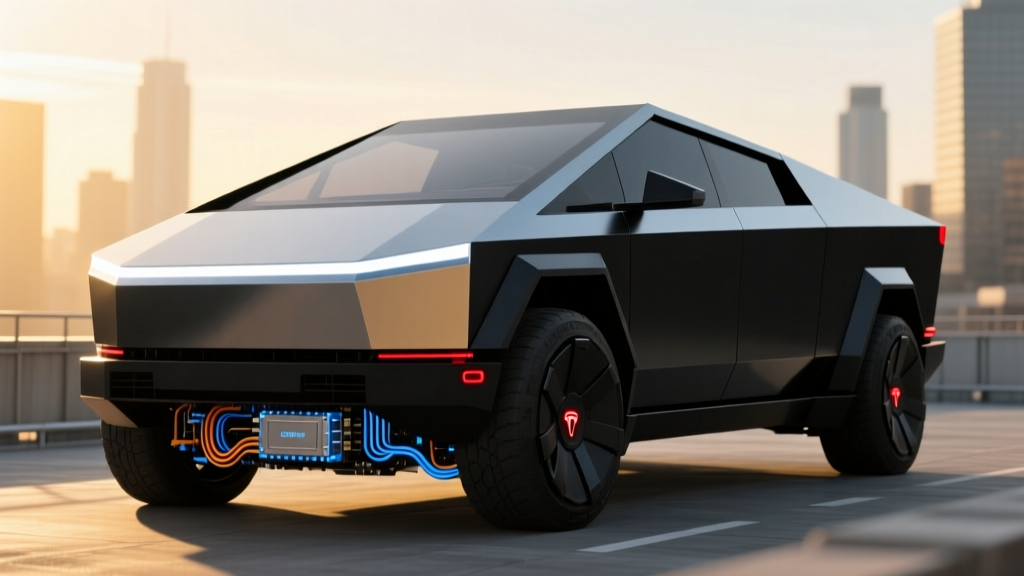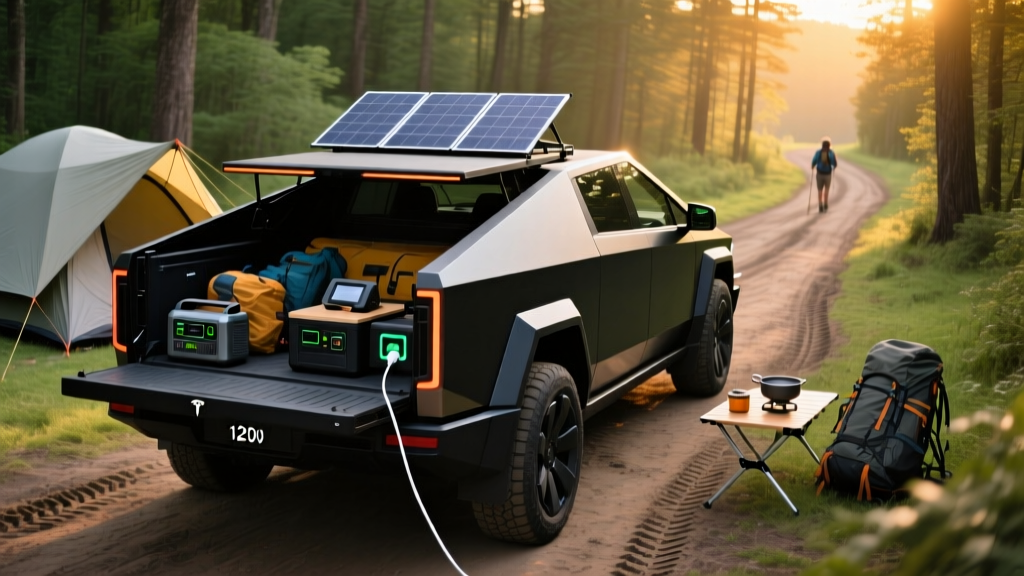
The Tesla Cybertruck was engineered to be a Swiss Army knife: daily commuter, job-site hauler, and—crucially—an off-grid camping platform. With its stainless-steel exoskeleton, integrated Powershare vehicle-to-load (V2L) capability, and a bed Tesla calls the "Vault," the Cybertruck invites overland builds in a way no other EV pickup currently does. But how well does it actually perform once you leave the pavement and the Supercharger network behind?
This review evaluates the Cybertruck specifically as a camping and overlanding rig. We'll cover the real-world range you can expect when loaded with gear, how fast it charges on the road, what you can actually power at camp, and whether the federal EV tax credit applies to a truck this expensive.
Quick Verdict: Is the Cybertruck a Viable Camping Platform?
Yes—with caveats. The Cybertruck's 123-cubic-foot Vault, 2,500-pound payload capacity, and up to 11.5 kW of exportable power make it one of the most capable EV camping platforms available. The dual-motor AWD system handles fire roads and forest service trails competently, and the air suspension offers up to 16 inches of ground clearance in Extract Mode. The limiting factor is range: heavily loaded, towing a teardrop, or pushing through cold mountain air, the Cybertruck's effective range shrinks significantly below its EPA sticker. If your camping style involves 150-mile-radius trips from a charging hub or solar-assisted boondocking, it excels. If you plan 400-mile remote transits without charging infrastructure, you'll need to plan meticulously.
Spec Table: Cybertruck AWD and Cyberbeast at a Glance
| Specification | AWD (Dual-Motor) | Cyberbeast (Tri-Motor) |
|---|---|---|
| EPA Range | 340 miles | 320 miles |
| Battery (usable est.) | ~123 kWh, NMC | ~123 kWh, NMC |
| 0-60 mph | 4.1 seconds | 2.6 seconds |
| Horsepower | 600 hp | 845 hp |
| Drivetrain | Dual-Motor AWD | Tri-Motor AWD |
| Towing Capacity | 11,000 lbs | 11,000 lbs |
| Payload Capacity | 2,500 lbs | 2,500 lbs |
| Bed Volume (Vault) | 123 cu ft (67 cu ft w/ tonneau closed) | |
| Bed Length | 6 ft (72 in) | |
| Ground Clearance (max) | 16 in (Extract Mode) | |
| Max DC Fast Charge | ~350 kW peak (NACS) | |
| 10-80% DC Charge Time | ~15 minutes (peak conditions) | |
| Level 2 Home Charge Rate | 11.5 kW (~44 mi/hr) | |
| V2L Export (Powershare) | Up to 11.5 kW total | |
| Base MSRP (2025) | $79,990 | $99,990 |
| Battery/Drive Unit Warranty | 8 yr / 150,000 mi | |
| Efficiency (EPA est.) | ~64 MPGe / ~52 kWh/100mi | ~60 MPGe / ~56 kWh/100mi |
Real-World Range: What to Expect When You're Loaded for Camp
Tesla's ~123 kWh usable battery pack uses NMC (nickel manganese cobalt) chemistry, chosen for its high energy density—critical in a vehicle this heavy. The pack's large capacity is the Cybertruck's camping ace: even at 70% of rated range, you still have more electrons on board than most EVs carry in total. That translates to practical 200+ mile one-way trips into areas without charging, with enough reserve to return.
Efficiency hovers around 52 kWh per 100 miles (AWD) under mixed driving, which is poor by sedan standards but competitive for a 6,800-pound stainless-steel pickup. The air suspension helps by lowering the ride height at highway speed, reducing drag. On forest service roads at 25-40 mph, efficiency actually improves due to lower aero losses, though rolling resistance from all-terrain tires partially offsets this.
According to EPA data on fueleconomy.gov, the Cybertruck AWD rates at approximately 64 MPGe combined. Real-world highway efficiency drops notably—expect closer to 55-60 MPGe at sustained 75 mph.
Charging on the Road and at the Campsite
Charging speed determines how long your road-trip pit stops take. The Cybertruck's 800-volt-class architecture supports DC fast charging at up to ~350 kW peak on Tesla's V4 Superchargers. However, peak rate is not sustained rate. The charging curve tapers substantially above 50% state of charge (SoC), and thermal management in hot or cold conditions further modulates speed.
| Charging Method | Power (kW) | Speed (mi/hr added) | Notes |
|---|---|---|---|
| DC Fast Charge (V4 Supercharger) | Up to ~350 kW peak | ~130 mi/hr (peak) | 10-80% in ~15 min; tapers sharply above 80% |
| DC Fast Charge (250 kW V3 Supercharger) | Up to ~250 kW peak | ~100 mi/hr (peak) | 10-80% in ~20 min |
| Level 2 Home (Tesla Wall Connector) | 11.5 kW (48A) | ~44 mi/hr | Full charge in ~11 hours |
| Level 2 Destination Charger | 7.2-11.5 kW | ~28-44 mi/hr | Varies by site; campgrounds often 30A/7.2 kW |
| Level 1 (120V Standard Outlet) | ~1.4 kW | ~5 mi/hr | Emergency/trickle only; useful for overnight top-off at remote cabins |
For camping specifically, the Level 1 trickle charge deserves attention. If you're parked at a cabin or campground with a standard 120V outlet, you can recover roughly 40-50 miles overnight—enough to offset accessory use and short excursions. Preconditioning the battery before arriving at a Supercharger (the truck does this automatically when you navigate to one) is essential for hitting peak charge rates. Skipping preconditioning in cold weather can double your 10-80% charge time.
The Cybertruck uses the NACS (North American Charging Standard) connector natively, which is now the dominant standard across North America. Access to the full Supercharger network—over 25,000 stalls in the US alone—remains the Cybertruck's single biggest road-trip advantage over CCS-equipped competitors.
Powershare at Camp: Running Your Site Off the Truck
This is where the Cybertruck separates itself from nearly every other EV on the market. Tesla's Powershare system provides up to 11.5 kW of continuous exportable power through a combination of bed-mounted 120V/240V outlets and the charge port. For context, a typical campsite runs on a 30-amp (3.6 kW) or 50-amp (12 kW) shore power connection. The Cybertruck can replicate or exceed what a standard RV pedestal delivers.
Practical camping applications:
- Induction cooktop (1,800W): Run it continuously for hours without taxing the battery meaningfully. Eight hours of cooking uses roughly 14 kWh—about 11% of the pack.
- Electric heater or space heater (1,500W): Critical for cold-weather camping. Running overnight (10 hours) draws ~15 kWh.
- Portable fridge/freezer (60W avg): Negligible draw—days of continuous operation.
- Camp lighting, laptops, Starlink (~200W combined): Essentially invisible against a 123 kWh pack.
- Power tools on job sites (1,500-3,000W intermittent): The dual-voltage 240V outlet handles welders, compressors, and saws.
The 123 kWh battery means you can run a moderate campsite load (averaging 1-2 kW) for two to four full days without driving. This eliminates the need for a portable gas generator entirely—no noise, no fumes, no fuel to carry.
Cargo, Bed, and Interior: Camping Practicality
The Cybertruck's Vault (Tesla's term for the composite bed) measures 6 feet long and 4 feet wide between the wheel wells, yielding 123 cubic feet of sealed, lockable storage with the powered tonneau retracted. With the tonneau closed, you get 67 cubic feet of weatherproof space—enough for a full overland kitchen setup, recovery gear, and camping equipment, all secured and dry.
Interior dimensions support two adults comfortably for multi-day trips:
- Front legroom: 41.6 inches
- Rear legroom: 38.2 inches (tight for tall adults on long drives)
- Front headroom: 40.9 inches
- Seating: 6-passenger capacity (3-across front bench)
The rear seat folds flat to create a pass-through to the Vault, useful for running power cables or storing long items like fishing rods and trekking poles. The stainless-steel bed requires no bed liner and resists scratches from gear, though it can be slippery—aftermarket tie-down solutions and bed mats are highly recommended for camping builds.
The air suspension can lower the truck for easy loading (Access Mode) or raise it to 16 inches of ground clearance (Extract Mode) for obstacle clearance on rough trails. The adaptive damping smooths out washboard forest roads better than a traditional leaf-spring pickup.
Pricing, Tax Credits, and What You'll Actually Pay
| Trim | Base MSRP | §30D Federal Credit | Effective Price (if eligible) |
|---|---|---|---|
| AWD (Dual-Motor) | $79,990 | Not eligible (MSRP cap $80,000 for trucks) | $79,990 |
| Cyberbeast (Tri-Motor) | $99,990 | Not eligible | $99,990 |
The IRS §30D federal EV tax credit imposes an $80,000 MSRP cap for trucks, vans, and SUVs. The Cybertruck AWD at $79,990 technically clears this threshold, but once any mandatory delivery fees, paint protection, or accessory packages push the total above $80,000, eligibility is lost. As currently configured with typical add-ons, most Cybertruck buyers will not qualify for the $7,500 credit. The Cyberbeast at $99,990 is well above the cap regardless.
Additionally, §30D has buyer income caps ($300,000 joint / $150,000 single modified AGI) and battery critical-mineral sourcing requirements that change annually. Consult a tax professional and verify current-year rules on IRS.gov before counting on any credit. Some states offer separate incentives that are not bound by the federal MSRP cap—check your state energy office for details.
Destination charges, Tesla's mandatory accessories, and sales tax will push the as-tested price of an AWD model to approximately $83,000-$87,000 before any incentives. Fully loaded Cyberbeast builds routinely exceed $110,000.
Driver-Assist Tech: Autopilot on the Highway to the Trailhead
For long highway drives to remote trailheads, Autopilot's adaptive cruise and lane-centering reduce fatigue significantly. FSD (Supervised) handles interchanges, stoplights, and some surface-street navigation, though its reliability in rural areas with faded lane markings or unmapped roads remains inconsistent. On forest service roads, you're driving manually—the Cybertruck's Off-Road mode adjusts throttle mapping, regen strength, and traction control for loose surfaces.
The 18.5-inch center touchscreen runs Tesla's latest infotainment software with integrated trip planning that factors in elevation, temperature, and Supercharger availability along your route. For camping, the built-in "Camp Mode" maintains climate control, powers USB outlets, and keeps the touchscreen active for music or white noise overnight—all while drawing from the main battery pack.
Pros and Cons: The Cybertruck as a Camping Vehicle
Pros
- 11.5 kW Powershare V2L eliminates the need for a camp generator
- 123 cu ft sealed, lockable Vault with powered tonneau
- 16 inches of ground clearance in Extract Mode; capable on moderate off-road terrain
- Massive 123 kWh battery provides 2-4 days of campsite power
- Supercharger network access for road-trip charging
- Stainless-steel bed resists damage; no liner needed
- Air suspension self-levels under load and adjusts ride height
- Camp Mode maintains climate and accessories overnight
Cons
- Real-world loaded range drops to 200-280 miles; towing cuts it further
- No federal tax credit on most configurations due to MSRP cap
- High purchase price ($80K-$100K+); camping accessories add thousands more
- Sharp angular bed limits some aftermarket camper-shell options
- Rear seat legroom (38.2 in) is tight for tall passengers on long trips
- Stainless-steel exterior shows fingerprints and requires specific cleaning products
- Off-road capability trails purpose-built trucks (Raptor, TRX) in extreme rock-crawling
- Insurance premiums run 30-50% higher than comparable conventional trucks
Who Should Buy the Cybertruck for Camping?
Choose the Cybertruck if: You want a single vehicle that commutes during the week, hauls gear on weekends, and powers your campsite without a generator. You camp within a 200-mile radius of home or along Supercharger corridors. You value the security of a sealed, lockable bed over an open pickup box. You're comfortable spending $80,000+ on a truck and understand the range tradeoffs of a heavy, high-performance EV.
Consider alternatives if: You need 400+ miles of real-world range for remote overlanding far from charging infrastructure. You're on a tighter budget (the Ford F-150 Lightning starts around $55,000 and qualifies for the tax credit). You need a full-size rear seat for family camping trips with children and gear. You prefer traditional body-on-frame off-road capability for extreme trails.
The Tesla Cybertruck spec page lists current pricing and configurations. For real-world owner camping builds and range data, EV overlanding forums and Tesla owner communities provide continuously updated trip reports.
Frequently Asked Questions
What is the real-world camping range of the Tesla Cybertruck?
Loaded with camping gear and driven at highway speeds, expect 250-280 miles from the AWD model (EPA rated at 340). Cold weather and towing reduce this to 170-240 miles. The 123 kWh battery still provides a larger absolute energy reserve than most EVs, even at reduced efficiency.
How fast does the Cybertruck charge on a road trip?
On a V4 Supercharger at peak rate, 10-80% takes approximately 15 minutes. On the more common V3 (250 kW) Superchargers, expect 20 minutes. Always precondition the battery by navigating to the charger in the truck's trip planner—this can shave 5-10 minutes off your stop.
Can I run my entire campsite off the Cybertruck?
Yes, within reason. Powershare delivers up to 11.5 kW through 120V and 240V outlets—more than a typical 30-amp campground pedestal. A moderate campsite load (induction cooktop, fridge, lights, Starlink) averaging 1-2 kW can run for 2-4 days on a full charge.
Does the Cybertruck qualify for the $7,500 federal EV tax credit?
Generally, no. The AWD trim at $79,990 barely meets the $80,000 MSRP cap for trucks under §30D, but any added fees or accessories push it over the limit. The Cyberbeast at $99,990 is ineligible. Buyer income limits and battery-sourcing rules further restrict eligibility. Verify current-year rules at IRS.gov.
Is the Cybertruck good off-road for overlanding?
It's competent on moderate trails, fire roads, and forest service roads. The 16-inch ground clearance, air suspension, and dual/tri-motor AWD handle loose surfaces, creek crossings, and moderate inclines well. For extreme rock-crawling or deep mud, purpose-built off-road trucks (Ford F-150 Raptor, Ram TRX) still have an edge in suspension articulation and approach/departure angles.
What aftermarket camping accessories exist for the Cybertruck?
The growing ecosystem includes rooftop tents (Thule, iKamper), bed rack systems, camper shells from Basecamp and other upfitters, slide-out kitchen modules, and Powershare-compatible power distribution panels. The angular bed geometry requires Cybertruck-specific designs—universal truck accessories often don't fit.
How does the Cybertruck compare to the F-150 Lightning for camping?
The Lightning offers more interior space, a lower starting price (~$55K), and tax-credit eligibility, but less range (230-320 miles EPA depending on pack), lower V2L output (9.6 kW max), and an open bed that requires a separate camper shell. The Cybertruck wins on range, sealed cargo security, and ground clearance. The Lightning wins on price, interior room, and value.