Quick Verdict: Can the Cybertruck Actually Double as a Camper?
The Tesla Cybertruck's angular stainless-steel exoskeleton and 6-foot bed have sparked an entire aftermarket ecosystem of camper shells, rooftop tents, and slide-out kitchen modules. But before you spec a Cybertruck as your next overland base camp, you need hard numbers on range under load, charging logistics in remote areas, and whether the interior and bed dimensions actually support comfortable sleeping and gear storage. This profile breaks down the 2026 Cybertruck's EV fundamentals through the lens of someone who wants to camp in it — not just commute.
Range & Efficiency: What Happens When You Load It Down?
Real-World Expectation: ~260–290 miles highway at 70 mph unloaded; subtract 15–25% when towing or carrying a loaded camper shell with gear (~200–240 miles practical range with a full overland setup)
The Cybertruck AWD's 340-mile EPA figure looks strong on paper, but the boxy, angular design creates a drag coefficient that punishes highway efficiency. On flat terrain at 65 mph, expect roughly 2.0–2.2 kWh/mile (about 48–50 MPGe equivalent). Add a camper topper (which ruins what little aerodynamic advantage the truck has), load 500–800 lbs of camping gear, water, and a rooftop tent, and that efficiency drops to 2.5–2.8 kWh/mile — cutting practical range to 200–240 miles before you need a charger.
Cold weather compounds the problem. In sub-30°F conditions, the structural battery pack loses roughly 15–20% of usable capacity even with Tesla's heat pump and battery preconditioning. A winter camping trip that starts with 340 miles of range might realistically deliver 180–210 miles with a loaded bed and cold-soaked pack.
Battery, Charging & Powertrain Specs
| Spec | AWD Dual-Motor | Cyberbeast (Tri-Motor) |
|---|---|---|
| Battery Capacity (usable) | ~123 kWh (estimated) | ~123 kWh (estimated) |
| Battery Chemistry | NMC (nickel manganese cobalt) | NMC |
| EPA Range | 340 miles | 320 miles |
| Max DC Fast Charge | 250 kW | 250 kW |
| 10–80% DCFC Time | ~30 minutes | ~30 minutes |
| Level 2 Home Charge Rate | 11.5 kW (~37 mi/hr) | 11.5 kW (~37 mi/hr) |
| Level 1 (120V) Trickle | ~1.4 kW (~4 mi/hr) | ~1.4 kW (~4 mi/hr) |
| Connector | NACS (native Tesla) | NACS (native Tesla) |
| 0–60 mph | 3.9 seconds | 2.6 seconds |
| Horsepower | 600 hp | 845 hp |
| Drivetrain | Dual-motor AWD | Tri-motor AWD |
| Max Towing | 11,000 lbs | 11,000 lbs |
| Payload Capacity | ~2,500 lbs | ~2,500 lbs |
Tesla's Supercharger network remains the strongest asset for overland travel. The 250 kW peak charge rate means a 10–80% session takes roughly 30 minutes at a V3 or V4 Supercharger — but sustained rates taper significantly above 60% state of charge. On a remote camping loop where Superchargers are 150–200 miles apart, plan conservatively: arrive at chargers with 15–20% SoC remaining, which means your usable range between stops is closer to 180–220 miles with a loaded camper.
At the campsite, Level 1 charging from a standard 120V outlet adds only about 4 miles per hour — enough to recover ~40 miles overnight, but not enough to meaningfully extend your trip without a generator or solar setup. Tesla's Powerwall integration at home lets you charge from stored solar, but off-grid camping requires planning around DC fast-charger locations.
The Cybertruck Camper Interior: Bed, Cabin & Storage Dimensions
The "camper interior" conversation around the Cybertruck centers on three zones: the cabin, the bed (vault), and the frunk. Here's what you're working with for an overland build:
| Dimension | Measurement |
|---|---|
| Bed Length (tailgate closed) | 72 inches (6 feet) |
| Bed Width (between wheel wells) | ~48 inches |
| Bed Width (max, above wells) | ~55 inches |
| Bed Volume | 67 cu ft |
| Front Headroom | 41.0 inches |
| Front Legroom | 41.7 inches |
| Rear Headroom | 38.4 inches |
| Rear Legroom | 38.2 inches |
| Frunk Volume | ~7.0 cu ft (front trunk) |
| Under-bed Storage (sub-vault) | Limited — structural pack occupies most under-floor space |
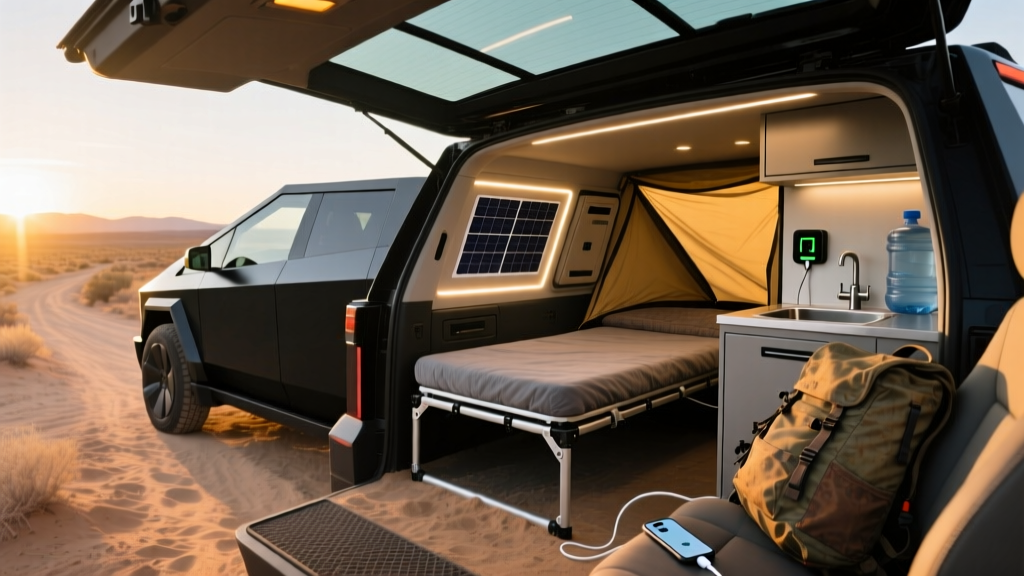
For sleeping: a 72" x 48" bed footprint fits a standard twin mattress between the wheel wells, but a full-size adult couple will find it tight. Most aftermarket camper shell manufacturers (such as Basecamp, Alu-Cab, and Space Camp) build platforms that extend over the wheel wells to achieve a ~72" x 55" sleeping surface — enough for a full mattress with minimal overhang.
The cabin seats five, with the rear bench folding flat to create additional interior cargo space. The minimalist interior (no traditional instrument cluster, single 18.5" center touchscreen, yoke or round steering wheel) means fewer surfaces to snag gear on, but also fewer storage cubbies for camping essentials like headlamps, maps, and utensils. Plan on aftermarket organizers.
The powered tonneau cover (the "sail") is a standout for camping: it retracts electrically and can support distributed weight, making it a viable base for rooftop tent mounting — though you'll want to verify the specific load rating with your tent manufacturer, as Tesla's published dynamic/static load limits for the sail are conservative.
Pricing, Tax Credits & Total Camping Build Cost
| Trim | Base MSRP | Federal §30D Credit | Effective Price |
|---|---|---|---|
| AWD Dual-Motor | $79,990 | $0 (exceeds MSRP cap) | $79,990 |
| Cyberbeast Tri-Motor | $99,990 | $0 (exceeds MSRP cap) | $99,990 |
The IRS §30D clean vehicle credit caps eligible trucks at an $80,000 MSRP threshold. The Cybertruck AWD at $79,990 technically sits at the edge — but destination fees, mandatory packages, and common add-ons (Foundation Series, FSD capability) push the as-delivered price above $80,000, disqualifying most configurations. The Cyberbeast at $99,990 is well above the cap. Additionally, buyer income limits ($150K single / $300K joint MAGI) and critical-mineral battery sourcing requirements apply.
Expect a realistic camping build to add $5,000–$20,000 on top of the truck price:
- Aftermarket camper shell/topper: $3,000–$12,000
- Rooftop tent: $1,500–$4,000
- Slide-out kitchen module: $1,500–$3,500
- Bed platform + storage drawers: $800–$2,000
- Portable power station + solar panels: $1,000–$3,000
- Recovery gear, lighting, accessories: $500–$2,000
Tech, Driver Assists & Off-Grid Features
The Cybertruck ships with Tesla's latest hardware (HW4/AI5) supporting Autopilot and the optional Full Self-Driving (Supervised) package. It's critical to understand: FSD is SAE Level 2 driver assistance — you must remain engaged, hands near the wheel, and eyes on the road at all times. It is not autonomous driving.
For camping, the Cybertruck's most useful tech features include:
- Camp Mode: Maintains cabin climate control and USB power overnight, drawing from the main battery pack — effectively turning the Cybertruck into a climate-controlled sleeping pod.
- 120V/240V bed outlet: The Cybertruck includes a 120V and 240V outlet in the bed, enabling you to power appliances, charge devices, or run a portable fridge directly from the 123 kWh battery. This is a massive advantage over gas trucks that require a separate generator.
- Bioweapon Defense Mode: HEPA filtration for dusty, smoky, or pollen-heavy campsites.
- Air suspension: Adaptive damping with up to ~16 inches of ground clearance in Extract Mode for rough terrain approach.
- Steer-by-wire: Variable-ratio steering eliminates the need for hand-over-hand turns on tight trails.
Warranty, Reliability & Ownership Considerations
| Coverage | Term |
|---|---|
| Basic Vehicle Warranty | 4 years / 50,000 miles |
| Battery & Drive Unit | 8 years / 120,000 miles (minimum 70% capacity retention) |
| Roadside Assistance | 4 years / 50,000 miles |
Tesla's 8-year/120,000-mile battery warranty guarantees at least 70% capacity retention. For an overland vehicle that may see heavy DC fast-charging cycles, heat exposure, and deep discharges from Camp Mode, monitoring State of Health (SoH) via the Tesla app is advisable. NMC chemistry offers higher energy density than LFP but is more sensitive to sustained high SoC storage — avoid leaving the truck at 100% for extended periods when not in use.
Reliability for the Cybertruck remains an evolving story. Early production units (2024–2025) saw recalls related to the accelerator pedal trim, windshield wiper motor, and tonneau cover entrapment risk. By 2026, Tesla has addressed several of these through service bulletins, but the steer-by-wire system and 48-volt electrical architecture are still relatively new at scale — carry a basic 12V jump pack and know your nearest Tesla Service Center location when venturing remote.
Cybertruck Camper vs. Key Competitors
| Factor | Tesla Cybertruck AWD | Rivian R1T Dual-Motor | Ford F-150 Lightning Lariat |
|---|---|---|---|
| EPA Range | 340 mi | 352 mi (Std) / 420 mi (Max) | 320 mi (Ext Range) |
| Bed Length | 72" | 54" (+ Gear Tunnel) | 67" (5.5-ft bed) |
| Max Tow | 11,000 lbs | 11,000 lbs | 10,000 lbs |
| DC Fast Charge | 250 kW | 200 kW | 150 kW |
| Bed Power Outlet | 120V / 240V | 120V (bed + cabin) | 120V / 240V (Pro Power Onboard) |
| Camp Mode | Yes | Yes (Camp Mode) | No (manual HVAC) |
| Starting MSRP | $79,990 | $69,900 | $59,995 |
| §30D Credit Eligible | Borderline (most configs no) | Yes (under $80K cap) | Yes (under $80K cap) |
The Rivian R1T's Gear Tunnel (a 67-cu-ft pass-through behind the rear seats) is arguably the most innovative storage feature in the electric truck segment for camping — it swallows skis, fishing rods, and bulky gear that would clutter a bed. The F-150 Lightning's lower price and available Pro Power Onboard (up to 9.6 kW of exportable power) make it a strong value play for campers who want to run power tools, induction cooktops, or even a window AC unit from the truck.
The Cybertruck wins on raw charging speed (250 kW vs. 200 kW for Rivian, 150 kW for Ford) and the Supercharger network's reliability in remote corridors. If your camping loops follow Supercharger routes, the Cybertruck's infrastructure advantage is real.
Who Should Buy the Cybertruck as a Camper?
- You camp primarily in the western US or along Supercharger-dense corridors
- You value 250 kW DC fast charging for minimal downtime between trailheads
- You want integrated 240V bed power without a generator
- You prioritize acceleration and performance alongside utility
- You're comfortable with a $80K+ truck plus $5K–$20K in camping accessories
- You need the federal §30D tax credit (the Lightning and some R1T configs qualify)
- You want more enclosed, lockable storage (Rivian's Gear Tunnel is unmatched)
- You need a larger bed for a full-size mattress without aftermarket modifications
- Budget is a primary concern (Lightning starts ~$20K lower)
Pros & Cons: Cybertruck as a Camper
- 250 kW Supercharger access for fast remote-area charging
- 120V/240V bed outlet eliminates generator dependency
- Camp Mode provides overnight climate control from main battery
- Air suspension with Extract Mode for trail clearance
- Stainless steel exoskeleton resists trail pinstriping and dents
- 600+ hp makes merging onto highways with a loaded bed effortless
- 48" bed width between wheel wells limits sleeping space without mods
- No federal tax credit on most configurations (MSRP cap issue)
- Boxy aero crushes highway efficiency, especially with a camper shell
- Real-world range with camping load drops to ~200–240 miles
- Minimal cabin storage cubbies for camping accessories
- Steer-by-wire and 48V architecture still proving long-term reliability
- Limited off-road ADAS capability — driver-assist systems need pavement
Frequently Asked Questions
What is the real-world range of the Cybertruck with a camper setup?
Unloaded highway range is roughly 260–290 miles. With a camper shell, rooftop tent, and 500–800 lbs of gear, expect 200–240 miles at highway speeds. Cold weather (below 30°F) can reduce this further to 180–210 miles.
How fast does the Cybertruck charge at home and on the road?
On a DC fast charger, the Cybertruck peaks at 250 kW, achieving 10–80% in approximately 30 minutes at a V3/V4 Supercharger. At home on a Level 2 Wall Connector (11.5 kW), you'll add about 37 miles of range per hour, fully recharging overnight from a 240V/48A circuit.
Does the Tesla Cybertruck qualify for the federal EV tax credit?
Most configurations do not. The IRS §30D credit caps eligible trucks at $80,000 MSRP. The AWD Dual-Motor starts at $79,990, but destination fees and common options push most deliveries above the cap. The Cyberbeast at $99,990 is ineligible. Always verify current rules at IRS.gov.
Can I sleep comfortably in the Cybertruck bed?
The bed is 72 inches long and 48 inches wide between the wheel wells — enough for a single adult on a twin mattress. Couples will need an aftermarket platform that extends over the wheel wells to achieve a ~55-inch width. Many owners use rooftop tents instead for more sleeping space.
How does the Cybertruck compare to the Rivian R1T for camping?
The Cybertruck charges faster (250 kW vs 200 kW) and has a longer bed (72" vs 54"). The R1T offers the Gear Tunnel for enclosed storage, a lower starting price ($69,900), and better §30D credit eligibility. Both offer Camp Mode. Choose based on your route planning (Supercharger reliance vs. CCS network) and storage needs.
What is the biggest drawback of using a Cybertruck for overland camping?
Range reduction under load is the primary concern. The combination of poor aerodynamics, heavy cargo, and cold weather can cut range by 35–40% from the EPA sticker. On remote loops with sparse charging, this requires careful route planning and conservative SoC management.