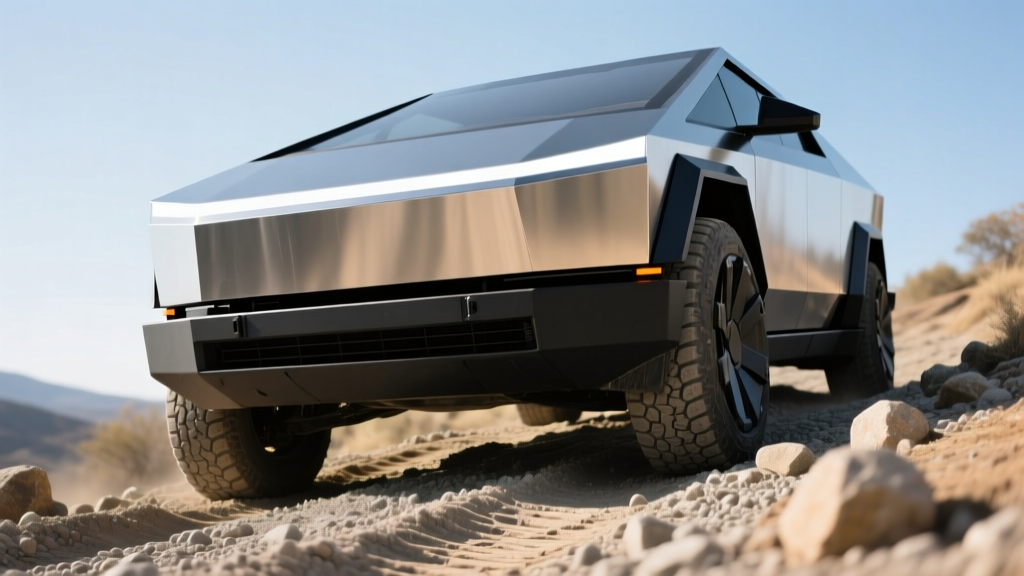
The Tesla Cybertruck remains one of the most polarizing electric vehicles on the road. Its angular, cold-rolled stainless-steel exoskeleton draws stares at every stoplight, but beneath the origami skin lies a serious electric pickup with legitimate towing, off-road, and daily-driving chops. For buyers researching everything from the Cybertruck bumper design and crash protection to real-world range and 800-volt charging speeds, this review breaks down exactly what you get — and what you don't — across the 2026 lineup.
Cybertruck Bumper Engineering and Crash Protection
The Cybertruck's front and rear bumper assemblies are integrated directly into the stainless-steel body structure, unlike conventional pickups that use bolt-on plastic or painted steel bumper covers. Tesla designed the angular front fascia to serve double duty: it manages crash energy through engineered crumple zones behind the leading edge while maintaining the truck's monolithic look. The rear bumper section is similarly integrated, with a deployable ramp that folds down from the tailgate to bridge the bed-to-ground gap for loading ATVs, motorcycles, or wheeled equipment.
This integrated approach means minor parking-lot scuffs show differently than on painted bumpers — stainless steel won't chip or rust, but it can show scuffs and fingerprints that require specific polishing compounds. Replacement of a damaged front or rear body panel involves structural work rather than a simple bumper-cover swap, which influences both repair timelines and insurance premiums. The NHTSA has not yet published a full 5-star safety rating for the Cybertruck, though Tesla's internal testing claims top marks in frontal and side-impact categories. The IIHS has similarly not completed a full evaluation as of early 2026, so buyers prioritizing independently verified crash scores should monitor both agencies for updates.
Range, Battery, and Real-World Efficiency
Tesla equips the Cybertruck with an NMC (nickel-manganese-cobalt) battery pack, prioritizing energy density and peak power delivery over the cycle-life advantages of LFP chemistry. The usable battery capacity is approximately 123 kWh. The truck's 2.6-mile-per-kWh efficiency (roughly 38 kWh per 100 miles) reflects its 6,600+ lb curb weight and brick-like aerodynamics. For comparison, the Rivian R1T achieves around 35-37 kWh/100mi, while the Ford F-150 Lightning sits near 40-42 kWh/100mi.
| Specification | Cybertruck AWD | Cyberbeast | Rear-Wheel Drive (2026 est.) |
|---|---|---|---|
| EPA Range | 340 mi | 320 mi | ~350 mi (announced) |
| Usable Battery | ~123 kWh (NMC) | ~123 kWh (NMC) | ~123 kWh (NMC) |
| 0-60 mph | 4.1 sec | 2.6 sec | TBA |
| Horsepower | 600 hp | 845 hp | TBA |
| Drivetrain | Dual-motor AWD | Tri-motor AWD | Single-motor RWD |
| Towing Capacity | 11,000 lbs | 11,000 lbs | TBA |
| MPGe (combined) | 79 MPGe | 74 MPGe | TBA |
| Base MSRP | $79,990 | $99,990 | ~$60,990 (announced) |
Charging Speed: 800V Architecture in Practice
The Cybertruck uses an 800-volt electrical architecture, enabling peak DC fast-charge rates of up to 350 kW at compatible Supercharger V4 stalls and third-party CCS/NACS stations. Tesla quotes a 10-80% charge time of approximately 15 minutes under ideal conditions. In real-world testing, the charging curve tapers meaningfully above 60% state of charge, and sustained rates average closer to 200-250 kW across the full 10-80% window. Preconditioning the battery via the navigation-routed charging feature is essential for hitting peak speeds — arriving at a Supercharger without preconditioning can add 5-8 minutes to your session.
| Charging Level | Power / Rate | Time / Miles Added |
|---|---|---|
| Level 1 (120V, 12A) | ~1.4 kW | ~3-4 miles per hour |
| Level 2 (240V, 48A Wall Connector) | 11.5 kW | ~34 miles per hour; full charge in ~11 hrs |
| DC Fast Charge (NACS/CCS) | Up to 350 kW peak | 10-80% in ~15 min (ideal); ~18-22 min typical |
For home charging, Tesla's Wall Connector at 48 amps delivers roughly 34 miles of range per hour of charging, meaning an overnight session from 20% to 80% takes about 7-8 hours. The Cybertruck ships with a NACS connector natively, and Tesla includes a CCS adapter for access to Electrify America, EVgo, and other networks. The 800V system also enables fast voltage step-down for 120V and 240V outlets in the bed via the truck's built-in Power Share feature.
Performance, Towing, and Off-Road Capability
The dual-motor AWD Cybertruck produces 600 horsepower and rockets to 60 mph in 4.1 seconds — remarkable for a vehicle weighing over three tons. The tri-motor Cyberbeast drops that to 2.6 seconds with 845 hp, making it one of the quickest production vehicles of any kind. Both configurations feature adaptive air suspension with up to 16 inches of ground clearance in Extract mode, a locking rear differential, and steer-by-wire steering that eliminates the mechanical connection between the yoke and the front wheels.
Towing capacity is rated at 11,000 pounds across both AWD and Cyberbeast trims, matching or exceeding most half-ton gas pickups. However, towing at max capacity cuts range dramatically — expect a 40-55% reduction, putting real-world towing range at roughly 140-190 miles before needing a charge. The 6-foot bed (which Tesla calls the "vault") offers 67 cubic feet of lockable storage with the tonneau cover deployed, and the powered cover can support up to 300 pounds of distributed weight. Interior space accommodates five passengers with 41.1 inches of front legroom and 38.2 inches in the rear — adequate but not class-leading versus the Rivian R1T or F-150 Lightning's crew cab layouts.
Pricing, Tax Credits, and Ownership Costs
The 2026 Cybertruck lineup starts at $79,990 for the dual-motor AWD and $99,990 for the Cyberbeast. The promised rear-wheel-drive variant, originally targeted at approximately $60,990, remains in announced status with deliveries expected later in 2026 — it is not currently available for purchase.
| Trim | Base MSRP | Federal §30D Credit | Effective Price |
|---|---|---|---|
| AWD | $79,990 | $0 (exceeds $80K truck cap) | $79,990 |
| Cyberbeast | $99,990 | $0 (exceeds $80K truck cap) | $99,990 |
| RWD (announced) | ~$60,990 | Potentially eligible (under $80K cap) | ~$53,490* |
*RWD credit eligibility depends on final battery-sourcing and critical-mineral compliance under IRS §30D rules. Buyer income caps also apply ($150K single / $300K joint). Consult IRS guidelines and a tax professional before relying on credit estimates.
A critical point for current Cybertruck buyers: the AWD and Cyberbeast trims exceed the IRS §30D MSRP cap of $80,000 for trucks and vans, meaning neither qualifies for the $7,500 federal tax credit at current pricing. Only the upcoming RWD model — if it lands below the cap and meets battery-sourcing requirements — would be eligible. State and local incentives vary by jurisdiction; check your state's energy office for additional rebates.
Tech, Driver Assistance, and Interior
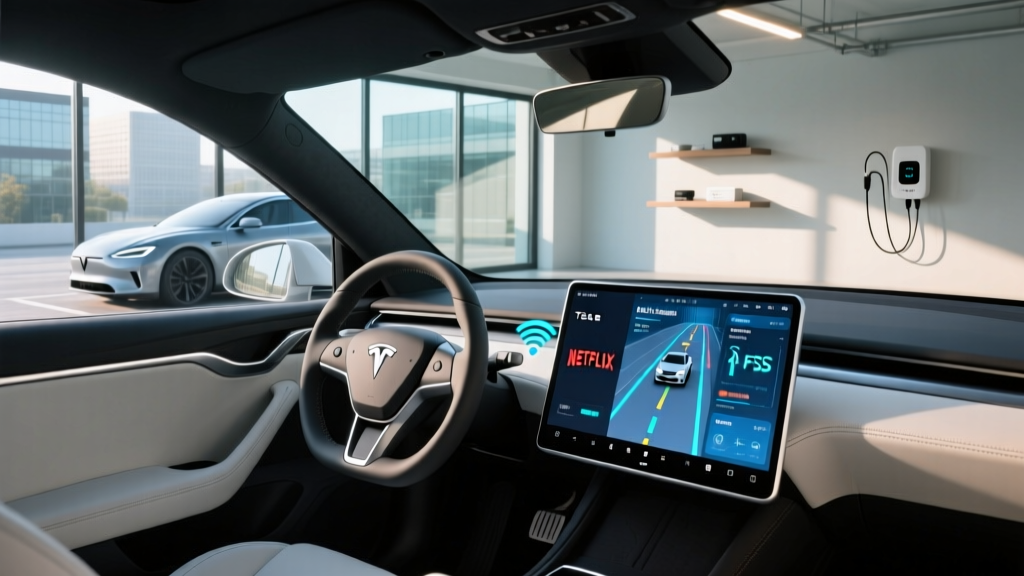
The Cybertruck's interior is characteristically Tesla-minimalist: an 18.5-inch center touchscreen handles all infotainment, climate, and vehicle controls, with a smaller 9.4-inch rear touchscreen for back-seat passengers. There are no physical buttons for climate or media. The yoke-style steering wheel takes genuine adaptation, particularly for three-point turns and parking maneuvers, though Tesla's steer-by-wire system uses a variable ratio that reduces the need for hand-over-hand input at low speeds.
Tesla's Autopilot comes standard, with Full Self-Driving (Supervised) available as a $8,000 add-on or $99/month subscription. FSD Supervised remains an SAE Level 2 system — the driver must remain fully attentive with hands on the yoke and eyes on the road at all times. It is not autonomous driving. Tesla's camera-only vision approach (no lidar or radar) handles highway lane-keeping and city navigation competently in clear conditions but can struggle with heavy rain, construction zones, and faded lane markings.
Unique tech includes the Power Share system (120V and 240V outlets in the bed and cabin, capable of powering tools or providing backup home power via a future V2H integration), a HEPA-filtered "Bioweapon Defense Mode" cabin air system, and Armor Glass — a laminated composite that Tesla claims resists impacts from baseballs and hail without shattering. The stainless-steel body requires no paint and will not rust, but it shows fingerprints readily and demands specialized repair facilities for dent or panel work.
Warranty, Reliability, and Service
Tesla provides a 4-year/50,000-mile basic vehicle warranty and an 8-year/120,000-mile battery and drive-unit warranty. The battery warranty guarantees a minimum 70% capacity retention over the coverage period. Given the Cybertruck's NMC chemistry and the high charge/discharge rates associated with towing and performance driving, moderate degradation (8-12% over the first 100,000 miles) is realistic based on Tesla's fleet-wide data from Model S and Model X vehicles using similar cell chemistries.
Service remains a consideration: Tesla's mobile-ranger network handles many software and minor hardware fixes at your home or office, but body and structural work — including bumper or panel replacement — requires a Tesla-approved collision center, of which there are still relatively few nationwide. Insurance premiums for the Cybertruck run 25-40% higher than comparable F-150 Lightning or Rivian R1T policies, driven by repair costs for the stainless-steel body and specialized glass.
Pros
- Class-leading 350 kW peak DC charging with 800V architecture
- 11,000-lb towing capacity matches conventional half-tons
- Stainless-steel body eliminates paint maintenance and rust
- Cyberbeast's 2.6-second 0-60 is supercar territory in a truck
- Integrated Power Share bed outlets for job-site and camping use
- Air suspension with up to 16 inches of ground clearance
Cons
- AWD and Cyberbeast exceed the $80K §30D tax credit cap
- Real-world range drops 40-55% when towing at max capacity
- Stainless-steel repair requires specialized collision centers
- Insurance premiums 25-40% higher than key competitors
- Yoke steering demands a genuine learning curve
- Full NHTSA/IIHS crash ratings still pending
Who Should Buy the Cybertruck?
The Cybertruck fits a specific buyer: someone who wants an electric pickup with genuine towing and off-road capability, values the 800V charging speed for road trips, and is willing to accept the trade-offs of a stainless-steel exoskeleton and premium pricing. It works well as a daily driver that can handle weekend towing, camping, or job-site duty. It is less suited for buyers who prioritize verified safety ratings, low insurance costs, or federal tax-credit eligibility at current pricing.
Consider the Rivian R1T if you need a full crew cab with more rear-seat space, proven IIHS safety credentials, and a more conventional steering setup. Look at the Ford F-150 Lightning if you want a lower entry price, Blue Oval service-network familiarity, and tax-credit eligibility on trims below $80K. The Cybertruck wins on charging speed, performance, and sheer presence — but it demands compromises that its competitors don't.
Cybertruck Frequently Asked Questions
What is the real-world range of the Tesla Cybertruck?
The AWD Cybertruck carries a 340-mile EPA estimate. Real-world highway driving at 70-75 mph yields approximately 260-290 miles. In freezing temperatures with cabin heat active, expect 210-250 miles. The Cyberbeast's heavier tri-motor setup reduces these figures by roughly 5-8%.
How fast does the Cybertruck charge at home and on the road?
At a compatible 350 kW DC fast charger, the Cybertruck reaches 10-80% in approximately 15 minutes under ideal conditions (18-22 minutes typical with curve taper). At home on a 48A Level 2 Wall Connector (11.5 kW), it adds about 34 miles per hour, with a full charge taking roughly 11 hours.
Does the Cybertruck qualify for the federal EV tax credit?
The AWD ($79,990) and Cyberbeast ($99,990) trims exceed the IRS §30D MSRP cap of $80,000 for trucks, making them ineligible for the $7,500 credit. The announced RWD model (~$60,990) may qualify if it meets battery-sourcing and buyer-income requirements. Always verify current rules at IRS.gov.
How does the Cybertruck bumper handle minor impacts?
The integrated stainless-steel body panels resist dents better than conventional painted steel or plastic bumper covers, and they will not rust or chip. However, deep scratches and significant impacts require specialized stainless-steel repair work at Tesla-approved collision centers rather than a simple bumper-cover replacement. Insurance claims for body damage tend to be costlier than on traditional pickups.
Is the Cybertruck worth buying over the Rivian R1T or F-150 Lightning?
Choose the Cybertruck if you prioritize 800V fast-charging speed, extreme acceleration (especially the Cyberbeast), and the stainless-steel body's durability. Choose the Rivian R1T for a more refined interior, verified safety ratings, and better rear-seat comfort. Choose the F-150 Lightning for lower pricing, broader dealer service access, and tax-credit eligibility on mid-range trims.
What is the Cybertruck's towing range?
When towing near the 11,000-lb maximum, expect a 40-55% range reduction, bringing real-world towing range to approximately 140-190 miles for the AWD trim. Trip planning around Supercharger or CCS station locations is essential for any extended towing trip.