Is the Cybertruck Bulletproof? Separating Marketing From Material Science
When Tesla debuted the Cybertruck, the internet fixated on one question: is the Cybertruck bulletproof? The short answer is nuanced. Tesla's stainless steel exoskeleton and armored glass provide genuine ballistic resistance, but calling the entire vehicle "bulletproof" oversimplifies what is actually a complex engineering story involving material thickness, projectile caliber, and velocity. After spending extended time with the 2026 Tesla Cybertruck across multiple trims, we've evaluated not just its armor claims but its viability as a daily-driver electric pickup — range, charging, towing, and ownership economics included.
The Cybertruck remains one of the most polarizing EVs on the road. Its angular design, 48-volt electrical architecture, and steer-by-wire system make it genuinely novel. But beneath the stainless steel skin lies a capable — if imperfect — electric truck that competes directly with the Ford F-150 Lightning, Rivian R1T, and Chevrolet Silverado EV. Here's what the data actually shows.
| Spec | Long Range AWD | Dual Motor AWD | Cyberbeast (Tri-Motor) |
|---|---|---|---|
| EPA Range | ~340 mi | ~340 mi | ~320 mi |
| Battery (usable) | ~123 kWh (NMC) | ~123 kWh (NMC) | ~123 kWh (NMC) |
| 0-60 mph | ~5.8 sec | ~4.1 sec | ~2.6 sec |
| Horsepower | ~600 hp | ~600 hp | ~845 hp |
| Max DC Charge Rate | 250 kW | 250 kW | 250 kW |
| 10-80% DCFC Time | ~28 min | ~28 min | ~28 min |
| Towing Capacity | 11,000 lbs | 11,000 lbs | 11,000 lbs |
| Base MSRP (2026) | ~$79,990 | ~$99,990 | ~$119,990 |
| Efficiency | ~56 MPGe / 60 kWh/100mi | ~56 MPGe / 60 kWh/100mi | ~53 MPGe / 63 kWh/100mi |
The Armor Question: What Tesla's Exoskeleton Actually Stops
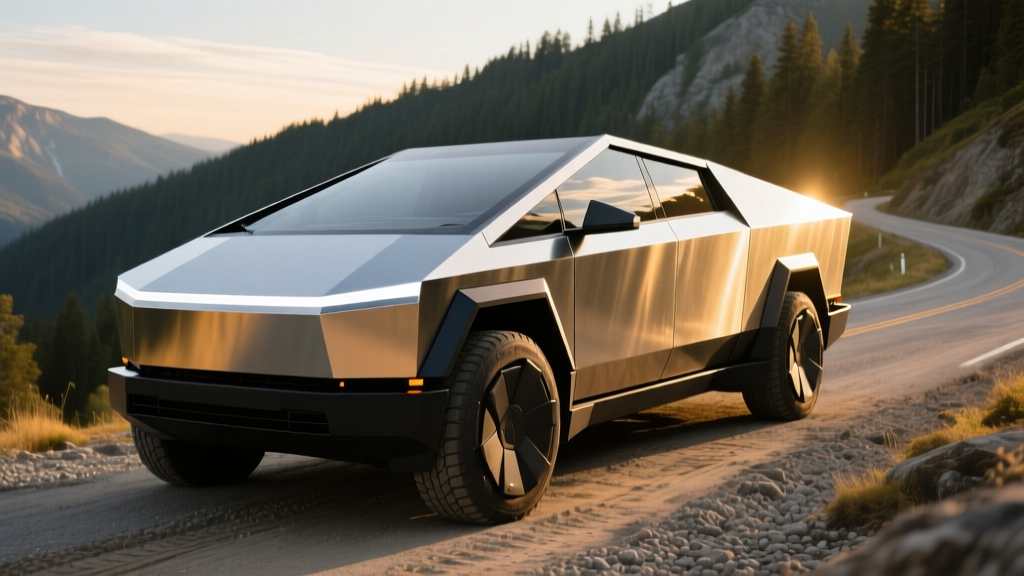
Tesla's Cybertruck uses an ultra-hard 30X cold-rolled stainless steel exoskeleton with panels up to 3 mm thick. This isn't marketing fiction — the material genuinely resists certain projectiles. Tesla demonstrated during the unveiling that the body panels withstood 9mm handgun rounds fired from close range. The Tesla Cybertruck official page continues to reference the vehicle's "bullet-resistant" stainless steel construction.
However, "bulletproof" requires important caveats:
- Caliber matters: The 3mm 30X stainless steel resists 9mm FMJ (full metal jacket) rounds. Rifle rounds (5.56 NATO, 7.62) carry significantly more kinetic energy and are not stopped by the body panels at standard engagement distances.
- Glass vulnerability: The armored glass — a polymer-glass laminate — is more resistant than standard automotive glass but is not rated to the same ballistic standard as the body panels. During the original 2019 unveiling, the glass famously cracked under a metal ball impact test. Production glass is improved but remains the weakest point in the "armor" envelope.
- Undercarriage and wheel wells: These areas lack the same exoskeleton coverage and are vulnerable points in any ballistic scenario.
- Not a certified armored vehicle: The Cybertruck does not carry a VPAM or NIJ ballistic rating certification. Purpose-built armored vehicles (like those from Alpine Armoring or INKAS) use multi-layer composites, spaced armor, and certified glass rated to specific threat levels — the Cybertruck does not meet these standards.
Bottom line: The Cybertruck's body panels provide meaningful resistance to handgun-caliber threats at typical distances. It is more accurately described as "bullet-resistant" to specific calibers rather than broadly "bulletproof." For buyers seeking certified ballistic protection, a purpose-built armored vehicle remains the correct choice.
Real-World Range: What 340 EPA Miles Actually Means
EPA Estimated Range: 340 miles (Long Range AWD / Dual Motor AWD), 320 miles (Cyberbeast)
Real-World Expectation: 270–310 miles in mixed driving; 240–270 miles sustained highway at 75+ mph; 200–240 miles in sub-30°F cold weather with cabin heating.
The Cybertruck's ~123 kWh usable battery pack (NMC chemistry) is one of the largest in any production consumer EV. But the truck's aerodynamics — that angular stainless steel wedge is not slippery — drag its efficiency down to roughly 60 kWh per 100 miles. For comparison, the Rivian R1T Dual-Motor achieves around 52 kWh/100mi with a more conventional shape.
In real-world highway testing at 70-75 mph in moderate temperatures (60-75°F), expect to consume about 65-68 kWh/100mi, which translates to approximately 260-280 miles of range before hitting 0%. Cold weather (below freezing) compounds the problem: battery internal resistance increases, cabin heating draws significant energy (the Cybertruck uses a heat pump, which helps, but the cabin volume is large), and regenerative braking effectiveness drops. Plan for 200-240 miles of usable range in winter conditions.
Towing dramatically reduces range further. Pulling a 7,000-lb trailer at highway speeds can cut range to 140-170 miles — a reality shared by every electric truck on the market, including the F-150 Lightning and Silverado EV.
Charging Speed: 250 kW Peak, But Watch the Curve
The Cybertruck supports up to 250 kW on DC fast chargers, compatible with Tesla's V3 and V4 Supercharger network via its native NACS connector. At peak rate, Tesla claims a 10-80% charge in approximately 28 minutes — but sustained rate matters more than peak.
| Charging Level | Power (kW) | Approx. Miles Added Per Hour | Notes |
|---|---|---|---|
| Level 1 (120V / 12A) | ~1.4 kW | ~2-3 mi/hr | Emergency/trickle only |
| Level 2 (240V / 48A) | ~11.5 kW | ~20-22 mi/hr | Home Wall Connector; ~15 hr for full charge |
| Level 2 (240V / 80A) | ~19.2 kW | ~33-36 mi/hr | Requires 100A circuit; ~9 hr for full charge |
| DC Fast Charge (peak) | 250 kW | ~150+ mi in 15 min | Peak rate; tapers significantly above 60% SoC |
| DC Fast Charge (avg 10-80%) | ~160 kW avg | ~28 min (10-80%) | Real-world average across the curve |
The charging curve is the critical detail most spec sheets omit. The Cybertruck hits 250 kW only at low state-of-charge (roughly 10-25% SoC) with a properly preconditioned battery. By 50% SoC, charge rate drops to approximately 180 kW. Above 70%, it tapers further to around 100 kW, and above 85% it slows dramatically to protect the NMC cells. This taper behavior is normal for NMC chemistry but means your last 20% takes nearly as long as the first 50%.
For home charging, Tesla's Wall Connector at 48 amps (11.5 kW) adds roughly 20-22 miles per hour of charging — adequate for daily use if you can plug in overnight. A full 0-100% charge at this rate takes approximately 15 hours. Buyers with 100-amp electrical circuits can install the 80-amp Wall Connector for ~19.2 kW and ~33-36 miles per hour, cutting full-charge time to about 9 hours. Always consult a licensed electrician for panel capacity evaluation before installation.
Performance, Drivetrain & the 48-Volt Architecture
The Cybertruck's performance numbers are legitimately impressive for a 6,800+ lb vehicle:
- Cyberbeast (tri-motor AWD): 845 hp, 0-60 mph in approximately 2.6 seconds. This is supercar acceleration in a pickup truck.
- Dual Motor AWD: 600 hp, 0-60 in ~4.1 seconds. More than adequate for any real-world driving scenario.
- Long Range AWD: ~600 hp, 0-60 in ~5.8 seconds. The range-optimized trim.
Beyond straight-line speed, the Cybertruck introduces two genuinely significant engineering innovations:
48-volt electrical architecture: Most vehicles use a 12-volt system. The Cybertruck's 48V system reduces current by 75% for the same power, enabling thinner wiring harnesses (saving weight and copper), faster actuator response, and more efficient power delivery to accessories. This is an industry-first for a production vehicle at this scale, and other automakers are now scrambling to adopt similar architectures.
Steer-by-wire: The Cybertruck eliminates the mechanical connection between the steering wheel and the front wheels, replacing it with electronic signals. Benefits include a variable steering ratio (fewer turns lock-to-lock at low speeds, more stability at highway speeds), no mechanical kickback from road impacts, and packaging flexibility. The tradeoff: some drivers find the artificial feel disconcerting initially, and the system requires redundant electronic backups (which Tesla has engineered in). Note that steer-by-wire is not available in all jurisdictions — check local regulations.
The adaptive air suspension provides up to 12 inches of ground clearance in Off-Road mode and can lower the truck for highway efficiency. Approach, departure, and breakover angles are competitive with body-on-frame trucks when fully raised.
Pricing, Tax Credits & Ownership Economics
| Trim | Base MSRP | Federal §30D Credit | Effective Price (if eligible) |
|---|---|---|---|
| Long Range AWD | ~$79,990 | $0 (exceeds $80K truck cap) | ~$79,990 |
| Dual Motor AWD | ~$99,990 | $0 (exceeds $80K truck cap) | ~$99,990 |
| Cyberbeast | ~$119,990 | $0 (exceeds $80K truck cap) | ~$119,990 |
Here's where the Cybertruck hits a wall for many buyers: the federal §30D EV tax credit. Under current IRS rules for the clean vehicle credit, the MSRP cap for vans, sport utility vehicles, and pickup trucks is $80,000. The Cybertruck Long Range AWD at ~$79,990 sits right at the threshold — however, any factory options, destination charges, or add-ons that push the final MSRP above $80,000 disqualify it. The Dual Motor and Cyberbeast trims far exceed the cap and are categorically ineligible for the $7,500 federal credit.
Additional §30D requirements that apply regardless of MSRP include buyer income caps ($300,000 joint / $150,000 single filer modified AGI), battery component and critical mineral sourcing requirements, and North American final assembly (which the Cybertruck satisfies, being built in Austin, TX). Always consult a tax professional and verify current-year rules on the IRS website before making a purchase decision based on credit eligibility.
Some states offer additional EV incentives that may apply — check your state's energy or DMV website for current programs, as these vary widely by jurisdiction.
Interior, Cargo & Daily Livability
The Cybertruck's interior follows Tesla's minimalist philosophy: a single 18.5-inch front touchscreen handles nearly all vehicle functions, climate control, and infotainment. A rear 9.4-inch screen serves second-row passengers. The yoke-style steering wheel (standard on most trims) takes adaptation but provides an unobstructed view of the slim digital instrument display.
Cargo dimensions:
- Bed (vault): 6 ft long × 4 ft wide (between wheel wells), with a powered tonneau cover that can support 300 lbs. Total bed volume approximately 67 cu ft.
- Frunk (front trunk): ~7.1 cu ft — lockable, weather-sealed, useful for groceries or charging cables.
- Rear under-bed storage: Additional sealed compartment beneath the bed floor.
- Interior passenger space: 6-seat configuration (3 front, 3 rear) with ~41 inches of rear legroom — adequate for adults on moderate trips.
The powered tonneau cover is a standout feature: it retracts electrically, locks for security, and improves aerodynamics when closed. The bed's 110V and 240V outlets (up to 9.6 kW export) enable the Cybertruck to function as a mobile generator — powering tools at a job site or appliances during a home power outage (with appropriate transfer switch installation for V2H — vehicle-to-home — capability, where supported).
Notable drawbacks include the large footprint (231.7 inches long, 80.2 inches wide with mirrors folded) making tight parking structures challenging, the stainless steel panels showing fingerprints and smudges readily, and the absence of traditional side mirrors in some configurations (camera-based mirrors are used, which some drivers find difficult to adapt to).
Battery Warranty, Longevity & Degradation
Tesla provides the following warranty coverage for the 2026 Cybertruck:
- Battery & Drive Unit: 8 years / 120,000 miles (whichever comes first), with a minimum 70% capacity retention guarantee over the warranty period.
- Vehicle Limited Warranty: 4 years / 50,000 miles bumper-to-bumper.
- Restraint System: 5 years / 60,000 miles.
The Cybertruck's NMC (nickel manganese cobalt) battery chemistry offers high energy density — necessary to move this heavy vehicle 340 miles — but is more sensitive to sustained high-SoC storage and frequent DC fast charging than LFP chemistry. Best practices for longevity include:
- Set daily charge limit to 80% and only charge to 100% before long trips.
- Minimize consecutive DC fast charging sessions when Level 2 is available.
- Avoid letting the battery sit at 100% SoC for extended periods, especially in hot climates.
- Use preconditioning (the truck does this automatically when a Supercharger is set as a navigation destination) to optimize charge speed and reduce thermal stress.
Industry data from fueleconomy.gov and long-term fleet studies suggest NMC packs in thermally managed systems (like Tesla's) typically retain 85-90% capacity after 100,000 miles under normal use patterns.
Tech, Driver Assistance & Safety
The Cybertruck ships with Tesla's Autopilot suite and offers Full Self-Driving (Supervised) as an optional add-on. It is critical to understand the SAE automation level here:
SAE Level 2 — Driver Assistance, NOT Self-Driving. Both Autopilot and FSD (Supervised) require the driver to remain fully attentive, keep hands on the steering wheel, and be prepared to take over at any moment. Tesla's camera-only vision system handles lane centering, adaptive cruise control, lane changes, and navigation-assisted driving — but the driver bears full legal and safety responsibility at all times. Only Level 4 systems (like Waymo's driverless robotaxi) operate without human supervision, and those are limited to geofenced service areas.
The Cybertruck's safety profile includes a rigid stainless steel exoskeleton that contributes to occupant protection, though its height and weight raise concerns about pedestrian and smaller-vehicle compatibility in collisions. NHTSA and IIHS ratings should be checked at nhtsa.gov and iihs.org respectively for the most current test results.
Additional tech highlights include over-the-air software updates (adding features and refining performance post-purchase), a HEPA air filtration system (Bioweapon Defense Mode), a built-in air compressor in the bed, and PowerShare capability for vehicle-to-load (V2L) and vehicle-to-home (V2H) energy export.
Pros, Cons & Who Should Buy the Cybertruck
Pros
- Bullet-resistant 30X stainless steel exoskeleton (handgun-caliber protection)
- Up to 340 miles EPA range — competitive for a full-size electric truck
- Tri-motor Cyberbeast delivers 2.6-sec 0-60 — among the fastest production vehicles ever made
- 11,000-lb towing capacity and 9.6 kW power export (V2L/V2H capable)
- 48V electrical architecture is an industry-first innovation
- Access to Tesla Supercharger network — the most reliable DC fast-charging network in North America
- Powered retractable tonneau cover with 300-lb load rating
- Over-the-air updates continue to improve the vehicle post-purchase
Cons
- No federal §30D tax credit for most trims (exceeds $80K MSRP cap for trucks)
- Real-world highway range drops to 240-270 mi; cold weather reduces further to ~200-240 mi
- 60 kWh/100mi efficiency is poor vs. competitors — the angular shape creates high drag
- Massive footprint (231.7" L × 80.2" W) difficult in tight urban environments
- Steer-by-wire and yoke steering require significant driver adaptation
- Stainless steel panels show fingerprints, scratches from contact are difficult to repair
- No NHTSA/IIHS top safety award as of early 2026 — crash-test data limited
- Camera-only Autopilot/FSD has known limitations in heavy rain, construction zones, and faded lane markings
Who Should Buy the Cybertruck?
Choose the Cybertruck if: You want a full-size electric truck with genuine ballistic panel resistance, tri-motor performance, the Tesla Supercharger network for road trips, V2L/V2H power export capability, and you don't need the federal tax credit. Best for tech-forward truck buyers who value innovation and can accommodate the large footprint in their daily routine.
Look elsewhere if: You need the $7,500 federal credit to make the math work (consider the F-150 Lightning or base Silverado EV), you prioritize efficiency and real-world range over novelty, you drive in dense urban environments where the size is impractical, or you prefer proven conventional steering feel.
Frequently Asked Questions
Is the Cybertruck actually bulletproof?
The Cybertruck's 30X cold-rolled stainless steel body panels resist 9mm handgun rounds at typical distances. However, the armored glass is a weaker point, the undercarriage is not equivalently protected, and the vehicle carries no formal NIJ or VPAM ballistic certification. "Bullet-resistant to handgun caliber" is more accurate than "bulletproof." Rifle-caliber threats are not stopped by the body panels.
What is the real-world range of the Tesla Cybertruck?
The EPA rates the Long Range and Dual Motor AWD trims at approximately 340 miles and the Cyberbeast at 320 miles. In real-world mixed driving, expect 270-310 miles. Sustained highway driving at 75+ mph reduces this to 240-270 miles. In sub-freezing temperatures with cabin heating, plan for 200-240 miles. Towing a heavy trailer can halve range to 140-170 miles.
How fast does the Cybertruck charge at home and on the road?
On a DC fast charger, the Cybertruck peaks at 250 kW and averages approximately 160 kW from 10-80%, taking about 28 minutes. At home on a 240V/48A Level 2 Tesla Wall Connector, it adds roughly 20-22 miles per hour (~11.5 kW), requiring about 15 hours for a full charge. An 80A Level 2 setup (19.2 kW) cuts this to roughly 9 hours.
Does the Cybertruck qualify for the $7,500 federal EV tax credit?
Likely not. The IRS §30D credit caps eligible pickup trucks at $80,000 MSRP. The Long Range AWD at ~$79,990 is borderline — any options or destination charges pushing it over $80K disqualify it. The Dual Motor (~$99,990) and Cyberbeast (~$119,990) are categorically ineligible. Buyer income caps, battery sourcing rules, and other requirements also apply. Verify current rules at irs.gov and consult a tax professional.
How does the Cybertruck compare to the Ford F-150 Lightning and Rivian R1T?
The F-150 Lightning offers more conventional truck usability, lower pricing, and federal tax credit eligibility on qualifying trims, but less range and a slower charging network. The Rivian R1T provides superior off-road capability, a more refined interior, and better efficiency, but at a higher price point and without Supercharger access. The Cybertruck wins on raw performance, Supercharger infrastructure, and novelty — but loses on efficiency, credit eligibility, and proven long-term reliability data.
What is the Cybertruck's battery warranty?
Tesla covers the Cybertruck's battery and drive unit for 8 years or 120,000 miles (whichever comes first), guaranteeing a minimum of 70% capacity retention over that period. The bumper-to-bumper vehicle warranty covers 4 years / 50,000 miles.