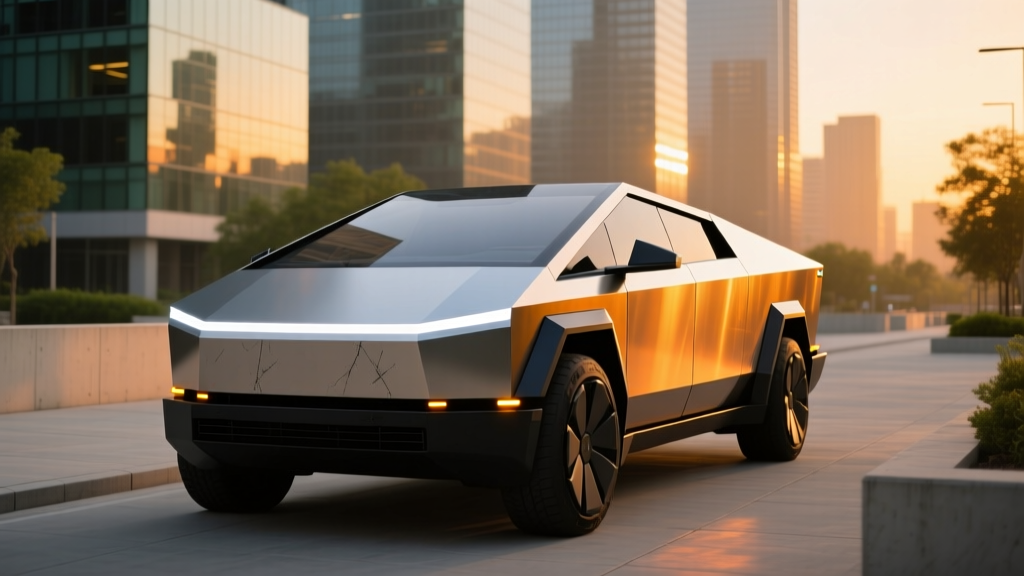
If any production vehicle earned the nickname blade runner cybertruck, it's Tesla's angular stainless-steel pickup. The Cybertruck looks like it rolled off the set of a Ridley Scott film, but beneath the cold-rolled exoskeleton sits a serious electric truck with up to 340 miles of EPA-estimated range, 845 horsepower, and a charging architecture that peaks at 350 kW. After two full model years on the road, we have real-world data on range, charging curves, ownership costs, and whether this polarizing EV actually delivers as a daily driver and work truck.
This review covers the 2026 Tesla Cybertruck lineup — the Rear-Wheel Drive, All-Wheel Drive, and Cyberbeast trims — with exact specs, honest range expectations, and a clear look at who should (and shouldn't) buy one.
Quick Verdict: Is the Cybertruck a Practical EV or a Statement Piece?
The Cybertruck is genuinely capable as an electric pickup: it tows up to 11,000 pounds, accelerates to 60 mph in as little as 2.6 seconds, and charges faster than nearly any other truck on the market. But its polarizing design, panel-gap inconsistencies, limited service-center capacity, and the reality that its real-world highway range falls 15–20% below the EPA sticker mean buyers need clear eyes before signing. If you want a fast-charging, tech-forward EV truck and can live with its quirks, the AWD trim at roughly $80,000 (before credits) is the sweet spot. If you need a conventional-feeling truck with broad service support, the Ford F-150 Lightning or Rivian R1T may serve you better.
Range, Battery, and Real-World Efficiency
EPA Estimated: 340 miles (Dual-Motor AWD with standard battery)
Real-World Highway (70 mph, 65°F): ~275–290 miles
Real-World Cold Weather (30°F, mixed driving): ~240–260 miles
With Range Extender Battery (AWD): EPA 470 miles, real-world highway ~380–400 miles
The Cybertruck's battery pack uses an NMC (nickel-manganese-cobalt) chemistry in a structural 4680-cell configuration. Tesla has not published the exact usable capacity for every trim, but teardown data and EPA efficiency figures place the standard AWD pack at approximately 123 kWh usable. The Rear-Wheel Drive model uses a smaller pack estimated at around 100 kWh usable, yielding its 250-mile EPA rating.
Efficiency for the AWD trim lands at approximately 53 MPGe combined, or roughly 63 kWh per 100 miles according to fueleconomy.gov. That's less efficient than a sedan like the Model 3 (which benefits from a lower, more aerodynamic profile), but competitive with other full-size electric pickups. The Cybertruck's angular shape creates substantial drag at highway speeds, which is why real-world 70-mph range drops noticeably compared to the EPA combined cycle.
| Spec | RWD | AWD | Cyberbeast |
|---|---|---|---|
| EPA Range | 250 mi | 340 mi (470 mi w/ extender) | 320 mi |
| Battery (usable, est.) | ~100 kWh NMC | ~123 kWh NMC | ~123 kWh NMC |
| Horsepower | 277 hp | 600 hp | 845 hp |
| 0–60 mph | 6.5 sec | 3.9 sec | 2.6 sec |
| Drivetrain | Single-motor RWD | Dual-motor AWD | Tri-motor AWD |
| Max Tow Capacity | 7,500 lb | 11,000 lb | 11,000 lb |
| MPGe (combined) | ~58 MPGe | ~53 MPGe | ~50 MPGe |
| Base MSRP | $60,990 | $79,990 | $99,990 |
Charging Speed: DC Fast, Level 2, and the 400-Volt Reality
The Cybertruck charges on a 400-volt architecture (not the 800V systems found in the Hyundai Ioniq 5 or Porsche Taycan). Despite this, Tesla's thermal management allows impressive peak charge rates on the AWD and Cyberbeast trims.
| Charging Level | Rate | Time / Miles Added |
|---|---|---|
| DC Fast Charge (V4 Supercharger) | Peak 350 kW | 10–80% in ~18 min (AWD) |
| DC Fast Charge (third-party CCS) | Peak ~175 kW (with adapter) | 10–80% in ~38 min |
| Level 2 Home (Tesla Wall Connector, 48A) | 11.5 kW | ~34 miles per hour of charging |
| Level 2 Home (40A / NEMA 14-50) | 9.6 kW | ~28 miles per hour of charging |
| Level 1 (120V household) | ~1.4 kW | ~4 miles per hour |
Charging-curve reality check: The Cybertruck AWD peaks near 350 kW only between roughly 10–30% state of charge. From 30–60%, the rate tapers to approximately 175–200 kW, and above 80% it drops below 60 kW. This means that 10–80% time of ~18 minutes is achievable at a V4 Supercharger with a preconditioned battery, but adding range from 80–100% will take an additional 25+ minutes. Plan your road-trip stops around the 10–80% sweet spot.
The Cybertruck uses the NACS (North American Charging Standard) connector natively, giving it direct access to Tesla's Supercharger network — now over 6,500 stations in North America. A Tesla-provided CCS adapter allows use of Electrify America, EVgo, and other non-Tesla DC networks, though at reduced peak speeds due to the adapter's throughput limitations.
Performance, Towing, and Drivetrain
The tri-motor Cyberbeast produces 845 horsepower and 740 lb-ft of torque, launching to 60 mph in 2.6 seconds — faster than a Porsche 911 Turbo S. The dual-motor AWD still delivers 600 hp and a 3.9-second 0–60, which is more than adequate for merging, passing, and towing confidence.
Towing is rated at 11,000 pounds for AWD and Cyberbeast trims, matching or exceeding most half-ton gas pickups. However, as with all EVs, towing at max capacity roughly halves your range. Expect approximately 150–170 miles of real-world range when towing 8,000+ pounds at highway speeds. The Cybertruck includes an integrated trailer brake controller and a tow/haul drive mode that adjusts regen and throttle mapping.
The rear-wheel-drive base model, introduced in 2025, offers 277 hp and a 6.5-second 0–60. It's the volume play for fleet buyers and cost-conscious shoppers, though its 7,500-pound tow rating and 250-mile range limit its utility for heavy work or road trips.
Pricing, Tax Credits, and Total Cost
| Trim | Base MSRP | Federal §30D Credit | Effective Price (est.) |
|---|---|---|---|
| RWD | $60,990 | Up to $7,500* | ~$53,490 |
| AWD | $79,990 | Up to $7,500* | ~$72,490 |
| Cyberbeast | $99,990 | $0 (exceeds MSRP cap) | $99,990 |
*Critical tax-credit caveats: Under IRS §30D rules, the federal EV tax credit of up to $7,500 requires all of the following:
- MSRP cap: Pickup trucks must have an MSRP at or below $80,000. The RWD ($60,990) and AWD ($79,990) qualify; the Cyberbeast ($99,990) does not.
- Buyer income limits: Modified AGI cannot exceed $150,000 (single), $225,000 (head of household), or $300,000 (joint filers).
- Battery sourcing: A percentage of critical minerals and battery components must be sourced from the U.S. or FTA partners. Tesla's 4680 cells use materials that have largely met these thresholds for 2025–2026, but final eligibility can change. Verify at the point of sale.
- Point-of-sale transfer: You can transfer the credit to the dealer at purchase for an immediate price reduction, rather than waiting to claim it on your tax return.
Always confirm current eligibility with your tax professional and the IRS before purchasing. Rules can shift with annual budget reconciliation acts.
Interior, Cargo, and Technology
The Cybertruck's cabin is minimalist even by Tesla standards: a single 18.5-inch touchscreen handles all infotainment, climate, and vehicle controls. There is no instrument cluster — speed and range data appear on the driver-side portion of the main screen. A rear 9.4-inch touchscreen serves second-row passengers.
Cargo dimensions:
- Bed length: 6 feet (with tailgate up); extends to ~8 feet with the powered tonneau-style "sail pillars" folded
- Bed volume: 67 cu ft (bed), plus 7.1 cu ft front trunk (frunk)
- Lockable under-bed storage: ~3.5 cu ft
- Passenger seating: 5 (bench front seat on some trims allows 6)
- Rear legroom: 38.2 inches
The stainless-steel vault bed includes integrated 120V and 240V outlets (PowerShare), enabling vehicle-to-load (V2L) capability up to 11.5 kW — enough to run power tools at a job site, a camper's appliances, or even provide emergency home backup power with the appropriate transfer switch.
Driver assistance: The Cybertruck ships with Tesla's Basic Autopilot (adaptive cruise + lane centering), which is an SAE Level 2 system requiring continuous driver supervision. Full Self-Driving (Supervised) is available as a $8,000 add-on or $99/month subscription. Despite the "FSD" name, this remains a Level 2 system — the driver must remain fully engaged, hands on or near the wheel, and eyes on the road at all times. Tesla's camera-only "Tesla Vision" approach means no LiDAR or radar redundancy.
Pros, Cons, and Who Should Buy
Pros
- Class-leading DC fast-charge speed (350 kW peak, 10–80% in ~18 min on V4 Superchargers)
- Access to the Tesla Supercharger network — the most reliable public DC network in North America
- Up to 470-mile EPA range with the optional Range Extender battery
- 11,000-lb tow rating with integrated brake controller
- 11.5 kW V2L / PowerShare for job-site and camping power
- Cyberbeast performance is supercar-level (2.6 sec 0–60)
- Stainless-steel exoskeleton resists dents and minor scratches
Cons
- Real-world highway range falls 15–20% below EPA due to aerodynamic drag
- Build quality inconsistencies (panel gaps, trim alignment) reported by early owners
- Limited Tesla Service Center capacity — long wait times for body and collision repair
- Cyberbeast exceeds $80K MSRP cap, disqualifying it from the $7,500 federal credit
- Camera-only driver assist lacks LiDAR/radar redundancy
- Polarizing design limits resale appeal in conservative markets
- No Apple CarPlay or Android Auto — Tesla's ecosystem only
Who Should Buy the Cybertruck?
Choose the Cybertruck AWD if: You want the fastest-charging electric truck with Supercharger network access, need V2L capability for work or camping, and value cutting-edge tech over traditional truck refinement.
Choose the Ford F-150 Lightning instead if: You prioritize dealer service availability, want a more conventional truck layout with a massive frunk (14.1 cu ft), and prefer a Pro Power Onboard system with broader aftermarket support.
Choose the Rivian R1T instead if: You want a quad-motor adventure truck with a gear tunnel, better off-road capability, and a more premium interior — and don't mind slower DC charging (~200 kW peak).
Warranty and Long-Term Ownership
Tesla covers the Cybertruck with the following warranty terms:
- Basic Vehicle: 4 years / 50,000 miles
- Battery & Drive Units: 8 years / 120,000 miles (whichever comes first), with a minimum 70% capacity retention guarantee
- Corrosion: 12 years / unlimited miles (stainless exoskeleton)
The 8-year/120,000-mile battery warranty is competitive with the industry standard. The 4680 structural battery pack is not designed for easy module-level replacement — a full pack swap, if needed out of warranty, is estimated at $15,000–$22,000 based on current Tesla service pricing for comparable packs. Battery degradation data from 2024–2025 delivery owners suggests approximately 5–7% loss over the first 30,000 miles, which is within normal NMC expectations. Long-term data beyond 60,000 miles is still limited as of 2026.
Frequently Asked Questions
What is the real-world range of the Cybertruck?
The AWD trim's EPA rating is 340 miles, but expect approximately 275–290 miles at sustained highway speeds (70 mph) in moderate temperatures. In cold weather (below 32°F), plan for 240–260 miles of mixed-driving range. The optional Range Extender battery pushes EPA range to 470 miles, with real-world highway figures around 380–400 miles.
How fast does the Cybertruck charge at home and on the road?
On a Tesla V4 Supercharger, the AWD and Cyberbeast peak at 350 kW, achieving a 10–80% charge in approximately 18 minutes with a preconditioned battery. At home on a 48-amp Level 2 Tesla Wall Connector (11.5 kW), you'll add roughly 34 miles per hour of charging — meaning an overnight 10-hour session adds approximately 340 miles, effectively a full charge.
Does the Cybertruck qualify for the $7,500 federal EV tax credit?
The RWD ($60,990) and AWD ($79,990) trims fall under the $80,000 MSRP cap for pickup trucks and can qualify for the full $7,500 credit under IRS §30D, provided the buyer meets income limits and the battery-sourcing requirements are met at time of purchase. The Cyberbeast ($99,990) exceeds the MSRP cap and does not qualify. Always verify with a tax professional.
Is the Cybertruck worth buying vs. the F-150 Lightning or Rivian R1T?
It depends on your priorities. The Cybertruck wins on charging speed and Supercharger network access. The F-150 Lightning wins on dealer service, conventional truck ergonomics, and frunk space. The Rivian R1T wins on off-road capability, interior quality, and adventure features. For a daily-commuter who road-trips frequently and values fast charging, the Cybertruck AWD is a strong pick. For fleet or job-site use where service uptime matters, the Lightning may be more practical.
Can the Cybertruck power my home or tools?
Yes. Tesla's PowerShare V2L system provides up to 11.5 kW through the bed's 120V and 240V outlets. This is sufficient for running circular saws, air compressors, camper appliances, or — with a licensed electrician's transfer switch installation — providing emergency backup power to essential home circuits.
What are the biggest drawbacks I should know before buying?
The three most common owner complaints as of 2026 are: (1) real-world range falling significantly below the EPA sticker, especially at highway speeds; (2) long wait times for collision and body repair due to limited Tesla Service capacity and stainless-steel panel fabrication complexity; and (3) the lack of Apple CarPlay/Android Auto, which locks you into Tesla's infotainment ecosystem entirely.