Tesla Cybertruck: More Than Just a Polarizing Design
The Tesla Cybertruck remains one of the most debated vehicles on the road — a stainless-steel wedge that splits opinion the moment it pulls into a parking lot. But beyond the angular exoskeleton and social-media spectacle, buyers researching the Cybertruck often land on a practical question: just how usable is the bed? For a truck that starts above $80,000 and weighs nearly 7,000 pounds, cargo utility isn't a secondary concern — it's the whole point.
This review breaks down the Cybertruck's bed dimensions, real-world range, charging behavior, and ownership economics to help you decide whether Tesla's electric pickup actually delivers as a work and lifestyle tool in 2026. We'll cover all three current trims — the Long Range AWD, the tri-motor Cyberbeast, and the base Rear-Wheel Drive (if available in your market) — with exact figures from the EPA and Tesla's own specifications.
Cybertruck Bed Size, Cargo Volume, and Real-World Utility
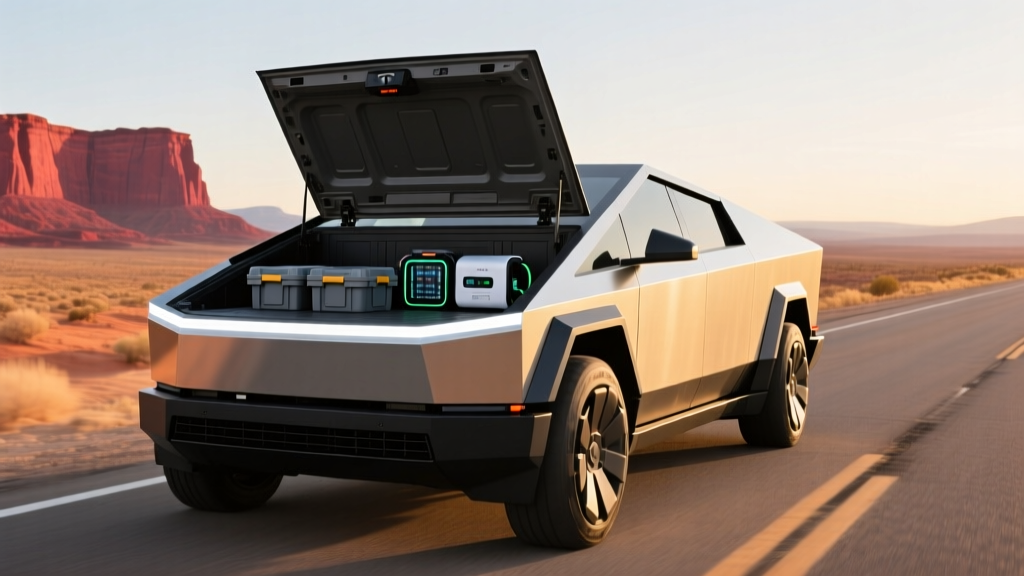
The Cybertruck's vault-style bed measures 6 feet long (72 inches) with the tailgate closed and extends to approximately 7 feet when the powered tonneau cover is retracted and the tailgate is lowered. Width between the wheel wells sits at roughly 49 inches — just narrow enough to make a standard 4×8 sheet of plywood a tight squeeze if laid flat. Maximum bed width at the top rail is approximately 56 inches.
Total bed cargo volume is rated at 67 cubic feet with the tonneau closed, expanding to approximately 120 cubic feet with the cover open. The powered stainless-steel tonneau cover is a standout feature: it retracts electrically, supports up to 300 pounds of distributed weight on top (useful for rooftop tent or kayak loading), and locks automatically with the vehicle.
| Dimension | Measurement |
|---|---|
| Bed Length (tailgate closed) | 72 in (6 ft) |
| Bed Length (tailgate down) | ~84 in (7 ft) |
| Bed Width (between wheel wells) | ~49 in |
| Bed Width (at top rail) | ~56 in |
| Bed Volume (tonneau closed) | 67 cu ft |
| Frunk Volume | ~7 cu ft (front trunk) |
| Sail pillar / gear locker | Lockable side compartments (~2 cu ft each) |
| Max Towing Capacity | 11,000 lbs |
| Max Payload | 2,500 lbs |
The lockable side compartments integrated into the sail pillars (the triangular structures behind the rear doors) are a clever addition — they provide secure, weather-sealed storage for tools, charging cables, or recovery gear without eating into bed space. The frunk (front trunk) adds another 7 cubic feet for groceries or a backpack.
For comparison, the Ford F-150 Lightning offers a 5.5-foot bed (67 cu ft) on its standard box, while the Rivian R1T provides a 4.5-foot bed with its innovative Gear Tunnel adding 11 cubic feet of enclosed cross-cab storage. The Cybertruck's 6-foot vault lands between these two in pure length but adds the security of a fully enclosed, lockable space from the factory.
Range, Battery, and Real-World Efficiency
The Long Range AWD Cybertruck carries an EPA-estimated range of 340 miles on its ~123 kWh (usable) battery pack. In real-world highway driving at 70-75 mph, expect approximately 270-290 miles before needing to charge. In cold weather (below 30°F), range can drop an additional 15-25%, bringing realistic winter highway range to roughly 220-250 miles. The Cyberbeast tri-motor trim sees its EPA range reduced to 320 miles due to the additional front motor's weight and energy draw.
Tesla uses an NMC (nickel manganese cobalt) lithium-ion battery architecture in the Cybertruck, prioritizing energy density for the heavy, aerodynamically challenged body. The pack operates on a 48-volt low-voltage architecture — an industry first for a production vehicle — which reduces wiring harness weight and allows smaller-gauge wires throughout the chassis.
| Trim | EPA Range | Battery (Usable) | Chemistry | MPGe (Combined) | kWh/100 mi |
|---|---|---|---|---|---|
| Long Range AWD (Dual Motor) | 340 mi | ~123 kWh | NMC | 67 MPGe | 50 kWh |
| Cyberbeast (Tri-Motor AWD) | 320 mi | ~123 kWh | NMC | 63 MPGe | 54 kWh |
Efficiency of 50-54 kWh per 100 miles is poor by EV standards — but expected for a 6,800-pound stainless-steel truck with the aerodynamic profile of a doorstop. For context, the Rivian R1T Dual-Motor achieves roughly 73 MPGe combined, and the F-150 Lightning Extended Range posts 70 MPGe. If efficiency is your primary metric, the Cybertruck trails its competition.
According to fueleconomy.gov, the Long Range AWD Cybertruck's combined MPGe rating of 67 translates to approximately 5 miles per gallon-equivalent more than the F-150 Lightning 4WD on the highway cycle — a marginal advantage that disappears in real-world mixed driving with payload or towing.
Charging Speed: DC Fast Charge and Home Level 2
The Cybertruck supports up to 350 kW peak DC fast charging on compatible Supercharger V4 stalls and third-party CCS/NACS stations. Tesla quotes a 10-80% charge time of approximately 28 minutes under optimal conditions (preconditioned battery, warm ambient temperature, available high-power stall).
However, the charging curve tells a more nuanced story. Peak 350 kW is sustained only briefly between roughly 10-20% state of charge. The rate tapers progressively — dropping to around 175 kW near 50% and further to 80-100 kW above 70%. This is standard behavior for large NMC packs but means your average charging power over a 10-80% session is closer to 175-200 kW, not the headline 350 kW figure.
| Charging Level | Power / Rate | Speed | Notes |
|---|---|---|---|
| DC Fast Charge (Peak) | 350 kW | ~200+ mi added in 15 min | Requires V4 Supercharger or equivalent; preconditioned battery |
| DC Fast Charge (10-80%) | ~175-200 kW avg | ~28 min (10-80%) | Curve tapers significantly above 70% SoC |
| Level 2 (Tesla Wall Connector) | 11.5 kW (48A) | ~34 mi/hr of charge | Full charge in ~11 hours from 0% |
| Level 2 (Standard 240V/40A) | 9.6 kW | ~28 mi/hr of charge | Common NEMA 14-50 outlet |
| Level 1 (120V) | ~1.4 kW | ~4 mi/hr of charge | Emergency/trickle only; ~85 hours for full charge |
At home on a Level 2 Tesla Wall Connector (hardwired, 60A circuit), the Cybertruck charges at 11.5 kW, adding roughly 34 miles of range per hour. A full 0-100% charge takes approximately 11 hours — meaning overnight charging from 20% to 80% is easily achievable in about 7 hours. If you're using a standard NEMA 14-50 outlet (40A), expect about 28 miles per hour of charging, which still covers most daily driving needs overnight.
One critical note: the Cybertruck ships with a NACS (North American Charging Standard) port natively, giving it seamless access to Tesla's Supercharger network — the most reliable DC fast-charging infrastructure in the U.S. as of 2026. Third-party networks (Electrify America, EVgo) are accessible via the included CCS adapter, though reliability on those networks remains inconsistent in many regions.
Performance, Drivetrain, and Towing
The Cybertruck Long Range AWD uses a dual-motor setup producing 600 horsepower and launching from 0-60 mph in 3.9 seconds. The Cyberbeast adds a third motor (two rear, one front) for a combined 845 horsepower and a 0-60 time of 2.6 seconds — making it one of the quickest production pickups ever built, rivaling supercars from a decade ago.
| Spec | Long Range AWD | Cyberbeast (Tri-Motor) |
|---|---|---|
| Drivetrain | Dual-Motor AWD | Tri-Motor AWD |
| Horsepower | 600 hp | 845 hp |
| 0-60 mph | 3.9 sec | 2.6 sec |
| Top Speed | 112 mph | 130 mph |
| Max Towing | 11,000 lbs | 11,000 lbs |
| Max Payload | 2,500 lbs | 2,500 lbs |
| Ground Clearance | Up to 16 in (adaptive air suspension) | Up to 16 in (adaptive air suspension) |
| Approach / Departure Angle | 35° / 30° | 35° / 30° |
Both trims feature adaptive air suspension with approximately 12 inches of vertical travel, allowing the Cybertruck to raise for off-road clearance or lower for highway efficiency and easier bed loading. The steer-by-wire system (Tesla calls it no mechanical linkage between steering wheel and rack) provides variable ratio steering that requires less than one full turn lock-to-lock — a genuinely novel experience that takes a few days to internalize.
Towing capacity of 11,000 pounds is competitive with the F-150 Lightning (10,000 lbs) and exceeds the Rivian R1T (11,000 lbs on quad-motor). However, towing at or near max capacity will slash range by 40-50% — expect roughly 150-170 miles of real-world range while towing a heavy trailer on the highway. This is a physics reality for all electric pickups, not a Cybertruck-specific flaw.
Pricing, Trims, and Federal Tax Credit Eligibility
The Cybertruck's pricing has shifted multiple times since its late-2023 launch. As of early 2026, the current trim lineup is:
| Trim | Base MSRP | As-Tested (Typical Config) | Federal Tax Credit (§30D) |
|---|---|---|---|
| Long Range AWD | $84,635 | $88,000-$92,000 | Up to $7,500* |
| Cyberbeast (Tri-Motor) | $104,635 | $108,000-$115,000 | Up to $7,500* |
*Federal tax credit eligibility is subject to IRS §30D requirements. See details below.
- MSRP Cap: Pickup trucks must have an MSRP at or below $80,000 to qualify. The Cybertruck Long Range at $84,635 and Cyberbeast at $104,635 both exceed the MSRP cap and are NOT eligible for the new-vehicle §30D credit as of current IRS guidance.
- Income Caps: Modified AGI must not exceed $150,000 (single), $225,000 (head of household), or $300,000 (joint filers).
- Battery Sourcing: Critical minerals and battery components must meet escalating domestic-content thresholds.
- Point-of-Sale Transfer: Eligible credits can be transferred to the dealer at purchase, reducing the purchase price directly.
Source: IRS.gov — Credits for New Clean Vehicles. Always consult a tax professional before relying on credit eligibility.
This is a critical point for buyers: at current pricing, the Cybertruck does not qualify for the $7,500 federal tax credit due to the $80,000 MSRP cap on trucks. This puts it at a significant effective-price disadvantage versus the F-150 Lightning (base trims starting around $55,000 and eligible for the credit) and certain Rivian R1T configurations that fall under the cap. Tesla has not announced plans for a lower-priced trim that would clear the $80,000 threshold.
Interior, Technology, and Driver Assistance
The Cybertruck's cabin is minimalist even by Tesla standards. A single 18.5-inch touchscreen dominates the dash, handling all vehicle controls, navigation, media, and climate functions. A rear 9.4-inch touchscreen serves back-seat passengers. There is no instrument cluster, no physical buttons, and no traditional stalks — turn signals are on the yoke-style steering wheel, and gear selection is via the touchscreen (with a backup overhead capacitive strip).
The yoke steering wheel remains divisive. Some owners adapt within a week; others find three-point turns and low-speed maneuvering frustrating without a full round wheel. Tesla offers a round steering wheel option in some markets, but the yoke is standard in the U.S.
Tech highlights include:
- Autopilot (standard): Adaptive cruise control, lane centering, automatic emergency braking, blind-spot monitoring. This is SAE Level 2 driver assistance — the driver must remain fully engaged at all times.
- Full Self-Driving (Supervised) ($8,000 option or $99/month): Adds automated lane changes, traffic light/stop sign recognition, and city-street navigation. Despite the name, this is still SAE Level 2 — hands-on or eyes-on supervision is legally required. It is not autonomous driving.
- Bioweapon Defense Mode: HEPA air filtration system with positive cabin pressure.
- Vehicle-to-Load (V2L): The Cybertruck can power external devices and tools via 120V and 240V outlets in the bed and cabin, up to approximately 9.6 kW of continuous output — enough to run power tools at a job site or supply limited backup power to a home during an outage.
- Off-Road Mode: Includes Wade Mode (pressurizes the battery enclosure for shallow water crossings) and extraction mode for recovery situations.
Notable drawbacks include the absence of Apple CarPlay and Android Auto (Tesla uses its own proprietary interface), limited rear-seat headroom due to the sloping roofline (taller passengers will find it snug), and the sheer width of the vehicle (approximately 80 inches without mirrors) making tight parking garages and narrow urban streets challenging.
Warranty, Ownership Costs, and Long-Term Outlook
| Coverage | Term |
|---|---|
| Basic Vehicle Limited Warranty | 4 years / 50,000 miles |
| Battery & Drive Unit Warranty | 8 years / 120,000 miles (minimum 70% capacity retention) |
| Restraint System | 5 years / 60,000 miles |
| Corrosion Perforation | 12 years (unlimited miles) |
The 8-year/120,000-mile battery and drive unit warranty is competitive with the industry standard (most EVs offer 8 years/100,000 miles). Tesla guarantees the battery will retain at least 70% of its original capacity during the warranty period. Given the Cybertruck's ~123 kWh pack, 70% retention would still yield approximately 238 miles of EPA range at end of warranty — adequate for most use cases.
Insurance costs for the Cybertruck are notably high. Average annual premiums in 2026 range from $3,500 to $5,500 depending on state, driver profile, and trim — roughly 40-60% higher than the F-150 Lightning. The stainless-steel body panels, specialized repair requirements, and high replacement parts costs all contribute. Get multiple insurance quotes before purchasing.
Maintenance costs are low relative to gas trucks — no oil changes, no transmission fluid, no spark plugs. Expect to spend on tire rotation, cabin air filter replacement, wiper fluid, and brake fluid checks. Regenerative braking significantly extends brake pad life. Tesla's mobile service and Supercharger network reduce ownership friction compared to newer EV brands.
Pros, Cons, and Who Should Buy the Cybertruck
Pros
- Secure, lockable 6-ft bed with powered tonneau cover
- 350 kW peak DC fast charging on V4 Superchargers
- Class-leading 9.6 kW V2L power output
- Tri-motor Cyberbeast performance (2.6 sec 0-60)
- Adaptive air suspension with 16 inches of ground clearance
- Access to Tesla Supercharger network (NACS native)
- Stainless-steel exoskeleton resists dents and corrosion
Cons
- Exceeds $80,000 MSRP cap — no federal tax credit
- Poor efficiency (50-54 kWh/100 mi) reduces real-world range
- Bed width between wheel wells (49 in) won't fit flat 4×8 plywood
- High insurance premiums ($3,500-$5,500/yr)
- Yoke steering is polarizing and not universally preferred
- No Apple CarPlay or Android Auto
- Large footprint difficult in urban environments
Best for: Tech-forward buyers who want a statement vehicle with genuine utility — the V2L capability, secure bed, and Supercharger access make it compelling for contractors who use power tools on-site, overlanding enthusiasts who value ground clearance and range, and early adopters who want the most talked-about truck on the road.
Look elsewhere if: You need the lowest total cost of ownership (the F-150 Lightning is cheaper, more efficient, and tax-credit-eligible), you require a full 4×8 sheet of plywood to lay flat in the bed, or you prefer a conventional steering wheel and physical controls.
Frequently Asked Questions
What is the real-world range of the Tesla Cybertruck?
The Long Range AWD has an EPA estimate of 340 miles, but real-world highway driving at 70-75 mph typically yields 270-290 miles. In cold weather below 30°F, expect 220-250 miles. The Cyberbeast tri-motor achieves 320 miles EPA, with real-world highway figures around 255-275 miles.
How fast does the Cybertruck charge at home and on the road?
On a DC fast charger, it peaks at 350 kW and charges from 10-80% in approximately 28 minutes. At home on a Level 2 Tesla Wall Connector (11.5 kW), it adds about 34 miles of range per hour, with a full charge taking roughly 11 hours.
Does the Tesla Cybertruck qualify for the federal EV tax credit?
No. Under current IRS §30D rules, pickup trucks must have an MSRP of $80,000 or less. The Cybertruck Long Range starts at $84,635 and the Cyberbeast at $104,635 — both exceed the cap and are ineligible for the $7,500 new-vehicle credit. Consult IRS.gov for the latest rules.
Can a 4×8 sheet of plywood fit flat in the Cybertruck bed?
Not easily. The bed width between the wheel wells is approximately 49 inches — about 1 inch narrower than a standard 4-foot sheet of plywood. You can angle it or place it on top of the wheel wells, but it will not lay flat between them. The powered tonneau cover also limits vertical clearance for stacked loads.
How does the Cybertruck compare to the F-150 Lightning and Rivian R1T?
The Cybertruck offers more bed length than the R1T (6 ft vs. 4.5 ft), more towing capacity than the Lightning (11,000 lbs vs. 10,000 lbs), and unique V2L capability. However, the Lightning is more efficient, less expensive, and qualifies for the federal tax credit. The R1T's Gear Tunnel and quad-motor option appeal to off-road buyers. Your choice depends on whether you prioritize tech/novelty (Cybertruck), value/efficiency (Lightning), or versatility/adventure (R1T).
What is the Cybertruck's towing range impact?
Towing near the 11,000-pound maximum will reduce range by approximately 40-50%. A Long Range AWD that achieves 340 miles EPA unloaded will realistically deliver 150-170 miles while towing a heavy trailer at highway speeds. Plan charging stops accordingly — this is consistent with all electric pickups currently on the market.