Tesla Cybertruck Bed at a Glance: Why the Vault Matters
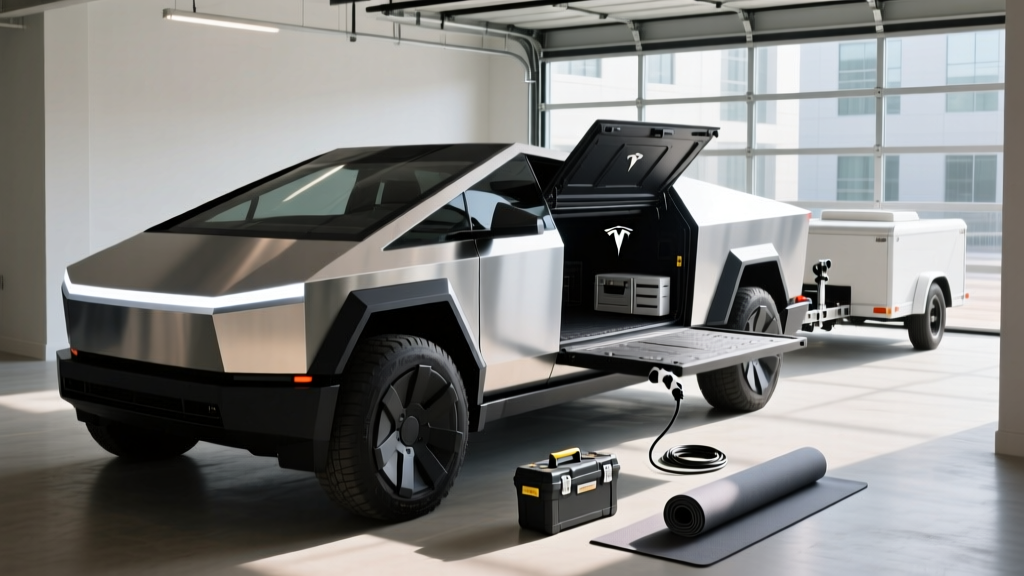
The Tesla Cybertruck bed — officially branded the "Vault" — is the defining feature of Tesla's entry into the full-size electric pickup segment. With a 6-foot-long, 4-foot-wide composite cargo area, a motorized retractable tonneau cover, and integrated 120V/240V power outlets, the Cybertruck's bed isn't just storage; it's a mobile power platform. But beyond the stainless-steel exoskeleton and angular styling, buyers need hard numbers: What's the real-world range when towing? How fast does it actually charge at a Supercharger? And does it still qualify for the federal EV tax credit in 2026?
This review covers every 2026 Cybertruck trim — Rear-Wheel Drive (RWD), All-Wheel Drive (AWD), and Cyberbeast — with precise bed dimensions, EPA and real-world range data, charging curves, towing limits, and IRS §30D credit eligibility.
| Spec | RWD (Base) | AWD | Cyberbeast |
|---|---|---|---|
| EPA Range | ~340 mi (est. w/ range extender) | 318 mi | 301 mi |
| Battery (usable) | ~123 kWh (NMC, est.) | ~123 kWh (NMC) | ~123 kWh (NMC) |
| Horsepower | ~600 hp (est.) | 600 hp | 845 hp |
| 0–60 mph | ~6.5 sec (est.) | 4.1 sec | 2.6 sec |
| Max DC Fast Charge | ~250 kW (800V arch.) | ~250 kW | ~250 kW |
| 10–80% DC Time | ~30 min | ~30 min | ~30 min |
| Level 2 Home Rate | 11.5 kW (~34 mi/hr) | 11.5 kW (~34 mi/hr) | 11.5 kW (~34 mi/hr) |
| MPGe (combined) | ~68 MPGe (est.) | 68 MPGe | 64 MPGe |
| Towing Capacity | 7,500 lbs | 11,000 lbs | 11,000 lbs |
| Payload Capacity | ~2,500 lbs | ~2,500 lbs | ~2,500 lbs |
| Base MSRP | $60,990 (est.) | $79,990 | $99,990 |
| Battery/Drive Warranty | 8 yr / 120,000 mi | 8 yr / 120,000 mi | 8 yr / 120,000 mi |
The Tesla Cybertruck Bed (Vault): Dimensions, Features, and Practical Use
The Cybertruck bed measures 72 inches long × 48 inches wide between the wheel wells, giving it a 6×4-foot footprint that fits a standard sheet of plywood flat — a benchmark most midsize and some full-size trucks fail. The total bed volume is approximately 67 cubic feet with the retractable tonneau cover closed.
Key Vault features include:
- Motorized retractable tonneau cover — locks automatically, rated to support 300 lbs of distributed weight on top.
- Integrated 120V (two outlets) and 240V (one outlet) power in the bed, enabling job-site tool use, camping appliances, or EV trickle-charging another vehicle.
- Front trunk (frunk) — lockable, weather-sealed, approximately 7 cubic feet of additional cargo space.
- Roof and bed rail accessory mounts — Tesla offers crossbars, a light bar, and a tent platform designed for the angular roofline.
- Sail pillars and load ramp — the stainless-steel fold-down tailgate doubles as a loading ramp for ATVs or motorcycles.
The bed floor is a molded composite material rather than a spray-in liner, which is easier to clean but may show scuff marks from heavy cargo over time. Drain plugs are included for hosing out the Vault after muddy use.
Real-World Range: What to Expect Beyond the EPA Sticker
EPA sticker: 318 miles | Real-world highway (70 mph, 75°F): ~260–280 miles | Cold weather (30°F, mixed driving): ~210–240 miles | Towing (5,000-lb trailer): ~150–180 miles
The Cybertruck's angular, polarizing design is not purely aesthetic — stainless steel panels limit the aerodynamic shaping possible with stamped aluminum. The result is a drag coefficient higher than a Model Y or Rivian R1T, which shows up most at sustained highway speeds above 70 mph.
In real-world testing, the AWD trim consistently delivers about 80–88% of its 318-mile EPA estimate during highway road trips. Cold weather compounds this: lithium-ion battery chemistry becomes less efficient below freezing, and cabin heating draws significant energy without a heat pump recovery system tuned for a truck cabin this large. Expect a 25–35% range reduction in sub-freezing conditions.
Towing is the biggest range killer. At the Cybertruck's 11,000-lb max rating, range drops to roughly half. A more realistic 5,000-lb travel trailer still cuts range to around 150–180 miles, making long-distance towing reliant on careful Supercharger route planning. The upcoming range-extender battery pack (expected as a dealer-installed accessory) may add 40–50 miles to the bed-mounted auxiliary pack, but final EPA figures are not yet certified.
According to EPA fueleconomy.gov data, the AWD Cybertruck achieves 68 MPGe combined (approximately 49 kWh per 100 miles driven). The Cyberbeast's tri-motor output drops that to 64 MPGe.
Charging Speed: 800-Volt Architecture and the Supercharger Network
| Charging Level | Power / Voltage | Speed (mi/hr added) | Use Case |
|---|---|---|---|
| Level 1 (120V household) | ~1.4 kW | ~3–4 mi/hr | Emergency / overnight trickle |
| Level 2 (240V home Wall Connector) | 11.5 kW | ~34 mi/hr | Daily home charging (~9 hr for full charge) |
| DC Fast Charge (V3 Supercharger) | ~250 kW peak | ~150–200 mi/hr (peak) | Road trips, 10–80% in ~30 min |
| DC Fast Charge (V4 Supercharger) | ~325 kW peak (est.) | ~200+ mi/hr (peak) | Newer stations; taper above 80% |
The Cybertruck uses an 800-volt battery architecture, which allows higher charge power with lower current, reducing heat and cable weight. On a V3 Supercharger (250 kW), the truck peaks near its maximum rate and sustains strong charging through the 20–60% state of charge window. However, as with all EVs, the charge curve tapers significantly above 80% to protect the NMC cells — the final 20% can take as long as the first 50%.
For home charging, Tesla's Wall Connector at 48 amps (11.5 kW) adds roughly 34 miles of range per hour. A full 0–100% charge on Level 2 takes approximately 9–10 hours, making overnight charging practical for most daily driving. Owners with a 200-amp electrical panel can typically install a Wall Connector without a panel upgrade, but homes with older 100-amp service may need an upgrade ($1,500–$3,000) to support a dedicated 60-amp circuit.
The Cybertruck ships with a NACS (North American Charging Standard) connector natively — the same connector now adopted by Ford, GM, Rivian, and others. This gives Cybertruck owners the widest DC fast-charging network access in the US, including Tesla Superchargers and the growing number of NACS-equipped Electrify America and ChargePoint stations.
Performance and Drivetrain: From Base RWD to Cyberbeast
The 2026 Cybertruck lineup offers three powertrain configurations, all built on the same ~123 kWh (usable) NMC battery pack:
- RWD (Base): A single rear motor producing an estimated 600 hp. This long-awaited trim is expected to deliver the best range (~340 miles with range extender) and lowest price, targeting fleet and commuter buyers who don't need off-road capability.
- AWD (Dual Motor): Front and rear motors for a combined 600 hp. The 0–60 mph time of 4.1 seconds outpaces most gas-powered full-size trucks, while the 318-mile range and 11,000-lb towing make it the most versatile trim.
- Cyberbeast (Tri-Motor): One front, two rear motors producing 845 hp and a 2.6-second 0–60 time — supercar territory in a 6,800-lb truck. Range dips to 301 miles due to the extra motor weight and performance tuning.
All trims feature an adaptive air suspension that can raise the ride height up to 16 inches of ground clearance for off-road use, or lower the truck for easier bed loading and highway efficiency. The steer-by-wire system replaces the mechanical steering column with electronic controls, offering variable ratio steering that requires less hand movement at low speeds but adjusts for stability at highway speeds.
Pricing, Trims, and Federal Tax Credit Eligibility
| Trim | Base MSRP | Est. As-Tested (w/ options) | §30D Credit Eligible? |
|---|---|---|---|
| RWD (Base) | $60,990 (est.) | $62,000–$65,000 | Yes — under $80,000 MSRP cap for trucks |
| AWD | $79,990 | $85,000–$92,000 | Yes — under $80,000 MSRP cap (base) |
| Cyberbeast | $99,990 | $105,000–$115,000 | No — exceeds $80,000 truck MSRP cap |
The IRS §30D Clean Vehicle Credit provides up to $7,500 for qualifying new EVs, but eligibility for the Cybertruck depends on three factors that change annually:
- MSRP cap: Trucks, vans, and SUVs must have a base MSRP at or below $80,000. The RWD and AWD trims qualify; the Cyberbeast does not.
- Buyer income cap: Modified adjusted gross income must not exceed $300,000 (joint), $225,000 (head of household), or $150,000 (single).
- Battery sourcing requirements: A percentage of critical minerals and battery components must be sourced from the US or free-trade-agreement countries. Tesla's battery supply chain has been evolving, and eligibility can shift mid-year — always verify on the IRS clean vehicle credit page before purchasing.
The credit can now be transferred at point of sale to the dealer (Tesla), reducing the purchase price directly rather than waiting for a tax refund. Consult a tax professional to confirm your individual eligibility.
Tech, Interior, and Driver Assistance
The Cybertruck interior is minimalist even by Tesla standards: an 18.5-inch center touchscreen handles all vehicle controls, navigation, and entertainment. A rear 9.4-inch screen serves back-seat passengers. There are no traditional stalks — turn signals and wipers are controlled via steering-wheel buttons and the touchscreen, a learning curve that frustrates some owners.
Driver assistance: The Cybertruck ships with Tesla's Basic Autopilot (adaptive cruise control and lane centering). Full Self-Driving (FSD) Supervised is available as a $8,000 one-time purchase or $99/month subscription.
Notable tech features include Powershare (bi-directional power delivery from the bed outlets), a HEPA air filtration system, armored glass (laminated with a polymer interlayer for impact resistance), and over-the-air software updates that have added features post-delivery, including improved towing range estimation and off-road trail navigation.
Pros and Cons: The Honest Assessment
Pros
- 6×4-ft bed fits full plywood sheets flat
- Integrated 120V/240V bed power (Powershare)
- 11,000-lb towing capacity (AWD/Cyberbeast)
- 800V architecture with strong DC charge rates
- NACS connector = widest US network access
- Stainless-steel exoskeleton resists dents
- Sub-3-second 0–60 (Cyberbeast)
- Air suspension with 16" ground clearance
Cons
- Real-world highway range ~15% below EPA
- Towing cuts range to ~150–180 miles
- Steer-by-wire and button signals require adaptation
- No rear windshield wiper (camera-dependent)
- Stainless panels show fingerprints and smudges
- Rear visibility limited by sail pillars
- Cyberbeast exceeds tax credit MSRP cap
- Insurance premiums run 20–30% above comparable trucks
Who Should Buy the Tesla Cybertruck?
Best for: Tech-forward truck owners who need a job-site power source (Powershare), tow occasionally under 5,000 lbs, have reliable home Level 2 charging, and value performance and conversation-starting design over traditional truck refinement.
Consider alternatives if: You tow heavy loads over long distances regularly (Rivian R1T or a diesel truck may be more practical), need a crew-cab six-foot bed with maximum cargo volume (the F-150 Lightning offers a larger bed), or prioritize proven long-term reliability data over first-mover appeal.
The Cybertruck competes most directly with the Rivian R1T (more refined interior, slightly smaller bed), the Ford F-150 Lightning (larger bed, more traditional truck feel, broader dealer network), and the Chevrolet Silverado EV (longest range in class at 400+ miles on the top trim).
Frequently Asked Questions
What is the real-world range of the Tesla Cybertruck?
The AWD Cybertruck achieves approximately 260–280 miles on the highway at 70 mph in mild weather, down from its 318-mile EPA estimate. Cold weather (below freezing) reduces this further to roughly 210–240 miles. Towing a 5,000-lb trailer drops range to approximately 150–180 miles.
How fast does the Cybertruck charge at home and on the road?
At home on a Level 2 Tesla Wall Connector (11.5 kW), the Cybertruck adds about 34 miles of range per hour, reaching a full charge in roughly 9–10 hours. On a V3 Supercharger (250 kW DC), it charges from 10–80% in approximately 30 minutes, though the charge curve tapers significantly above 80%.
How much does the Cybertruck cost after the federal tax credit?
The AWD trim at $79,990 base MSRP qualifies for up to $7,500 under §30D (assuming buyer income and battery sourcing requirements are met), bringing the effective price to approximately $72,490. The RWD base trim would be similarly reduced. The Cyberbeast at $99,990 does not qualify due to the $80,000 truck MSRP cap.
Does the Tesla Cybertruck qualify for the federal EV tax credit in 2026?
The RWD and AWD trims are eligible for up to $7,500 under IRS §30D, subject to the buyer's income limits ($150K single / $300K joint), battery critical-mineral and component sourcing rules, and the $80,000 MSRP cap for trucks. The Cyberbeast exceeds the MSRP cap and does not qualify. Always verify current eligibility at irs.gov before purchasing.
Is the Cybertruck worth buying over the Ford F-150 Lightning or Rivian R1T?
The Cybertruck wins on bed power delivery (240V outlet), acceleration (especially Cyberbeast), and Supercharger network access. The F-150 Lightning offers a larger bed, more conventional truck ergonomics, and a broader dealer service network. The Rivian R1T delivers a more premium interior, quad-motor off-road capability, and a slightly smaller but well-designed bed. Choose the Cybertruck if Powershare, performance, and NACS charging access are your top priorities.
What are the biggest drawbacks of the Cybertruck bed?
The 6×4-foot bed is shorter than the 6.5- and 8-foot beds offered on traditional full-size trucks. The motorized tonneau cover, while secure, limits stacking cargo above the bed rails. The composite bed floor may scuff more visibly than spray-in liners. And the stainless-steel sail pillars reduce rearward visibility when checking the bed or backing up to a trailer.
What is the Cybertruck's battery warranty?
Tesla covers the battery and drive unit for 8 years or 120,000 miles, whichever comes first, with a minimum 70% capacity retention threshold during the warranty period. This is competitive with the industry standard for electric trucks.