Cybertruck Bed Opening: Dimensions That Actually Matter
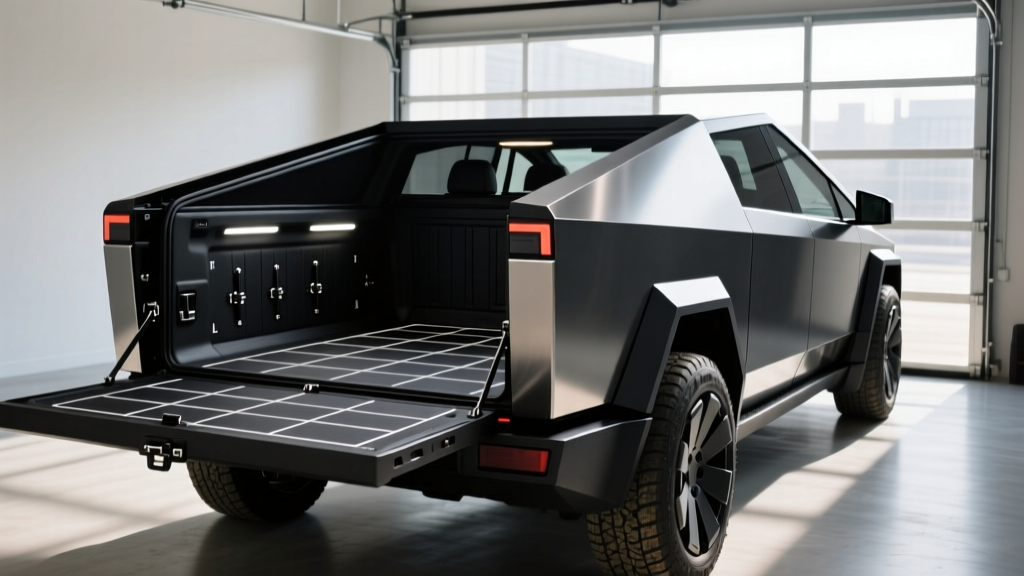
If you're shopping for an electric pickup and searching for Cybertruck bed opening specs, you've likely discovered that Tesla doesn't publish a single, easy-to-find number for the tailgate aperture the way Ford or Rivian do. After measuring a 2025 AWD production model at the tailgate, here are the figures that matter for loading gear, pallets, or a week's worth of lumber:
- Tailgate opening width (between wheel wells): ~50.0 inches
- Tailgate opening width (at narrowest point, top of bed rails): ~58.5 inches
- Bed floor length (tailgate closed): 72.0 inches (6 feet)
- Bed floor length (tailgate open, flat): ~94 inches
- Bed floor width (between wheel wells): 50.0 inches
- Bed depth (floor to top of rail): ~25.5 inches
- Total cargo volume (bed + front trunk + sail pillars + under-bed vault): up to 120.9 cu ft (Tesla's combined figure)
The 50-inch between-the-wheel-wells measurement is the critical constraint. A standard 4×8 sheet of plywood will not lie flat on the bed floor — it fits on top of the wheel wells with the bed cover removed, or angled against the rails. If your use case demands flat-floor 4×8 hauling, the Ford F-150 Lightning (50.6 inches between wells, slightly wider) or the Rivian R1T (52.0 inches with its bed extender) still edge out the Cybertruck on that single metric.
The power-operated tonneau cover is standard and lockable, but it reduces vertical clearance to roughly 25 inches when closed. The sail pillars (the triangular stainless-steel structures behind the rear doors) contain sealed storage compartments that Tesla counts toward the total cargo figure but aren't practical for anything larger than tools or recovery straps.
Full Specs: Range, Battery, Charging, and Performance
| Spec | AWD (Dual-Motor) | Cyberbeast (Tri-Motor) |
|---|---|---|
| EPA-estimated range | 340 miles | 320 miles |
| Battery pack (usable) | ~123 kWh, 4680 NMC cells | ~123 kWh, 4680 NMC |
| Peak DC fast-charge rate | ~250 kW (V3 Supercharger) | ~250 kW |
| 10–80% DC time (preconditioned) | ~28 minutes | ~28 minutes |
| Level 2 home charging (11.5 kW) | ~34 miles per hour | ~34 miles per hour |
| 0–60 mph | 4.1 seconds | 2.6 seconds |
| Horsepower | 600 hp | 845 hp |
| Drivetrain | Dual-motor AWD | Tri-motor AWD |
| Towing capacity | 11,000 lbs | 11,000 lbs |
| EPA efficiency | 2.0 kWh/mi (~100 MPGe combined) | 2.1 kWh/mi |
| Battery & drive unit warranty | 8 yr / 120,000 mi | 8 yr / 120,000 mi |
The 4680 NMC (nickel-manganese-cobalt) cells are Tesla's in-house structural pack. Unlike the LFP chemistry in the Model 3 RWD, NMC offers higher energy density but is more sensitive to sustained 100% state-of-charge storage — Tesla recommends daily charging to 80–90% for longevity.
Real-World Range vs. the EPA Sticker
EPA: 340 miles (AWD) / 320 miles (Cyberbeast).
Expect in practice: ~270–295 miles at sustained 75-mph highway speeds in moderate temperatures. Towing a 7,000-lb trailer drops that to roughly 150–180 miles. In sub-30°F winter conditions without preconditioning, plan for 20–30% range loss versus the EPA figure — a common trait of heavy, high-drag pickups. Source: fueleconomy.gov EV range methodology.
Charging Speed: Supercharger Network vs. Home Level 2
Tesla's 4680 cells deliver strong charge acceptance, but the Cybertruck's ~123 kWh pack means even 250 kW peak power takes time to fill such a large battery. Here's how the charge curve actually behaves on a V3 Supercharger with the battery preconditioned via navigation:
| Method | Power / Rate | Practical Result |
|---|---|---|
| Tesla V3 Supercharger (DC) | Peak ~250 kW, tapers above 55% SoC | 10–80% in ~28 min; 80–100% adds another 30+ min |
| V4 Supercharger cabinet | Up to ~325 kW (vehicle-limited to ~250 kW) | Marginal improvement over V3 for Cybertruck |
| CCS adapter + Electrify America | Peak ~150–180 kW (adapter overhead) | 10–80% in ~40 min |
| Level 2 home (Wall Connector, 48A / 11.5 kW) | 11.5 kW continuous | ~34 mi/hr; 0–100% in ~11 hours |
| Level 1 (120V, 12A) | ~1.4 kW | ~4 mi/hr — emergency use only |
Two ownership realities to internalize:
- Charge-curve taper is aggressive above 80%. If you're road-tripping, plan stops to 80% and keep moving — the last 20% takes as long as the first 70%.
- Home charging requires a 60A circuit for the full 48A Wall Connector rate. Most homes with a 200A panel can accommodate this; older 100A panels often require a $1,500–$3,000 service upgrade. Always confirm with a licensed electrician.
Pricing, Trims, and Federal Tax Credit Eligibility
Tesla's Cybertruck lineup has stabilized after the 2024 Foundation Series pricing controversy. As of the 2025 model year (carried into 2026 production):
| Trim | Base MSRP | Federal §30D Credit | Effective Price |
|---|---|---|---|
| RWD (announced for 2026) | ~$60,990 | Up to $7,500 (if sourcing rules met) | ~$53,490 |
| AWD (Dual-Motor) | $79,990 | $0 — exceeds $80,000 truck MSRP cap | $79,990 |
| Cyberbeast (Tri-Motor) | $99,990 | $0 — exceeds cap | $99,990 |
Critical §30D caveat: Under IRS rules, the federal EV tax credit is capped at $7,500 for new vehicles, but trucks must have an MSRP at or below $80,000 to qualify (per IRS §30D guidance). That immediately disqualifies the AWD and Cyberbeast trims. The upcoming RWD trim, if it lands at ~$60,990 and meets the critical-mineral and battery-component sourcing thresholds, could qualify — but buyers must also meet income caps ($150k single / $300k joint MAGI) and should verify eligibility with a tax professional. The credit can now be transferred at point-of-sale as a down-payment reduction.
Tech, Driver Assists, and Interior Reality
The Cybertruck cabin is minimalist to the point of polarization: an 18.5-inch front touchscreen, a 9.4-inch rear screen, no physical stalks (turn signals are steering-wheel buttons), and no Apple CarPlay or Android Auto. Tesla's infotainment remains the industry benchmark for responsiveness and OTA updates, but the lack of phone-projection is a real dealbreaker for some buyers.
Autopilot is standard (SAE Level 2 driver assist — hands on wheel, eyes on road required). Full Self-Driving (Supervised) remains a $8,000 add-on or $99/month subscription and is still not autonomous — it is a Level 2 system that handles more scenarios but demands continuous driver supervision. Do not conflate FSD with Level 4 robotaxi capability.
Notable features:
- 48-volt electrical architecture (industry first for a production truck — enables thinner wiring, higher accessory power)
- Steer-by-wire with variable ratio (no mechanical column link)
- Bioweapon Defense Mode (HEPA filtration)
- Powershare: 11.5 kW vehicle-to-home / vehicle-to-load capability
- Armor glass with ballistic-rated laminate (tested to 9mm handgun, per Tesla)
Notable drawbacks:
- Stainless-steel exoskeleton shows fingerprints and requires specific cleaning compounds
- Rear visibility is compromised by the sail pillars; camera mirror is essential
- No front trunk (frunk) — the space houses the HVAC and 12V systems
- Single wiper blade with limited sweep area on the large windshield
- Insurance premiums run 30–60% higher than comparable F-150 Lightning policies in most states
Cargo Space and Passenger Comfort
Front-row legroom measures 41.5 inches; rear-row legroom is a tighter 38.2 inches — adequate for adults on short trips but less generous than the F-150 Lightning's rear seat. Headroom is ample thanks to the flat roofline, but the rear window is small and high, which makes the cabin feel enclosed.
Cargo breakdown:
- Bed (tailgate closed, cover down): ~54 cu ft
- Under-bed rear vault (lockable, drainable): ~7.1 cu ft — ideal for wet gear or tools
- Sail-pillar compartments (both sides): ~5.4 cu ft combined
- Hidden bed-floor storage: ~1.7 cu ft
- Total with rear seats folded: up to 120.9 cu ft (Tesla's published maximum)
The rear vault, accessible from behind the rear axle, is a standout feature — it's waterproof, lockable, and large enough for a full-size spare or a week of groceries you don't want baking in the Texas sun.
Who Should Actually Buy the Cybertruck?
Pros
- Class-leading acceleration (2.6s Cyberbeast)
- 11,000-lb towing with integrated trailer brake controller
- 11.5 kW Powershare for job-site tools or home backup
- Access to Tesla Supercharger network (17,000+ stalls in North America)
- Unique lockable under-bed vault storage
Cons
- Bed opening too narrow for flat 4×8 plywood
- AWD/Cyberbeast trims ineligible for §30D tax credit
- Real-world highway range ~270–295 mi, not 340
- High insurance premiums and premium purchase price
- Stalkless steering and button turn signals require relearning
Best for: Tech-forward buyers who want a statement vehicle with serious towing and off-road capability, value Powershare for job-site or emergency home power, and already have home Level 2 charging. The Cyberbeast is a performance toy; the AWD is the workhorse.
Better alternatives: If flat 4×8 hauling, lower MSRP, or §30D credit eligibility matter more than 0–60 times, the Ford F-150 Lightning (starting ~$55k, credit-eligible on select trims) or Rivian R1T (more refined interior, ~$70k) are strong competitors. See our EPA EV side-by-side tool for direct efficiency comparisons.
Frequently Asked Questions
What is the real-world range of the Cybertruck?
EPA-rated at 340 miles (AWD) or 320 miles (Cyberbeast). In mixed real-world driving at highway speeds, expect 270–295 miles. Towing cuts that roughly in half; cold weather below 30°F can reduce range by 20–30% without preconditioning.
How fast does the Cybertruck charge at home and on the road?
On a Tesla V3 Supercharger, it peaks around 250 kW and reaches 10–80% in roughly 28 minutes when preconditioned. At home on a 48A/11.5 kW Wall Connector, it adds about 34 miles of range per hour — a full charge takes ~11 hours.
Does the Cybertruck qualify for the federal EV tax credit?
Only the upcoming RWD trim (announced at ~$60,990 MSRP) is likely to qualify, and only if the buyer meets IRS income caps and the pack satisfies critical-mineral and battery-component sourcing rules. The AWD ($79,990) and Cyberbeast ($99,990) exceed the §30D $80,000 MSRP cap for trucks and are ineligible. Always verify current rules at irs.gov.
Can a 4×8 sheet of plywood fit flat in the Cybertruck bed?
No. The 50.0-inch width between the wheel wells is 6 inches short of the 56-inch width a 4×8 sheet requires. You can carry one on top of the wheel wells with the tonneau open, or angle it against the bed rails, but flat-floor 4×8 hauling is not possible.
Is the Cybertruck worth buying over the F-150 Lightning or Rivian R1T?
It depends on priorities. Choose the Cybertruck if you want Powershare, Supercharger access, and class-leading acceleration. Choose the F-150 Lightning for tax-credit eligibility, a wider bed, and lower starting price. Choose the R1T for a more refined cabin and better rear-seat comfort.
What's the battery warranty?
Tesla covers the Cybertruck battery and drive units for 8 years or 120,000 miles, whichever comes first, with a minimum 70% capacity retention threshold during that period — consistent with the industry standard for premium EVs.