Tesla Cybertruck: Beyond the Stainless Steel Hype
The Tesla Cybertruck polarizes like few vehicles before it. Love the angular stainless-steel exoskeleton or hate it, the electric pickup forces a legitimate question for truck buyers: does the utility match the aesthetics? With a 72.8-inch (6.07-foot) bed length, dual- and tri-motor powertrains, and Tesla's 800-volt-class architecture, the Cybertruck attempts to redefine what an electric pickup can do — while challenging established players like the Ford F-150 Lightning, Rivian R1T, and Chevrolet Silverado EV.
This review breaks down every spec that matters to real truck owners: the Cybertruck bed length and cargo reality, EPA range versus what you'll actually see on the highway, DC fast-charging speeds under real conditions, and whether the federal tax credit actually applies. We'll also address the elephant in the room — towing range loss and cold-weather efficiency — because no stainless-steel skin changes the laws of physics.
Cybertruck Bed Length, Cargo Space, and Payload Reality
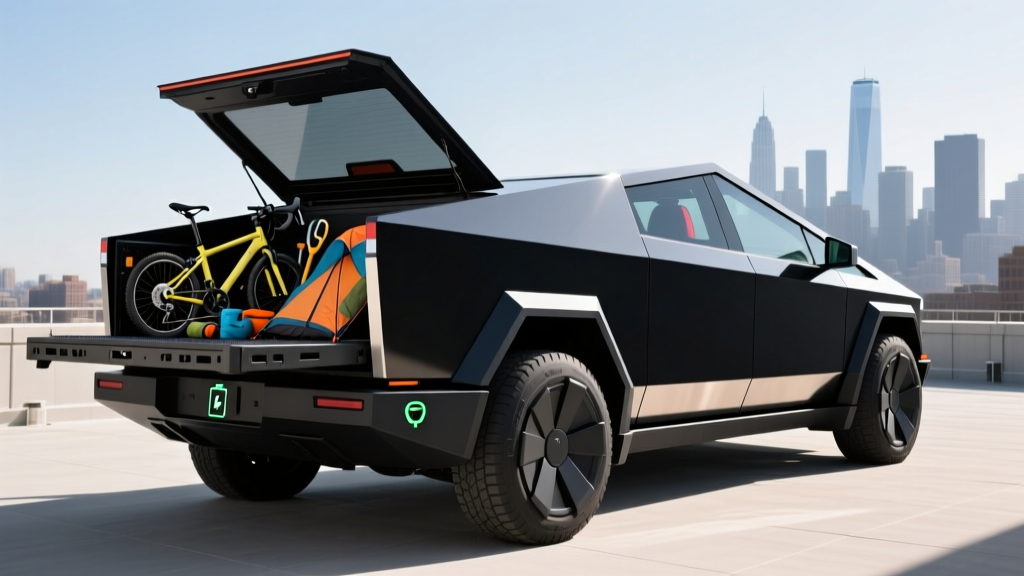
The headline spec truck buyers search for: the Cybertruck bed length is 72.8 inches (6.07 feet) with the tailgate closed. That's roughly competitive with a standard short-bed pickup, though shorter than the 6.5- and 8-foot beds common on full-size trucks like the F-150 and Silverado. With the tailgate lowered, usable length extends, and Tesla's composite bed liner (no paint to scratch) is designed for work use.
| Specification | Value |
|---|---|
| Bed Length (tailgate closed) | 72.8 in (6.07 ft) |
| Bed Width (between wheel wells) | ~48 in |
| Cargo Bed Volume | 67 cu ft |
| Front Trunk (Frunk) | 7.1 cu ft |
| Maximum Payload | 2,500 lbs |
| Maximum Towing Capacity | 11,000 lbs (AWD/Cyberbeast) |
| Overall Vehicle Length | 231.5 in |
| Ground Clearance (Extract Mode) | 17.4 in |
The 67-cubic-foot bed volume is respectable, and the power-operated motorized tonneau cover — standard on all trims — adds security and improves aerodynamics. However, the bed's trapezoidal shape (narrower at the top due to the exoskeleton design) means standard 4x8 sheets of plywood won't lie flat between the wheel wells. For contractors who regularly haul sheet goods, this is a meaningful limitation compared to a traditional F-150 or Silverado bed.
The 7.1-cubic-foot frunk is modest — smaller than the F-150 Lightning's massive front trunk — but useful for secure, weatherproof storage of tools or charging cables. The Cybertruck's lockable "sail pillars" (the triangular structures flanking the bed) don't add cargo volume but contribute to the vehicle's structural rigidity.
Range, Efficiency, and the Real-World Mileage Gap
Tesla offers the Cybertruck in three configurations for the 2025 model year: the Long Range AWD (dual-motor) and the Cyberbeast (tri-motor). The base Rear-Wheel-Drive model, originally announced at a lower price point, has been repeatedly delayed and as of early 2026 remains unavailable for delivery. Here's what the EPA says versus what owners report:
EPA Estimated Range: 340 miles
Real-World Expectation: ~270–300 miles highway; ~240–260 miles in cold weather (below 32°F); ~180–220 miles while towing 8,000+ lbs
EPA Estimated Range: 320 miles
Real-World Expectation: ~255–285 miles highway; ~225–245 miles in cold weather; ~170–200 miles while towing heavy loads
The gap between EPA estimates and real-world mileage is pronounced in the Cybertruck — more so than in most EVs. The vehicle's 6,600+ lb curb weight, tall ride height, and angular stainless-steel body create significant aerodynamic drag, particularly above 65 mph. On the EPA's fueleconomy.gov listing, the Long Range AWD achieves 70 MPGe combined (approximately 48 kWh per 100 miles), which is notably less efficient than the Ford F-150 Lightning Extended Range at 72 MPGe and far behind sedans like the Tesla Model S.
Cold-weather impact: Expect 20–30% range loss in sustained sub-freezing temperatures. The Cybertruck's heat pump helps cabin efficiency, but the large battery pack requires significant energy to maintain optimal operating temperature. Preconditioning the battery while plugged in mitigates this but doesn't eliminate it.
Towing reality: This is where the Cybertruck — and all current EV pickups — faces physics. Towing an 8,000-lb trailer at highway speeds can reduce range by 40–50%. A 340-mile EPA rating becomes a 170–200-mile practical range with a heavy trailer. Plan charging stops accordingly, or keep towing to shorter hauls.
Battery Chemistry, Capacity, and Long-Term Degradation
Tesla has not officially published the Cybertruck's exact battery capacity in a spec sheet, but teardown analysis and EPA filing data indicate a usable capacity of approximately 123 kWh (gross capacity likely ~130 kWh). The chemistry is NMC (Nickel Manganese Cobalt) — specifically Tesla's 4680 cell format, which uses a structural battery pack where the cells themselves contribute to the vehicle's rigidity.
LFP vs NMC in the Cybertruck: Unlike the Tesla Model 3 and Model Y Standard Range variants (which use LFP/lithium iron phosphate chemistry for lower cost and longer cycle life), the Cybertruck requires NMC's higher energy density to achieve its range targets in a heavy vehicle. The trade-off: NMC cells degrade slightly faster over time and shouldn't be routinely charged to 100% for daily use (Tesla recommends 80% for daily driving, 100% only before long trips).
| Spec | Long Range AWD | Cyberbeast (Tri-Motor) |
|---|---|---|
| Battery Chemistry | NMC (4680 cells) | NMC (4680 cells) |
| Usable Battery Capacity | ~123 kWh | ~123 kWh |
| Drivetrain | Dual-Motor AWD | Tri-Motor AWD |
| Horsepower | 600 hp | 845 hp |
| 0–60 mph | 3.9 seconds | 2.6 seconds |
| Top Speed | 130 mph | 130 mph |
| EPA Range | 340 miles | 320 miles |
Battery warranty: Tesla covers the Cybertruck's battery and drive unit for 8 years or 150,000 miles (whichever comes first), with a guaranteed minimum capacity retention of 70%. This is on par with the Ford F-150 Lightning's 8-year/100,000-mile battery warranty (though Tesla offers 50,000 more miles of coverage). Real-world 4680 cell degradation data is still limited given the Cybertruck's late-2023 production start, but Tesla's historical fleet data suggests 10–15% degradation over 150,000 miles is typical for NMC packs.
Charging Speed: DC Fast Charge, Level 2, and the 800V Advantage
The Cybertruck uses Tesla's proprietary NACS (North American Charging Standard) connector — which is now becoming the industry standard, adopted by Ford, GM, Rivian, and most major automakers through 2025–2026. This gives the Cybertruck native access to Tesla's Supercharger network, widely regarded as the most reliable DC fast-charging infrastructure in North America.
| Charging Level | Power / Rate | Speed / Time |
|---|---|---|
| Level 1 (120V household outlet) | ~1.4 kW | ~3–4 miles of range per hour |
| Level 2 (240V home charger, 48A) | 11.5 kW | ~34 miles of range per hour; full charge in ~11–12 hours |
| DC Fast Charge (Tesla Supercharger V4) | Peak 250 kW | 10–80% in ~28 minutes; ~150 miles added in 15 min |
| DC Fast Charge (non-Tesla 350 kW station, with adapter) | Peak ~250 kW (vehicle-limited) | Similar to Supercharger; vehicle caps at ~250 kW |
The charging curve reality: The Cybertruck's 250 kW peak charge rate is competitive but not class-leading. The Rivian R1T (Dual-Motor with Max Pack) peaks at approximately 220 kW, while the F-150 Lightning peaks at 150 kW (Extended Range) — so the Cybertruck has an edge over the Lightning in DC charging speed. However, the 250 kW peak is not sustained. Like all EVs, the Cybertruck's charge rate tapers significantly above 50% State of Charge (SoC), and drops sharply above 80%. The 10–80% time of approximately 28 minutes is acceptable for road trips but not exceptional — the Hyundai Ioniq 5 and Kia EV6 (with 800V architecture) achieve 10–80% in roughly 18 minutes, albeit in smaller, lighter vehicles.
Home charging setup: For daily use, a Level 2 home charger is essential. Tesla's Wall Connector ($420 for the unit) at 48 amps on a 60-amp circuit delivers 11.5 kW, adding approximately 34 miles of range per hour — enough to fully replenish the Cybertruck overnight. Professional installation of a 240V/60A circuit typically costs $800–$2,500 depending on your electrical panel capacity and run distance. Homes with older 100-amp service panels may require a $2,000–$4,000 panel upgrade to support the Cybertruck alongside other high-draw appliances.
Pricing, Trim Levels, and Federal Tax Credit Eligibility
The Cybertruck's pricing has shifted significantly since its original 2019 unveiling (when Tesla promised a $39,900 base price). As of the 2025 model year, here's what buyers actually pay:
| Trim | Base MSRP | As-Tested (typical options) | Federal §30D Tax Credit |
|---|---|---|---|
| Long Range AWD | $79,990 | $82,000–$86,000 | Not eligible (exceeds $80,000 MSRP cap for trucks) |
| Cyberbeast (Tri-Motor) | $99,990 | $102,000–$108,000 | Not eligible (exceeds $80,000 MSRP cap for trucks) |
| Rear-Wheel Drive (announced) | $60,990 (est.) | N/A — not yet in production | Potentially eligible if MSRP stays under $80,000 and sourcing rules are met |
Federal tax credit reality: Under current IRS §30D rules, new clean vehicle credits are capped at $7,500 and subject to three major constraints: (1) an MSRP cap of $80,000 for trucks, vans, and SUVs; (2) buyer income limits ($150,000 single / $300,000 joint adjusted gross income); and (3) battery component and critical mineral sourcing requirements that phase out vehicles with Chinese-sourced materials. The Long Range AWD at $79,990 sits at the razor's edge of the MSRP cap, and any dealer-added options or destination charges that push the MSRP above $80,000 disqualify it. The Cyberbeast at $99,990 is firmly ineligible.
For most Cybertruck buyers in 2025–2026, the federal tax credit is not available. State-level incentives (such as California's CVRP or Colorado's innovative motor vehicle credit) may apply — check your state's current incentive programs for eligibility.
Performance, Tech, and Driver-Assistance Features
The Cybertruck's performance figures are supercar-adjacent, particularly in Cyberbeast trim. The tri-motor variant's 845 horsepower and 2.6-second 0–60 mph time make it the quickest production pickup ever built. Even the dual-motor Long Range AWD, at 600 hp and 3.9 seconds to 60 mph, outpaces nearly every gas-powered performance truck on the market.
Beyond straight-line speed, the Cybertruck's technical highlights include:
- 48-volt electrical architecture: A first for a mass-production vehicle, the 48V system (vs. the traditional 12V) reduces wiring harness weight by up to 70% and enables higher-power accessories. This also means the Cybertruck does not use a traditional 12V lead-acid auxiliary battery.
- Steer-by-wire: No mechanical connection between the yoke (steering wheel) and the front wheels. This enables the Cybertruck's remarkably tight turning radius (under 37 feet) despite its size, and allows variable steering ratios — as little as 340 degrees of lock-to-lock rotation at low speeds.
- Adaptive air suspension: Up to 17.4 inches of ground clearance in Extract Mode, with automatic ride-height adjustment based on speed and terrain. The suspension can also self-level when loading cargo or towing.
- Powershare (V2L/V2H): Vehicle-to-load capability provides up to 11.5 kW of continuous power output through bed-mounted and cabin outlets — enough to power tools at a job site, run appliances during an outage, or even provide limited vehicle-to-home backup power.
- 18.5-inch front touchscreen: Runs Tesla's latest infotainment software with navigation, streaming, gaming, and a dedicated camera view for the bed and trailer hitch. No Apple CarPlay or Android Auto — Tesla's closed ecosystem only.
Driver assistance — Autopilot and FSD (Supervised): The Cybertruck comes standard with Tesla's Basic Autopilot (traffic-aware cruise control and lane-keeping). Full Self-Driving (Supervised) is available as an $8,000 add-on or $99/month subscription. FSD adds automatic lane changes, traffic light/stop sign recognition, and enhanced navigation on city streets.
Notable drawbacks:
- The yoke-style steering wheel (standard, no round wheel option) is controversial and impractical for low-speed maneuvering and three-point turns, despite steer-by-wire's quick ratio.
- Rear visibility is poor due to the tonneau cover and sail pillar design — the digital rearview camera mirror is mandatory for safe backing.
- Panel gaps and build quality have improved since early 2024 deliveries but remain inconsistent compared to legacy automakers.
- The stainless-steel body is fingerprint-prone and difficult to repair — minor dents require panel replacement rather than traditional paintless dent repair.
- No Apple CarPlay, Android Auto, or Android Automotive support.
- Insurance premiums are significantly higher than comparable gas trucks — expect $250–$400/month depending on your driving record and state.
Who Should Buy the Cybertruck — and Who Shouldn't
Pros
- 72.8-inch bed with secure, motorized tonneau cover standard
- Class-leading acceleration (2.6s 0–60 Cyberbeast)
- Native NACS connector + Supercharger network access
- 11.5 kW Powershare (V2L) for job-site and home backup power
- 11,000-lb towing capacity
- Stainless-steel exoskeleton is dent- and corrosion-resistant
- 17.4-inch ground clearance in Extract Mode for off-road use
- 8-year/150,000-mile battery warranty (longest in class)
Cons
- No federal tax credit at current MSRP levels
- Real-world highway range significantly below EPA estimates
- Towing cuts range by 40–50%
- Bed cannot accommodate 4x8 plywood flat between wheel wells
- Yoke steering is polarizing and impractical for some maneuvers
- High insurance costs ($250–$400/month typical)
- Build quality still inconsistent vs. legacy trucks
- Rear-Wheel-Drive base trim not yet available
The Cybertruck is best for: Tech-forward truck owners who want a statement vehicle with legitimate utility — job-site power via V2L, secure lockable cargo, strong towing capacity, and daily-driver comfort. It suits owners who can charge at home (Level 2 is essential given the large battery), who don't regularly tow long distances, and who value acceleration and technology over traditional truck ergonomics.
Look elsewhere if: You need a true work truck that regularly hauls 4x8 sheet goods (the F-150 Lightning or Silverado EV beds handle this better), you tow heavy trailers long distances (range loss makes this impractical without frequent charging stops), you're on a budget (even the cheapest available Cybertruck is ~$80,000 with no tax credit), or you need proven long-term reliability data (the Cybertruck is too new for 5-year ownership data).
Key competitors to cross-shop:
- Ford F-150 Lightning: More conventional truck ergonomics, larger frunk, available under $60,000 (and eligible for the $7,500 tax credit), but slower charging (150 kW peak) and less range (320 miles Extended Range).
- Rivian R1T: More refined interior, better off-road capability with quad-motor option, 420-mile Max Pack range, but starts at $79,900 and has a smaller 54.2-inch bed (with the standard bed; a longer bed option exists).
- Chevrolet Silverado EV: Massive 390+ mile range (4WT trim), available work-truck pricing, but limited availability and less proven software.
Frequently Asked Questions
What is the exact Cybertruck bed length?
The Cybertruck bed length is 72.8 inches (6.07 feet) with the tailgate closed. This is comparable to a short-bed pickup. The bed width between the wheel wells is approximately 48 inches, which means standard 4-foot-wide plywood sheets cannot lie flat — a notable limitation for contractors. Total bed volume is 67 cubic feet with the motorized tonneau cover closed.
What is the real-world range of the Cybertruck?
The EPA rates the Long Range AWD at 340 miles and the Cyberbeast at 320 miles. In real-world highway driving at 70+ mph, expect approximately 270–300 miles (Long Range) and 255–285 miles (Cyberbeast). Cold weather (below 32°F) reduces range by an additional 20–30%, and towing heavy trailers can cut range by 40–50%. These reductions are typical for heavy electric pickups and not unique to the Cybertruck.
How fast does the Cybertruck charge at home and on the road?
On a Level 2 home charger (240V, 48A), the Cybertruck charges at 11.5 kW, adding about 34 miles of range per hour — a full charge takes roughly 11–12 hours. On DC fast chargers (Tesla Superchargers or compatible stations), it peaks at approximately 250 kW, achieving a 10–80% charge in about 28 minutes. The charge rate tapers significantly above 80% SoC to protect the battery.
Does the Cybertruck qualify for the $7,500 federal EV tax credit?
As of 2025, the Cybertruck Long Range AWD ($79,990 MSRP) and Cyberbeast ($99,990 MSRP) do not qualify for the IRS §30D federal tax credit. The Long Range AWD sits at the $80,000 MSRP cap for trucks, and any added options push it over the limit. The Cyberbeast far exceeds the cap. The announced Rear-Wheel-Drive trim ($60,990 estimated) may qualify when it becomes available, subject to battery sourcing rules and buyer income limits. Always verify current eligibility on irs.gov and consult a tax professional.
Is the Cybertruck worth buying versus the F-150 Lightning or Rivian R1T?
It depends on your priorities. The Cybertruck wins on acceleration, tech novelty, V2L power output (11.5 kW), and Supercharger network access. The F-150 Lightning wins on conventional truck ergonomics, tax credit eligibility, lower starting price, and a larger frunk. The Rivian R1T wins on interior refinement, off-road capability (quad-motor), and available longer range (420 miles with Max Pack). If you want a work-first truck, the Lightning is more practical. If you want a tech showcase with legitimate truck capability, the Cybertruck delivers — at a premium price.
How long will the Cybertruck battery last?
Tesla warranties the Cybertruck battery for 8 years or 150,000 miles with at least 70% capacity retention. Based on Tesla's historical NMC fleet data, owners can expect approximately 10–15% degradation over 150,000 miles. The 4680 structural battery pack is a newer design, so long-term (10+ year) data is not yet available. To maximize battery life, Tesla recommends charging to 80% for daily use and limiting 100% charges to road trips.
Can the Cybertruck tow a boat or camper long distance?
The Cybertruck can tow up to 11,000 lbs (AWD and Cyberbeast trims), which covers most boat trailers and mid-size travel trailers. However, towing at highway speeds reduces range by approximately 40–50%, turning the 340-mile EPA rating into roughly 170–200 miles of practical range. For long-distance towing, plan charging stops every 150 miles or consider a gas/diesel truck for heavy towing duty. The Cybertruck's Powershare (V2L) feature can power trailer accessories, which is a unique advantage at campsites.