The Cybertruck Bed: What Makes It Different
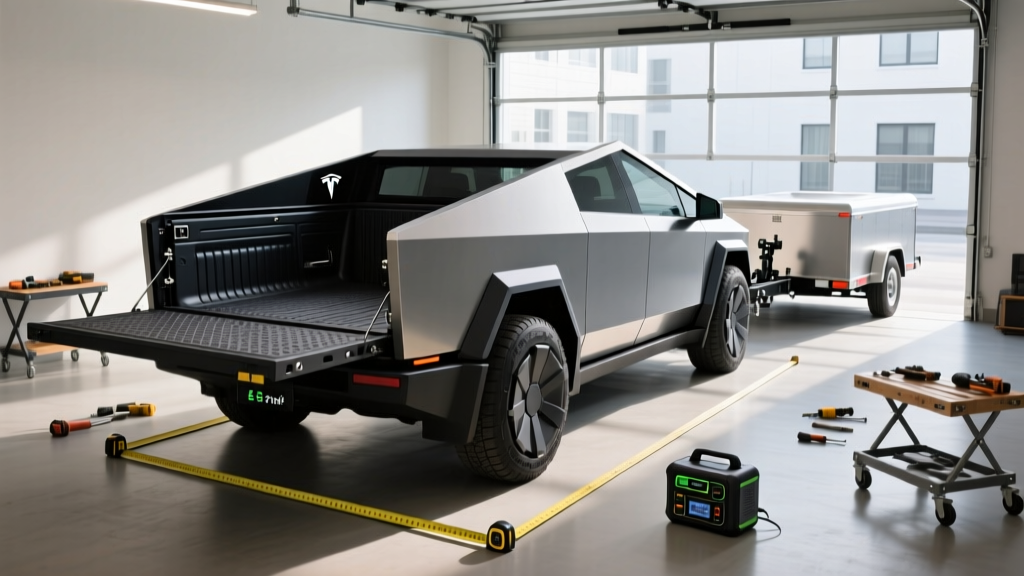
The Tesla Cybertruck's stainless-steel exoskeleton gets the headlines, but for truck buyers, the utility story lives in the back. The Tesla Cybertruck bed — which Tesla calls "the Vault" — measures 6 feet long by 4 feet wide between the wheel wells, offering 74.3 cubic feet of lockable cargo volume with the tonneau cover closed. That's competitive with mid-size pickups like the Ford Maverick and Hyundai Santa Cruz, though notably shorter than a full-size F-150 Lightning's 5.5-foot box (which is wider at 50.6 inches between the wheels).
What sets the Cybertruck bed apart isn't just dimensions — it's integration. The bed features a motorized roller-shutter tonneau that can support up to 300 pounds of distributed weight, a built-in air compressor with a hose routed to the bed, 120V and 240V power outlets (enabling up to 11.5 kW of continuous output via Tesla's Powershare system), and a tailgate that deploys as a ramp rated for 1,900 pounds. The bed floor is a textured composite material designed to resist scratches and dents without a liner.
But a truck bed is only as useful as the vehicle hauling it. Below, we break down the Cybertruck's range, charging, pricing, and ownership reality so you can decide whether this EV pickup actually works as a workhorse — or whether it's a lifestyle truck wearing a bed as a costume.
Tesla Cybertruck Bed Specifications at a Glance
| Specification | AWD (Dual-Motor) | Cyberbeast (Tri-Motor) |
|---|---|---|
| Bed Length | 72 in (6 ft) | 72 in (6 ft) |
| Bed Width (between wheel wells) | 48 in (4 ft) | 48 in (4 ft) |
| Cargo Volume (tonneau closed) | 74.3 cu ft | 74.3 cu ft |
| Max Payload | 2,500 lbs | 2,500 lbs |
| Max Towing Capacity | 11,000 lbs | 11,000 lbs |
| Tonneau Load Capacity | 300 lbs (distributed) | 300 lbs (distributed) |
| Tailgate Ramp Rating | 1,900 lbs | 1,900 lbs |
| Battery Capacity (usable) | ~123 kWh (NMC) | ~123 kWh (NMC) |
| EPA Range | 340 mi | 320 mi |
| Efficiency | 69 MPGe (2.0 kWh/mi) | 64 MPGe (2.2 kWh/mi) |
| Peak DC Fast Charge | 250 kW | 250 kW |
| 10–80% DC Fast Charge | ~30 min | ~30 min |
| Level 2 Home Charge Rate | 11.5 kW (~37 mi/hr) | 11.5 kW (~37 mi/hr) |
| 0–60 mph | 4.1 sec | 2.6 sec |
| Horsepower | 600 hp | 845 hp |
| Drivetrain | Dual-Motor AWD | Tri-Motor AWD |
| Base MSRP | $79,990 | $99,990 |
| Battery/Drive Unit Warranty | 8 yr / 120,000 mi | 8 yr / 120,000 mi |
Sources: Tesla Cybertruck specs, fueleconomy.gov
Real-World Range: What to Expect With a Loaded Bed
The Cybertruck's ~123 kWh usable NMC battery pack is among the largest in any production EV, but the truck's 6,800-lb curb weight (AWD) and angular stainless-steel body create substantial aerodynamic drag. Efficiency of roughly 2.0 kWh/mile (AWD) is reasonable for a full-size electric truck, but it means you're consuming energy at nearly double the rate of a sedan like the Tesla Model 3.
For context, the Ford F-150 Lightning Extended Range (131 kWh, EPA 320 mi) delivers similar real-world results. The Rivian R1T Max Pack (141 kWh, EPA 352 mi) edges ahead on paper but costs significantly more. If your use case involves frequent heavy towing, no current EV truck will deliver more than 200 miles per charge under load — plan your charging stops accordingly.
Charging Speed: DC Fast, Home Level 2, and Powershare
The Cybertruck supports up to 250 kW peak DC fast charging on Tesla's V3 and V4 Superchargers. However, as with all large battery packs, peak rate isn't sustained rate. The charge curve holds near 250 kW only between roughly 10–30% state of charge, then tapers progressively. The 10–80% charge takes approximately 30 minutes under ideal conditions (preconditioned battery, warm ambient temperature, V3+ stall). In cold weather without preconditioning, add 10–15 minutes.
At home on a Level 2 Wall Connector (48A circuit, 11.5 kW), the Cybertruck adds approximately 37 miles of range per hour of charging. A full 0–100% charge takes roughly 11–12 hours. This means overnight charging easily replenishes a day's driving for most owners, but if you deplete the pack on a long tow day, a full recharge requires dedicated time.
| Charge Level | Power (kW) | Miles Added per Hour | Notes |
|---|---|---|---|
| Level 1 (120V outlet) | ~1.4 kW | ~3–4 mi/hr | Emergency/trickle only |
| Level 2 (240V, 48A) | 11.5 kW | ~37 mi/hr | Home Wall Connector |
| DC Fast (V3 Supercharger) | Up to 250 kW | ~850 mi/hr (peak) | 10–80% in ~30 min |
| DC Fast (CCS adapter, non-Tesla) | Up to 250 kW | Variable | Requires NACS-to-CCS adapter for some networks |
Powershare (V2L/V2H): The Cybertruck's bidirectional charging system outputs up to 11.5 kW continuously through the bed-mounted 240V outlet and 120V outlets. This is enough to run power tools on a job site, power a camper's AC unit, or — with Tesla's optional home gateway — provide whole-home backup during outages. This is a genuine utility differentiator over trucks without bidirectional capability.
Pricing, Trims, and Federal Tax Credit Eligibility
As of the 2025–2026 model year, Tesla offers the Cybertruck in two trims (the originally promised $60,000 RWD model was canceled):
- AWD (Dual-Motor): $79,990 MSRP (before destination)
- Cyberbeast (Tri-Motor): $99,990 MSRP (before destination)
Destination charges add approximately $1,995. Tesla's "Foundation Series" early-build packages added $20,000 but are no longer applied to new orders as of late 2024.
The Cybertruck qualifies as a truck for the IRS MSRP cap of $80,000. This means the AWD trim at $79,990 technically clears the cap, but any added options, paint protection, or accessories that push the final MSRP above $80,000 will disqualify it. The Cyberbeast at $99,990 does not qualify. Additionally, the buyer must meet income caps ($150,000 single / $300,000 joint AGI), and the battery must satisfy critical-mineral and battery-component sourcing requirements that the IRS updates annually. Always verify current-year eligibility at irs.gov before purchase. The credit can be transferred to the dealer at point of sale as an instant discount.
| Trim | MSRP | Max §30D Credit | Effective Price (if eligible) |
|---|---|---|---|
| AWD | $79,990 | $7,500 | ~$72,490 |
| Cyberbeast | $99,990 | $0 (exceeds MSRP cap) | $99,990 |
Performance and Drivetrain: Quick but Heavy
The Cybertruck AWD's dual-motor setup delivers 600 horsepower and a 4.1-second 0–60 mph time — quick for any pickup, let alone one weighing nearly 7,000 lbs. The Cyberbeast's tri-motor system produces 845 hp and hits 60 mph in 2.6 seconds, which is supercar territory in a vehicle with a 6-foot bed.
However, performance comes with trade-offs. The Cybertruck's steer-by-wire system (Tesla calls it a "yoke" setup, though a round steering wheel is now available) takes genuine adaptation. The 48-volt electrical architecture enables sharper responses but introduces service complexity. And at highway speeds, wind noise around the angular body is noticeably higher than in a rounded-body truck like the Rivian R1T or F-150 Lightning.
Towing capacity is rated at 11,000 lbs for both trims — matching or exceeding most half-ton gas pickups. Tesla's integrated trailer brake controller and tow-assist cameras are standard. But remember: towing near max capacity will roughly halve your range, making long-distance towing an exercise in Supercharger planning.
Interior, Tech, and Driver Assistance
The Cybertruck seats up to five (three-across front bench, two-across rear), though the rear seat is tighter on legroom (approximately 38 inches) than the F-150 Lightning's back row. Cargo space behind the rear seats is limited — the cabin is optimized for front-seat comfort, and the frunk (front trunk) adds about 7 cu ft for smaller items.
The 18.5-inch center touchscreen handles infotainment, climate, and vehicle controls. There are no physical buttons — everything is screen-based, including the glovebox release and windshield wiper controls, which frustrates some owners. The camera-based "digital rearview mirror" (a screen displaying a rear-facing camera feed) is useful given the tonneau cover blocks the traditional mirror view, but it takes adjustment.
Autopilot and FSD (Supervised): Tesla's Autopilot (adaptive cruise + lane centering) is standard. Full Self-Driving (Supervised) is a $8,000 add-on (or $99/month subscription as of 2025). FSD is a SAE Level 2 driver-assist system — it does not make the Cybertruck autonomous. The driver must remain attentive, keep hands on the yoke/wheel, and be ready to intervene at any time. Despite the "Full Self-Driving" name, this is not a Level 4 robotaxi system like Waymo.
Who Should Buy the Cybertruck — And Who Shouldn't
- Want bidirectional power (Powershare) for job-site tools, camping, or home backup
- Prioritize acceleration and performance in a truck form factor
- Already live in the Tesla Supercharger ecosystem and value its reliability
- Need a lockable, weatherproof bed with integrated air compressor and power outlets
- Can charge at home (Level 2) and don't regularly tow over 200 miles one-way
- Need a full 8-foot bed (F-250/350 territory) or wider 50+ inch wheel-well spacing for plywood sheets flat
- Frequently tow heavy trailers over 300+ miles (range becomes a serious constraint)
- Prefer physical buttons, proven long-term service networks, or conventional truck ergonomics
- Want the most affordable electric truck (F-150 Lightning XLT starts ~$55,000 and qualifies for the credit more easily)
How the Cybertruck Bed Compares to Key Rivals
| Spec | Tesla Cybertruck AWD | Ford F-150 Lightning (5.5' bed) | Rivian R1T (4.5' bed) |
|---|---|---|---|
| Bed Length | 72 in | 67.1 in | 54.1 in |
| Bed Width (between wells) | 48 in | 50.6 in | 50.6 in |
| Max Payload | 2,500 lbs | 2,235 lbs | 1,764 lbs |
| Max Towing | 11,000 lbs | 10,000 lbs | 11,000 lbs |
| Bidirectional Power | Yes (11.5 kW) | Yes (9.6 kW, Pro Power) | Yes (camp kitchen, limited V2L) |
| EPA Range | 340 mi | 320 mi (Ext. Range) | 352 mi (Max Pack) |
| Base Price | $79,990 | ~$55,000 (XLT) | ~$79,900 (Dual-Motor) |
The Cybertruck offers the longest bed of the three EV trucks but the narrowest width between the wheel wells — meaning standard 4x8 sheets of plywood will fit length-wise but cannot lay flat between the wells. The F-150 Lightning wins on width and overall practicality for traditional truck tasks, while the Rivian R1T's shorter bed is offset by its innovative Gear Tunnel (a pass-through storage compartment behind the cab).
Frequently Asked Questions
What is the real-world range of the Tesla Cybertruck?
The EPA rates the AWD at 340 miles and the Cyberbeast at 320 miles. Real-world highway driving at 70–75 mph yields approximately 270–290 miles (AWD) or 250–270 miles (Cyberbeast). Cold weather (below freezing) reduces range by 15–25%. Towing near max capacity cuts range roughly in half.
How fast does the Cybertruck charge?
On a 250 kW DC Supercharger, 10–80% takes about 30 minutes with a preconditioned battery. At home on a Level 2 Wall Connector (11.5 kW), the truck adds ~37 miles per hour, requiring roughly 11–12 hours for a full charge from empty.
Does the Tesla Cybertruck qualify for the federal EV tax credit?
The AWD trim at $79,990 MSRP falls under the $80,000 truck cap, making it potentially eligible for up to $7,500 under IRS §30D — provided the buyer meets income limits ($150K single / $300K joint), and the battery satisfies critical-mineral and component-sourcing requirements for the current tax year. The Cyberbeast at $99,990 exceeds the MSRP cap and does not qualify. Verify at irs.gov before purchasing.
Can plywood sheets fit flat in the Cybertruck bed?
A 4x8 sheet fits lengthwise (the bed is 6 feet, and the tailgate extends the floor), but the 48-inch width between the wheel wells is narrower than the standard 48-inch sheet width, meaning sheets cannot rest on the wheel wells like they can in an F-150 Lightning (50.6 inches between wells). You'll need to angle or prop sheets, which is a practical drawback for contractors.
Is the Cybertruck worth buying over the F-150 Lightning or Rivian R1T?
The Cybertruck wins on bed length, payload, bidirectional power output (11.5 kW), and acceleration. The F-150 Lightning wins on bed width, starting price, dealer service network, and easier tax credit qualification. The Rivian R1T wins on off-road capability, build quality perception, and the innovative Gear Tunnel. Your choice depends on whether you prioritize performance and tech (Cybertruck), value and practicality (Lightning), or adventure-vehicle refinement (R1T).
What are the biggest pros and cons of the Cybertruck bed?
- 6-foot length — longest in EV truck class
- Lockable motorized tonneau (300-lb rated)
- Built-in air compressor and 120V/240V outlets
- 11.5 kW Powershare bidirectional power
- 2,500-lb payload, 11,000-lb towing
- Composite bed floor — no liner needed
- 48-inch width between wells — plywood doesn't lay flat
- Tonneau cover limits vertical cargo height
- No traditional bed accessories ecosystem (yet)
- Stainless body panels are expensive to repair if dented at bed rails
- Tailgate ramp is steep for low-clearance ATVs
- High starting price limits tax credit access