Quick Verdict: The Cybertruck Beast Is a Physics-Defying Luxury Pickup
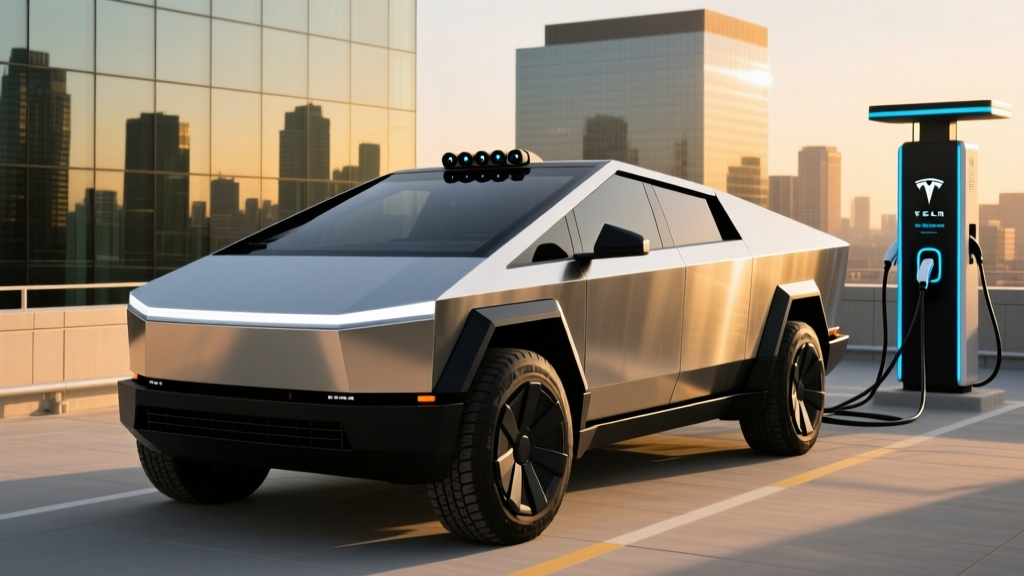
The Tesla Cybertruck Beast (formerly the tri-motor "Cyberbeast" trim) occupies a singular position in the EV truck market: an 845-horsepower stainless-steel angular pickup that hits 60 mph in 2.6 seconds while offering a usable 320-mile EPA range and a 6-foot composite bed. For 2026, Tesla continues to refine the Beast's software-defined suspension, steer-by-wire steering, and 800-volt-class architecture — but at a base MSRP of $99,990, it lands firmly in luxury-performance territory where the federal §30D tax credit becomes a complicated question.
This review breaks down the Cybertruck Beast's real-world efficiency, charging behavior, ownership economics, and whether its spec sheet justifies the price against rivals like the Rivian R1T Tri-Motor and the GMC Hummer EV 3X.
Cybertruck Beast Specifications at a Glance
| Specification | 2026 Tesla Cybertruck Beast |
|---|---|
| Base MSRP | $99,990 (excl. destination) |
| As-Tested Price (FSD + Foundation Series) | ~$107,490 |
| EPA Range | 320 miles |
| Battery Capacity (usable) | ~123 kWh (estimated), NMC chemistry |
| Battery Architecture | 4680 structural cells, ~800V nominal |
| Drivetrain | Tri-motor AWD (1 front, 2 rear) |
| Horsepower | 845 hp |
| 0-60 mph | 2.6 seconds |
| Top Speed | 130 mph (electronically limited) |
| Max DC Fast Charge | 250 kW (peak) |
| 10-80% DC Fast Charge | ~18 minutes (preconditioned) |
| Level 2 Home Charging | 11.5 kW / ~34 mi/hr (48A on Wall Connector) |
| Efficiency | 56 MPGe combined / ~58 kWh/100 mi |
| Towing Capacity | 11,000 lbs (max, properly equipped) |
| Payload | 2,500 lbs |
| Bed Length | 6 ft (lockable vault) |
| Cargo Volume (bed + frunk) | ~67 cu ft bed, ~7 cu ft frunk |
| Seating | 5 passengers (3 front bench + 2 rear) |
| Rear Legroom | ~34.3 inches |
| Ground Clearance (max, Extract Mode) | 17.4 inches |
| Approach / Departure Angle | 35° / 34° |
| Battery & Drive Unit Warranty | 8 years / 120,000 miles |
| Basic Vehicle Warranty | 4 years / 50,000 miles |
Real-World Range: What 320 EPA Miles Actually Means
Real-World Highway (70 mph, 75°F): ~255–275 miles
Real-World Highway (32°F, cold weather): ~210–240 miles
Mixed City/Suburban: ~280–310 miles
Max Towing (heavy trailer, hilly): ~130–160 miles
The Cybertruck Beast's 320-mile EPA figure sits between the All-Wheel Drive dual-motor variant (340 miles) and was partially achieved through the now-discontinued range-extender option. In practice, the tri-motor's extra weight and higher rolling resistance from 35-inch all-terrain tires mean you should plan around 260 miles of usable highway range on a warm day.
Efficiency hovers around 58 kWh/100 miles in mixed driving according to fueleconomy.gov data. That translates to roughly 1.7 miles per kWh — reasonable for a 6,800-pound truck, but noticeably thirstier than the dual-motor AWD Cybertruck's ~50 kWh/100 mi. Cold weather compounds this: expect a 20–25% range reduction in sustained sub-freezing temperatures, even with Tesla's heat pump and battery preconditioning active.
For context, a 300-mile road trip at 75 mph in summer conditions will require one DC fast-charge stop. Plan for two stops in winter or mountainous terrain. If you tow near the 11,000-pound max, range collapses dramatically — a reality shared by every EV pickup on the market.
Charging Speed: 250 kW Peak and the Curve Reality
| Charging Method | Max Power | Rate / Time | Notes |
|---|---|---|---|
| Tesla Supercharger V4 (DC) | 250 kW peak | 10–80% in ~18 min | Preconditioned; tapers sharply above 80% |
| CCS Adapter + Electrify America | ~200 kW (adapter-limited) | 10–80% in ~22 min | Requires Tesla CCS adapter (included) |
| Level 2 — Tesla Wall Connector (48A) | 11.5 kW | ~34 miles/hr; 0–100% in ~11 hrs | Requires 60A circuit |
| Level 2 — Generic J1772 (via adapter) | 7.2–11.5 kW | ~21–34 miles/hr | Depends on station amperage |
| Level 1 — Standard 120V Outlet | ~1.4 kW | ~4 miles/hr | Emergency/trickle only |
The Cybertruck Beast uses Tesla's 4680 structural battery pack with an estimated ~800V nominal architecture, which enables its 250 kW peak DC charge rate. On a V3 or V4 Supercharger with the battery preconditioned (navigate to a Supercharger in the nav system and the truck warms the pack automatically), you'll see the charge curve ramp quickly to ~250 kW between 10–30% State of Charge (SoC), then step down progressively through the 40–60% range, and taper significantly above 80%.
This is the critical detail most spec sheets omit: peak kW is not sustained kW. The 10–80% time of ~18 minutes averages roughly 175 kW sustained — impressive for a 123 kWh pack, but don't expect to sit at 250 kW for the entire session. Charging from 80–100% can add another 25–30 minutes, so plan your stops around the 80% mark for efficiency.
At home on a Tesla Wall Connector wired to a 60-amp breaker (48 amps continuous), the Beast replenishes about 34 miles of range per hour. An overnight charge from 20% to 80% takes roughly 7 hours — adequate for daily use if you plug in every night. Home charging installation typically runs $1,200–$3,500 depending on your electrical panel capacity and run distance. If your home has a 100-amp main panel, expect a $2,000–$4,000 panel upgrade to 200 amps before adding a dedicated EV circuit.
Performance: 845 Horsepower and Steer-by-Wire
The Beast trim's tri-motor powertrain (one front motor, two rear motors) delivers 845 horsepower and a manufacturer-claimed 2.6-second 0–60 mph time — making it one of the quickest production pickups ever built, rivaling the Rivian R1T Tri-Motor Max (2.9 sec) and handily beating the GMC Hummer EV 3X (~3.0 sec). The instant torque delivery from three independent motors also enables precise torque vectoring, which you feel in cornering stability despite the truck's substantial curb weight.
The Cybertruck's steer-by-wire system eliminates the mechanical connection between the steering wheel and the front wheels. Instead, electronic signals control the rack. The practical result is a variable steering ratio: at low speeds, the wheel requires less than one full lock turn for maximum steering angle (incredibly quick for parking lots and tight trails). At highway speeds, the ratio lengthens for stability. It takes roughly 20 minutes of driving to build muscle memory, but most owners adapt quickly.
The adaptive air suspension offers five ride-height settings, including an "Extract" mode that raises ground clearance to 17.4 inches for off-road obstacles. The stainless-steel exoskeleton panels are dent-resistant but fingerprint-prone — Tesla recommends a ceramic coating or PPF for owners who want a showroom finish.
Pricing, Tax Credits, and Ownership Economics
| Item | Amount |
|---|---|
| Base MSRP (Beast trim) | $99,990 |
| Destination Fee | $1,995 |
| FSD (Supervised) Add-On | $8,000 (or $99/mo subscription) |
| Typical As-Tested Price | ~$107,490 |
| Federal §30D Tax Credit | $0 — exceeds MSRP cap |
| Estimated 5-Year Electricity Cost (15k mi/yr) | ~$5,800 (at $0.16/kWh avg) |
| Estimated 5-Year Insurance | ~$18,000–$24,000 (varies heavily by state/driver) |
Here's the hard truth for Cybertruck Beast buyers: this truck does not qualify for the federal §30D new clean vehicle tax credit. The IRS caps eligible pickup trucks at an MSRP of $80,000 (source: IRS §30D guidelines). At $99,990 base — before any options — the Beast exceeds that threshold by nearly $20,000. The dual-motor All-Wheel Drive Cybertruck, starting around $79,990, may qualify depending on battery-sourcing compliance and your income, but the Beast and AWD trims above $80K are categorically ineligible.
Additionally, §30D imposes buyer income caps: modified adjusted gross income (MAGI) cannot exceed $300,000 (joint filers), $225,000 (head of household), or $150,000 (single). Even if a vehicle qualifies on price, high-earning buyers are excluded. Always consult a tax professional before assuming credit eligibility.
Insurance is another ownership reality worth budgeting for. The Cybertruck Beast's combination of high repair costs (stainless-steel body panels, steer-by-wire components, structural battery), 845 hp output, and six-figure price tag pushes annual premiums to $3,600–$4,800 for a typical driver — significantly above the EV truck average. Get quotes before ordering.
Tech, Interior, and Daily Usability
The Cybertruck's interior is minimalist even by Tesla standards. The 18.5-inch front touchscreen handles nearly all vehicle functions — climate, media, navigation, vehicle settings, and camera views. A 9.4-inch rear touchscreen serves back-seat passengers. There are no physical buttons for climate or volume; everything routes through the display or the yoke-style steering wheel's touch controls.
Driver Assistance: The Beast ships with Basic Autopilot (lane-keeping, adaptive cruise). Tesla's Full Self-Driving (Supervised) package — currently a SAE Level 2 system requiring active driver supervision at all times — is available as an $8,000 add-on or $99/month subscription. FSD (Supervised) handles highway lane changes, on-ramp to off-ramp navigation, and some city-street scenarios, but it is not autonomous driving. You must keep your hands on the yoke and eyes on the road.
Unique features include the powered tonneau cover (rated to support 300 lbs distributed weight for rooftop tent camping), the vault-style bed with 120V and 240V outlets for powering tools or appliances (up to 11.5 kW output via Powershare), and the HEPA bioweapon-defense air filtration system. The front trunk (frunk) provides ~7 cubic feet of lockable storage.
Notable drawbacks: Rear-seat legroom at 34.3 inches is tight for adults on long trips — the Rivian R1T offers ~38 inches. Visibility through the angular rear window is poor, though the digital rearview camera mitigates this. The stainless-steel body, while dent-resistant, shows every smudge and requires specific cleaning products. Panel-gap consistency has improved since the 2024 launch, but build-quality scrutiny remains higher than on legacy luxury trucks.
Cybertruck Beast vs. Key Competitors
The Beast competes in a narrow band of high-performance electric pickups. Here's how it stacks up against the two most direct rivals:
| Spec | Tesla Cybertruck Beast | Rivian R1T Tri-Motor Max | GMC Hummer EV 3X Pickup |
|---|---|---|---|
| Starting MSRP | $99,990 | ~$105,900 | ~$104,595 |
| EPA Range | 320 mi | ~420 mi (Max Pack) | ~314 mi |
| Horsepower | 845 hp | 850 hp | 830 hp |
| 0-60 mph | 2.6 sec | ~2.9 sec | ~3.0 sec |
| Max Tow | 11,000 lbs | 11,000 lbs | 7,500 lbs |
| §30D Tax Credit | No (over MSRP cap) | No (over MSRP cap) | No (over MSRP cap) |
| Charging Network | Tesla Supercharger (NACS native) | Tesla Supercharger (NACS adapter) | CCS (NACS adapter available) |
| Bed Length | 6 ft | 4.5 ft | 5 ft |
The Rivian R1T Tri-Motor Max offers substantially more range (420 miles with the Max Pack) and a more conventional, refined interior, but a shorter bed and higher starting price. The Hummer EV 3X delivers comparable power and the party-trick CrabWalk diagonal-drive feature, but trails in towing and efficiency. The Cybertruck Beast's advantages are its Supercharger network access, 6-foot bed, and 2.6-second sprint — its trade-offs are rear-seat space, visibility, and polarizing design.
Pros, Cons, and Who Should Buy
Pros
- Class-leading 2.6-second 0-60 in a pickup
- Access to Tesla Supercharger network (most reliable DC fast-charging in the US)
- 6-foot bed with powered tonneau and 11.5 kW Powershare output
- 11,000-lb towing capacity
- Steer-by-wire enables extremely tight low-speed maneuvering
- Stainless-steel exoskeleton resists dents and scratches
- Over-the-air updates continuously add features
Cons
- $99,990 base price; no federal tax credit eligibility
- Real-world highway range closer to 255–275 miles, not 320
- Rear-seat legroom (34.3") is cramped for adult passengers
- Poor rear visibility; reliance on camera display
- High insurance premiums ($3,600–$4,800/year typical)
- Steer-by-wire learning curve and long-term reliability unknowns
- Stainless-steel body shows fingerprints constantly
- Towing cuts range to 130–160 miles
Who the Cybertruck Beast Suits Best
Buy it if: You want the quickest production pickup available, rely on long-distance road trips where Supercharger access matters, need a full 6-foot bed for work or recreation, and can absorb six-figure pricing without a tax credit.
Skip it if: You regularly carry adult rear-seat passengers, want 400+ miles of range for remote-area overlanding (look at the Rivian R1T Max Pack), or need the $7,500 federal credit to make the math work (consider the dual-motor Cybertruck AWD below $80K).
For towing: The 11,000-lb capacity is legitimate, but plan charging stops every 130–160 miles when loaded. For frequent heavy towing, a diesel pickup still offers superior range-under-load.
For daily commuting: If you charge at home overnight, the Beast is a perfectly comfortable (if wide) daily driver. Most commuters use 40–60 miles round-trip, well within the buffer.
Frequently Asked Questions
What is the real-world range of the Tesla Cybertruck Beast?
The EPA rates it at 320 miles, but real-world highway driving at 70 mph in moderate temperatures yields approximately 255–275 miles. In cold weather (below 32°F), expect 210–240 miles. City driving with regenerative braking recovers more energy, pushing closer to 280–310 miles.
How fast does the Cybertruck Beast charge?
On a Tesla Supercharger (V3 or V4), it peaks at 250 kW and charges from 10–80% in approximately 18 minutes when the battery is preconditioned. On a home Level 2 Wall Connector at 11.5 kW (48 amps), it adds about 34 miles of range per hour, taking roughly 7 hours to go from 20% to 80%.
Does the Cybertruck Beast qualify for the federal EV tax credit?
No. The IRS §30D credit caps eligible pickup trucks at $80,000 MSRP. The Cybertruck Beast starts at $99,990, well above the threshold. Even the buyer's income, battery-sourcing compliance, and point-of-sale transfer rules cannot override the MSRP cap. Consult a tax professional for your specific situation, and check current rules at IRS.gov.
Is the Cybertruck Beast worth buying over the Rivian R1T or Hummer EV?
It depends on your priorities. Choose the Beast for the quickest acceleration, Tesla Supercharger access, and a longer 6-foot bed. Choose the Rivian R1T Tri-Motor Max if range is paramount (420 mi with Max Pack) and you value a more conventional luxury interior. Choose the Hummer EV 3X for unique off-road features like CrabWalk and a lower (though still six-figure) entry price. None of these trucks qualify for the federal tax credit.
How long will the Cybertruck Beast's battery last?
Tesla warranties the battery and drive units for 8 years or 120,000 miles (whichever comes first), with a minimum 70% capacity retention threshold during that period. Based on data from Tesla's 4680 cells in other models, degradation typically plateaus around 10–12% loss after 100,000 miles for drivers who avoid habitual 100% charges and frequent DC fast-charging. Replacement cost for the structural pack, if needed out of warranty, is estimated at $18,000–$28,000+ based on current Tesla service pricing — though this is expected to decrease as 4680 production scales.
Can I charge the Cybertruck Beast at non-Tesla chargers?
Yes. Tesla includes a CCS adapter, allowing the Cybertruck to use Electrify America, EVgo, and other CCS-equipped networks. However, peak charge rates may be limited to ~200 kW via the adapter, compared to 250 kW on native Superchargers. As the industry transitions to NACS (Tesla's connector standard), more networks are adding native NACS cables, which will eventually eliminate the adapter need.