The Cybertruck Interior: Polarizing Outside, Surprisingly Practical Inside
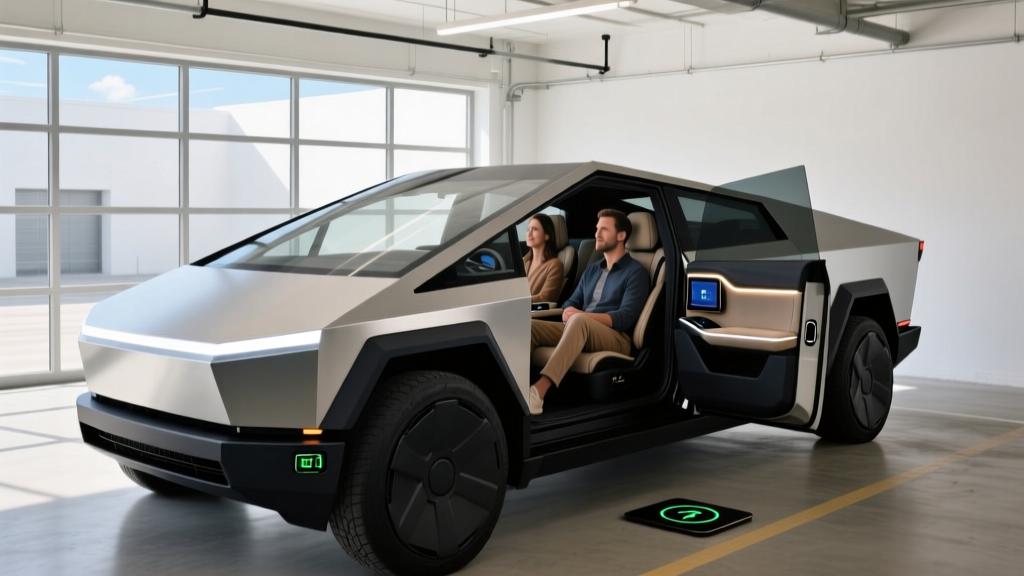
Love it or hate it, the Tesla Cybertruck's angular stainless-steel exoskeleton dominates every parking lot it enters. But once you climb inside — particularly into the back seat — the conversation shifts from styling to substance. For buyers researching the Cybertruck back seat and interior, the big questions are about passenger comfort, cargo versatility, and whether this electric pickup can genuinely serve as a daily family hauler or a long-distance road-trip rig.
After extensive time behind the wheel and in the rear seats, we're breaking down every dimension, every tech feature, and every real-world ownership number you need before signing the order sheet. From EPA range and DC fast-charging speeds to federal tax credit eligibility under current IRS §30D rules, this is the data-driven interior and ownership profile of the 2025–2026 Tesla Cybertruck lineup.
Cybertruck Back Seat Dimensions and Passenger Comfort
The Cybertruck seats five across two rows. The rear bench is a three-across setup with a 60/40 split-fold function. Tesla designed the rear floor to be flat — no transmission tunnel hump — which gives the middle passenger usable foot space, a common complaint in body-on-frame pickups.
Rear-Seat Measurements at a Glance
| Metric | Cybertruck (AWD) | Ford F-150 Lightning (for comparison) | Rivian R1T |
|---|---|---|---|
| Rear legroom | 41.7 in | 43.6 in | 37.3 in |
| Rear headroom | 38.2 in | 40.4 in | 38.0 in |
| Rear shoulder room | 57.1 in | 66.9 in | 56.5 in |
| Rear hip room | 53.5 in | 62.6 in | 52.0 in |
| Seating capacity | 5 | 5 | 5 |
At 41.7 inches of rear legroom, the Cybertruck's back seat is adequate for adults on long drives, though it falls about two inches short of the F-150 Lightning. The seat cushion is relatively flat and firm — supportive on highway stretches but lacking the deep bolstering you'd find in a luxury SUV. The sloping roofline cuts into headroom slightly; passengers over 6'2" may notice the headliner proximity, especially if the panoramic glass roof is installed (it reduces padding thickness overhead).
Real-world note: Three adults across the rear bench is tight for trips longer than an hour. The shoulder room (57.1 in) is narrower than a full-size pickup. This is a midsize-pickup interior in a full-size-truck footprint. For families with two kids in car seats and an occasional middle passenger, it works well. For regular six-footers in the back, the Lightning's SuperCrew cab still wins on space.
Rear-Seat Amenities
Tesla equips the rear with:
- A 9.4-inch rear touchscreen mounted on the back of the center console — controls climate, seat heating, and media
- Two USB-C ports (up to 65W for laptop charging)
- Heated rear seats (all three positions on higher trims)
- ISOFIX/LATCH anchors on the two outboard seats for child safety seats
- Heated and ventilated front seats; rear ventilation available on Cyberbeast
The rear touchscreen is a standout feature that rear passengers genuinely appreciate on road trips. Kids can control their own media without pestering the driver. However, the screen's position low on the console means shorter passengers and children in car seats may have trouble reaching it.
Cargo Space: Bed, Frunk, and Interior Versatility
The Cybertruck's cargo story extends well beyond the back seat. The 6-foot composite bed (marketed as the "vault") offers 67 cu ft of volume with the tonneau cover closed. The motorized retractable cover is a standard feature and a genuine differentiator — it seals weather out and locks securely, something most traditional tonneau covers require aftermarket upgrades to achieve.
| Cargo Area | Volume / Dimensions |
|---|---|
| Bed (vault, cover closed) | 67 cu ft |
| Bed length | 72 in (6 ft) |
| Bed width (between wheel wells) | 48 in (fits a standard sheet of plywood) |
| Front trunk (frunk) | 7.1 cu ft |
| Under-bed rear storage | ~7 cu ft (lockable, accessible from bed) |
| Max payload | 2,500 lbs |
| Max towing capacity | 11,000 lbs (AWD/Cyberbeast) |
The frunk is modest at 7.1 cu ft — enough for a charging cable kit and a small bag of groceries, but not a full suitcase. The under-bed storage compartment on the driver's side is a clever addition for securing tools or valuables out of sight.
With the rear seats folded flat (60/40 split), the interior cargo area opens up significantly for long items that need weather protection. The pass-through from the bed into the cabin (via the lowered midgate on some configurations) adds flexibility for hauling lumber or kayaks, though the midgate is not as seamless as the Chevrolet Silverado EV's system.
Range, Battery, and Efficiency: The Numbers That Matter
The Cybertruck lineup uses a structural battery pack with 4680-format cells in an NMC (nickel-manganese-cobalt) chemistry. Usable capacity is approximately 123 kWh across the AWD and Cyberbeast trims. Tesla has not released an LFP variant of the Cybertruck — the energy demands of a heavy, angular, 6,800-lb stainless-steel truck require the higher energy density of NMC.
| Trim | EPA Range | Real-World Highway (70 mph) | Cold Weather (below 30°F) |
|---|---|---|---|
| AWD (Dual-Motor) | 340 miles | ~270–290 miles | ~220–250 miles |
| Cyberbeast (Tri-Motor) | 320 miles | ~255–275 miles | ~210–240 miles |
| RWD (base, announced) | ~250 miles (est.) | ~200–220 miles | ~170–190 miles |
The Cybertruck's boxy aerodynamics (Cd ~0.38 estimated) and 6,800+ lb curb weight penalize highway efficiency significantly. Expect 15–20% range loss at sustained 75–80 mph speeds versus the EPA combined figure. In freezing temperatures, battery preconditioning helps but NMC chemistry still loses 25–35% range.
Efficiency figures from fueleconomy.gov place the AWD Cybertruck at approximately 67 MPGe combined (roughly 50 kWh/100 mi). That is notably less efficient than a Model Y (120+ MPGe) or even the F-150 Lightning (~70 MPGe). The physics are unavoidable: heavy mass plus a flat windshield and sharp edges create substantial aerodynamic drag at highway speed.
For daily commuting under 60 miles round-trip, the range is more than adequate even in winter. For road trips exceeding 300 miles, plan at least one charging stop — and build in a buffer for terrain and weather.
Charging Speeds: DC Fast Charging and Home Level 2
The Cybertruck uses the NACS (North American Charging Standard) connector natively — no adapter needed for Tesla Superchargers. This is a significant advantage in 2026 as the Supercharger network remains the most reliable DC fast-charging infrastructure in the U.S.
| Charging Method | Power / Rate | Speed / Time |
|---|---|---|
| DC Fast Charge (Supercharger V4) | Peak 250 kW (sustained ~180 kW average to 80%) | 10–80% in ~30 minutes; adds ~135 miles in 15 min |
| DC Fast Charge (max capable) | Up to 350 kW (limited by vehicle thermal management) | Not yet widely achievable; future V4 stalls may unlock |
| Level 2 Home (Tesla Wall Connector, 48A) | 11.5 kW | ~37 miles of range per hour; full charge in ~11 hours |
| Level 2 Home (standard 240V/32A) | 7.7 kW | ~25 miles per hour; full charge in ~16 hours |
| Level 1 (120V household) | ~1.4 kW | ~4–5 miles per hour; emergency/trickle only |
Charging curve reality check: The Cybertruck peaks at 250 kW on V3/V4 Superchargers, but the charge curve tapers significantly above 60% SoC. The 10–80% time of roughly 30 minutes is competitive with the F-150 Lightning (which peaks at ~150–190 kW depending on pack) but slower than the Hyundai Ioniq 5 or Kia EV9, which can sustain higher rates relative to their pack sizes. On a road trip, expect to spend 25–35 minutes at a Supercharger stop for a meaningful charge.
At home, the 123 kWh pack is enormous. Even with a 48-amp Tesla Wall Connector (11.5 kW), a full 0–100% charge takes roughly 11 hours. Most owners will plug in nightly and maintain a 20–80% daily window, which is achievable in about 6–7 hours — fine for overnight charging on a standard 240V/60A circuit. Budget $800–$1,500 for a professional Wall Connector installation (electrician + permit), and verify your electrical panel can handle the additional 60A load.
Performance: 0-60, Horsepower, and Drivetrain
| Spec | AWD (Dual-Motor) | Cyberbeast (Tri-Motor) |
|---|---|---|
| Horsepower | 600 hp | 845 hp |
| 0–60 mph | 3.9 seconds | 2.6 seconds |
| Top speed | 112 mph | 130 mph |
| Drivetrain | Dual-motor AWD | Tri-motor AWD (torque vectoring) |
| Adaptive air suspension | Standard | Standard |
| Ground clearance (max) | 16.0 in | 16.0 in |
The Cyberbeast's 2.6-second 0–60 time makes it one of the quickest production vehicles ever sold, period. But the more practical AWD trim's 3.9 seconds is already supercar-rivaling territory from a 6,800-lb truck. The adaptive air suspension provides 12 inches of adjustment — lowering for highway efficiency or raising for off-road clearance — and the 48-volt steer-by-wire system eliminates the mechanical connection between the steering yoke and the wheels, enabling the Cybertruck's signature tight turning radius despite its size.
ADAS note: The Cybertruck ships with Tesla's Enhanced Autopilot and offers Full Self-Driving (Supervised) as a $8,000 add-on or $99/month subscription. Per NHTSA guidelines, this is a SAE Level 2 driver-assistance system. The driver must remain fully engaged, hands on the yoke (or applying torque), and eyes on the road at all times. It is not autonomous driving. Tesla's FSD has improved substantially in 2025–2026 for highway and city navigation, but it still requires constant supervision and can make unexpected lane-change or braking decisions in construction zones and complex intersections.
Pricing, Trims, and Federal Tax Credit Eligibility
The Cybertruck's pricing has shifted since its 2023 reveal. As of the 2025–2026 model year, here is the current MSRP breakdown:
| Trim | Base MSRP | Est. After §30D Credit* | Status |
|---|---|---|---|
| RWD (base) | $60,990 | ~$53,490 | Announced; limited availability 2026 |
| AWD (Dual-Motor) | $79,990 | $79,990 (no credit — exceeds MSRP cap) | Available |
| Cyberbeast (Tri-Motor) | $99,990 | $99,990 (no credit — exceeds MSRP cap) | Available |
*Federal tax credit reality: Under current IRS §30D rules, the clean vehicle credit provides up to $7,500 — but only if the vehicle's MSRP does not exceed $80,000 for trucks, vans, and SUVs. The AWD at $79,990 squeaks under the cap and may qualify, but only if the buyer also meets income thresholds (AGI ≤ $150,000 single / $300,000 married filing jointly) AND the vehicle meets critical-mineral and battery-component sourcing requirements, which have tightened significantly under 2024–2026 rules. The Cyberbeast at $99,990 exceeds the cap entirely and does not qualify.
Additionally, the point-of-sale transfer option (available since 2024) lets eligible buyers apply the credit as an instant rebate at the dealer rather than waiting for tax filing. Confirm eligibility with a tax professional before relying on the credit in your purchase budget — battery-sourcing requirements change annually, and a vehicle that qualified in 2025 may not qualify in 2026.
Ownership Costs, Warranty, and Long-Term Outlook
Tesla covers the Cybertruck with:
- Basic vehicle warranty: 4 years / 50,000 miles
- Battery & drive unit warranty: 8 years / 120,000 miles (whichever comes first), with a minimum 70% capacity retention threshold
- Corrosion warranty: 12 years with no mileage limit (relevant for the stainless-steel exoskeleton)
The 8-year/120,000-mile battery warranty is slightly more generous on mileage than the standard Tesla 100,000-mile threshold, reflecting the truck's heavier use case. However, replacing a 123 kWh NMC structural pack out of warranty is estimated at $18,000–$25,000+ based on current Tesla service pricing for large packs. Degradation data on the 4680 cells is still maturing — early 2024 delivery vehicles are only now accumulating 24+ months of real-world data. Expect roughly 5–8% capacity loss over the first 50,000 miles based on Tesla's historical NMC pack behavior, with the curve flattening significantly afterward.
Insurance: Cybertruck insurance premiums have been notably higher than the segment average. Multiple carriers have been slow to establish actuarial data on the stainless-steel body panels and steer-by-wire system. Expect quotes 30–50% above an equivalently priced F-150 Lightning. Shop multiple carriers and check Tesla's own insurance product, which uses real-time driving data to set premiums.
Charging cost vs. gas: At a national average of $0.15/kWh for home charging, filling the 123 kWh pack costs roughly $18.50 for ~320 miles of range — about $0.058/mile. A comparable gas truck at 18 MPG and $3.50/gallon runs $0.194/mile. Over 15,000 miles/year, that's a fuel savings of roughly $2,040 annually when charging primarily at home. Public DC fast charging at $0.35–$0.50/kWh narrows the gap considerably.
Pros, Cons, and the Verdict
✅ Pros
- Class-leading acceleration (2.6s Cyberbeast, 3.9s AWD)
- Native NACS connector — full Supercharger access, no adapter
- Standard motorized tonneau cover and under-bed storage
- Rear 9.4-inch touchscreen is genuinely useful for passengers
- Adaptive air suspension with 12" travel and self-leveling under load
- 48V architecture enables steer-by-wire and rear-wheel steering
- 11,000-lb towing capacity (AWD/Cyberbeast)
- Stainless-steel exoskeleton resists dents and corrosion
❌ Cons
- Back seat is tighter than F-150 Lightning — not ideal for three adults
- Highway range drops significantly due to poor aerodynamics (67 MPGe)
- AWD/Cyberbeast trims mostly ineligible for §30D tax credit
- Insurance premiums 30–50% above comparable electric trucks
- Steer-by-wire and yoke steering require an adjustment period
- Stainless-steel panels show fingerprints and are difficult to repair
- 30-minute DC fast charge is slower than some competitors relative to pack size
- No Apple CarPlay / Android Auto — Tesla ecosystem only
Who Should Buy the Cybertruck — And Who Shouldn't
Choose the Cybertruck if:
- You want an electric truck that stands apart and prioritize performance and tech over traditional truck comfort
- You primarily commute and tow, with road trips under 300 miles between stops
- You have home Level 2 charging and can charge overnight to offset the large pack
- Your family is two adults plus two kids — the back seat fits children and teens well
- You value the integrated tonneau cover, air suspension, and 48V architecture as standard features
Look elsewhere if:
- You regularly carry three adults in the back seat — the F-150 Lightning's SuperCrew cab offers significantly more shoulder and hip room
- You drive 400+ mile highway routes frequently and want maximum range efficiency (the aerodynamics hurt here)
- You need the $7,500 federal tax credit — the Cyberbeast doesn't qualify, and the AWD's eligibility depends on tight income/sourcing rules
- You prefer CarPlay, physical buttons, or a conventional steering wheel
- Insurance cost is a major factor in your total-cost-of-ownership calculation
The Cybertruck's interior — back seat included — is a capable, tech-forward space that works well for small families and tech-savvy truck buyers. It is not the most spacious electric truck interior on the market, and the range penalty of its angular design is a real ownership factor on long highway runs. But for the buyer who wants something genuinely different, with best-in-class performance and Tesla's charging network advantage, the Cybertruck delivers an experience no other electric pickup can match.
Frequently Asked Questions
Is the Cybertruck back seat comfortable for adults on long road trips?
Yes, for two adults. The 41.7 inches of legroom is adequate, and the flat floor helps. For three adults across the bench, shoulder room (57.1 in) gets tight after about an hour. It's more comparable to a midsize SUV's rear seat than a full-size pickup's.
Does the Tesla Cybertruck qualify for the $7,500 federal EV tax credit in 2026?
It depends on the trim and your income. The AWD at $79,990 is under the $80,000 truck MSRP cap and may qualify if you meet AGI limits (≤$300,000 married filing jointly) and the battery-sourcing requirements are met. The Cyberbeast at $99,990 does not qualify. Always verify current eligibility on IRS.gov and consult a tax professional before purchasing.
How long does it take to charge the Cybertruck at home?
On a 48-amp Tesla Wall Connector (11.5 kW), a full charge of the 123 kWh pack takes about 11 hours. Most owners charging from 20% to 80% overnight will need roughly 6–7 hours, which is manageable with nightly plug-in habits.
What is the real-world highway range of the Cybertruck AWD?
The EPA rates the AWD at 340 miles combined, but real-world highway driving at 70–75 mph typically yields 270–290 miles. In cold weather (below 30°F), expect 220–250 miles. The boxy aerodynamics and heavy weight are the primary factors.
How does the Cybertruck compare to the Ford F-150 Lightning for families?
The Lightning offers more rear-seat space (43.6 in legroom, 66.9 in shoulder room), a lower starting price, and more traditional truck ergonomics. The Cybertruck wins on performance, native Supercharger access, and standard features like the motorized tonneau cover and air suspension. For maximum back-seat comfort, the Lightning is the stronger family choice.
Is Tesla's FSD (Full Self-Driving) actually self-driving?
No. FSD (Supervised) is an SAE Level 2 driver-assistance system. The driver must remain fully alert, keep hands on the yoke, and be prepared to take over at any moment. It can navigate highways and city streets but is not autonomous. Only Level 4 services like Waymo operate without a human driver.