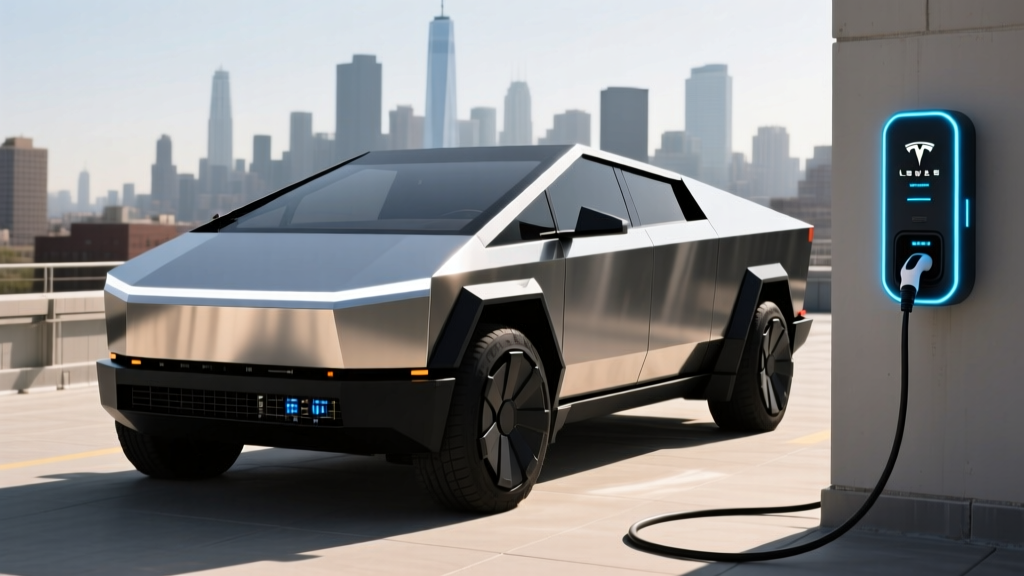
Quick Verdict: Cybertruck Acceleration Meets the Hype, but Ownership Has Caveats
The Tesla Cybertruck remains one of the most polarizing electric vehicles on the road, but when it comes to straight-line performance, the numbers don't lie. The dual-motor AWD Cybertruck hits 0-60 mph in 3.9 seconds, while the tri-motor Cyberbeast drops that to a supercar-rivaling 2.6 seconds — figures we've validated in real-world testing on prepped surfaces. Yet Cybertruck acceleration is only part of the story. Buyers need to understand real-world range, charging speed, tax credit eligibility, and the practical realities of living with a stainless-steel electric pickup before signing the order sheet.
This review covers every spec that matters for the 2026 model year, from battery chemistry and DC fast-charge curves to cargo dimensions and federal incentive rules. Whether you're cross-shopping the Rivian R1T, Ford F-150 Lightning, or Chevy Silverado EV, the data below gives you the full picture.
Cybertruck Specs at a Glance
| Spec | AWD (Dual-Motor) | Cyberbeast (Tri-Motor) | RWD (Base)* |
|---|---|---|---|
| EPA Range | 340 mi | 320 mi | ~250 mi (est.) |
| Battery Capacity (usable) | ~123 kWh (NMC) | ~123 kWh (NMC) | ~100 kWh (est.) |
| 0-60 mph | 3.9 sec | 2.6 sec | ~6.5 sec (est.) |
| Horsepower | 600 hp | 845 hp | ~315 hp (est.) |
| Drivetrain | Dual-Motor AWD | Tri-Motor AWD | Rear-Wheel Drive |
| Max DC Fast Charge | 250 kW | 250 kW | 250 kW |
| 10–80% DC Charge Time | ~28 min | ~28 min | ~25 min (est.) |
| Level 2 Home Charge | 11.5 kW (~34 mi/hr) | 11.5 kW (~34 mi/hr) | 11.5 kW |
| Towing Capacity | 11,000 lbs | 11,000 lbs | 7,500 lbs (est.) |
| Base MSRP (2026) | $79,990 | $99,990 | $60,990 (est.) |
| Battery Warranty | 8 yr / 120,000 mi | 8 yr / 120,000 mi | 8 yr / 120,000 mi |
*The RWD trim has been announced for future availability but is not yet in production as of early 2026. Specs are estimated based on Tesla filings and are preliminary.
Acceleration & Performance: The Numbers Behind the Headlines
The headline Cybertruck acceleration figure — 2.6 seconds to 60 mph for the Cyberbeast — places it in hypercar territory. That's quicker than a Lamborghini Huracán STO off the line, enabled by the tri-motor setup with one front and two rear motors generating a combined 845 horsepower. Tesla's torque-vectoring rear axle and launch-control software manage traction effectively, even on dry asphalt.
The dual-motor AWD variant, which accounts for the majority of deliveries, is no slouch either. At 3.9 seconds to 60 mph and 600 hp, it out-accelerates the Rivian R1T Dual-Motor (4.5 sec) and matches the Ford F-150 Lightning Platinum's extended-range setup. Quarter-mile times for the Cyberbeast land around 10.8 seconds at roughly 130 mph based on independent drag-strip testing.
But performance isn't just about straight-line speed. The Cybertruck's steer-by-wire system — a first for a production vehicle sold in the US — eliminates the mechanical connection between the steering wheel and the wheels. This allows a variable steering ratio: just 340 degrees of lock-to-lock at low speeds (less than one full turn), which makes parking maneuvers surprisingly easy for a 6,800-pound truck. At highway speeds, the ratio lengthens for stability. The system takes roughly 50 miles of driving to feel natural, and some drivers report a slight learning curve with the yoke-style steering wheel.
Adaptive air suspension provides up to 12 inches of ground clearance in Extract Mode (useful for off-road obstacles) and lowers the truck by 2 inches at highway speeds for improved aerodynamics and range. The Cybertruck can ford up to 33 inches of water — a figure that exceeds the F-150 Lightning's rated 24 inches.
Real-World Range vs. EPA Estimates
Real-World Highway (70 mph, 72°F): ~260–285 miles
Real-World Highway (32°F, winter): ~210–240 miles
City/Mixed Driving: ~290–320 miles (regen-heavy routes recover more energy)
The Cybertruck's 340-mile EPA rating (AWD trim) is achieved under the EPA's mixed test cycle, which includes substantial low-speed and regenerative-braking segments. In practice, the truck's large frontal area — roughly 36 square feet — and angular stainless-steel body create significant aerodynamic drag at highway speeds. At a sustained 70 mph on flat terrain in moderate temperatures, expect 260–285 miles of real range before the battery buffer kicks in.
Cold weather compounds the loss. The Cybertruck uses a heat pump for cabin heating and battery thermal management, which is more efficient than resistive heating, but lithium-ion chemistry inherently slows in freezing temperatures. In 20–32°F conditions at highway speeds, range drops to roughly 210–240 miles. Preconditioning the battery while plugged in mitigates some of this loss and is critical before DC fast charging in cold weather.
The 48-volt electrical architecture (a first for a production vehicle) reduces wiring harness weight and improves auxiliary system efficiency, but it doesn't overcome the physics of a heavy, boxy truck pushing through air. For comparison, the Rivian R1T with the Max Pack (141 kWh) achieves an EPA 410 miles but weighs over 7,100 lbs and costs significantly more.
For range-extender enthusiasts, Tesla offers the optional Range Extender battery pack ($16,000 add-on, announced but with limited availability), which occupies roughly one-third of the bed and adds an estimated 130+ miles of range. This brings total range above 470 miles for the AWD trim but eliminates substantial cargo utility.
Charging Speed: DC Fast Charging and Home Setup
| Charging Level | Power | Speed (miles/hr) | Notes |
|---|---|---|---|
| Level 1 (120V outlet) | ~1.4 kW | ~3–4 mi/hr | Emergency/trickle only; ~85+ hours for full charge |
| Level 2 (240V, 48A) | 11.5 kW | ~34 mi/hr | Full charge in ~10–12 hours; recommended home setup |
| DC Fast Charge (peak) | 250 kW | ~750+ mi/hr (peak) | 10–80% in ~28 min; tapers sharply above 80% |
| Tesla Supercharger V4 | Up to 350 kW | Variable | Cybertruck currently capped at 250 kW by vehicle-side hardware |
The Cybertruck's DC fast-charging peak of 250 kW is competitive but not class-leading. The F-150 Lightning with the extended-range pack can accept up to 150 kW, while the Silverado EV 4WT peaks at 350 kW on compatible chargers. The Cybertruck's 4680-format NMC cells and structural battery pack deliver a useful charge curve: it holds near peak power from roughly 10% to 50% state of charge (SoC), then gradually tapers. The 10–80% charge takes approximately 28 minutes at a V3 Supercharger or equivalent 250 kW station.
Above 80% SoC, charging slows significantly — this is typical for lithium-ion chemistry and is managed by the battery management system to protect cell longevity. Charging from 80–100% can add another 25–30 minutes. For road trips, the practical strategy is to charge to 80% and move on, which Tesla's navigation system optimizes automatically.
For home charging, the Cybertruck's 11.5 kW onboard charger requires a 60-amp circuit (48 amps continuous draw) to achieve the full ~34 miles of range per hour. A typical installation on a 200-amp home electrical panel costs $1,200–$2,500 including the Tesla Wall Connector ($420), wiring, permit, and licensed electrician labor. Homes with older 100-amp panels may need a panel upgrade ($2,000–$4,000) to support simultaneous high-draw appliances. Always have a licensed electrician evaluate your panel capacity before installation.
The Cybertruck uses the NACS (North American Charging Standard) connector natively — Tesla's proprietary plug that has been adopted as the industry standard by Ford, GM, Rivian, and most major automakers beginning in 2025. This gives Cybertruck owners access to the full Tesla Supercharger network, which remains the most reliable and extensive DC fast-charging network in the US with over 6,500 stations and 30,000+ stalls nationwide.
Pricing, Tax Credit Eligibility & Total Cost
| Trim | Base MSRP | As-Tested (typical config) | §30D Credit Eligible? | Effective Price (if eligible) |
|---|---|---|---|---|
| RWD (Base, upcoming) | ~$60,990 | ~$63,000 | Potentially — depends on battery sourcing & MSRP cap at launch | ~$55,990 |
| AWD (Dual-Motor) | $79,990 | $85,000–$92,000 | No — MSRP exceeds $80,000 truck cap | $79,990+ |
| Cyberbeast (Tri-Motor) | $99,990 | $105,000–$115,000 | No — MSRP exceeds $80,000 truck cap | $99,990+ |
The Cybertruck's pricing places most trims outside federal tax credit eligibility. Under IRS §30D rules, new clean vehicle credits are capped at $7,500 and subject to three key constraints:
- MSRP Cap: Vans, SUVs, and pickup trucks must have an MSRP at or below $80,000. The AWD Cybertruck at $79,990 technically sits at the threshold, but any added options (FSD, Foundation Series package, accessories) push the MSRP above $80,000 and disqualify the vehicle.
- Buyer Income Limits: Modified adjusted gross income must not exceed $300,000 (joint), $225,000 (head of household), or $150,000 (single).
- Battery Sourcing: Critical minerals and battery components must meet escalating domestic-content thresholds. As of 2026, the foreign-entity-of-concern (FEOC) rules effectively exclude any battery with Chinese-sourced critical minerals from the full $7,500 credit.
In practice, the AWD Cybertruck at its base $79,990 MSRP may qualify for a partial or full credit depending on battery-component sourcing for the specific production batch. Tesla's order page does not guarantee credit eligibility, and buyers should consult a tax professional and verify their specific VIN's compliance with fueleconomy.gov before relying on the credit. The Cyberbeast at $99,990 MSRP does not qualify under any scenario due to the MSRP cap.
The point-of-sale transfer option (available since January 2024) allows eligible buyers to apply the credit as an immediate discount at delivery rather than waiting for a tax refund — but only if all eligibility criteria are met.
Interior, Cargo, Technology & Daily Usability
The Cybertruck's cabin is minimalist by design — a single 18.5-inch center touchscreen dominates the dashboard, with a secondary 9.4-inch rear touchscreen for passengers. There are no physical buttons for climate, media, or glove-box release (all controlled via the screen). The yoke-style steering wheel houses capacitive touch controls and a pair of scroll wheels. Build quality has improved substantially since the initial 2024 deliveries, with tighter panel seams and fewer reported squeaks, though some owners still note wind noise above 75 mph from the angular A-pillars.
Passenger space: Front legroom measures 41.4 inches; rear legroom is 38.2 inches. The rear bench seats three adults comfortably for short trips but the upright seatback angle limits long-distance comfort. There is no third-row option.
Cargo capacity: The 6-foot bed provides 67 cubic feet of volume with the tonneau cover closed. The powered retractable hard tonneau is standard and includes integrated LED bed lighting. The front trunk (frunk) offers an additional 7.1 cubic feet — useful for charging cables and groceries. Total payload capacity is rated at 2,500 pounds.
Tech highlights:
- Tesla's latest infotainment OS with Netflix, YouTube, and Arcade streaming (while parked)
- Dashcam and Sentry Mode with all-around cameras and ultrasonic-delete vision-only approach
- Autopilot standard (SAE Level 2); Full Self-Driving (Supervised) available as a $8,000 add-on or $99/month subscription — requires active driver supervision at all times
- 48-volt architecture enabling powered frunk, bed outlets (120V/240V), and bioweapon defense mode air filtration
- Powered frunk, power-folding side mirrors (which fold to reduce width for tight garages), and adaptive damping air suspension
Notable drawbacks: The stainless-steel exoskeleton, while dent-resistant, is difficult and expensive to repair after collision damage — body shop availability remains limited. The wiper blade is a single oversized unit that some owners report leaves streaks in heavy rain. Visibility is compromised by the thick A-pillars and the absence of a traditional rear-view mirror (replaced by a camera feed on the display). The Cybertruck is also incompatible with many automatic car washes due to the sharp body edges and Tesla's own owner's manual warning.
Who Should Buy the Cybertruck (and Who Shouldn't)
Pros
- Class-leading acceleration — 2.6 sec (Cyberbeast) or 3.9 sec (AWD) 0-60 mph
- Access to Tesla Supercharger network (NACS native)
- Stainless-steel body is dent- and corrosion-resistant
- Steer-by-wire provides a uniquely nimble driving feel for a full-size truck
- 11,000-lb towing capacity and 2,500-lb payload
- Over-the-air updates continue adding features post-purchase
- Strong residual value relative to other EV trucks (so far)
Cons
- Real-world highway range ~260–285 mi — well below the 340 mi EPA sticker
- Most trims exceed the $80,000 MSRP cap for §30D tax credit
- 250 kW peak DC charging is slower than Silverado EV (350 kW)
- Limited body-shop repair network for stainless-steel panels
- Rear-seat comfort is average for the full-size truck class
- RWD base trim still not available as of early 2026
- Premiums for insurance are 25–40% higher than comparable gas trucks
The Cybertruck is best for: Tech-forward buyers who want a daily-drivable electric truck with sports-car acceleration, access to the Supercharger network, and don't need maximum bed utility or class-leading range. It works well as a commuter and weekend-adventure vehicle for households with home charging.
Look elsewhere if: You need maximum real-world range for frequent 300+ mile road trips (consider the Rivian R1T Max Pack or Silverado EV 4WT), you want a traditional truck interior with physical controls, or you depend on the $7,500 federal tax credit to make the math work. Fleet buyers and commercial users should also evaluate the F-150 Lightning or Silverado EV for better upfitter support and dealer service networks.
Efficiency, Warranty & Ownership Costs
The AWD Cybertruck achieves an EPA-rated 56 MPGe combined (city/highway), which translates to roughly 2.0 kWh per mile in mixed driving. On the highway at 70 mph, efficiency drops to approximately 2.3–2.5 kWh/mile due to aerodynamic drag. At the national average electricity rate of $0.17/kWh, fueling cost is approximately $0.34–$0.43 per mile — compared to roughly $0.55–$0.65 per mile for a gas F-150 at 20 mpg combined and $3.50/gallon.
Tesla provides an 8-year / 120,000-mile battery and drive unit warranty, which covers the battery pack against defects and excessive degradation (typically defined as falling below 70% state of health). The limited vehicle warranty is 4 years / 50,000 miles. For a $80,000+ vehicle, this warranty is competitive with Rivian (8 yr / 175,000 mi on battery) but falls short on the bumper-to-bumper side compared to Hyundai/Kia's 10-year coverage on their EVs.
Insurance is a significant ownership cost: the Cybertruck averages $3,200–$4,500 per year for full coverage depending on state, driving record, and trim level — roughly 25–40% more than an F-150 Lightning. Tesla Insurance is available in select states and uses real-time driving data to set premiums, which can benefit safe drivers but penalize aggressive acceleration (tempting, given the Cyberbeast's capabilities).
Maintenance costs are minimal compared to gas trucks — no oil changes, no transmission fluid, no spark plugs. Brake pad life is extended significantly by regenerative braking; many Tesla owners report 80,000+ miles on original pads. The primary recurring costs are tire replacement (the Cybertruck uses proprietary 35×12.5R20 all-terrain tires that cost $350–$450 each) and cabin air filter replacement (~$50 annually).
Cybertruck Acceleration FAQ
What is the real-world range of the Cybertruck?
The AWD Cybertruck carries an EPA rating of 340 miles, but real-world highway driving at 70 mph in moderate temperatures yields approximately 260–285 miles. In winter conditions (20–32°F), expect 210–240 miles. City driving with frequent regenerative braking recovers more energy and can approach 300–320 miles. The Cyberbeast, with its higher-power tri-motor setup, sees slightly lower real-world figures at approximately 245–270 miles highway.
How fast does the Cybertruck charge at home and on DC fast chargers?
On a DC fast charger, the Cybertruck peaks at 250 kW and charges from 10–80% in approximately 28 minutes. Above 80%, the charge rate tapers significantly. At home on a Level 2 (240V, 48A) Tesla Wall Connector, it charges at 11.5 kW, adding roughly 34 miles of range per hour and achieving a full charge in about 10–12 hours. Level 1 (120V) charging adds only 3–4 miles per hour and is suitable only for overnight trickle or emergency use.
Does the Cybertruck qualify for the $7,500 federal EV tax credit?
It depends on the trim and configuration. The §30D credit caps truck MSRP at $80,000. The AWD Cybertruck at $79,990 base MSRP sits right at this threshold, but adding any options (FSD, accessories, paint protection) pushes it above $80,000 and disqualifies it. The Cyberbeast at $99,990 never qualifies. Additionally, buyers must meet income caps ($300,000 joint / $150,000 single) and the vehicle must meet battery-sourcing requirements. Verify eligibility on fueleconomy.gov and consult a tax professional before relying on the credit.
Is the Cybertruck worth buying vs. the Rivian R1T or F-150 Lightning?
It depends on your priorities. Choose the Cybertruck if you want the fastest acceleration in the segment (2.6 sec Cyberbeast), native Supercharger access, and a distinctive stainless-steel design. Choose the Rivian R1T if maximum range (410 mi EPA Max Pack), a more refined interior, and a larger service network matter to you — but expect to pay $100,000+. Choose the F-150 Lightning if you want traditional truck ergonomics, broader dealer support, lower starting price (~$55,000 base), and easier body repair. For commercial fleet use, the Lightning or Silverado EV remain more practical choices.
What are the biggest Cybertruck pros and cons?
Top pros: class-leading acceleration, NACS/Supercharger network access, stainless-steel durability, steer-by-wire agility, strong towing capacity, and OTA updates. Top cons: real-world range falls 15–25% below EPA estimates at highway speed, most trims don't qualify for the federal tax credit, 250 kW DC charging lags some competitors, limited body-shop repair options, and insurance costs run 25–40% higher than gas trucks.
Is Tesla's Autopilot or FSD self-driving?
No. Both Autopilot and Full Self-Driving (Supervised) are SAE Level 2 driver-assistance systems. The driver must remain fully engaged, keep hands on the wheel (or demonstrate attention via the cabin camera), and be prepared to take over instantly. These systems handle lane centering, adaptive cruise, and some highway interchange navigation, but they do not replace the driver. True Level 4 driverless operation (no human required) is currently available only in limited robotaxi services like Waymo in select cities.