Quick Verdict: The Cybertruck AWD at $59,990
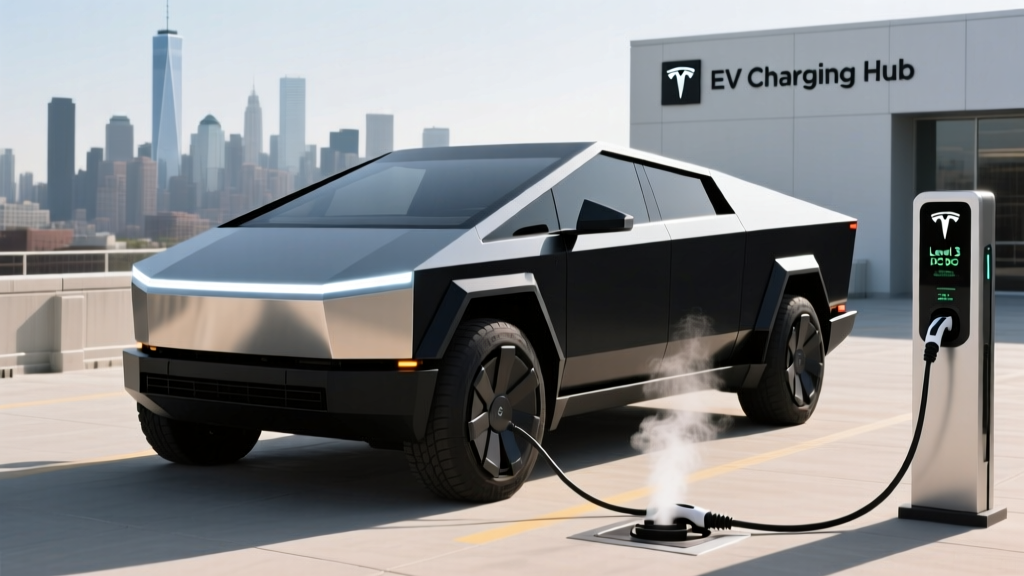
The dual-motor Cybertruck AWD occupies the middle of Tesla's stainless-steel pickup lineup, priced at $59,990 before incentives and options. It delivers 340 miles of EPA-estimated range, a 4.1-second 0-60 mph time, and access to Tesla's 48-volt electrical architecture with steer-by-wire steering. For buyers who need all-weather traction and towing capability without stepping up to the $79,990 Cyberbeast, the AWD trim is the volume play — provided you can navigate the federal tax credit's evolving battery-sourcing requirements.
| Spec | Cybertruck AWD (2026) |
|---|---|
| Base MSRP | $59,990 |
| EPA Range | 340 miles |
| Battery (usable) | ~123 kWh (NMC) |
| Max DC Fast Charge | 250 kW (peak) |
| 10–80% DC Charge Time | ~28 minutes |
| Level 2 Home Charge | 11.5 kW (~37 mi/hr) |
| 0–60 mph | 4.1 seconds |
| Horsepower | 600 hp (combined) |
| Drivetrain | Dual-motor AWD |
| Towing Capacity | 11,000 lbs |
| Efficiency | 67 MPGe / 50 kWh/100mi (est.) |
| Battery Warranty | 8 years / 120,000 miles |
| Basic Warranty | 4 years / 50,000 miles |
Range and Efficiency: 340 EPA Miles, But What's Real?
The EPA rates the dual-motor Cybertruck AWD at 340 miles on a full charge. That figure comes from a ~123 kWh usable battery pack using Tesla's 4680-format NMC (nickel-manganese-cobalt) cells, manufactured at Giga Texas. The truck's angular stainless-steel exoskeleton creates a drag coefficient of roughly 0.38 Cd — significantly higher than a sedan but competitive for a full-size pickup.
The 340-mile EPA sticker assumes a mix of city and highway driving at moderate temperatures. Expect the following in practice:
- Highway cruising (70–75 mph, 65°F): ~280–300 miles before needing a charge stop
- Cold weather (20°F, highway): ~230–260 miles — the large frontal area and steel body amplify heat-pump energy draw
- City/suburban mixed driving: ~310–330 miles, closer to the EPA figure thanks to regenerative braking
- With 10,000-lb trailer: ~150–180 miles — towing cuts range nearly in half, consistent with all electric pickups
For context, fueleconomy.gov lists the Cybertruck AWD's combined efficiency at approximately 50 kWh per 100 miles — meaning every mile costs roughly 20 cents at the national average electricity rate of $0.16/kWh, or about $10 for a 50-mile round-trip commute.
One ownership insight: the Cybertruck's massive battery means you rarely need a full 100% charge for daily driving. Most owners set the charge limit to 80% for daily use (~272 miles), preserving long-term battery health and reducing charge times.
Charging Speed: 250 kW Peak, But the Curve Tells the Real Story
The Cybertruck AWD supports up to 250 kW peak DC fast charging on Tesla's V3 and V4 Superchargers via its native NACS (North American Charging Standard) connector. However, as with every large-battery EV, peak rate is not sustained rate.
| Charging Level | Power | Rate | Notes |
|---|---|---|---|
| Level 1 (120V outlet) | ~1.4 kW | ~4 mi/hr | Emergency/top-up only |
| Level 2 (240V, 48A) | 11.5 kW | ~37 mi/hr | Full overnight charge in ~11 hrs |
| DC Fast (V3 Supercharger) | 250 kW peak | 10–80% in ~28 min | Sustains ~200 kW to ~50%, tapers above |
| DC Fast (V4 Supercharger) | 250 kW peak | 10–80% in ~28 min | Same rate, improved cable management |
| Non-Tesla DC (CCS adapter) | Up to 150 kW | 10–80% in ~40 min | Requires Tesla CCS adapter; Electrify America, EVgo |
The charging curve is the detail most spec sheets hide. The Cybertruck's 4680 cells sustain roughly 200–230 kW from 10% to about 50% State of Charge (SoC), then taper progressively. The 10–80% time of approximately 28 minutes is competitive with the Rivian R1T and Ford F-150 Lightning, but slower than Hyundai-Kia's 800V platforms (Ioniq 5, EV6) that achieve 10–80% in 18 minutes at 350 kW chargers.
Home charging practicality: A Level 2 Tesla Wall Connector at 48 amps delivers 11.5 kW, adding roughly 37 miles of range per hour. A full 0–100% charge takes about 11 hours — fine for overnight replenishment. Installation typically requires a 60-amp dedicated circuit; budget $800–$2,000 for professional installation depending on your panel's capacity and proximity to the garage. If your home has a 100-amp main panel, a panel upgrade to 200 amps may be necessary, adding $1,500–$3,000.
Performance and Drivetrain: Dual-Motor AWD Muscle
The Cybertruck AWD pairs a front induction motor with a rear permanent-magnet synchronous motor for a combined output of 600 horsepower and an estimated 740 lb-ft of torque. The result is a 4.1-second 0–60 mph time — quicker than a Ford F-150 Lightning Lariat (4.0s in Extended Range) and comparable to the Rivian R1T Dual-Motor (4.5s).
Tesla's steer-by-wire system eliminates the mechanical connection between the steering yoke and the wheels, replacing it with electronic actuators. This allows variable steering ratios: fewer than one full turn lock-to-lock at parking speeds, meaning no hand-over-hand maneuvering. It takes roughly a week of daily driving to build muscle memory, after which it feels intuitive.
The AWD system provides torque vectoring between axles, and the truck's adaptive air suspension offers up to 12 inches of ground clearance in Extract Mode — useful for off-road trails or steep driveways. Normal ride height sits at approximately 10 inches, with the ability to lower for highway efficiency or raise for approach/departure angle.
Towing capacity is rated at 11,000 pounds, matching the F-150 Lightning's maximum and trailing the Rivian R1T's 11,000-pound rating. The 6.5-foot composite bed (marketed as a "vault") includes a powered tonneau cover and integrated 120V/240V outlets capable of delivering up to 9.6 kW of continuous power — enough to run a welder, circular saw, or power an entire campsite.
Cargo, Passenger Space, and Interior Tech
The Cybertruck seats five across two rows. Rear legroom measures approximately 38 inches — adequate for adults on longer trips but not class-leading compared to the Ford F-150 Lightning's more generous 43 inches. The rear bench is relatively flat and firm, a consequence of the skateboard battery platform beneath.
Cargo dimensions:
- Bed length: 72 inches (6 ft) with tailgate up; 78 inches with tailgate down
- Bed width (between wheel wells): ~48 inches
- Bed volume: ~67 cu ft (with powered tonneau closed)
- Frunk (front trunk): ~7 cu ft — lockable, drainable, useful for groceries or charging cables
- Interior cabin storage: Moderate — center console bin, door pockets, no traditional glovebox (relocated behind a touchscreen-accessible panel)
The interior centers on an 18.5-inch touchscreen that controls virtually every vehicle function, including climate, glovebox release, and mirror adjustment. A rear 9.4-inch touchscreen serves second-row passengers. There are no physical buttons on the dash — everything routes through the UI. This minimalist approach polarizes buyers: some appreciate the clean aesthetic, others miss tactile controls for volume or defrost while driving.
Standout tech features include:
- Autopilot (standard): Adaptive cruise control + lane-keeping assist — SAE Level 2, requiring constant driver supervision
- Full Self-Driving Supervised (optional, ~$8,000): Adds automatic lane changes, traffic-light recognition, and navigation-on-Autopilot. Still Level 2 — not autonomous
- Sentry Mode + Dashcam: 360-degree recording when parked or driving
- Powershare (V2L): 9.6 kW output from bed and frunk outlets
- Bioweapon Defense Mode: HEPA-grade cabin air filtration
Tesla Autopilot and FSD (Supervised) are SAE Level 2 driver-assistance systems. The driver must remain fully attentive, with hands on the yoke, at all times. These systems do not make the Cybertruck self-driving. Misuse has resulted in NHTSA investigations and recalls. Treat them as advanced cruise control, not a substitute for an engaged driver.
Pricing, Trims, and Federal Tax Credit Eligibility
The 2026 Cybertruck lineup includes three trims:
| Trim | MSRP | Drivetrain | EPA Range | §30D Credit Eligibility |
|---|---|---|---|---|
| RWD (Long Range) | $59,990 | Rear-Wheel Drive | ~340 mi | Varies — check IRS sourcing rules |
| AWD (Dual Motor) | $79,990 | Dual-Motor AWD | 340 mi | Varies — MSRP within truck cap |
| Cyberbeast | $99,990 | Tri-Motor AWD | 320 mi | Varies — MSRP within truck cap |
Note: Tesla has adjusted Cybertruck pricing multiple times since launch. The $59,990 RWD was announced for future availability; the AWD at $79,990 is the current volume dual-motor trim as of early 2026. Always verify current pricing on Tesla's configurator.
Federal tax credit (IRS §30D) breakdown:
- MSRP cap: Trucks/vans/SUVs must have an MSRP ≤ $80,000. The AWD at $79,990 qualifies; the Cyberbeast at $99,990 does not.
- Buyer income cap: Modified AGI ≤ $150,000 (single), $225,000 (head of household), $300,000 (married filing jointly).
- Battery sourcing: The credit is split into two halves ($3,750 each) — one for critical-mineral sourcing and one for battery-component manufacturing, both with escalating domestic-content thresholds through 2026. Tesla's 4680 cells are manufactured at Giga Texas, but cathode-material sourcing may not fully satisfy all thresholds. The credit amount can range from $0 to $7,500 depending on the specific vehicle's supply-chain compliance at time of delivery.
- Point-of-sale transfer: If eligible, you can transfer the credit to the dealer at purchase for an immediate price reduction rather than claiming it on your tax return.
- Verification: Always check the IRS clean vehicle credit eligibility page for the specific VIN before purchasing. Rules change frequently.
If the full $7,500 credit applies, the effective price of the AWD drops to approximately $72,490. If only the $3,750 battery-component half qualifies, the effective price is $76,240. Consult a tax professional for your specific situation.
Who Should Buy the Cybertruck AWD?
Choose the Cybertruck AWD if:
- You want a distinctive, conversation-starting EV pickup with strong performance credentials
- You need Supercharger network access for road trips (the most reliable DC fast-charging network in the US)
- You value V2L powershare capability for job sites, camping, or backup power
- You're comfortable with a yoke-style steering wheel and touchscreen-dominant controls
- You prioritize stainless-steel durability and dent resistance over traditional paint finishes
Consider the Rivian R1T or F-150 Lightning instead if:
- You need more rear-seat legroom and a conventional steering wheel (R1T, Lightning)
- You prefer a more traditional truck interior with physical controls (Lightning)
- You want a longer bed option (R1T offers a longer bed with gear tunnel; Lightning has a 5.5-ft bed but a larger Mega Power Frunk)
- You need proven long-term reliability data — the Cybertruck's steer-by-wire and 48V architecture are first-generation implementations
Pros and Cons
- 340-mile EPA range is among the best in the EV pickup segment
- 250 kW Supercharger access with the most reliable US charging network
- 9.6 kW V2L powershare from bed outlets — job-site and camping versatility
- 4.1-second 0–60 mph in a 6,800-lb truck is genuinely quick
- Stainless-steel body resists dents, scratches, and corrosion
- Adaptive air suspension with Extract Mode for off-road clearance
- Real-world highway range drops to ~280 miles; towing cuts it to ~160 miles
- Steer-by-wire and yoke require a learning curve — not for everyone
- Touchscreen-only controls frustrate drivers who prefer physical buttons
- Rear-seat legroom (38 in) trails the F-150 Lightning (43 in)
- First-generation 48V architecture and steer-by-wire carry early-adopter reliability risk
- FSD (Supervised) costs $8,000 extra and remains Level 2 — not autonomous
- Federal tax credit eligibility is uncertain due to evolving battery-sourcing rules
Frequently Asked Questions
What is the real-world range of the Tesla Cybertruck AWD?
The EPA rates the Cybertruck AWD at 340 miles. In real-world highway driving at 70–75 mph in mild conditions, expect approximately 280–300 miles. In cold weather (below freezing), that drops to roughly 230–260 miles. Towing a heavy trailer reduces range to approximately 150–180 miles. Always plan charging stops with a 20–30% buffer below the EPA number for road trips.
How fast does the Cybertruck charge at home and on the road?
At home on a Level 2 Tesla Wall Connector (11.5 kW), the Cybertruck gains about 37 miles of range per hour, with a full charge taking approximately 11 hours. On a Tesla V3 or V4 Supercharger, it peaks at 250 kW and charges from 10% to 80% in roughly 28 minutes. Using a non-Tesla DC charger with the CCS adapter, expect slower speeds — typically 150 kW peak, yielding a 10–80% charge in about 40 minutes.
Does the Cybertruck AWD qualify for the $7,500 federal EV tax credit?
It may qualify for the full $7,500, a partial $3,750, or no credit at all, depending on battery-sourcing compliance at the time of delivery. The AWD's $79,990 MSRP falls within the $80,000 truck cap. Buyer income limits apply ($150K single / $300K joint). The credit can be transferred at point of sale for an instant price reduction. Always verify your specific VIN on the IRS eligibility page before committing to a purchase.
Is the Cybertruck AWD worth buying vs. the Rivian R1T or F-150 Lightning?
The Cybertruck AWD wins on Supercharger network access, range efficiency, and V2L power output. The Rivian R1T offers superior build quality, more creative storage (gear tunnel), and a more conventional driving experience. The Ford F-150 Lightning provides a familiar truck layout, more rear-seat space, and a lower starting price (though with less range in standard-battery form). If Supercharger reliability and tech-forward design are your priorities, the Cybertruck earns its spot. If traditional truck ergonomics and proven build quality matter more, test-drive the R1T and Lightning first.
What is the Cybertruck's battery warranty?
Tesla covers the Cybertruck's battery and drive unit for 8 years or 120,000 miles, whichever comes first, with a minimum 70% capacity retention guarantee. This is competitive with the industry standard and slightly more generous on mileage than some rivals (Ford covers the Lightning battery at 8 years / 100,000 miles). The basic vehicle warranty is 4 years / 50,000 miles.
Is the Cybertruck's steer-by-wire safe?
Steer-by-wire is an established technology used in aviation and now adapted for automotive use (also found in the Lexus RZ 450e and Toyota bZ4X in some markets). Tesla's implementation includes redundant actuators and fail-safe systems. However, it is first-generation in a production Tesla, and some drivers report a disconnected feel during the adjustment period. NHTSA has not issued any recalls specific to Cybertruck steer-by-wire as of early 2026, but long-term reliability data remains limited.
Can I charge a Cybertruck on non-Tesla chargers?
Yes. The Cybertruck uses the NACS connector natively, which is now the standard adopted by most major automakers. At non-Tesla DC fast chargers (Electrify America, EVgo, ChargePoint) that use CCS connectors, you'll need Tesla's CCS adapter (sold separately, ~$250). As of 2026, many charging networks are adding NACS cables directly, reducing the need for an adapter over time.