The 2026 Cybertruck Update: What's Changed and Why It Matters
Since deliveries began in late 2023, the Tesla Cybertruck has moved from polarizing concept to an increasingly common sight on American roads. The 2026 model year brings refinements to software, build quality, and the accessory ecosystem — but the core mechanicals remain largely unchanged. For buyers weighing a six-figure electric pickup against rivals like the Rivian R1T, Ford F-150 Lightning, and Chevrolet Silverado EV, this Cybertruck update breaks down exactly what you get, where it falls short, and whether the numbers pencil out in 2026.
Tesla offers three configurations for the 2026 model year: the rear-wheel-drive base model (limited availability), the Dual Motor All-Wheel Drive, and the tri-motor Cyberbeast. The stainless-steel exoskeleton, steer-by-wire steering, and 48-volt electrical architecture continue to set it apart from every other truck on the market — but novelty doesn't pay the bills. Let's get into the specs.
Range, Battery, and Real-World Efficiency
| Spec | Dual Motor AWD | Cyberbeast (Tri-Motor) |
|---|---|---|
| EPA Range | 340 miles | 320 miles |
| Battery Capacity (usable) | ~123 kWh | ~123 kWh |
| Battery Chemistry | NMC (Nickel Manganese Cobalt) | NMC |
| EPA Efficiency | 58 MPGe / 58 kWh/100mi | 61 MPGe / 63 kWh/100mi |
| 0–60 mph | 3.9 seconds | 2.6 seconds |
| Horsepower | 600 hp | 845 hp |
| Drivetrain | Dual Motor AWD | Tri-Motor AWD |
| Towing Capacity | 11,000 lbs | 11,000 lbs |
| Payload | 2,500 lbs | 2,500 lbs |
The Dual Motor's EPA estimate of 340 miles is respectable for a 6,800-pound truck. However, in sustained 75-mph highway driving at moderate temperatures, expect roughly 275–295 miles before you need to plug in. In cold weather (below 32°F), range drops an additional 15–25%, putting real-world winter highway range closer to 220–250 miles. The Cyberbeast's stickier tires and higher power draw reduce its real-world highway range to approximately 255–275 miles in fair conditions.
If you regularly tow, plan for a 40–55% range reduction depending on trailer weight and aerodynamics. Towing a 7,000-pound enclosed trailer at highway speeds can cut range to under 160 miles.
The 123 kWh (usable) NMC pack is one of the largest in any consumer EV. Tesla's structural battery pack contributes to chassis rigidity, but it also means battery replacement — should it ever be needed out of warranty — will be a significant expense. Tesla does not currently offer an LFP option in the Cybertruck; the energy density required for this vehicle's range and performance targets demands NMC chemistry.
For efficiency context, the EPA's fueleconomy.gov listing shows the Dual Motor at 58 MPGe combined. That translates to roughly 58 kWh consumed per 100 miles of mixed driving. It's not class-leading — the Rivian R1T Dual Motor achieves around 70 MPGe — but the Cybertruck's mass and angular aerodynamics work against it.
Charging Speed: DC Fast Charge and Home Level 2
| Charging Level | Power / Rate | Speed (Miles Added) | Notes |
|---|---|---|---|
| Level 1 (120V) | ~1.4 kW | ~3 mi/hr | Emergency/trickle only |
| Level 2 (240V, 48A) | 11.5 kW | ~29 mi/hr | Home Wall Connector; ~11 hr for full charge |
| Level 2 (240V, 80A) | 19.2 kW | ~48 mi/hr | Requires upgraded Wall Connector + 100A circuit |
| DC Fast Charge (peak) | 250 kW | ~155 mi in 15 min | Peak rate only; tapers above 50% SoC |
| DC Fast 10–80% | — | ~28 minutes | With battery preconditioning active |
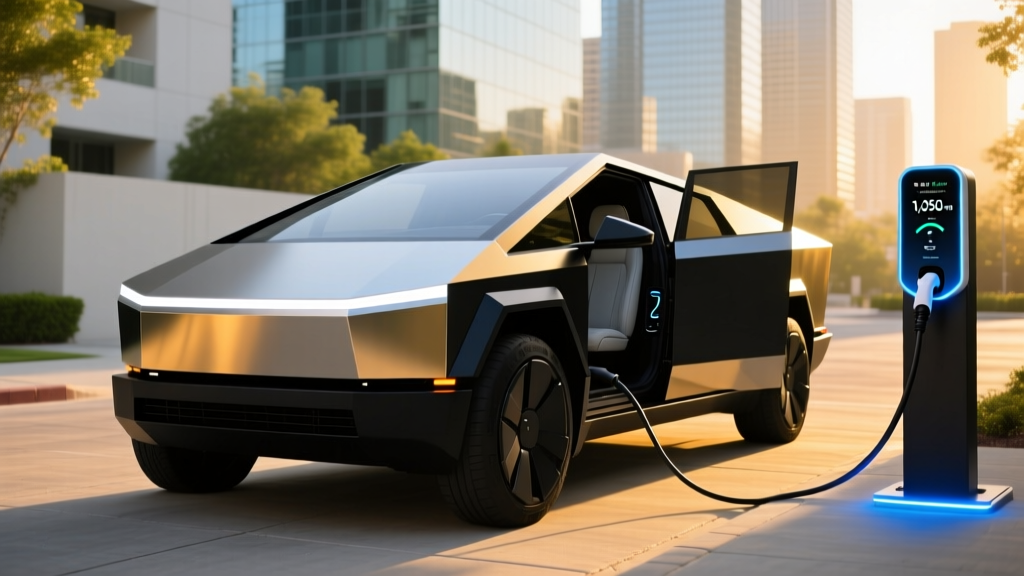
The Cybertruck uses Tesla's NACS connector natively — no adapter needed at Superchargers. At V4 Supercharger stalls capable of 250 kW, the truck peaks near that rate briefly in the 10–25% state-of-charge window, then tapers progressively. The 10–80% charge time of approximately 28 minutes is competitive but not exceptional; the Hyundai Ioniq 5 and Kia EV9, with their 800-volt architectures, achieve 10–80% in roughly 18 minutes.
At home, the onboard charger accepts up to 19.2 kW on a 240-volt, 80-amp circuit — but that requires Tesla's higher-amperage Wall Connector and a dedicated 100-amp breaker. Most residential installations will run a 48-amp / 11.5 kW setup, adding roughly 29 miles of range per hour of charging. That's adequate for overnight replenishment of daily driving but means a full 0–100% charge takes about 11 hours.
One critical note on preconditioning: always navigate to a Supercharger using the truck's built-in navigation. This triggers battery thermal preconditioning, warming or cooling the pack to optimal temperature before you arrive. Skipping this step — for instance, by pulling into a charger you found manually — can add 5–10 minutes to your charging session, especially in cold weather.
Pricing, Trims, and Federal Tax Credit Eligibility
| Trim | Base MSRP | §30D Credit Eligible? | Effective Price* |
|---|---|---|---|
| RWD (base) | $60,990 | No — exceeds truck MSRP cap | $60,990 |
| Dual Motor AWD | $79,990 | No — exceeds truck MSRP cap | $79,990 |
| Cyberbeast | $99,990 | No — exceeds truck MSRP cap | $99,990 |
*Effective price does not include destination, options, or state/local incentives. Federal credit analysis below.
Under current IRS rules, the §30D clean vehicle credit for new EVs has an MSRP cap of $80,000 for vans, sport utility vehicles, and pickup trucks. The Dual Motor AWD at $79,990 sits just under this threshold, but the final delivered price with destination and mandatory options typically pushes it above the cap. The Cyberbeast at $99,990 is well over.
Additionally, §30D imposes buyer income caps ($300,000 joint / $225,000 head of household / $150,000 individual modified AGI) and strict critical mineral and battery component sourcing requirements that phase in annually. Even if the Dual Motor's MSRP qualifies, battery-sourcing rules may reduce or eliminate the credit amount.
Bottom line: Do not count on receiving the full $7,500 federal credit on any Cybertruck trim. Consult a tax professional and verify current-year eligibility on fueleconomy.gov before purchasing.
As-tested pricing climbs quickly. A Dual Motor AWD with the Full Self-Driving (Supervised) package ($8,000), Armor Glass upgrade, and all-weather interior protection pushes past $92,000 before taxes and fees. Tesla's pricing has fluctuated throughout the Cybertruck's production run — always confirm current figures on Tesla's configurator before committing.
Interior, Cargo, and Technology
The Cybertruck's cabin is minimalist even by Tesla standards. A single 18.5-inch touchscreen dominates the dash, handling navigation, climate, media, and vehicle settings. A rear 9.4-inch screen serves back-seat passengers. There are no physical stalks — turn signals are on the steering wheel, and gear selection is via the touchscreen or a backup console button strip.
Passenger space is adequate but not generous for a full-size truck. Front legroom measures approximately 41.5 inches; rear legroom is about 38.2 inches — tighter than the F-150 Lightning's rear seat. The rear bench fits three adults for short trips but feels snug on long drives due to the upright seatback angle.
Cargo is where the Cybertruck differentiates. The 6-foot bed (styled as the "vault") offers 67 cubic feet of lockable storage with the powered tonneau cover closed. The frunk adds roughly 7 cubic feet of secure, weatherproof space. The bed's 2,500-pound payload and 11,000-pound tow rating match or exceed most half-ton gas trucks. A built-in air compressor and bed-mounted 120V/240V outlets (with the optional Powershare package) enable job-site and campsite utility.
Standout tech includes:
- Steer-by-wire with variable ratio — fewer than one full turn lock-to-lock
- 48-volt electrical architecture (industry first in a production vehicle)
- Adaptive air suspension with up to 16 inches of ground clearance in Extract Mode
- Autopark and Summon via the Tesla app
- Over-the-air software updates adding features post-purchase
Notable drawbacks:
- Stainless-steel panels show fingerprints and are difficult to repair after dents
- Wiper blade design and single front wiper struggle in heavy rain
- Visibility is compromised by the thick A-pillars and angular rear window
- No Apple CarPlay or Android Auto — Tesla's ecosystem only
- Panel-gap consistency has improved but still draws complaints from some owners
Driver Assistance: Autopilot and FSD (Supervised)
Tesla's Autopilot and Full Self-Driving (Supervised) are Level 2 driver-assistance systems under the SAE J3016 taxonomy. This means the system can manage steering, acceleration, and braking under certain conditions, but the driver must remain fully engaged, hands on or near the wheel, and eyes on the road at all times. The Cybertruck is not a self-driving vehicle. No consumer vehicle sold in the U.S. today is.
The Cybertruck ships with Basic Autopilot (traffic-aware cruise control and autosteer on marked highways). The $8,000 FSD (Supervised) upgrade adds automatic lane changes, traffic-light and stop-sign recognition, and navigation-guided on-ramp-to-off-ramp driving. In our experience, FSD performs well on well-marked divided highways but requires frequent interventions on construction zones, faded lane markings, and complex urban intersections.
Tesla's camera-only vision approach (no lidar or radar) continues to draw scrutiny. The NHTSA has investigated multiple Tesla Autopilot-related incidents, and buyers should treat FSD as a convenience feature, not a replacement for attentive driving.
- Drive without a licensed, attentive operator in the driver's seat
- Navigate all weather conditions (heavy rain, snow, fog degrade performance)
- Handle unmapped or poorly marked roads reliably
- Eliminate the driver's legal liability in a collision
Warranty, Ownership Costs, and Long-Term Outlook
Tesla covers the Cybertruck with:
- Basic Vehicle Limited Warranty: 4 years / 50,000 miles
- Battery & Drive Unit Warranty: 8 years / 120,000 miles (minimum 70% battery capacity retention)
- Restraint System Warranty: 5 years / 60,000 miles
The 8-year/120,000-mile battery warranty is competitive with the F-150 Lightning (8 yr / 100,000 mi) and slightly better than Rivian's (8 yr / 175,000 mi on battery but with a 70% retention threshold). Tesla's warranty guarantees the pack will retain at least 70% of its original capacity; in practice, Tesla's fleet data suggests NMC packs in moderate climates typically retain 85–90% after 100,000 miles.
Ownership economics are mixed. Electricity costs for the Cybertruck average roughly $0.04–$0.06 per mile when charging at home on a national-average residential rate of $0.16/kWh — significantly less than a comparable gas truck at $0.18–$0.22/mile. However, insurance premiums for the Cybertruck run 30–50% higher than the F-150 Lightning due to repair-cost concerns around the stainless-steel body and steer-by-wire components. Expect annual premiums in the $2,800–$4,200 range depending on your state and driving record.
Depreciation is the wildcard. Early Cybertruck resale values were buoyed by waitlist demand and markups, but as production has scaled, used prices have normalized. Plan for depreciation in line with other luxury EVs — roughly 40–50% over three years — unless you purchased a highly sought-after configuration.
Pros, Cons, and Who Should Buy
- Class-leading acceleration (2.6 sec Cyberbeast)
- 11,000-lb towing and robust bed utility
- Stainless-steel body is dent- and corrosion-resistant
- NACS native — full Supercharger network access
- 48V architecture and steer-by-wire are genuine innovations
- OTA updates continuously improve the vehicle
- Strong Supercharger reliability nationwide
- No federal §30D tax credit for most trims (MSRP cap)
- Real-world range significantly below EPA, especially towing
- Insurance premiums substantially above class average
- Rear seat comfort lags F-150 Lightning and Silverado EV
- No CarPlay/Android Auto support
- Stainless panels difficult to repair; body-shop network limited
- High entry price — $80K+ for the volume AWD trim
- Choose the Cybertruck if: you want a high-performance electric truck with serious towing capability, value the Supercharger network for road trips, and are comfortable paying a premium for distinctive design and technology.
- Choose the F-150 Lightning if: you need maximum rear-seat space, prefer a conventional truck layout, and want a lower starting price with broader dealer service coverage.
- Choose the Rivian R1T if: you prioritize off-road capability, want a quad-motor option, and prefer Rivian's adventure-oriented design and gear-tunnel storage.
- Choose the Silverado EV if: you need the longest bed options, want GM's Ultium platform, and prefer a more traditional interior layout.
Frequently Asked Questions
What is the real-world range of the 2026 Tesla Cybertruck?
The Dual Motor AWD carries an EPA rating of 340 miles, but real-world highway driving at 75 mph typically yields 275–295 miles. In cold weather below freezing, expect 220–250 miles. The Cyberbeast's real-world highway range is approximately 255–275 miles in fair conditions. Towing cuts range by 40–55%.
How fast does the Cybertruck charge at home and on the road?
On a 250 kW DC fast charger (Tesla Supercharger V4), the Cybertruck charges from 10–80% in approximately 28 minutes with preconditioning. At home on a standard 48-amp Level 2 setup (11.5 kW), it adds about 29 miles per hour, requiring roughly 11 hours for a full charge. An 80-amp Level 2 circuit (19.2 kW) cuts that to about 7 hours.
Does the Cybertruck qualify for the $7,500 federal EV tax credit?
Likely not. The IRS §30D credit caps eligible pickups at $80,000 MSRP. The Dual Motor AWD starts at $79,990, but destination fees and options push it over. The Cyberbeast at $99,990 is ineligible. Even the base RWD, if available, may fail battery-sourcing requirements. Always verify current-year rules on irs.gov and consult a tax professional.
Is the Cybertruck worth buying over the F-150 Lightning or Rivian R1T?
It depends on your priorities. The Cybertruck wins on acceleration, tow rating, and Supercharger access. The F-150 Lightning wins on rear-seat space, dealer service, and price. The Rivian R1T wins on off-road capability and adventure features. If you value performance and the Tesla ecosystem above all, the Cybertruck delivers. If you need a more practical family truck with easier service access, the Lightning is the safer bet.
How long will the Cybertruck battery last?
Tesla warranties the battery for 8 years or 120,000 miles with a minimum 70% capacity retention. Based on Tesla's fleet data for NMC packs, most owners in moderate climates can expect 85–90% capacity at 100,000 miles. Full battery replacement, if ever needed out of warranty, is estimated at $15,000–$22,000 based on current pack pricing — though this figure should decrease as battery costs continue to decline.
Can the Cybertruck power my home during an outage?
The Cybertruck supports vehicle-to-load (V2L) via its bed-mounted outlets, which can power tools, appliances, or camping equipment. Tesla has announced vehicle-to-home (V2H) capability via Powershare, which would allow the truck to serve as a backup power source during grid outages. However, V2H requires compatible home electrical equipment and a bidirectional charger. Confirm current availability and hardware requirements with Tesla before relying on this feature.
What are the biggest complaints from current Cybertruck owners?
The most common owner-reported issues include windshield cracking (Tesla has issued service bulletins addressing early-production glass), software glitches affecting the steer-by-wire calibration, high tire wear on the Cyberbeast's performance tires, and difficulty finding body shops qualified to repair stainless-steel panels. Tesla's mobile service and service-center network has improved, but wait times for bodywork remain longer than for conventional trucks.