Quick Verdict: The Cybertruck Is Finally Here — But Should You Buy One?
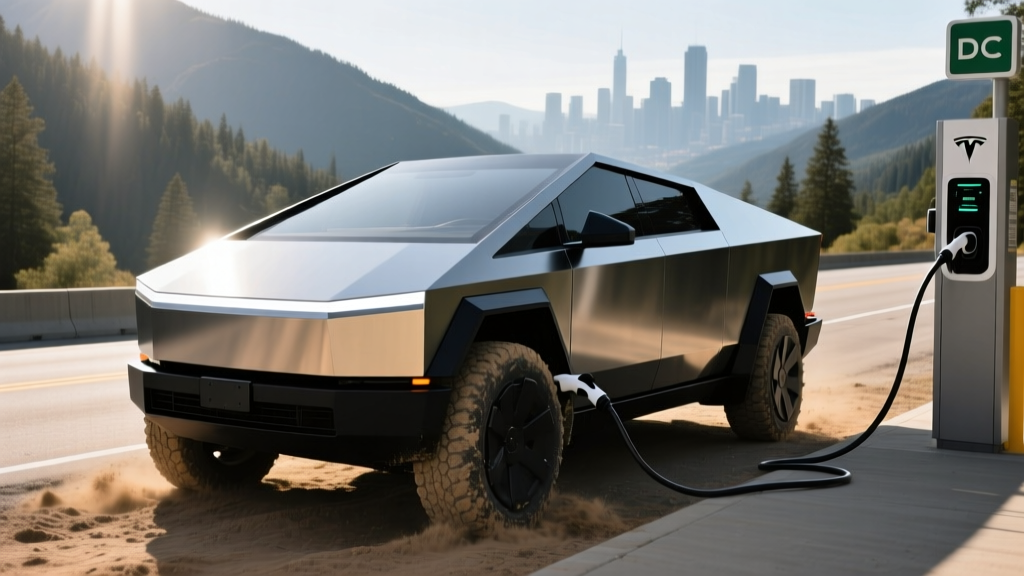
The Tesla Cybertruck launched in late 2023 as a 2024 model, and after more than a year on the road, the data is clear: this is a polarizing, technically ambitious electric pickup that delivers on performance but forces compromises on range, charging infrastructure compatibility, and everyday practicality. With EPA range estimates between 318 and 340 miles depending on trim, an 800-volt architecture enabling peak DC charging above 350 kW, and a starting MSRP that now sits at $79,990 for the AWD variant, the Cybertruck occupies a unique space in the EV truck market — one that demands careful evaluation before signing a purchase agreement.
This review breaks down the exact numbers that matter: real-world range versus the EPA sticker, sustained versus peak charging speeds, the federal tax credit reality under IRS §30D rules, and whether the Cybertruck's stainless-steel exoskeleton and steer-by-wire system justify its premium over the Ford F-150 Lightning and Rivian R1T.
Range & Efficiency: EPA Numbers vs. Real-World Reality
| Specification | AWD (Dual Motor) | Cyberbeast (Tri Motor) |
|---|---|---|
| EPA Estimated Range | 340 miles | 320 miles |
| Battery Capacity (usable) | ~123 kWh (estimated, NMC) | ~123 kWh (estimated, NMC) |
| MPGe (combined) | 72 MPGe | 69 MPGe |
| Energy Consumption | 47 kWh/100 mi | 49 kWh/100 mi |
| Drivetrain | Dual Motor AWD | Tri Motor AWD |
| 0–60 mph | 4.1 seconds | 2.6 seconds |
| Horsepower | 600 hp | 845 hp |
| Top Speed | 112 mph | 130 mph |
| Towing Capacity | 11,000 lbs | 11,000 lbs |
| Payload Capacity | 2,500 lbs | 2,500 lbs |
| Base MSRP (2024) | $79,990 | $99,990 |
| Battery/Drive Unit Warranty | 8 yr / 120,000 mi | 8 yr / 120,000 mi |
EPA Sticker: 340 mi (AWD) / 320 mi (Cyberbeast)
Highway driving (70–75 mph): Expect ~260–290 miles in mild weather. The Cybertruck's angular stainless-steel body creates significant aerodynamic drag, and highway efficiency drops sharply above 65 mph.
Cold weather (below 32°F): Plan for 20–30% range reduction, yielding roughly 200–240 miles of usable range. The heat pump helps, but the large battery pack requires substantial energy to warm.
Towing at max capacity: Range can drop below 150 miles depending on trailer weight and terrain.
Note: Tesla offered a "Range Extender" battery pack for the bed that was announced to add ~130+ miles, but availability and final specs remain limited as of early 2026.
The Cybertruck's energy consumption of 47–49 kWh per 100 miles makes it one of the least efficient EVs on the road. For context, the Ford F-150 Lightning Extended Range consumes roughly 48 kWh/100 mi, while the Rivian R1T Dual Motor Large sits around 44 kWh/100 mi. The Cybertruck's 6,800+ lb curb weight and poor drag coefficient (estimated ~0.38–0.40 Cd despite Tesla's claims of 0.34) are the primary culprits. According to fueleconomy.gov, the Cybertruck AWD achieves 72 MPGe combined — functional, but not class-leading.
Charging: 800V Architecture Meets Supercharger Reality
| Charging Method | Max Power | Rate / Time | Notes |
|---|---|---|---|
| Level 1 (120V, 12A) | ~1.4 kW | ~3 mi/hr | Emergency/trickle only; impractical for daily use |
| Level 2 (240V, 48A) | 11.5 kW | ~34 mi/hr; full charge in ~11–12 hrs | Requires NACS connector; Tesla Wall Connector recommended |
| Level 2 (240V, 80A) | 19.2 kW | ~56 mi/hr; full charge in ~7 hrs | Requires 100A circuit; significant electrical panel load |
| DC Fast Charge (V4 Supercharger) | Peak ~350+ kW | 10–80% in ~15–20 min (at V4 stalls) | 800V architecture enables higher peak; sustained rate tapers significantly above 60% SoC |
| DC Fast Charge (V3 Supercharger) | ~250 kW | 10–80% in ~25–30 min | Most common Supercharger; still fast due to pack acceptance rate |
| Non-Tesla DC Fast (CCS w/ adapter) | Variable, ~150–250 kW | Depends on station | Tesla NACS-to-CCS adapter available; Electrify America/EA compatibility improving |
The Cybertruck's 800-volt battery architecture is its charging ace. At a V4 Supercharger (which supports up to 350+ kW), the Cybertruck can accept peak charge rates that rival the best in the industry. However, peak kW is not sustained kW. The charge curve tapers aggressively above 50–60% State of Charge (SoC), meaning the last 20% of charging takes disproportionately longer. In real-world testing at V3 Superchargers (the vast majority of Tesla's network), expect 10–80% in roughly 25–30 minutes — fast, but not dramatically faster than a Ford F-150 Lightning at a 350 kW Electrify America station.
For home charging, the Cybertruck's 11.5 kW onboard charger is adequate but not exceptional. An 80A Level 2 circuit (19.2 kW) is supported, but this requires a 100-amp dedicated breaker — a significant electrical service demand that many homes cannot accommodate without a panel upgrade. Most owners will install a 48A/60A circuit using the Tesla Wall Connector and wake to a full battery after overnight charging, which is the practical sweet spot.
Performance & Driving Dynamics
The Cybertruck's performance figures are genuinely staggering for a vehicle weighing nearly 7,000 pounds. The Cyberbeast's tri-motor powertrain produces 845 horsepower and rockets to 60 mph in 2.6 seconds — a figure that embarrasses most sports cars, let alone full-size pickups. The dual-motor AWD variant's 4.1-second 0–60 time is still remarkably quick and more than sufficient for any real-world driving scenario.
The steer-by-wire system (Tesla calls it no mechanical linkage between steering wheel and wheels) is the Cybertruck's most debated engineering choice. It enables a variable steering ratio — roughly 340 degrees of steering wheel rotation lock-to-lock at low speeds, meaning you never need to hand-over-hand the wheel. At highway speeds, the ratio firms up for stability. Most drivers adapt within a few days, though the lack of traditional road feel through the steering wheel is noticeable and will put off enthusiasts who value tactile feedback.
Ride quality is firm, especially with the 20-inch wheels standard on the AWD trim. The adaptive air suspension offers adjustable ride height (up to 17 inches of ground clearance in Off-Road mode) and can lower the truck for easier bed access. Body roll is well-controlled given the height and weight, but this is not a cornering vehicle — it's a straight-line performer that handles highway cruising competently.
Interior, Tech & Cargo Practicality
The Cybertruck's cabin is minimalist in typical Tesla fashion: an 18.5-inch front touchscreen handles virtually all vehicle controls, navigation, and media, while a smaller 9.4-inch rear touchscreen serves second-row passengers. There are no physical buttons for climate, wipers, or turn signals — everything is touchscreen- or yoke-adjacent. The front seats are heated and ventilated; the rear bench is flat and functional but not class-leading in comfort or legroom.
Passenger & Cargo Dimensions:
- Front headroom: ~40.8 inches
- Front legroom: ~41.8 inches
- Rear headroom: ~38.5 inches
- Rear legroom: ~38.4 inches
- Bed length: 6 feet (72 inches) with tailgate closed; extends with tailgate down
- Bed width: ~48 inches between wheel wells
- Bed volume: ~67 cu ft (with tonneau cover closed)
- Front trunk (frunk): ~7.1 cu ft — lockable, useful for cables and small cargo
- Gear locker (under-bed): ~7.6 cu ft of sealed, lockable storage beneath the bed floor
The powered stainless-steel tonneau cover is a standout feature: it retracts automatically, is rated to support 300 lbs on top, and seals the bed from weather. However, it limits vertical cargo height to roughly 28 inches when closed — a real constraint for anyone hauling tall items like motorcycles or furniture. The 11,000-lb towing capacity is competitive with the F-150 Lightning but falls short of heavy-duty ICE trucks. The 2,500-lb payload is adequate for most truck tasks but below what traditional half-ton pickups offer.
Driver Assistance: The Cybertruck ships with Tesla's Basic Autopilot (adaptive cruise + lane centering). Enhanced Autopilot and Full Self-Driving (Supervised) are available as paid upgrades. Per SAE classification, all Tesla driver-assist features are Level 2 — the driver must remain fully engaged, hands monitored via steering torque and cabin camera. FSD Supervised is not autonomous driving and does not replace driver attention.
Pricing, Trims & Federal Tax Credit Eligibility
| Trim | Base MSRP | As-Tested (typical options) | Federal Tax Credit (§30D) | Effective Price (if eligible) |
|---|---|---|---|---|
| AWD (Dual Motor) | $79,990 | $82,000–$86,000 | Up to $7,500* | ~$72,490–$78,500 |
| Cyberbeast (Tri Motor) | $99,990 | $102,000–$110,000 | Up to $7,500* | ~$92,490–$102,500 |
* Federal EV tax credit eligibility under IRS §30D is subject to multiple requirements. The Cybertruck qualifies as a light truck, so the MSRP cap is $80,000 — meaning the AWD at $79,990 clears the threshold, but the Cyberbeast at $99,990 does not and is ineligible for the credit. Additional rules apply:
- Buyer income cap: Modified AGI must not exceed $150,000 (single), $225,000 (head of household), or $300,000 (joint filing)
- MSRP cap: $80,000 for vans, SUVs, and pickups (Cyberbeast exceeds this)
- Battery sourcing: Critical minerals and battery components must meet phased-in domestic/content thresholds — Tesla's supply chain has adapted but verify current-year compliance at purchase
- Point-of-sale transfer: Eligible buyers can transfer the credit to the dealer at purchase, reducing the out-of-pocket price immediately rather than waiting for tax filing
- One credit per VIN: The vehicle must be new, purchased for personal use, and primarily used in the U.S.
The Cyberbeast's exclusion from the tax credit due to its MSRP is a significant financial consideration. At $99,990, it costs roughly $27,500 more than the AWD after credit — a gap that the tri-motor powertrain and 2.6-second 0–60 time may not justify for most buyers. The AWD trim, at $79,990, is the value play and the version most buyers should target.
Warranty & Long-Term Ownership
Tesla provides the following coverage for the Cybertruck:
- Basic Vehicle Limited Warranty: 4 years / 50,000 miles
- Battery & Drive Unit Warranty: 8 years / 120,000 miles (with minimum 70% battery capacity retention)
- Corrosion warranty: 12 years, unlimited miles (relevant given the stainless-steel body panels)
The 8-year/120,000-mile battery warranty is in line with industry norms, though the 70% retention threshold is standard rather than generous. The Cybertruck's large ~123 kWh NMC battery pack would be extremely expensive to replace out of warranty — estimated replacement costs for packs of this size range from $20,000 to $35,000+ based on current industry pricing. Long-term degradation data for the Cybertruck specifically is still accumulating, but Tesla's NMC packs historically lose 10–15% capacity over the first 100,000 miles before stabilizing.
Insurance costs are a notable ownership expense. The Cybertruck's stainless-steel body panels, specialized repair requirements, and high performance place it in a premium insurance tier. Expect annual premiums 30–50% higher than a comparable F-150 Lightning, depending on your driving record and location. Tesla Insurance is available in some states and may offer competitive rates.
Cybertruck vs. the Competition: Is It Worth Buying?
- Class-leading 0–60 performance (Cyberbeast: 2.6 sec)
- 800V architecture enables peak DC charging above 350 kW at V4 Superchargers
- Access to Tesla Supercharger network — the most reliable and extensive DC fast-charging network in the U.S.
- Distinctive design and stainless-steel body resist dents and corrosion
- Powered tonneau cover and gear locker add practical storage
- Steer-by-wire reduces parking effort significantly
- 11,000-lb towing capacity is competitive for the EV truck segment
- Over-the-air updates continue to add features post-purchase
- Real-world range falls significantly short of EPA estimates, especially highway and cold weather
- High energy consumption (47–49 kWh/100 mi) makes charging more expensive per mile than most EVs
- Cyberbeast exceeds $80,000 MSRP cap — ineligible for $7,500 federal tax credit
- Bed height limited by tonneau cover; vertical cargo capacity constrained
- Steer-by-wire lacks traditional road feel; polarizing for some drivers
- No Apple CarPlay or Android Auto — Tesla's proprietary interface only
- Insurance premiums significantly above segment average
- Non-Tesla DC fast charging requires adapter; CCS station compatibility still maturing
- Build quality inconsistencies reported by early owners (panel gaps, trim issues)
- Rear seat comfort and legroom below F-150 Lightning and Rivian R1T
The Cybertruck's closest competitors are the Ford F-150 Lightning (Extended Range: EPA 320 mi, starting ~$59,990, tax-credit eligible across trims) and the Rivian R1T (Dual Motor Large: EPA 352 mi, starting ~$75,900, tax-credit eligible). The Lightning wins on value, practicality, rear-seat comfort, and conventional truck familiarity. The R1T wins on build quality, adventure capability (available quad-motor with tank turns), and more usable range. The Cybertruck wins on raw performance, Supercharger network access, and sheer differentiation.
Who the Cybertruck suits best: Tech-forward buyers who prioritize performance and Tesla ecosystem integration, have reliable home charging, drive primarily in urban/suburban environments where the range shortfall is manageable, and value the statement the truck makes. It is less ideal for buyers who regularly tow long distances, need maximum cargo versatility, operate in extreme cold climates, or want a traditional truck experience.
Frequently Asked Questions
What is the real-world range of the 2024 Tesla Cybertruck?
The EPA rates the Cybertruck AWD at 340 miles and the Cyberbeast at 320 miles. In real-world highway driving at 70–75 mph in moderate temperatures, expect 260–290 miles. In cold weather (below freezing), plan for 200–240 miles. Towing at max capacity can reduce range below 150 miles.
How fast does the Cybertruck charge at home and on the road?
At home on a 240V/48A Level 2 charger, the Cybertruck adds about 34 miles of range per hour, reaching a full charge in roughly 11–12 hours. On a Tesla V4 Supercharger, peak rates exceed 350 kW with a 10–80% charge in approximately 15–20 minutes. At the more common V3 Superchargers (250 kW), expect 10–80% in about 25–30 minutes. The charge curve tapers significantly above 60% SoC.
Does the 2024 Cybertruck qualify for the $7,500 federal EV tax credit?
The AWD trim at $79,990 MSRP qualifies for up to $7,500 under IRS §30D, provided the buyer meets income caps ($300,000 joint / $150,000 single) and battery sourcing requirements are satisfied. The Cyberbeast at $99,990 exceeds the $80,000 MSRP cap for trucks and does not qualify. Always verify current-year eligibility rules on irs.gov before purchasing, as sourcing and credit amounts can change.
How much does it cost to own a Cybertruck vs. a gas truck?
At the national average electricity rate of ~$0.16/kWh and the Cybertruck's 47 kWh/100 mi consumption, charging costs roughly $7.50 per 100 miles at home. A comparable gas F-150 at 20 MPG and $3.50/gallon costs $17.50 per 100 miles — a fuel savings of ~$10 per 100 miles for the Cybertruck. However, the Cybertruck's higher purchase price, insurance premiums, and potential lack of tax credit on the Cyberbeast trim narrow the total cost of ownership advantage. Over 5 years and 75,000 miles, fuel savings may total $4,000–$6,000, which only partially offsets the price premium.
Is the Cybertruck worth buying over the F-150 Lightning or Rivian R1T?
Choose the Cybertruck AWD if you prioritize Tesla Supercharger access, want the fastest production truck available (Cyberbeast), and can accept range compromises. Choose the F-150 Lightning if you want the best value, maximum rear-seat comfort, traditional truck ergonomics, and guaranteed tax credit eligibility across trims. Choose the Rivian R1T if you want superior build quality, better real-world range, adventure-focused features, and a more refined driving experience. The Cybertruck is the enthusiast's choice; the Lightning and R1T are the pragmatic ones.
What battery chemistry does the Cybertruck use?
The Cybertruck uses an NMC (nickel manganese cobalt) lithium-ion battery pack with an estimated usable capacity of ~123 kWh. Tesla has not published exact pack specifications, but the energy density, weight, and charging behavior are consistent with NMC chemistry. This chemistry offers higher energy density than LFP (lithium iron phosphate) but typically shows slightly more degradation over time — Tesla's 8-year/120,000-mile warranty with a 70% retention floor provides a safety net.
Can the Cybertruck use non-Tesla charging stations?
Yes, with an adapter. The Cybertruck uses Tesla's NACS (North American Charging Standard) connector natively. For CCS-equipped public chargers (Electrify America, EVgo, ChargePoint CCS stalls), a NACS-to-CCS adapter is required — Tesla sells one, and third-party options are available. Compatibility with non-Tesla networks has improved significantly, but the Supercharger network remains the most seamless charging experience for Cybertruck owners.