Quick Verdict: Does the Cybertruck Deliver on Its Promises?
The Tesla Cybertruck remains one of the most polarizing vehicles on the road in 2026, but its engineering credentials are harder to dismiss. With a dual-motor AWD variant that sprints to 60 mph in as little as 3.9 seconds and a tri-motor Cyberbeast that cuts that to 2.6 seconds, Tesla has proven that a stainless-steel exoskeleton truck can outrun most sports cars. However, the real-world ownership experience — from its actual highway range to public charging compatibility — tells a more nuanced story than the spec sheet alone.
This guide covers every current Cybertruck trim with exact numbers: EPA range, battery chemistry, charging curves, pricing after federal incentives, and the practical limitations every buyer should know before signing a purchase agreement.
Tesla Cybertruck 0-60 and Performance by Trim
The headline number most shoppers search for — Tesla Cybertruck 0-60 time — varies significantly depending on which variant you choose and whether you activate the range-extending software unlock. Here is the current 2026 lineup:
| Specification | Long Range (AWD) | Foundation Series (AWD) | Cyberbeast (Tri-Motor AWD) |
|---|---|---|---|
| 0-60 mph | 3.9 seconds | 3.9 seconds | 2.6 seconds |
| Horsepower | ~600 HP | ~600 HP | ~845 HP |
| Drivetrain | Dual-Motor AWD | Dual-Motor AWD | Tri-Motor AWD |
| Top Speed | 130 mph | 130 mph | 130 mph |
| Towing Capacity | 11,000 lbs | 11,000 lbs | 11,000 lbs |
| Payload Capacity | 2,500 lbs | 2,500 lbs | 2,500 lbs |
A few real-world notes on these figures. The 2.6-second Cyberbeast time is achieved with rollout subtracted and on a prepared surface — expect 2.8 to 3.0 seconds on typical asphalt. The dual-motor trims deliver their 3.9-second time consistently, though repeated launches will trigger thermal management that slightly softens subsequent runs. For context, the Long Range Cybertruck hits 60 mph faster than a base Porsche 911 Carrera, which is remarkable for a 6,600-pound truck.
Range, Efficiency, and the Real-World Reality
Long Range / Foundation Series: EPA 340 miles — expect ~270–290 miles at sustained 75 mph highway speeds; ~230–250 miles in freezing temperatures (below 32°F).
Cyberbeast: EPA 320 miles — expect ~255–275 miles highway; ~215–240 miles in severe cold.
The Cybertruck's angular stainless-steel body creates substantial aerodynamic drag (estimated Cd ~0.38), which disproportionately reduces highway range compared to sleeker EVs. City driving with regenerative braking yields closer to EPA figures.
Efficiency numbers from fueleconomy.gov show the Long Range AWD at approximately 67 MPGe combined (roughly 50 kWh per 100 miles). That makes the Cybertruck one of the least energy-efficient EVs on the market — heavier and less aerodynamic than the Ford F-150 Lightning Extended Range (70 MPGe) and far thirstier than a Rivian R1T Dual-Motor (73 MPGe). You will pay for those extra electrons at DC fast chargers.
Battery Chemistry, Capacity, and Longevity
Tesla has not published exact usable kWh figures for the Cybertruck battery pack, but independent teardowns and EPA filing data estimate approximately 123 kWh usable for the Long Range/Foundation Series and a slightly larger pack for the Cyberbeast (estimated ~135 kWh usable). Both use NMC (nickel-manganese-cobalt) chemistry, chosen for its higher energy density — necessary given the truck's extreme weight and aero penalty.
What this means for owners: NMC cells degrade slightly faster than LFP (lithium iron phosphate) chemistry over time, particularly if regularly charged to 100%. Tesla recommends daily charging to 80–90% for NMC packs and reserving 100% for road trips. Over a 150,000-mile ownership period, expect approximately 8–12% capacity loss based on current NMC degradation data from Tesla's fleet.
Tesla's battery and drive unit warranty covers 8 years / 120,000 miles (whichever comes first) with a minimum 70% capacity retention threshold. This is competitive with the Ford F-150 Lightning (8yr/100k) and slightly better on mileage.
Charging Speed: DC Fast, Level 2, and the NACS Advantage
| Charging Method | Rate / Power | Cybertruck Performance |
|---|---|---|
| DC Fast Charging (peak) | Up to 350 kW | 10–80% in ~25–30 minutes (V4 Supercharger); tapers significantly above 60% SoC |
| DC Fast Charging (sustained avg.) | ~180–220 kW average | Expect ~35–40 minutes for 10–80% at older V3 (250 kW) stalls |
| Level 2 Home Charging | 11.5 kW (48A) | ~37 miles of range per hour; full charge in ~11–12 hours |
| Level 1 (120V outlet) | ~1.4 kW | ~4–5 miles per hour — emergency/trickle use only |
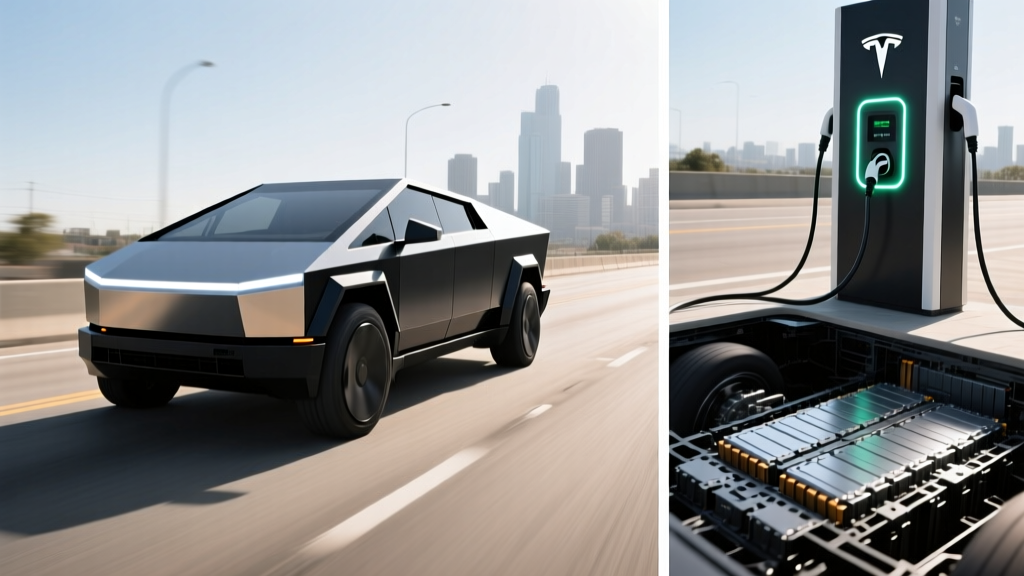
The Cybertruck uses the NACS (North American Charging Standard) connector natively — Tesla's proprietary plug that is now the industry standard adopted by Ford, GM, Rivian, and most major automakers for 2025+. This gives Cybertruck owners seamless access to the entire Supercharger network (over 25,000 stalls in North America as of early 2026) without an adapter.
Charging curve reality check: The Cybertruck's peak 350 kW rate is only sustained between roughly 10–30% State of Charge. The curve tapers to ~200 kW by 50%, ~120 kW by 70%, and drops below 50 kW above 90%. This is normal physics for large NMC packs, but it means the last 20% of a charge takes nearly as long as the first 60%. Plan your road-trip stops around 10–80% sessions for optimal time efficiency.
For home charging, Tesla's Wall Connector at 48 amps (11.5 kW on a 60A circuit) adds approximately 37 miles of range per hour. Most Cybertruck owners who charge overnight from 20% to 80% will wake up with a full daily buffer. Installation typically requires a 240V/60A dedicated circuit — budget $800–$2,000 for the electrician work depending on your panel's proximity to the garage, per industry estimates.
Pricing, Trims, and Federal Tax Credit Eligibility
Tesla restructured Cybertruck pricing for 2026, moving away from the initial Foundation Series-only strategy. Current MSRP figures:
| Trim | Base MSRP (2026) | As-Tested (with common options) | §30D Federal Tax Credit |
|---|---|---|---|
| Long Range AWD | $79,990 | $82,000–$86,000 | Not eligible (MSRP exceeds $80,000 truck cap) |
| Foundation Series AWD | $99,990 | $105,000+ | Not eligible (MSRP exceeds $80,000 truck cap) |
| Cyberbeast Tri-Motor | $104,990 | $110,000+ | Not eligible (MSRP exceeds $80,000 truck cap) |
Under current IRS rules (irs.gov), the federal EV tax credit for new vehicles has an MSRP cap of $80,000 for trucks, vans, and SUVs. The Cybertruck Long Range at $79,990 sits exactly at the threshold — but destination fees and mandatory options push it above. As of 2026, no Cybertruck trim qualifies for the $7,500 federal credit.
Additional §30D restrictions include buyer income caps ($150K single / $300K joint AGI), battery critical-mineral sourcing requirements, and North American assembly rules. Even if a future base-model Cybertruck drops below the MSRP cap, battery-component sourcing rules must also be satisfied. Consult a tax professional for your specific situation.
Cargo, Interior Space, and Practicality
The Cybertruck's unconventional geometry creates unusual trade-offs in usable space:
- Bed length: 6 feet (72 inches) with the tonneau cover closed; extends to ~8 feet with the midgate folded down into the cabin
- Bed width: Approximately 43 inches between wheel wells — narrower than a traditional F-150 bed
- Bed volume: ~67 cubic feet with midgate up
- Front trunk (frunk): ~7.1 cubic feet — enough for charging cables and a small bag
- Rear-seat legroom: ~38 inches — adequate for adults on shorter trips, tight for taller passengers on long hauls
- Rear-seat headroom: Compromised by the sloping roofline — passengers over 6'2" will notice
- Ground clearance: Up to 16 inches (in Extract mode with adaptive air suspension)
- Approach/departure angles: 35°/30° — genuinely capable off-road geometry
The sail-shaped bed sides and angular tonneau cover look striking but limit what you can stack vertically. There are no traditional bed rails for aftermarket racks (Tesla offers its own integrated L-track system). The powered tonneau is robust and supports ~300 pounds distributed — useful for rooftop tent camping — but repairs to the mechanism are dealer-only.
Technology, Driver Assistance, and Drawbacks
The Cybertruck runs Tesla's latest vehicle software on an 18.5-inch front touchscreen and a 9.4-inch rear passenger screen. Key technology features:
- Steer-by-wire: No physical steering column — a yoke-style wheel with variable ratio (fewer turns lock-to-lock at low speed, more stability at highway speed). Takes 1–2 weeks of daily driving to build muscle memory.
- 48-volt electrical architecture: An industry first for a production vehicle, enabling thinner wiring harnesses and more powerful accessories. Impressive engineering, but long-term serviceability is unproven.
- Autopilot (standard): SAE Level 2 driver assistance with adaptive cruise, lane centering, and automatic emergency braking. The driver must remain engaged at all times.
- Full Self-Driving Supervised (optional, ~$8,000): Also SAE Level 2 despite the name — adds intersection handling, city-street navigation, and parking features. Still requires full driver attention and hands-on-wheel monitoring.
- Powershare: Vehicle-to-load (V2L) capability with 120V and 240V outlets in the bed — can run power tools, tailgate setups, or provide emergency home backup (up to 11.5 kW continuous).
- Armor glass: Laminated glass with improved impact resistance, though not bulletproof as early marketing implied.
Tesla Autopilot and FSD Supervised are SAE Level 2 driver-assistance systems. They are not self-driving. The driver is legally and practically responsible for all vehicle operation. NHTSA has issued multiple investigations into Tesla's driver-monitoring system. Do not use these features as a substitute for attentive driving.
Notable drawbacks:
- Single front wiper with limited sweep area — visibility compromise in heavy rain
- No Apple CarPlay or Android Auto — Tesla's ecosystem only
- Rear visibility is poor; relies heavily on the digital rearview camera
- Panel gaps and build quality inconsistency remain a concern on early-production units
- Insurance premiums run 30–50% higher than comparable F-150 Lightning policies due to repair complexity
- Stainless-steel exterior shows fingerprints and smudges constantly; Tesla sells a proprietary ceramic coating kit (~$150)
Who Should Buy the Cybertruck (and Who Shouldn't)
Buy the Cybertruck if:
✅ You want the fastest production truck available and value acceleration as a daily thrill
✅ You live near reliable Supercharger infrastructure and primarily drive in urban/suburban settings
✅ You need genuine 11,000-lb towing and Powershare V2L for job-site or camping use
✅ You are comfortable with steer-by-wire and Tesla's touchscreen-only interface
Consider alternatives if:
❌ Maximum range is your top priority (Rivian R1T Max Pack: EPA 410 miles)
❌ You need a full-size 8-foot bed for construction materials or ATVs
❌ You want federal tax credit eligibility (F-150 Lightning Lariat and Rivian R1T qualify)
❌ You prioritize back-seat comfort for tall adults on long trips
❌ You want proven long-term reliability data and lower insurance costs
Frequently Asked Questions
What is the real-world range of the Tesla Cybertruck?
The Long Range AWD carries an EPA rating of 340 miles, but real-world highway driving at 70–80 mph typically yields 270–290 miles. In freezing temperatures, expect 230–250 miles. The Cyberbeast's heavier tri-motor setup drops EPA to 320 miles with similar real-world reductions. Towing cuts range roughly in half — plan for 150–170 miles between charges when pulling a 7,000-lb trailer.
How fast does the Cybertruck charge on the road and at home?
At a Tesla V4 Supercharger (350 kW capable), the Cybertruck charges from 10–80% in approximately 25–30 minutes, though the sustained average is closer to 180–220 kW due to charge-curve taper. At home on a Level 2 Wall Connector (11.5 kW), you gain about 37 miles of range per hour — an overnight session easily replenishes a full day's driving.
Does the Tesla Cybertruck qualify for the $7,500 federal EV tax credit?
As of 2026, no. The §30D tax credit imposes an $80,000 MSRP cap for trucks, and every current Cybertruck trim meets or exceeds that threshold once destination fees are included. Additionally, buyers must meet income caps ($150K single / $300K joint) and the vehicle must satisfy battery-sourcing requirements. Check the latest rules at irs.gov or consult a tax professional.
Is the Cybertruck worth buying over the Ford F-150 Lightning or Rivian R1T?
It depends on your priorities. The Cybertruck wins outright on 0-60 acceleration (no competitor comes close to the Cyberbeast's 2.6 seconds), steer-by-wire novelty, and V2L Powershare capability. The F-150 Lightning wins on interior space, traditional truck usability, BlueCruise hands-free highway driving, and tax-credit eligibility on mid-tier trims. The Rivian R1T wins on maximum range (410 miles with Max Pack), off-road sophistication, and build quality. Cross-shop all three if you're spending $80K+.
What are the biggest pros and cons of owning a Cybertruck?
- Class-leading 0-60 acceleration (2.6s Cyberbeast)
- Seamless Supercharger network access (NACS native)
- 11,000-lb towing + 11.5 kW Powershare V2L
- Unique design — unmistakable road presence
- Adaptive air suspension with up to 16" ground clearance
- Over-the-air updates continuously add features
- No federal tax credit (all trims above MSRP cap)
- Poor highway efficiency (~50 kWh/100mi)
- Real-world range significantly below EPA sticker
- Steep learning curve with steer-by-wire and yoke
- High insurance premiums (30–50% above segment average)
- Compromised rear-seat headroom and bed width
How does the Cybertruck handle in snow and off-road conditions?
The dual- and tri-motor AWD system provides excellent traction in snow, and the adaptive air suspension can raise the truck to 16 inches of ground clearance for trail use. Approach and departure angles (35°/30°) are genuinely competitive with body-on-frame trucks. However, the Cybertruck's 6,600+ lb curb weight means momentum carries on icy descents — winter tires are strongly recommended over all-season rubber for snow-belt owners. Regenerative braking in "Hold" mode provides effective one-pedal deceleration on packed snow.
What is the Cybertruck's battery warranty?
Tesla covers the battery pack and drive unit for 8 years or 120,000 miles, whichever comes first, with a guaranteed minimum of 70% capacity retention. The rest of the vehicle carries a 4-year / 50,000-mile limited warranty. This battery coverage is slightly more generous than the F-150 Lightning's 8-year/100,000-mile threshold.