The Tesla Cyberquad for Kids: Quick Verdict
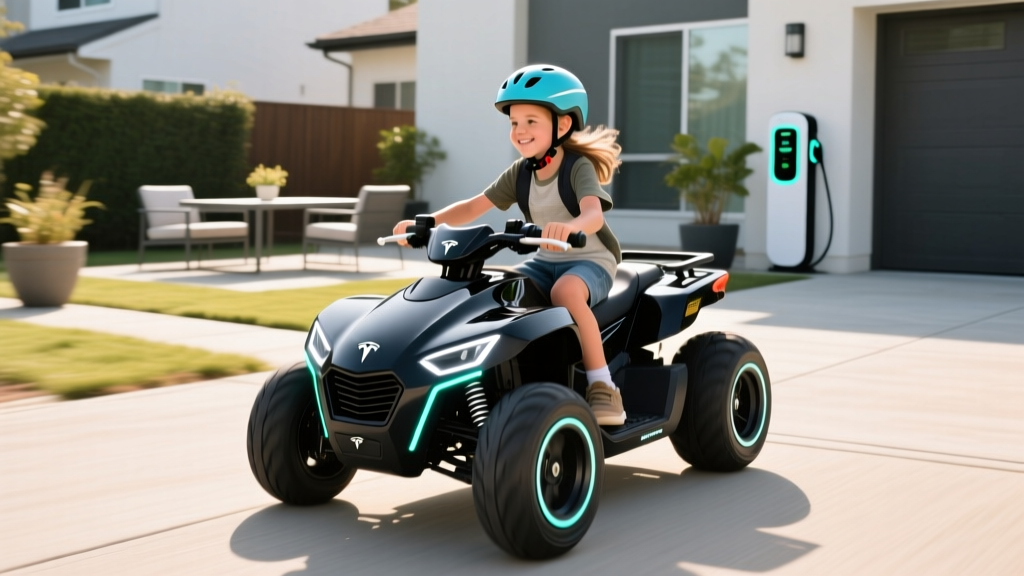
The Tesla Cyberquad for Kids is a battery-electric ATV designed for riders ages 8 and up. It is not a road-legal vehicle, not EPA-rated, and not eligible for the federal §30D EV tax credit. What it is: a $1,900 electric quad that delivers roughly 15 miles of range per charge, a top speed of 10 mph, and a build quality that punches well above typical ride-on toys. For parents evaluating it against $300-$600 big-box-store electric quads, the Cyberquad occupies a different tier entirely — closer to a premium youth powersports product than a toy. But at nearly 20 times the price of entry-level alternatives, the math demands scrutiny.
| Spec | Value |
|---|---|
| Price (MSRP) | $1,900 |
| Battery Capacity | 1.2 kWh (lithium-ion) |
| Range (claimed) | Up to 15 miles |
| Top Speed | 10 mph (adjustable to 5 mph) |
| Motor | 500W brushless DC, single-speed |
| Charge Time (0–100%) | ~5 hours (120V household outlet) |
| Max Rider Weight | 140 lbs |
| Recommended Age | 8+ years |
| Vehicle Weight | ~105 lbs |
| Warranty | 1 year limited |
Range and Real-World Riding
Tesla claims up to 15 miles of range from the Cyberquad's 1.2 kWh battery pack. That figure assumes optimal conditions: a lighter rider (under 100 lbs), flat terrain, moderate speed (5–7 mph), and warm ambient temperatures. In real-world use, expect meaningful variation.
Claimed Range: 15 miles (up to)
Real-World Expectation: 8–12 miles under typical riding conditions. Heavier riders approaching the 140-lb limit, hilly terrain, or sustained 10 mph operation will push range toward the lower end. Cold weather (below 40°F) further reduces usable capacity by an estimated 15–25%, consistent with lithium-ion behavior at low temperatures.
The 1.2 kWh pack uses standard lithium-ion cells (Tesla has not published whether these are NMC or LFP chemistry, though the pack size and cost structure suggest NMC for energy density). Unlike Tesla's road vehicles, the Cyberquad has no published EPA rating — it is classified as a youth off-road vehicle, not a highway-capable EV. There is no MPGe figure because it is not a registered motor vehicle.
For context, 10–12 miles of real-world range translates to roughly 60–90 minutes of continuous riding at moderate speeds. For most backyard or trail-session use cases, this is adequate. For all-day riding at a property or campground, you will need to plan around the 5-hour recharge window or invest in a second unit.
Charging: What Parents Need to Know
The Cyberquad charges exclusively via a standard 120V household outlet using the included charger. There is no DC fast charging, no Level 2 compatibility, and no NACS or CCS connector — this is a dedicated off-road vehicle with a simple charging architecture.
| Charge Level | Power | 0–100% Time | Notes |
|---|---|---|---|
| 120V AC (included charger) | ~240W | ~5 hours | Standard household outlet |
| Level 2 / DC Fast | N/A | N/A | Not supported |
The ~240W charge rate means a full 0–100% cycle draws roughly 1.2 kWh from your wall — about the same energy as running a microwave for 12 minutes. At the US average electricity rate of ~$0.17/kWh, a full charge costs approximately $0.20. The operating cost is negligible.
The 5-hour charge time is the practical limitation. Unlike swapping a gas can on a youth ATV, you cannot quickly "refuel" the Cyberquad mid-day. Tesla does not currently offer a fast-charge accessory or swappable battery option. If your child rides hard in the morning, the quad will not be ready again until late afternoon.
Performance and Ride Quality
The 500W brushless DC motor delivers a claimed top speed of 10 mph, with a parent-adjustable speed limiter that can restrict the quad to 5 mph. Acceleration is brisk enough for the target age group — Tesla has not published a 0–60 figure (nor would it be meaningful at a 10 mph top speed), but initial torque delivery from the single-speed electric drivetrain gives it punch off the line that comparable gas-powered youth quads lack.
The Cyberquad features a steel frame, adjustable suspension, and 8-inch pneumatic tires. It is rear-wheel drive (single motor), which is standard for youth ATVs in this class. Braking is handled by a rear disc brake with a handlebar-mounted lever.
Ride quality is firm but appropriate for off-road use. The suspension handles grass, dirt, and gravel competently, but this is not a dune or trail-riding machine — the 4.5-inch ground clearance and modest suspension travel limit it to relatively smooth off-pavement surfaces. It is best suited to large yards, flat fields, and mild dirt paths.
Pricing and Tax Credit Eligibility
The Tesla Cyberquad for Kids carries a base MSRP of $1,900, sold exclusively through Tesla's online store. There are no trim levels, no option packages, and no dealer negotiation — the price is fixed.
| Item | Amount |
|---|---|
| Base MSRP | $1,900 |
| Federal §30D Tax Credit | $0 — not eligible |
| State/Local EV Incentives | $0 — not eligible (off-road vehicle) |
| Total Out-of-Pocket | $1,900 + tax/shipping |
Why no tax credit? The IRS §30D Clean Vehicle Credit applies only to new, highway-capable vehicles with four wheels and a gross vehicle weight rating under 14,000 lbs that meet MSRP caps ($55,000 sedans / $80,000 SUVs/trucks), buyer income limits, and battery component/critical mineral sourcing requirements. The Cyberquad is classified as an off-road youth vehicle with three operational wheels (technically four, but not a registered motor vehicle). It does not qualify under any current federal or state EV incentive program.
At $1,900, the Cyberquad sits in a pricing gap: far above the $300–$600 range of mass-market electric ride-ons (Razor, Best Choice Products, Costzon) but below genuine youth ATV offerings from powersports brands. The closest analog in price might be a used gas-powered Yamaha Raptor 90 or Polaris ACE 150, though those are different products with different capability profiles.
Build Quality, Tech, and Drawbacks
This is where the Cyberquad justifies its price premium. The steel frame, functional suspension, and pneumatic tires put it in a different category than plastic-bodied ride-ons. The angular Cybertruck-inspired design is a genuine head-turner, and the build quality reflects Tesla's manufacturing standards rather than outsourced toy production.
Notable features:
- Adjustable speed limiter (5 mph or 10 mph) controlled by parents
- Functional LED headlight and taillight
- Steel frame with adjustable suspension
- Reverse gear (unusual for youth quads)
- USB-C port (for device charging, not vehicle charging)
Notable drawbacks:
- No smartphone app or telemetry (unlike Tesla road vehicles)
- No parental remote-kill-switch or GPS geofencing
- 5-hour charge time with no fast-charge option
- Non-replaceable battery — when the pack degrades, the vehicle is effectively disposable
- 140-lb weight limit excludes most teens and all adults
- No horn, mirrors, or road-legal equipment
Pros
- Premium build quality (steel frame, real suspension)
- Near-silent electric operation — neighborhood-friendly
- Minimal operating cost (~$0.20 per full charge)
- Adjustable speed limiter for younger riders
- Instant electric torque feels more responsive than gas equivalents
- Distinctive Cybertruck design
Cons
- $1,900 price is steep for a youth vehicle with a 1-year warranty
- 5-hour recharge time limits all-day riding
- Non-replaceable battery creates end-of-life concern
- No parental remote shut-off or GPS tracking
- 15-mile max range (8–12 miles real-world) may not suffice for larger properties
- 140-lb weight limit means kids outgrow it quickly
Who Is the Cyberquad For?
The Cyberquad for Kids is best suited to a narrow buyer profile: Tesla-enthusiast families with children ages 8–12 who have a large yard or access to flat off-road riding areas, and who value build quality and brand alignment over price optimization. It works as a premium gift for a specific age window — expect 3–4 years of usable life before the rider outgrows the weight limit or craves more speed and range.
It is not the right choice if:
- You need all-day range (consider a gas youth ATV or a second battery/vehicle)
- Your rider is approaching 130+ lbs or is taller than average for their age
- You want parental GPS tracking or remote kill-switch features (look at Razor or dedicated youth ATV brands with app integration)
- You expect this to hold resale value like a Tesla road vehicle
Cyberquad vs. the Competition
| Feature | Tesla Cyberquad | Razor Dirt Quad 500 | Best Choice Products 12V Kids ATV |
|---|---|---|---|
| Price | $1,900 | ~$500 | ~$300 |
| Battery | 1.2 kWh lithium-ion | 36V (lead-acid equivalent ~0.5 kWh) | 12V SLA (~0.2 kWh) |
| Range (claimed) | 15 miles | ~10 miles (68 min continuous) | ~3–5 miles |
| Top Speed | 10 mph | 9 mph | 3.7 mph |
| Max Rider Weight | 140 lbs | 140 lbs | 66 lbs |
| Frame | Steel, adjustable suspension | Steel, rigid rear | Plastic, rigid |
| Charge Time | ~5 hours | ~12 hours | ~12 hours |
| Warranty | 1 year | 90 days | 60 days |
The Cyberquad's advantages over the Razor Dirt Quad 500 are real but incremental: faster charging (5 vs. 12 hours), slightly more range, and a more robust suspension. Whether that justifies a $1,400 price premium depends entirely on your budget and how much you value the Tesla brand experience. Against the sub-$400 plastic ride-ons, the Cyberquad is a fundamentally different product class.
Frequently Asked Questions
What is the real-world range of the Tesla Cyberquad?
Tesla claims up to 15 miles. In real-world riding with a 70–100 lb child on mixed terrain at moderate speeds, expect 8–12 miles. Heavier riders, hills, sustained high speed, and cold weather all reduce range. Plan for roughly 60–90 minutes of continuous riding per charge.
How fast does the Cyberquad charge?
It charges from a standard 120V outlet at roughly 240W, taking about 5 hours for a full 0–100% charge. There is no DC fast charging or Level 2 option. A full charge costs approximately $0.20 in electricity.
Does the Cyberquad qualify for the federal EV tax credit?
No. The IRS §30D Clean Vehicle Credit applies only to registered, highway-capable four-wheeled motor vehicles meeting MSRP, income, and battery-sourcing requirements. The Cyberquad is classified as an off-road youth vehicle and is not eligible for any federal or state EV incentive.
Is the Cyberquad worth $1,900 vs. cheaper alternatives?
For families who prioritize build quality, faster charging, and the Tesla brand experience — and who accept the 1-year warranty and non-replaceable battery — the Cyberquad delivers a premium youth riding experience. For budget-conscious buyers, the Razor Dirt Quad 500 at ~$500 offers 70–80% of the capability at 25% of the price.
Can adults ride the Cyberquad?
The maximum rider weight is 140 lbs. Most adults exceed this limit, and the physical dimensions are scaled for children ages 8–12. Tesla does not offer an adult-sized Cyberquad (the previously announced adult concept was never produced).
What happens when the battery degrades?
The battery is not user-replaceable, and Tesla does not currently offer a battery replacement service for the Cyberquad. With typical use, expect 3–5 years before noticeable capacity loss. This is the product's most significant long-term ownership risk and a notable sustainability concern.
Is the Cyberquad safe for kids?
The Cyberquad includes a parent-adjustable speed limiter (5 or 10 mph) and a rear disc brake. However, it lacks a remote kill-switch, GPS geofencing, or rollover protection. Tesla recommends helmets and adult supervision. It was recalled in 2022 and subsequently re-released with updated safety labeling. Always verify you have the current production version.