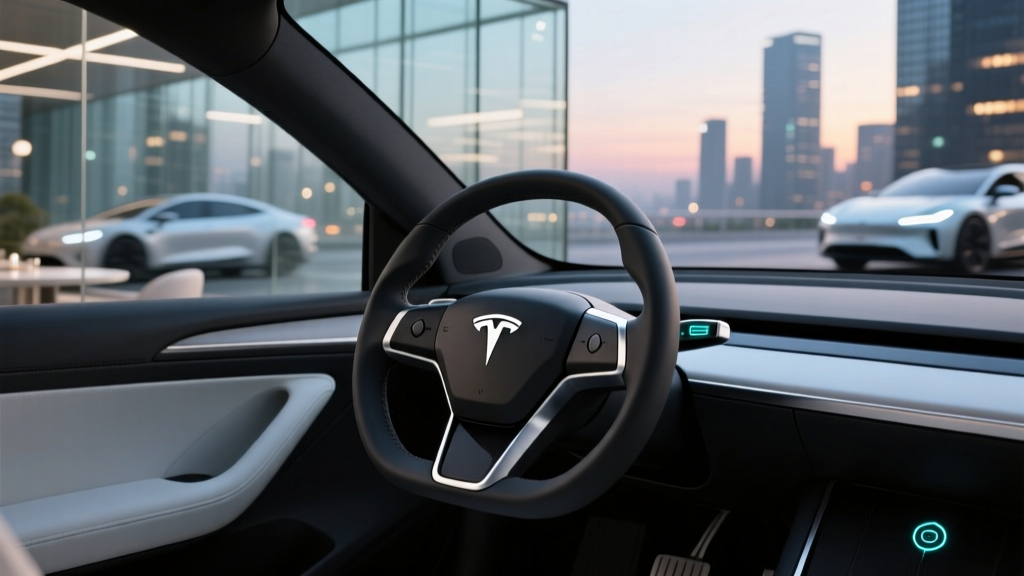
Since Tesla unveiled the Cybercab concept in late 2024, one question has dominated search engines and EV forums alike: will the Tesla Cybercab have a steering wheel? The short answer, based on Tesla's official unveiling and subsequent statements through early 2026, is no — the production-intent Cybercab is designed without a steering wheel or pedals, positioning it as a dedicated Level 4 robotaxi rather than a consumer-owned vehicle. But the reality of bringing a steering-wheel-free vehicle to public roads involves regulatory, technical, and manufacturing hurdles that deserve a closer look.
Below, we break down everything confirmed and estimated about the Cybercab's specs, platform, charging architecture, and timeline — and what a "Cybercab steering wheel" variant might mean if regulators or market forces force Tesla's hand.
What Is the Tesla Cybercab?
The Tesla Cybercab is a purpose-built, two-passenger autonomous vehicle designed exclusively for Tesla's planned robotaxi network. Unlike the Model 3 or Model Y, which are consumer vehicles with optional driver-assist features, the Cybercab is engineered from the ground up to operate without human intervention. Tesla CEO Elon Musk has stated the vehicle will have no steering wheel, no pedals, and no traditional driver controls.
The design language borrows heavily from the Cybertruck — angular stainless-steel-adjacent aesthetics, a narrow greenhouse, and butterfly-style doors. The interior concept showed a single bench seat, a large central touchscreen for ride-hailing controls, and no forward-facing driver interface whatsoever.
The Cybercab is designed as a Level 4 autonomous vehicle — meaning it handles all driving tasks within its defined operational design domain (ODD) without any human fallback. This is fundamentally different from Tesla's current FSD (Supervised), which remains a Level 2 system requiring constant driver attention. Level 4 vehicles like Waymo's Jaguar I-PACE fleet operate today only in geofenced areas with extensive mapping and remote-assist infrastructure.
Cybercab Steering Wheel: Why It Doesn't Have One (and Could It Change?)
The absence of a steering wheel in the Cybercab is not an oversight — it's a core design decision. Tesla's thesis is that removing manual controls eliminates the "handoff problem" that plagues Level 2 and Level 3 systems: the dangerous moment when a disengaged driver must suddenly retake control. By designing for full autonomy from the start, Tesla argues, the vehicle is inherently safer.
However, several factors could force a steering-wheel-equipped variant:
- Federal Motor Vehicle Safety Standards (FMVSS): Current U.S. regulations assume a human driver. Vehicles without steering wheels require exemptions from NHTSA, and the exemption process is limited in volume and slow to approve.
- State-level variation: States like California and Arizona have pathways for driverless testing, but many states have no legal framework for steering-wheel-free vehicles on public roads.
- Consumer variant possibility: Industry analysts have speculated Tesla could offer a "Cybercab with steering wheel" as a consumer micro-car or urban commuter vehicle if the robotaxi timeline stretches further.
As of early 2026, Tesla has not announced any steering-wheel-equipped Cybercab variant. All public statements maintain the driverless configuration.
Announced and Estimated Specifications
Because the Cybercab has not entered production as of 2026, many specifications remain preliminary. The figures below combine Tesla's official unveil data with informed estimates based on Tesla's current platform architecture and battery supply chain.
| Specification | Cybercab (Announced / Estimated) |
|---|---|
| EPA Range (est.) | ~250 miles (target) |
| Battery Capacity | ~50 kWh usable (est.), LFP chemistry |
| Drivetrain | Rear-wheel drive, single motor |
| Horsepower | ~200 hp (est.) |
| 0-60 mph | ~6.5 seconds (est.) |
| Max DC Fast Charge | ~170 kW peak (est., NACS) |
| 10-80% DC Charge Time | ~25 minutes (est.) |
| Level 2 Home Charge | ~11.5 kW / ~38 mi/hr (est.) |
| Seating | 2 passengers |
| Cargo Volume | Limited (rear trunk area, ~10 cu ft est.) |
| Efficiency (target) | ~130 MPGe / ~26 kWh/100 mi |
| Steering Wheel | None (Level 4 robotaxi design) |
| Target Production | 2026-2027 (announced) |
The Cybercab's estimated ~250-mile EPA target is designed for urban robotaxi duty cycles — stop-and-go city driving at moderate speeds where EVs are most efficient. In real-world operation, expect:
• City driving: ~230-250 miles (regen braking helps in stop-and-go)
• Highway repositioning: ~190-210 miles at 70 mph (aerodynamic drag reduces range 15-20%)
• Cold weather (below 32°F): ~175-200 miles (LFP batteries are more susceptible to cold-weather range loss than NMC, typically 20-30% reduction)
For a robotaxi, range matters less than charge turnaround time — Tesla's plan involves frequent short top-ups between rides.
Charging Architecture and Turnaround Time
For a robotaxi, charging speed is arguably the most critical spec. Every minute spent charging is a minute not earning revenue. Tesla has indicated the Cybercab will support wireless inductive charging as its primary charging method — the vehicle would autonomously pull into a charging pad embedded in a parking spot or depot and charge without any physical plug-in.
However, wireless charging is inherently slower than wired DC fast charging. Industry estimates place wireless charging efficiency at 85-90% (vs. 95%+ for wired), with power levels likely in the 50-100 kW range for the Cybercab's pad system. Tesla will also retain a NACS port for wired fast charging at Supercharger stations during depot operations.
| Charging Method | Power (kW) | Miles Added per Hour | Notes |
|---|---|---|---|
| Wireless Inductive Pad | ~50-100 kW (est.) | ~170-340 mi/hr | Primary method; autonomous docking |
| Wired DC Fast (NACS) | ~170 kW peak | ~580 mi/hr (peak) | Depot Supercharger; tapers above 80% |
| Level 2 AC (backup) | ~11.5 kW | ~38 mi/hr | Overnight depot charging |
The LFP battery chemistry choice is strategic here. LFP cells tolerate frequent partial charging cycles better than NMC — they can be charged to 100% regularly without the same degradation concerns. For a robotaxi doing multiple short charge cycles per day, this is a significant longevity advantage.
Battery Chemistry: Why LFP Makes Sense for Robotaxis
Tesla has increasingly standardized on lithium iron phosphate (LFP) chemistry for its standard-range vehicles, and the Cybercab is expected to follow suit. Here's why:
| Factor | LFP (Expected for Cybercab) | NMC (Used in Long Range/Performance) |
|---|---|---|
| Cycle Life | 3,000-5,000+ cycles | 1,500-2,500 cycles |
| 100% SoC Charging | Safe for daily use | Accelerates degradation |
| Energy Density | Lower (heavier pack for same kWh) | Higher (lighter, more range) |
| Cold-Weather Performance | More range loss (20-30%) | Less range loss (15-20%) |
| Cost per kWh | Lower (~$80-100/kWh) | Higher (~$110-140/kWh) |
| Critical Minerals | No cobalt or nickel | Requires cobalt/nickel |
For a fleet vehicle racking up 60,000-100,000 miles per year with multiple daily charge cycles, LFP's superior cycle life and tolerance for 100% state-of-charge operation outweigh its lower energy density. The Cybercab's compact size and modest range target mean the weight penalty of LFP is manageable.
Pricing, Business Model, and Tax Credit Reality
The Cybercab is not a vehicle you can buy. Tesla has stated it will own and operate the Cybercab fleet directly, similar to Waymo's model. Musk has projected a per-mile ride cost of approximately $0.20 — undercutting both Uber/Lyft and personal car ownership on a cost-per-mile basis.
Tesla has also projected a manufacturing cost of under $30,000 per unit at scale, though this figure has not been independently verified and Tesla's production timelines have historically slipped.
| Cost Factor | Details |
|---|---|
| Consumer Purchase Price | Not available — fleet-only vehicle |
| Estimated Unit Cost (Tesla internal) | Under $30,000 (announced target) |
| Projected Ride Cost | ~$0.20/mile (announced target) |
| Federal Tax Credit (§30D) | Not applicable — vehicle not sold to consumers. Fleet tax credits under §45W (Commercial Clean Vehicle Credit) may apply to Tesla's fleet operations, subject to IRS rules. |
| Consumer Alternative | Tesla Model 3 RWD: $38,990 MSRP; eligible for up to $7,500 §30D credit (income/MSRP/sourcing rules apply — see IRS.gov) |
Because the Cybercab won't be sold to consumers, the IRS §30D new clean vehicle credit does not apply. Buyers looking for a Tesla vehicle they can own and that qualifies for federal incentives should look at the Model 3 or Model Y, both of which have varying §30D eligibility depending on current battery-sourcing and critical-mineral requirements. Always verify eligibility against current IRS guidance before purchasing, as these rules change frequently.
Competitive Landscape: Cybercab vs. Waymo and Zoox
The Cybercab enters a robotaxi market where competitors have years of operational head start. Here's how it stacks up against the established players:
| Factor | Tesla Cybercab | Waymo (6th Gen) | Amazon Zoox |
|---|---|---|---|
| Steering Wheel | None | None (custom vehicle) | None |
| SAE Level | Level 4 (target) | Level 4 (operational) | Level 4 (limited ops) |
| Live Service Cities (2026) | None yet | Phoenix, SF, LA, Austin | Las Vegas, SF (limited) |
| Sensor Suite | Vision-only (cameras) | LiDAR + radar + cameras | LiDAR + radar + cameras |
| Passengers | 2 | 4 | 4 |
| Revenue Miles Driven | 0 | Millions (paid rides) | Limited |
The most significant differentiator — and risk — is Tesla's vision-only approach. Waymo and Zoox both use LiDAR as a primary sensor alongside cameras and radar, providing redundant depth perception and reliable performance in low-visibility conditions. Tesla has bet that its neural network training on billions of fleet-driven camera miles will achieve equivalent or superior performance without the cost and complexity of LiDAR. This remains the most debated technical question in autonomous driving, and the Cybercab will be the ultimate proof point.
• It is NOT available for consumer purchase
• It is NOT operational on public roads as of early 2026
• Tesla's current FSD (Supervised) on Model 3/Y is Level 2 and requires driver attention — this is a different system from the Cybercab's intended Level 4 autonomy
• Vision-only autonomy has not yet been validated at scale in heavy rain, fog, or snow by any production fleet
• Regulatory approval for steering-wheel-free vehicles requires NHTSA exemptions with volume caps
Warranty, Fleet Maintenance, and Longevity
Because the Cybercab is a fleet vehicle, traditional consumer warranty structures don't apply in the usual sense. However, Tesla's fleet economics depend on vehicle longevity. Based on Tesla's current warranty framework and the demands of robotaxi operation:
- Battery warranty: Tesla's consumer vehicles carry an 8-year/100,000-mile battery warranty (with a minimum 70% capacity retention threshold). Fleet vehicles will likely see similar or extended coverage, but Tesla will self-insure its own fleet.
- Powertrain: 8-year/120,000-mile coverage on current consumer models; fleet duty cycles may push replacement intervals shorter.
- LFP advantage: At an estimated 50 kWh pack doing one full cycle per day, LFP chemistry should sustain 8+ years of operation before hitting 70% state of health — a key factor in fleet economics.
Who Is the Cybercab For?
The Cybercab isn't for buyers — it's for riders. Specifically:
- Urban commuters in Tesla's eventual service cities who currently spend on Uber/Lyft or public transit
- Airport travelers seeking predictable, app-based point-to-point transport
- Mobility-impaired individuals who cannot drive and need autonomous transport (though the 2-seat, butterfly-door design raises accessibility questions)
- Cost-conscious riders if Tesla's $0.20/mile target materializes — significantly cheaper than current ride-hailing averages of $1.50-$2.50/mile
For EV buyers looking to purchase a vehicle today, the Cybercab is irrelevant to your decision. Look at the Tesla Model 3 or Model Y on fueleconomy.gov for EPA range, efficiency, and comparison data on vehicles you can actually drive home.
- Potentially lowest per-mile ride cost in the market
- LFP battery optimized for fleet duty cycles
- Wireless charging reduces fleet labor costs
- Tesla's massive real-world driving data for AI training
- Compact 2-seat design efficient for urban density
- Not available — no announced firm launch date
- Vision-only autonomy unproven at Level 4 scale
- Regulatory pathway for no-steering-wheel vehicles uncertain
- Only 2 passengers limits use cases vs. Waymo's 4-seat vehicles
- Tesla's production timelines have historically slipped by years
- No consumer ownership option
Frequently Asked Questions
Does the Tesla Cybercab have a steering wheel?
No. As announced, the Cybercab is designed without a steering wheel or pedals. It is intended as a Level 4 autonomous robotaxi with no manual driving capability. Tesla has not announced any variant with a steering wheel as of early 2026.
Can I buy a Tesla Cybercab?
No. The Cybercab is planned as a Tesla-owned fleet vehicle for its robotaxi network. It will not be sold to individual consumers. If you want to own a Tesla, the Model 3 (starting at $38,990) and Model Y remain the core consumer options.
When will the Cybercab be available?
Tesla has targeted production beginning in 2026-2027, but this timeline has shifted multiple times since the original 2024 unveiling. No firm date has been confirmed, and regulatory approval for steering-wheel-free operation adds additional uncertainty.
How does the Cybercab charge without a driver to plug it in?
Tesla plans to use wireless inductive charging pads as the primary charging method. The vehicle would autonomously position itself over a ground-mounted pad. A NACS port is expected as a backup for wired DC fast charging at depot locations.
Does the Cybercab qualify for the federal EV tax credit?
The IRS §30D new clean vehicle credit does not apply because the Cybercab is not sold to consumers. Tesla may qualify for commercial fleet tax incentives under §45W, but this is separate from consumer credits. Always check IRS.gov for current rules.
How does Tesla's vision-only approach compare to Waymo's LiDAR?
Waymo uses LiDAR, radar, and cameras for sensor redundancy. Tesla relies solely on cameras processed by neural networks. LiDAR provides precise depth data in all lighting conditions but is expensive. Tesla argues camera-based systems scale better with AI training. Neither approach has been definitively proven superior at national scale — the Cybercab's eventual deployment will be the largest real-world test of vision-only Level 4 autonomy.
What happens if the Cybercab encounters a situation it can't handle?
Level 4 robotaxis use remote-assist infrastructure — a human operator monitors the fleet and can guide the vehicle through unusual scenarios (construction zones, accidents, severe weather). The vehicle can also pull over safely and end the ride if it loses confidence. This is fundamentally different from Level 2 systems like Tesla FSD (Supervised), where the driver in the seat is the fallback.
Sources: Tesla investor presentations, NHTSA regulatory filings, IRS §30D guidance, fueleconomy.gov, NHTSA Automated Driving Systems. All Cybercab specifications are preliminary and subject to change. This article reflects information available as of early 2026.