What the Tesla Cybercab Production Start Means for 2026
Tesla's long-promised dedicated robotaxi finally has a manufacturing timeline. The Tesla Cybercab production start is targeted for late 2026 at the Austin Gigafactory, with initial units earmarked for Tesla's own ride-hailing network rather than private retail sales. This is a critical distinction: Tesla has positioned the Cybercab as a fleet-first vehicle, meaning individual buyers may not be able to purchase one at launch — or possibly ever in its initial generation.
For EV shoppers researching whether to wait for the Cybercab or buy an available electric vehicle now, this profile breaks down every confirmed and projected specification, the real-world implications of its design choices, and how it compares to vehicles you can actually order today.
The Cybercab is designed as a Level 4 autonomous vehicle, meaning it operates without a human driver within defined operational design domains (specific mapped areas, weather conditions, and speeds). This is fundamentally different from Tesla's current Full Self-Driving (Supervised), which is a Level 2 system requiring constant driver attention. Level 4 robotaxis like Waymo's fleet in Phoenix and San Francisco are the closest existing comparison.
Projected Specifications: Battery, Range, and Efficiency
Because the Cybercab has not yet entered production, the following specifications are based on Tesla's October 2024 "We, Robot" event disclosures, patent filings, and supply-chain reporting. All figures should be treated as preliminary and subject to change before the production start date.
| Specification | Projected / Announced |
|---|---|
| EPA Range (est.) | ~250 miles (projected) |
| Battery Capacity | ~50-60 kWh usable (LFP chemistry expected) |
| Drivetrain | Rear-wheel drive, single motor |
| Horsepower | ~200-250 hp (estimated) |
| 0-60 mph | Not disclosed (not performance-oriented) |
| MPGe (est.) | ~130-140 MPGe combined (projected) |
| Efficiency | ~24-26 kWh/100 mi (projected) |
| Seating | 2 passengers |
| Cargo Volume | Minimal — no steering wheel, no frunk confirmed |
| Base MSRP (if retail) | ~$25,000-$30,000 (announced target) |
| Steering Wheel / Pedals | None — fully autonomous design |
The projected EPA range of ~250 miles assumes moderate-speed city driving in temperate conditions. For a robotaxi operating in stop-and-go urban environments, actual daily range may closely match the EPA figure due to regenerative braking recapturing energy. However, sustained highway speeds above 65 mph could reduce range by 15-20% (to roughly 200-210 miles). Cold-weather operation in northern climates could further reduce usable range by 20-30%, dropping effective range to approximately 175-200 miles — a significant constraint for fleet operators who need to balance charging downtime against ride availability.
Battery Chemistry: Why LFP Makes Sense for a Robotaxi
Industry reporting and Tesla's own battery strategy point toward lithium iron phosphate (LFP) chemistry for the Cybercab. This is a deliberate trade-off:
| Factor | LFP (Expected for Cybercab) | NMC (Typical Long-Range EVs) |
|---|---|---|
| Energy Density | Lower (~160 Wh/kg cell-level) | Higher (~250 Wh/kg cell-level) |
| Cycle Life | 3,000-5,000+ cycles | 1,000-2,000 cycles |
| Cost per kWh | Lower — no cobalt or nickel | Higher — cobalt/nickel supply chain |
| Cold-Weather Performance | Weaker — more range loss below freezing | Better cold-weather retention |
| Daily Charging to 100% | Recommended — no degradation penalty | Not recommended — accelerates degradation |
| Best For | Fleet use, daily cycling, cost minimization | Maximum range, cold climates, performance |
For a fleet vehicle that will charge daily and accumulate 50,000+ miles per year, LFP's superior cycle life and lower cost are the right engineering choice. The range penalty is acceptable when the vehicle operates within a geofenced urban area with predictable daily mileage.
Charging Speed and Fleet Logistics
Charging infrastructure is the operational bottleneck for any robotaxi fleet. Every minute a Cybercab spends at a charger is a minute it cannot generate ride revenue. Tesla has not disclosed official charging specifications, but based on the projected battery size and Tesla's current Supercharger architecture, we can estimate the following:
| Charging Level | Power (kW) | Estimated Time | Notes |
|---|---|---|---|
| Level 1 (120V) | ~1.4 kW | N/A for fleet | Not practical for robotaxi use |
| Level 2 (240V, 48A) | ~11.5 kW | ~5-6 hrs (0-100%) | Overnight depot charging |
| DC Fast Charge (peak) | ~150-175 kW (est.) | ~20-25 min (10-80%) | Smaller battery limits peak kW |
Charging curve reality: A 50-60 kWh battery cannot accept the same peak charge rate as a 100 kWh pack. Even if Tesla's V4 Superchargers can deliver 350+ kW, the Cybercab's smaller battery will likely peak around 150-175 kW and taper significantly above 60-70% state of charge. The 10-80% time of 20-25 minutes is reasonable for mid-day top-ups between ride sessions, but fleet operators will need to model charging logistics carefully to avoid dead-heading to chargers during peak demand hours.
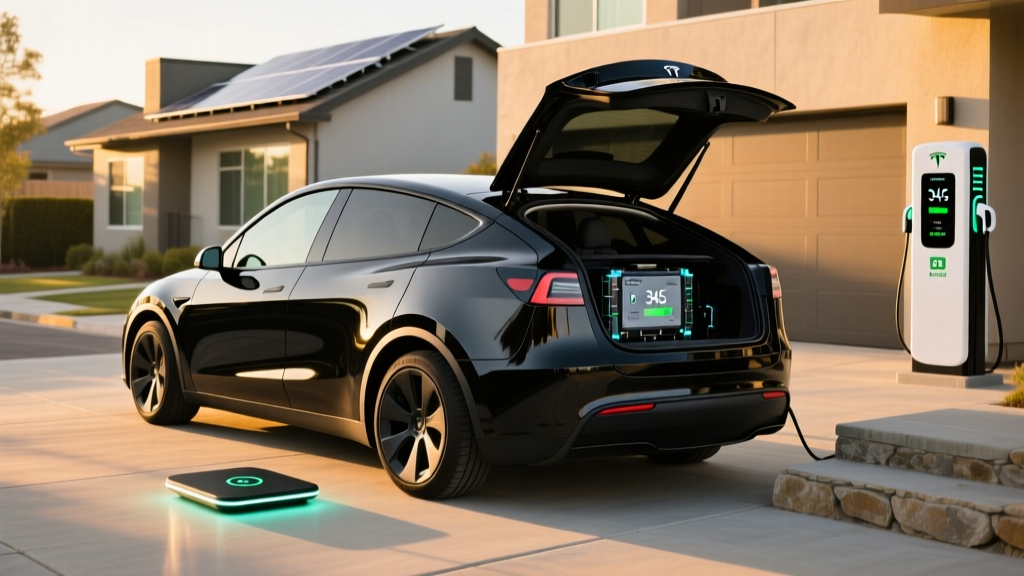
Tesla has also demonstrated wireless inductive charging concepts for the Cybercab, which would allow vehicles to charge at designated pads without plugging in. If deployed at scale, this could dramatically reduce fleet operational complexity — though no timeline or power level has been confirmed for production.
Design, Interior, and the No-Steering-Wheel Question
The Cybercab's most radical design choice is the complete absence of a steering wheel, pedals, and mirrors. This is not a vehicle you can drive — it is a vehicle that drives you. The interior concept shown at Tesla's 2024 event featured:
- Two forward-facing seats with a center console
- A large central touchscreen for ride information and entertainment
- Butterfly-style doors for curb-side entry
- No traditional trunk — limited storage behind and beneath seats
- Solar panel integration on the roof (announced but unconfirmed for production)
The two-seat configuration is a deliberate bet on ride-hailing data: the vast majority of Uber and Lyft trips carry one or two passengers. But it also means the Cybercab cannot serve families, groups, or airport runs with significant luggage — limiting its addressable market within the ride-hailing ecosystem.
As of early 2026, the National Highway Traffic Safety Administration (NHTSA) has not approved vehicles without steering controls for unrestricted public-road operation nationwide. Tesla will need either a regulatory exemption or a design modification (such as a removable or hidden steering control) to legally operate the Cybercab on public roads outside of limited pilot programs. Waymo's current fleet uses Chrysler Pacifica and Jaguar I-PACE vehicles with standard steering wheels, even though passengers cannot use them. The Cybercab's steering-wheel-free design faces a higher regulatory bar. Check NHTSA's automated vehicle safety page for current rulemaking status.
Pricing, Tax Credits, and the Ownership Question
Elon Musk has stated a target price of under $30,000 for the Cybercab if sold to consumers, with a per-mile ride cost of approximately $0.20 — undercutting both Uber and public transit in many markets. However, Tesla has not confirmed whether retail sales will be available at launch.
| Cost Factor | Projected Figure |
|---|---|
| Announced Target MSRP | $25,000 - $30,000 |
| Federal Tax Credit (§30D, max) | Up to $7,500 (if eligible) |
| Effective Price After Credit | $17,500 - $22,500 (best case) |
| Per-Mile Ride Cost (Tesla target) | ~$0.20/mile |
Federal Tax Credit Eligibility (§30D) — If Retail Sales Happen
Should Tesla offer the Cybercab for individual purchase, eligibility for the IRS §30D clean vehicle credit would depend on several factors that change annually:
- MSRP cap: The vehicle must have an MSRP at or below $55,000 for sedans / $80,000 for SUVs/trucks — the Cybercab's ~$25,000-$30,000 target clears this easily
- Buyer income cap: Modified adjusted gross income must not exceed $150,000 (single) / $300,000 (joint) — verify with a tax professional
- Battery sourcing: Critical minerals and battery components must meet escalating domestic-content thresholds that tighten each year through 2029
- Final assembly: Must occur in North America — Austin, TX production satisfies this
- Point-of-sale transfer: Eligible buyers can transfer the credit to the dealer for an immediate price reduction at purchase
Because battery-sourcing rules tighten yearly, a Cybercab purchased in late 2026 may face different eligibility than one purchased in 2027. Always verify current rules on IRS.gov before making purchase decisions based on tax credits.
Cybercab vs. Available Alternatives: What Should You Buy Today?
If you are an individual buyer looking for an EV right now, the Cybercab is not an option — it is not on sale, has no confirmed retail channel, and faces unresolved regulatory hurdles. Here is how the announced Cybercab compares to vehicles you can actually purchase in 2026:
| Spec | Tesla Cybercab (Announced) | Tesla Model 3 RWD | Chevrolet Equinox EV 2LT |
|---|---|---|---|
| EPA Range | ~250 mi (est.) | 272 mi | 319 mi |
| Battery | ~50-60 kWh LFP | 60 kWh LFP | 85 kWh NMC |
| DC Fast Charge Peak | ~150-175 kW (est.) | 170 kW | 150 kW |
| 10-80% Charge Time | ~20-25 min (est.) | ~25 min | ~30 min |
| Seating | 2 | 5 | 5 |
| Steering Wheel | No | Yes | Yes |
| Driver Required | No (Level 4) | Yes (Level 2) | Yes (Level 2) |
| Base MSRP | ~$25,000-$30,000 | $38,990 | $33,600 |
| Available Now? | No — announced | Yes | Yes |
Wait for the Cybercab if: You are a fleet operator or investor evaluating Tesla's robotaxi business model, you live in a city likely to be in Tesla's initial geofenced launch area, and you are comfortable with a 2027+ timeline for any consumer access.
Buy an available EV now if: You need a personal vehicle for commuting, family transport, road trips, or any use case that requires a steering wheel, more than two seats, cargo space, or the ability to drive outside a geofenced zone. The Model 3, Equinox EV, Hyundai Ioniq 5, and dozens of other EVs are available today with proven range, charging infrastructure access, and full regulatory approval.
Pros, Cons, and the Bottom Line
- Lowest per-mile cost in ride-hailing if $0.20/mi target is met
- LFP battery designed for 3,000+ charge cycles — built for fleet longevity
- No driver needed — eliminates the largest cost in ride-hailing
- Tesla's Supercharger network provides proven charging backbone
- Sub-$30,000 price point if retail sales eventually materialize
- Not available for purchase — no confirmed retail sales channel
- No steering wheel — cannot be driven manually in any circumstance
- Only 2 seats — eliminates family, group, and luggage-heavy trips
- Regulatory approval for steering-wheel-free vehicles is unresolved
- Limited range (~250 mi) constrains operational radius
- Production start has slipped from prior Tesla timelines
- Cold-weather LFP performance may limit northern-climate deployment
Warranty and Long-Term Durability (Projected)
Tesla has not published Cybercab warranty terms. For reference, Tesla's current consumer vehicles carry an 8-year / 100,000-mile battery and drive unit warranty (120,000 miles for Long Range and Performance models), guaranteeing a minimum of 70% battery capacity retention over the warranty period.
For a fleet vehicle accumulating 50,000-80,000 miles annually, the standard consumer warranty would be exhausted in 1-2 years. Tesla will likely offer a commercial/fleet warranty structure for the Cybercab, potentially tied to the LFP battery's inherent cycle-life advantage. LFP cells can typically endure 3,000-5,000 full charge cycles before degrading to 80% capacity — at 250 miles per cycle, that translates to 750,000-1,250,000 miles before significant degradation, far exceeding typical vehicle lifespans.
Frequently Asked Questions
What is the real-world range of the Tesla Cybercab?
Based on announced specifications, the Cybercab is projected to achieve approximately 250 miles of EPA-estimated range. In real-world robotaxi use — predominantly stop-and-go city driving with frequent regenerative braking — actual range may closely match the EPA figure. Highway operation at sustained speeds above 65 mph could reduce this to roughly 200-210 miles, and cold-weather conditions (below 32°F) could drop effective range to 175-200 miles due to LFP chemistry's sensitivity to low temperatures.
How fast does the Cybercab charge?
Official charging specs have not been released. Based on the projected 50-60 kWh battery and Tesla's Supercharger architecture, DC fast charging should peak around 150-175 kW, with a 10-80% session taking approximately 20-25 minutes. Level 2 charging at 11.5 kW (48A, 240V) would fully replenish the battery in roughly 5-6 hours — suitable for overnight depot charging. The smaller battery means lower peak kW than Tesla's larger vehicles, but shorter total charge times due to less total energy needed.
Can I buy a Tesla Cybercab for personal use?
Not currently, and possibly not at launch. Tesla has positioned the Cybercab primarily as a fleet vehicle for its planned ride-hailing network. Elon Musk has suggested that retail sales may eventually be available at around $25,000-$30,000, but no purchase channel, delivery timeline, or consumer configuration has been announced. Individual buyers should not delay an EV purchase waiting for Cybercab availability.
Does the Cybercab qualify for the federal EV tax credit?
If Tesla eventually sells the Cybercab to individual consumers, it would likely qualify for up to $7,500 under IRS §30D, given its sub-$30,000 target price (well under the $55,000 sedan MSRP cap), North American assembly in Austin, and Tesla's increasing domestic battery sourcing. However, buyer income limits ($150,000 single / $300,000 joint) and evolving critical-mineral sourcing requirements apply. Always verify current eligibility on IRS.gov and consult a tax professional before relying on the credit in purchase decisions.
Is the Cybercab self-driving — and is that legal?
The Cybercab is designed as an SAE Level 4 autonomous vehicle, meaning it operates without any human driver within defined geofenced areas. This is genuinely driverless — not the same as Tesla's current FSD (Supervised), which is a Level 2 system requiring constant human attention. However, as of early 2026, NHTSA has not broadly approved vehicles without steering controls for unrestricted public-road use. Tesla will need regulatory exemptions or rule changes to deploy the Cybercab at scale. Waymo currently operates Level 4 robotaxis in select cities using vehicles with steering wheels that passengers simply cannot access.
Is the Cybercab worth waiting for vs. buying an EV now?
For individual buyers: no. The Cybercab is not on sale, faces regulatory uncertainty, and is designed as a two-seat robotaxi — not a personal vehicle. If you need an EV for commuting, family use, or road trips, available vehicles like the Tesla Model 3 ($38,990, 272 mi EPA), Chevrolet Equinox EV ($33,600, 319 mi), or Hyundai Ioniq 5 ($42,600, 303 mi) offer proven range, full regulatory approval, and immediate availability. The Cybercab is relevant to fleet investors and urban transportation planners, not current car shoppers.
Sources and Further Reading
- NHTSA — Automated Vehicle Safety: Current regulatory framework for driverless vehicles
- IRS — Clean Vehicle Credits (§30D): Federal tax credit eligibility rules and income/MSRP caps
- fueleconomy.gov (EPA): Official range and efficiency data for all currently available EVs