When Tesla unveiled the Cybercab in late 2024, the headline was unmistakable: a two-seat electric vehicle with no steering wheel and no pedals. The concept grabbed attention because it represents Tesla's most aggressive bet on full autonomy — a purpose-built robotaxi designed not for individual ownership in the traditional sense, but for a fleet-based, ride-hailing model. As of early 2026, the Cybercab remains in pre-production status with limited pilot testing underway, and Tesla has targeted a production start in 2026. But between Elon Musk's timeline promises and the regulatory reality of deploying a Level 4 driverless vehicle at scale, there is a wide gap worth examining with hard data.
This profile covers everything Tesla has officially disclosed about the Cybercab's battery, range, charging, and technology — paired with the real-world context you need to evaluate whether this vehicle will actually reach consumers, and in what form.
What Is the Tesla Cybercab (and Why Does It Have No Steering Wheel)?
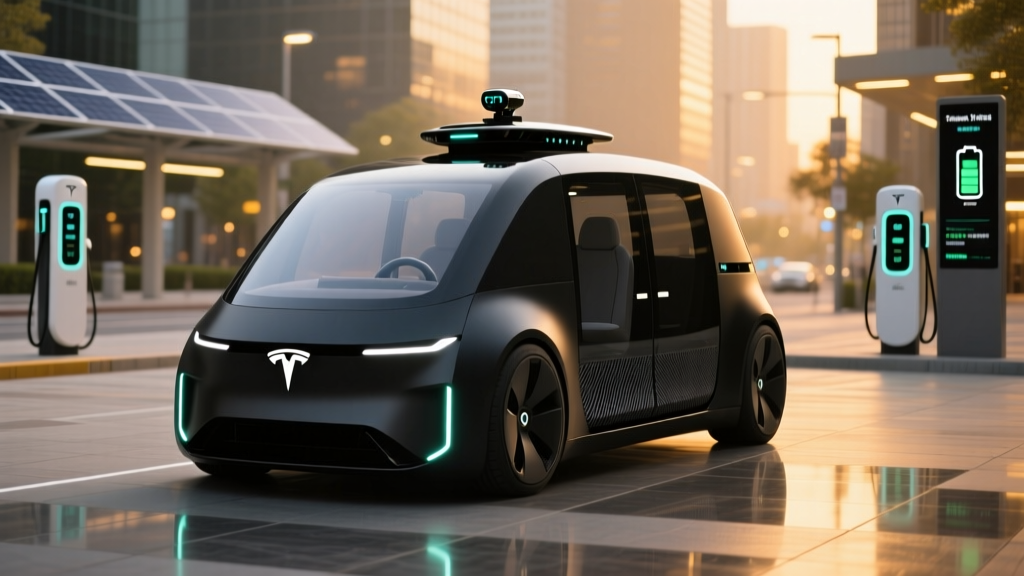
The Tesla Cybercab — sometimes referred to as the "Robotaxi" — is a compact, two-passenger battery-electric vehicle designed from the ground up for autonomous operation. Unlike the Model Y or Model 3, which are built for human drivers with optional driver-assistance features, the Cybercab eliminates all manual driving controls. No steering wheel. No accelerator or brake pedals. No side mirrors in the production-intent design.
This design choice signals Tesla's intention to operate the Cybercab as a SAE Level 4 autonomous vehicle — meaning the vehicle handles all driving tasks within a defined operational design domain (ODD) without any human intervention or fallback. This is a fundamentally different category from Tesla's current Full Self-Driving (Supervised) software, which is a Level 2 system requiring constant driver attention.
Tesla CEO Elon Musk has stated the Cybercab will operate on a model similar to Airbnb or Uber, where vehicle owners could add their Cybercab to a Tesla-managed fleet to earn revenue when not using it personally. Tesla also plans to operate its own fleet. The projected cost per mile for riders, according to Tesla, would be roughly $0.20/mile — undercutting conventional rideshare significantly.
Announced Specs: Range, Battery, and Efficiency
Tesla has been deliberately sparse on detailed technical specifications for the Cybercab, but here is what has been confirmed or strongly indicated through official presentations and regulatory filings as of early 2026:
| Specification | Tesla Cybercab (Announced/Estimated) |
|---|---|
| EPA Est. Range | ~250 miles (preliminary, not EPA-certified) |
| Battery Capacity | ~50 kWh usable (estimated) |
| Battery Chemistry | Likely LFP (lithium iron phosphate) |
| Max DC Fast Charge | Not officially disclosed; estimated 150–250 kW |
| 10–80% DC Charge Time | ~20–25 min (estimated) |
| Level 2 Home Charging | Not applicable (fleet/depot charging model) |
| 0–60 mph | Not disclosed |
| Horsepower | Not disclosed; likely single-motor RWD, ~150–200 hp |
| Drivetrain | Expected RWD (single motor) |
| Seating | 2 passengers |
| Estimated Base Price | ~$25,000–$30,000 (announced target) |
The likely use of LFP chemistry is strategic. LFP batteries trade lower energy density for longer cycle life (often 3,000+ cycles before 80% capacity retention), lower cost per kWh, and greater thermal stability. For a robotaxi expected to log 50,000–100,000 miles per year, cycle life matters far more than maximizing range per charge.
Charging Strategy: Depot-Centric, Not Consumer-Facing
The Cybercab's charging model is fundamentally different from a consumer EV. Tesla has indicated the vehicle will rely primarily on depot-based DC fast charging and inductive (wireless) charging pads rather than plug-in home charging. This makes sense for a fleet vehicle that doesn't have a traditional "owner" plugging in at night.
| Charging Method | Power (kW) | Estimated Time (10–80%) | Notes |
|---|---|---|---|
| Tesla Supercharger V4 (DC) | ~150–250 kW (est.) | ~20–25 min | NACS connector; fleet depot use |
| Inductive Charging Pad | ~15–25 kW (est.) | N/A (overnight/trickle) | No plug-in required; depot parking |
| Level 2 (J1772/NACS) | N/A | N/A | Not designed for home charging |
The absence of a traditional charge port in some Cybercab prototypes has fueled speculation that Tesla is betting entirely on wireless inductive charging. However, production-intent vehicles will likely include a NACS port for Supercharger compatibility during repositioning and maintenance. The inductive pad concept would allow Cybercabs to autonomously park over a charging pad at depots without any human plugging in — a critical efficiency gain for fleet operators.
Autonomy Hardware and Software: What Powers Driverless Operation
The Cybercab is expected to run on Tesla's next-generation hardware suite, potentially designated HW5 or AI5, which Tesla has described as offering roughly 10x the compute performance of the current HW4 platform. The sensor suite relies entirely on cameras — Tesla's "vision-only" approach — with no LiDAR or radar, a decision that remains controversial in the autonomous vehicle industry.
Competitors like Waymo (Alphabet) use a multi-sensor stack combining LiDAR, radar, and cameras to achieve Level 4 operation. Waymo's sixth-generation driver system, deployed in Phoenix, San Francisco, and Los Angeles, has logged millions of fully driverless miles. Tesla's camera-only approach must match or exceed this reliability without the redundancy that LiDAR provides — a significant engineering challenge.
Tesla has also stated the Cybercab will use an "Unsupervised" version of its FSD software stack — meaning no driver monitoring camera, no steering wheel reminders, and no expectation of human takeover. This is the same software ambition behind Tesla's stated goal of launching unsupervised FSD in existing Model 3 and Model Y vehicles, a timeline that has repeatedly slipped.
Pricing, Ownership Model, and Tax Credit Eligibility
Tesla has targeted a Cybercab production cost below $35,000, with a stated consumer purchase price around $25,000–$30,000. However, Tesla's pricing projections have historically been optimistic, and the final MSRP at launch remains unconfirmed.
| Cost Factor | Estimate / Status |
|---|---|
| Announced Target MSRP | $25,000–$30,000 |
| Federal Tax Credit (§30D) | Up to $7,500 if eligible (see requirements below) |
| Effective Price After Credit | ~$17,500–$22,500 (if eligible) |
| Point-of-Sale Transfer | Available under current IRS rules — reduces purchase price at dealership |
| Estimated Cost Per Mile (Fleet) | ~$0.20/mile (Tesla's projection) |
Federal EV Tax Credit (§30D) Eligibility Checklist
If the Cybercab becomes available for individual purchase (not just fleet operation), buyers would need to meet all of the following IRS §30D requirements to claim the up-to-$7,500 credit:
- MSRP Cap: Vehicle base price must be ≤ $55,000 for sedans / ≤ $80,000 for SUVs/trucks. The Cybercab's target price clears this easily.
- Buyer Income Cap: Modified adjusted gross income ≤ $150,000 (single) / ≤ $300,000 (married filing jointly) / ≤ $225,000 (head of household).
- Battery Component Manufacturing: A percentage of battery components must be manufactured or assembled in North America (threshold increases annually; 100% by 2029).
- Critical Minerals Sourcing: A percentage of critical minerals must be sourced from the U.S. or a free-trade-agreement partner (threshold increases annually).
- Foreign Entity of Concern (FEOC): Battery components and critical minerals cannot be sourced from prohibited FEOC entities (primarily targeting Chinese supply chains).
- Final Assembly: Vehicle must undergo final assembly in North America.
Given that the Cybercab is expected to be manufactured at a U.S. facility (likely Giga Texas), the assembly requirement should be satisfied. However, battery sourcing compliance depends on Tesla's supply chain at the time of production — and these rules tighten each year. Consult a tax professional before relying on credit eligibility.
Interior, Cargo, and Passenger Experience
The Cybercab's interior is radically minimalist. With no steering column, pedal assembly, or instrument cluster, the cabin opens up into a lounge-like two-seat configuration. Tesla's unveil showed butterfly-style doors and a wide bench seat with a central touchscreen for ride information, entertainment, and climate control.
Concrete cargo dimensions have not been officially published, but the vehicle's compact footprint (similar in length to a Mazda MX-5 Miata) suggests limited trunk space — likely 10–15 cubic feet behind the seats, suitable for a carry-on suitcase or grocery bags. There is no frunk (front trunk) in the production-intent design, as the front area houses computing hardware and HVAC components.
Legroom should be generous for a two-seater, with Tesla claiming accommodation for passengers up to 6'4". However, the absence of any manual override controls means passengers are entirely dependent on the autonomous system — a psychological barrier for some riders, as surveys of robotaxi users in Phoenix and San Francisco have shown mixed comfort levels.
How the Cybercab Compares to Competing Robotaxis
The Cybercab is far from the only steering-wheel-free EV concept or operational robotaxi. Here's how it stacks up against vehicles already in commercial service or advanced testing:
| Vehicle | Status (2026) | SAE Level | Sensor Stack | Service Areas |
|---|---|---|---|---|
| Waymo 6th-Gen (Jaguar I-PACE) | Commercial service | Level 4 | LiDAR + cameras + radar | Phoenix, SF, LA, Austin |
| Zoox (purpose-built) | Limited pilot | Level 4–5 target | LiDAR + cameras + radar | Las Vegas, Foster City |
| Cruise Origin | Program paused/restructured | Level 4 target | LiDAR + cameras + radar | N/A (suspended) |
| Tesla Cybercab | Pre-production / pilot | Level 4 target | Cameras only (vision) | None yet |
The most critical differentiator is that Waymo is already completing hundreds of thousands of paid, driverless rides per month with a proven multi-sensor stack. Tesla is attempting to leapfrog directly to a vision-only Level 4 system at massive scale — something no company has yet achieved. The NHTSA and state-level regulators (notably California's DMV and CPUC) will need to validate Tesla's safety case before any driverless deployment.
Timeline and Regulatory Hurdles
Tesla has stated a target of beginning Cybercab production in 2026, with fleet deployment following shortly after. However, several factors complicate this timeline:
- Federal Motor Vehicle Safety Standards (FMVSS): Current U.S. regulations require a steering wheel, mirrors, and other manual controls in passenger vehicles. Tesla would need an FMVSS exemption from NHTSA to sell a steering-wheel-free vehicle — similar to the exemption Nuro received for its low-speed delivery pod, but for a full-speed passenger vehicle. No such exemption has been granted for a consumer-speed car.
- State-Level Approval: Each state where the Cybercab operates driverless must authorize Level 4 deployment. California, Arizona, and Texas have frameworks for this, but approval is not automatic — Cruise's suspension in California demonstrates that regulators can and will pull permits after safety incidents.
- Safety Validation: Tesla must demonstrate to regulators that its vision-only system can handle the full spectrum of driving scenarios safely. This typically requires millions of miles of validated data — and Tesla's FSD Supervised miles, which include human interventions, do not directly translate to Level 4 validation.
- Manufacturing Ramp: Tesla's history with new vehicle launches (Cybertruck delays being the most recent example) suggests that even if the Cybercab enters low-rate production in 2026, meaningful volume is unlikely before 2027–2028.
Who Is the Cybercab For?
The Cybercab is not a vehicle you'll test-drive at a dealership in the traditional sense. Its target "users" fall into distinct categories:
Choose the Cybercab (as a rider) if:
- You live in a metro area where Tesla deploys the fleet (likely starting in Austin, Phoenix, or similar Sun Belt cities)
- You want low-cost point-to-point rides (~$0.20/mile projected) without owning a car
- You're comfortable with fully autonomous, no-override transportation
Consider buying a Cybercab (as a fleet investor) if:
- Tesla opens individual purchases and you want to earn revenue through the Tesla fleet network
- You accept the risk that autonomous fleet economics are unproven at scale
- You have access to depot charging or Tesla-managed fleet infrastructure
Look elsewhere if:
- You need a personal vehicle with manual driving capability
- You live outside initial deployment zones (likely limited to 2–4 cities at launch)
- You want a proven, currently available robotaxi — use Waymo in Phoenix, SF, or LA today
Pros and Cons
Pros
- Extremely low projected operating cost (~$0.20/mile)
- Purpose-built for autonomy — no legacy driver components
- LFP battery chemistry offers long cycle life for fleet use
- Potential for individual owners to earn fleet revenue
- Tesla's massive existing Supercharger network for depot charging
- Low target MSRP ($25K–$30K) could make fleet economics viable
Cons
- No steering wheel = no manual override if the system fails
- Vision-only autonomy unproven at Level 4 in production
- FMVSS exemption required — not guaranteed
- Timeline has already slipped; meaningful volume unlikely before 2027+
- Only 2 seats — limited utility for families or groups
- No confirmed EPA range or official specs as of early 2026
- Regulatory approval required city-by-city
Frequently Asked Questions
Can I buy a Tesla without a steering wheel today?
No. As of early 2026, the Tesla Cybercab is in pre-production and pilot testing. It is not available for purchase or ride-hailing service. Tesla has targeted production to begin in 2026, but regulatory approvals (FMVSS exemption, state-level driverless permits) must be secured before any public deployment. Every Tesla currently available for purchase (Model 3, Model Y, Model S, Model X, Cybertruck) includes a steering wheel and pedals.
What is the real-world range of the Tesla Cybercab?
Tesla has indicated approximately 250 miles of range, but this figure is preliminary and has not been EPA-certified. For urban fleet operation with frequent stops (where regenerative braking is highly effective), real-world range may approach the stated figure. In cold weather or sustained highway operation, expect 15–25% reduction, bringing effective range to roughly 190–210 miles. The smaller ~50 kWh battery (likely LFP chemistry) prioritizes cycle life and cost over maximum range.
How fast does the Cybercab charge?
Official charging specs have not been published. Based on Tesla's architecture and the estimated battery size, DC fast charging at 150–250 kW is plausible, which would deliver a 10–80% charge in roughly 20–25 minutes at a Supercharger V4 station. Tesla has also demonstrated wireless inductive charging for the Cybercab, intended for autonomous depot charging at lower power (~15–25 kW) over longer periods. This vehicle is not designed for home Level 2 charging.
Does the Cybercab qualify for the $7,500 federal EV tax credit?
Potentially, yes — if it is sold to individual buyers (not just fleets) and meets all IRS §30D requirements. The target MSRP of $25,000–$30,000 is well below the $55,000 sedan cap. However, battery component sourcing, critical mineral requirements, buyer income limits, and final assembly rules all apply. Eligibility cannot be confirmed until Tesla publishes final battery supply chain details and the vehicle enters production. Always consult a tax professional and check the latest IRS guidance before assuming credit eligibility.
Is Tesla's Cybercab safer than Waymo?
There is no public safety data to compare because the Cybercab has not operated in commercial driverless service. Waymo has completed millions of driverless miles and publishes safety data reviewed by regulators and IIHS-affiliated researchers. Tesla's vision-only approach must demonstrate equivalent or superior safety to earn Level 4 deployment approval. Until validated data exists, any safety comparison is speculative.
Will the Cybercab replace Uber and Lyft?
Tesla's long-term ambition appears to be exactly that — a lower-cost, autonomous ride-hailing network. However, Waymo already partners with Uber in select markets, and the robotaxi market is likely to be multi-player. The Cybercab would need to scale across dozens of cities, secure regulatory approval in each, and build rider trust — a process that will take years, not months.
What happens if the Cybercab's system encounters a situation it can't handle?
For a Level 4 vehicle, the system must execute a "minimal risk condition" — typically pulling to the side of the road and stopping safely — without human intervention. Tesla has not detailed the Cybercab's specific minimal-risk maneuver protocols. This is a critical safety requirement that regulators will scrutinize before granting deployment approval.
Bottom Line
The Tesla Cybercab represents an ambitious vision: a $25,000–$30,000 electric robotaxi with no steering wheel, no pedals, and a projected operating cost of $0.20 per mile. If Tesla can solve the vision-only Level 4 autonomy challenge, secure FMVSS exemptions, and scale fleet deployment across major metro areas, the Cybercab could reshape urban transportation economics.
But "if" carries enormous weight here. Waymo has been operating Level 4 robotaxis commercially for years with a multi-sensor approach, and Tesla's camera-only system has yet to demonstrate equivalent capability without a human safety net. The regulatory path for a steering-wheel-free passenger vehicle traveling at highway speeds is uncharted territory in the U.S.
For now, the Cybercab remains a compelling concept with preliminary specs and an aspirational timeline. If you need autonomous rides today, Waymo is operational in multiple cities. If you need a Tesla today, every model in the lineup still comes with a steering wheel — and that won't change until regulators, not just engineers, say otherwise.