The Tesla Cybercab is not a car you buy. It is a vehicle you summon. Unveiled in October 2024 and targeted for production beginning in 2026, Tesla's purpose-built robotaxi strips away the steering wheel, pedals, and traditional dashboard to create an interior optimized entirely for passengers. For anyone researching the Tesla Cybercab interior, the central question is not "how does it drive?" — it is "what does it feel like to ride in it?"
This profile examines every confirmed and projected detail of the Cybercab's cabin, from its two-seat butterfly-door layout to its infotainment approach, while also covering the vehicle's announced range, battery specs, charging performance, and the economics of Tesla's robotaxi vision. Because the Cybercab is announced but not yet in commercial service as of 2026, figures below reflect Tesla's stated targets and industry analysis — not finalized EPA certifications.
The Cybercab Interior: A Cabin Without a Driver
Every design decision in the Cybercab interior flows from one premise: no human will ever operate this vehicle. That eliminates the need for a steering column, instrument cluster, center console, rearview mirrors, and pedal box. What remains is a radically simplified space that Tesla describes as a "living room on wheels."
Seating Configuration
The production-intent Cybercab shown at the "We, Robot" event features two individual bucket seats rather than a bench. This is a deliberate choice — a two-seat layout maximizes floor space, simplifies cleaning between rides, and aligns with Tesla's data showing that the majority of rideshare trips carry one or two passengers. The seats are fixed-position with no manual adjustment rails visible in prototypes, suggesting that seat positioning may be handled via adjustable bolsters or simply accepted as-is by riders (similar to airline seating).
Butterfly Doors and Entry
The Cybercab uses upward-swinging butterfly doors — a dramatic departure from conventional ride-hail vehicles. Tesla says these provide a wider, more accessible opening than a traditional sedan door, making entry and exit easier in tight urban parking. The tradeoff is mechanical complexity and potential clearance issues in low-ceiling garages. For fleet operators, door mechanism reliability will be a critical maintenance variable.
Infotainment and Displays
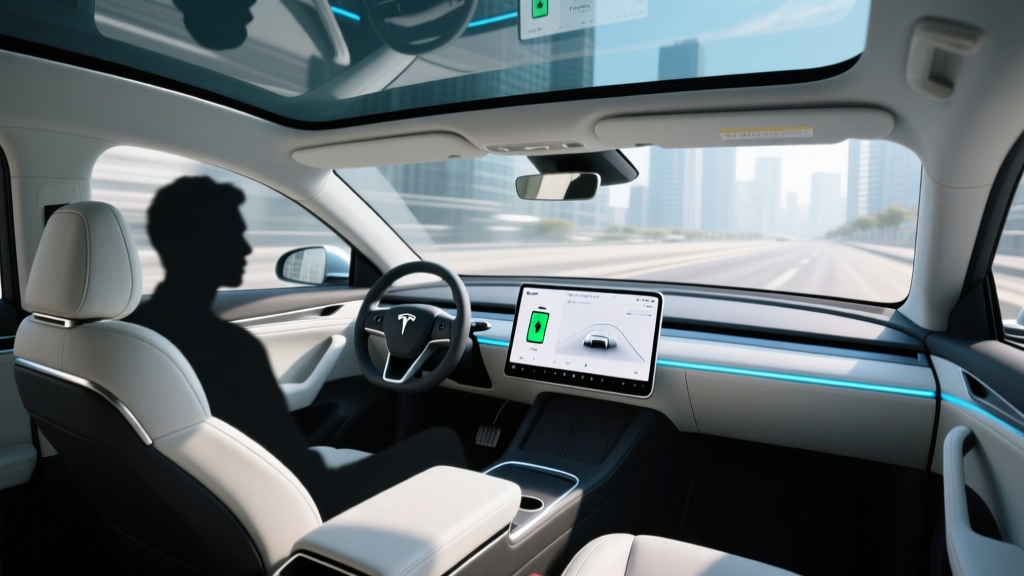
Without a driver, the traditional Tesla touchscreen moves to the center console between the two seats as a shared entertainment and trip-information display. Riders can expect:
- Real-time route mapping and ETA
- Streaming video and music (likely requiring a Tesla or rider account login)
- Climate and lighting controls accessible to passengers
- Potential integration with Tesla's app ecosystem for ride status and payment
No physical buttons, knobs, or stalks are present. The interface is entirely touchscreen-driven — consistent with Tesla's minimalist philosophy across the Model 3, Model Y, and Cybertruck.
Climate and Comfort
Tesla has confirmed the Cybercab includes a heat pump for cabin heating and cooling — a critical efficiency feature that avoids the range penalty of resistive heating in cold weather. Air vents are integrated into the dashboard in a slim, horizontal layout. Ambient lighting runs along the lower door panels and footwells, creating a lounge-like atmosphere that differentiates the experience from a standard Uber or Lyft ride.
While Tesla has not published exact cubic-foot measurements, the Cybercab's footprint is similar to a compact sedan. Estimated passenger volume: ~85-95 cu ft. Cargo space behind the two seats: ~15-20 cu ft — enough for two carry-on suitcases or several grocery bags. No frunk has been confirmed on the production-intent model. Legroom should be generous given the absence of front-seat track intrusion, likely exceeding 42 inches.
Announced Range, Battery, and Efficiency
The Cybercab is designed for high-utilization urban and suburban routes, not cross-country road trips. Tesla has stated the vehicle will target an EPA-estimated range of approximately 250 miles on a single charge. This is achievable with a relatively modest battery pack given the vehicle's light weight (estimated 3,500-3,800 lbs) and aerodynamic teardrop profile.
| Specification | Cybercab (Announced/Projected) |
|---|---|
| EPA Est. Range | ~250 miles (target) |
| Real-World Range Expectation | ~200-220 mi highway; ~170-190 mi in cold weather (30°F) |
| Battery Capacity | ~50-60 kWh usable (projected, LFP chemistry likely) |
| Efficiency | ~120-130 MPGe est. / ~26-28 kWh/100mi |
| Drivetrain | Rear-wheel drive, single motor |
| 0-60 mph | ~6.0 seconds (projected) |
| Horsepower | ~250-300 hp (est.) |
| Top Speed | Electronically limited (fleet-typical ~90 mph) |
Battery chemistry: Tesla has not confirmed the Cybercab's cell chemistry, but LFP (lithium iron phosphate) is the most likely candidate. LFP offers superior cycle life (3,000+ full cycles vs. ~1,500 for NMC), lower cost, and greater thermal stability — all priorities for a fleet vehicle that may charge daily and accumulate 50,000+ miles per year. The tradeoff is lower energy density, which is acceptable given the Cybercab's compact size and moderate range target.
A 250-mile EPA target sounds adequate for urban robotaxi duty, but fleet operators should plan for ~200 miles of usable range in practice. Highway-speed trips, cold weather (which can reduce range 15-25%), and the need to maintain a charge buffer for deadheading to chargers all eat into the sticker number. Tesla's fleet management software will likely enforce a 10-15% minimum SoC, further reducing effective range to ~170-185 miles between charges.
Charging Speed and Fleet Logistics
For a robotaxi, charging speed is arguably more important than range. Every minute a Cybercab sits at a charger is a minute it cannot earn revenue. Tesla has not published official DC fast-charge specs, but based on the projected battery size and Tesla's current Supercharger architecture, we can make informed estimates.
| Charge Level | Power / Rate | Time / Miles Added |
|---|---|---|
| Level 1 (120V) | ~1.4 kW | Not applicable for fleet use |
| Level 2 (240V) | ~11.5 kW (est.) | ~40-45 mi/hr; full charge in ~5-6 hrs |
| DC Fast Charge | ~170-250 kW peak (est.) | 10-80% in ~20-25 min (projected) |
| Tesla Wireless (Inductive) | ~11-19 kW (announced) | Depot charging overnight; ~5-6 hrs full |
Wireless charging is a headline feature. At the Cybercab unveil, Tesla demonstrated inductive charging pads that the vehicle can autonomously align with — no plug-in required. This is significant for fleet operations: vehicles can charge at depots without human intervention, reducing labor costs and enabling overnight top-ups. However, inductive charging is slower than wired DC fast charging and is best suited for overnight depot use rather than mid-day quick charges.
Charging curve reality: With a ~50-60 kWh LFP pack, peak charge rates will likely taper significantly above 60-70% SoC. Fleet operators will optimize by charging to 80% rather than 100% during peak hours, reserving full charges for overnight depot sessions. The 10-80% window is where the Cybercab will spend most of its fast-charging time, and a ~20-25 minute estimate in that window is competitive with current compact EVs.
Autonomous Driving: SAE Level 4, Not Level 2
The Cybercab is designed as a Level 4 autonomous vehicle — meaning it operates without any human driver in defined geographic and environmental conditions. This is fundamentally different from Tesla's current consumer vehicles, which use Autopilot and FSD (Supervised) — both SAE Level 2 systems that require the driver to remain fully engaged. The Cybercab has no steering wheel or pedals because no human will ever drive it. Regulatory approval for Level 4 operation is required in each jurisdiction before commercial service can begin.
Tesla's approach to autonomy relies on a vision-only sensor suite — cameras and neural networks, without LiDAR or radar. This is controversial in the autonomous driving industry, where competitors like Waymo (Alphabet) and Cruise (GM) use multi-sensor stacks including LiDAR for redundancy. Tesla argues that camera-based perception, trained on billions of miles of real-world driving data from its existing fleet, will eventually match or exceed LiDAR-equipped systems.
As of 2026, no Tesla vehicle has received regulatory approval for driverless Level 4 operation on public roads. The Cybercab's commercial launch depends on Tesla obtaining these approvals, which vary by state and municipality. Arizona, Nevada, Texas, and California have established frameworks for autonomous vehicle testing and deployment, but full commercial robotaxi permits remain limited.
- The Cybercab cannot be purchased by consumers — it is designed exclusively for Tesla's planned robotaxi fleet
- Level 4 operation requires regulatory approval in each service area; launch will be city-by-city
- Initial deployment will likely be limited to geofenced urban zones with favorable weather
- Vision-only autonomy may face challenges in heavy rain, fog, snow, or construction zones
- Timeline for widespread commercial availability remains uncertain beyond 2026 production start
Pricing, Business Model, and the Tax Credit Question
The Cybercab's economics are central to Tesla's pitch. CEO Elon Musk has stated that Tesla intends to produce the Cybercab at a cost below $30,000 per unit and charge riders approximately $0.20 per mile — undercutting both traditional rideshare services and personal car ownership on a per-mile basis.
| Cost Factor | Estimated Figure |
|---|---|
| Projected Unit Production Cost | <$30,000 (Tesla target) |
| Consumer Purchase Price | N/A — not sold to consumers (planned) |
| Rider Cost Per Mile | ~$0.20 (Tesla target) |
| Federal EV Tax Credit (§30D) | Potentially $7,500 per vehicle to Tesla (fleet buyer); subject to MSRP, income, and battery sourcing rules per IRS guidelines |
| Projected Fleet Battery Warranty | 8 yr / 100,000+ mi (est., consistent with Tesla fleet vehicles) |
Does the Cybercab qualify for the federal EV tax credit? The IRS §30D credit applies to new clean vehicles purchased for use. Since Tesla would own and operate the Cybercab fleet (or sell to fleet operators), the credit mechanics differ from consumer purchases. If Tesla sells Cybercabs to fleet partners, those buyers could potentially claim the credit — subject to:
- MSRP cap: $55,000 for sedans (Cybercab should clear this easily at <$30,000)
- Battery sourcing requirements: Critical minerals and battery components must meet escalating domestic-content thresholds per current IRS rules
- Buyer income: For fleet/corporate buyers, income caps do not apply in the same way as individual purchases
- Commercial clean vehicle credit (§45W): Fleet operators may alternatively qualify under this provision for vehicles above 14,000 lbs GVWR — unlikely to apply to the compact Cybercab
Tax credit eligibility for fleet EVs is complex. Fleet operators should consult a tax professional and review current-year IRS guidance on clean vehicle credits before modeling economics.
Tech Features and Rider Experience
Without driving duties, the Cybercab's technology is oriented entirely toward the passenger experience and fleet management:
Confirmed and Projected Tech
- Tesla Vision autonomy stack: Camera-only perception system powered by Tesla's custom AI inference hardware (likely HW5 or later)
- Central touchscreen: Shared display for route info, entertainment, and climate control
- Over-the-air updates: Continuous improvement of ride quality, routing, and entertainment — standard across all Tesla vehicles
- Wireless (inductive) charging: Autonomous alignment with depot charging pads
- Heat pump HVAC: Efficient climate control minimizing range impact
- App integration: Summon, ride tracking, payment, and preferences via Tesla app
- Interior monitoring: Cabin cameras for safety, cleanliness verification between rides, and lost-item recovery
Notable Drawbacks
- Two-seat limitation: Families of three or more cannot use the Cybercab — this is a hard capacity constraint
- No personal storage: No glovebox, limited cubbies — riders keep belongings on their laps or the floor
- Vision-only autonomy: Performance in adverse weather (heavy rain, snow, fog) remains an open question
- Accessibility: Butterfly doors and low-slung seating may challenge riders with mobility limitations; ADA compliance details are not yet published
- Privacy: Interior cameras and Tesla account integration raise data-privacy considerations for riders
Cybercab vs. Competitors: How Does It Compare?
The Cybercab enters a robotaxi market where Waymo already operates commercial driverless service in Phoenix, San Francisco, Los Angeles, and Austin using LiDAR-equipped Jaguar I-PACE vehicles. Cruise (GM) is working toward relaunch after its 2023 safety suspension. Amazon's Zoox has a purpose-built bidirectional vehicle in testing.
| Feature | Tesla Cybercab | Waymo (Jaguar I-PACE) | Zoox |
|---|---|---|---|
| Seats | 2 | 3-4 | 4 |
| Sensor Suite | Vision only | LiDAR + cameras + radar | LiDAR + cameras + radar |
| Commercial Service | Announced (2026+) | Live (multiple cities) | Testing (Las Vegas, SF) |
| Est. Range | ~250 mi | ~200 mi (modified I-PACE) | ~150 mi |
| Wireless Charging | Yes (inductive) | No | No |
| Est. Unit Cost | <$30,000 | ~$100,000+ (w/ sensors) | Not disclosed |
The Cybercab's primary advantage is cost. By eliminating LiDAR (which adds $10,000-$30,000+ per vehicle) and designing for mass production on Tesla's gigacasting lines, Tesla aims to produce a robotaxi at a fraction of the per-unit cost of competitors. The tradeoff is the unproven nature of vision-only Level 4 autonomy at scale.
Who Is the Cybercab For?
The Cybercab is not a vehicle you buy — it is a mobility service you use. Its ideal use cases include:
- Urban commuters who need a quick, affordable solo ride within a geofenced city zone
- Airport and transit connectors for single travelers or couples with light luggage
- Nightlife and event transportation where a compact, easy-to-enter vehicle is preferable
- Cost-conscious riders who want rideshare pricing below Uber/Lyft
It is not suited for families, group travel, grocery hauls requiring significant cargo space, or riders in areas outside the initial geofenced service zones.
Frequently Asked Questions
What is the real-world range of the Tesla Cybercab?
Tesla targets ~250 miles EPA-estimated, but fleet operators should plan for ~200 miles of practical range accounting for highway speeds, cold weather (15-25% reduction below freezing), and operational charge buffers. For urban stop-and-go routes with regenerative braking, real-world range may approach the EPA estimate more closely.
How fast does the Cybercab charge?
Projected DC fast charging peaks at ~170-250 kW, with a 10-80% charge in approximately 20-25 minutes. Level 2 charging at depots adds ~40-45 miles per hour. Wireless inductive charging at ~11-19 kW is designed for overnight depot use, not quick top-ups.
Can I buy a Tesla Cybercab for personal use?
No. Tesla has stated the Cybercab is designed exclusively for its robotaxi fleet. Consumers will access the vehicle through a ride-hailing service, not purchase it. Tesla has not announced any consumer-purchase variant.
Is the Cybercab actually self-driving?
The Cybercab is designed for SAE Level 4 autonomy — no human driver required in approved service areas. This is fundamentally different from Tesla's consumer Autopilot/FSD (Supervised) systems, which are Level 2 and require full driver attention. However, Level 4 regulatory approval has not been granted to Tesla in any jurisdiction as of 2026.
When will the Cybercab be available to riders?
Tesla has targeted production beginning in 2026, but commercial rider availability depends on regulatory approval in each service city. A realistic timeline for initial limited service in one or two cities is late 2026 to 2027, with broader rollout over subsequent years. Timelines for autonomous vehicles have historically slipped, so treat announced dates as optimistic.
Does the Cybercab qualify for the federal EV tax credit?
As a fleet vehicle not sold to individual consumers, the Cybercab does not qualify for the §30D consumer credit directly. However, Tesla or fleet partners purchasing the vehicles may be eligible for clean vehicle credits under current IRS rules, subject to battery sourcing and other requirements. Consult a tax professional for fleet-purchase credit modeling.
What are the biggest pros and cons of the Cybercab?
- Ultra-low projected rider cost (~$0.20/mi)
- Purpose-built robotaxi design — no compromise from a consumer vehicle
- Wireless inductive charging for autonomous depot operations
- LFP battery for long cycle life in high-utilization fleet use
- Heat pump for efficient cold-weather operation
- Butterfly doors for dramatic, accessible entry
- Only 2 seats — excludes families and groups
- Vision-only autonomy unproven at Level 4
- No regulatory approval for driverless operation yet
- Limited cargo space (~15-20 cu ft)
- Butterfly doors add mechanical complexity
- No confirmed ADA accessibility details
- Not available for consumer purchase
Note: The Tesla Cybercab is an announced vehicle with production targeted for 2026. All specifications in this article reflect Tesla's stated targets and industry projections. Final EPA range, battery capacity, charging speeds, and pricing will be confirmed when the vehicle enters production and receives regulatory certifications. Always verify current details via Tesla's official channels and NHTSA before making transportation decisions based on this information.