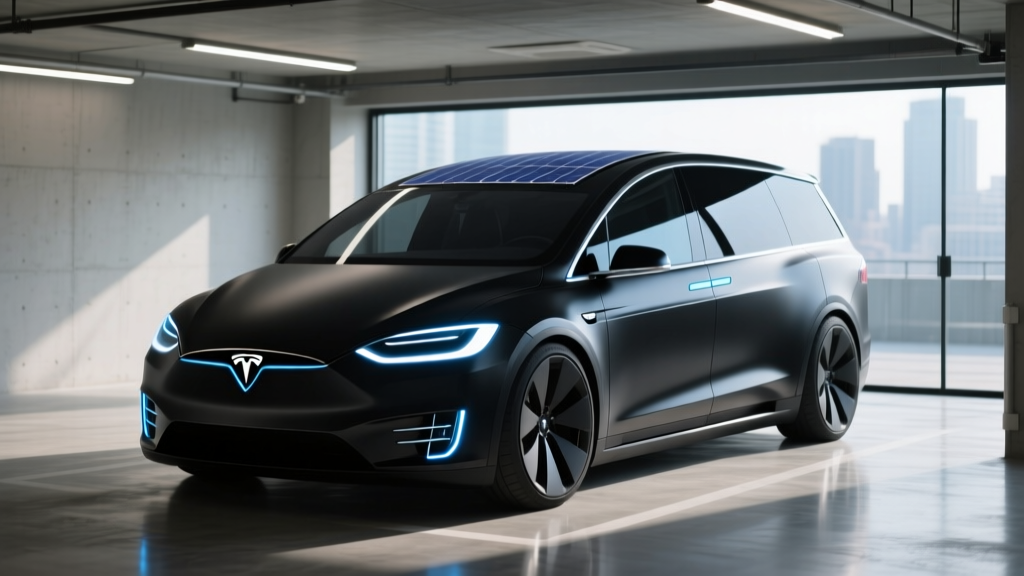
Ever since the Cybertruck's angular stainless-steel body hit production in late 2023, speculation has swirled around a larger sibling: the Tesla Cyber Van. As of early 2026, Tesla has not officially announced a production timeline, pricing, or confirmed specifications for a Cyber-branded van. What follows is a data-driven synthesis of Tesla's current platform capabilities, patent filings, executive commentary, and competitive landscape analysis — clearly separating what's known from what's estimated.
If and when Tesla brings a Cyber Van to market, it would enter a commercial and passenger EV van segment currently served by the Ford E-Transit, Mercedes-Benz eSprinter, and Rivian EDV (built for Amazon). Below, we break down the most credible projections and what buyers should watch for.
Projected Range, Battery, and Efficiency
Based on the Cybertruck's platform architecture and Tesla's current 4680 battery cell production, a Cyber Van would likely share the structural battery pack design introduced with the Cybertruck. Here's what the numbers suggest:
| Spec | Estimated (Single-Motor RWD) | Estimated (Dual-Motor AWD) |
|---|---|---|
| Battery Capacity | ~123 kWh usable (4680 cells, NMC) | ~123 kWh usable (4680 cells, NMC) |
| EPA Range (projected) | 280–320 miles | 250–290 miles |
| Efficiency (projected) | ~44–48 kWh/100 mi | ~48–52 kWh/100 mi |
| MPGe (projected) | ~75–80 MPGe combined | ~68–74 MPGe combined |
For context, the EPA's EV testing methodology already factors in some real-world variability, but large commercial vehicles with high frontal area and weight tend to see greater variance between sticker and actual range. The Ford E-Transit, for example, carries an EPA range of just 126 miles on a 68 kWh battery — a reflection of how energy-hungry full-size vans can be.
Charging Speed: DC Fast Charging and Home Level 2
Tesla's Supercharger network remains the gold standard for DC fast charging reliability. A Cyber Van would almost certainly use the NACS (North American Charging Standard) connector, now adopted industry-wide. Here's what charging performance would look like based on the Cybertruck's architecture:
| Charging Level | Power (kW) | Speed / Notes |
|---|---|---|
| Level 1 (120V household) | ~1.4 kW | ~3–4 mi/hr — emergency/trickle only |
| Level 2 (240V, 48A Wall Connector) | ~11.5 kW | ~25–30 mi/hr — full charge overnight in ~10–12 hrs |
| DC Fast (V3 Supercharger) | Peak ~250 kW | 10–80% in ~30–35 min (est.) — charge curve tapers significantly above 80% |
| DC Fast (V4 Supercharger) | Peak ~350 kW (if supported) | Potentially 10–80% in ~20–25 min if vehicle architecture allows |
Understanding the charge curve: Peak kW ratings (250 kW or 350 kW) represent the maximum rate at low state-of-charge (SoC). As the battery fills past ~50%, charging speed tapers to protect cell longevity. The "10–80% time" is the most useful real-world metric because charging above 80% slows dramatically — often to under 50 kW. For a ~123 kWh pack, expect the average sustained rate from 10–80% to be roughly 130–160 kW even at a V3 Supercharger.
For fleet operators, Level 2 depot charging at 11.5 kW per vehicle overnight would be the primary refueling method, with DC fast charging reserved for mid-day top-ups or longer route extensions.
Performance and Powertrain Projections
Tesla has never been shy about performance, even in workhorse vehicles. The Cybertruck demonstrated that a heavy, angular EV can still deliver sports-car acceleration. A Cyber Van would likely offer multiple powertrain configurations:
| Configuration | Horsepower (est.) | 0–60 mph (est.) | Drivetrain | Towing (est.) |
|---|---|---|---|---|
| Base RWD | ~350 hp | 6.5–7.5 sec | Single-motor, rear-wheel drive | 5,000–6,000 lbs |
| Dual-Motor AWD | ~600 hp | 4.5–5.5 sec | Dual-motor, all-wheel drive | 7,500–10,000 lbs |
| Tri-Motor (if offered) | ~800+ hp | 3.5–4.0 sec | Tri-motor AWD | 10,000+ lbs |
For a commercial van, acceleration matters less than payload capacity, cargo volume, and driveability in urban delivery routes. However, Tesla's approach has consistently been to offer performance that exceeds segment norms — the Cybertruck AWD hits 60 mph in 3.9 seconds, which is extraordinary for a 6,800-pound truck.
Cargo, Passenger Space, and Dimensions
The Cyber Van's most critical selling point would be interior volume. Based on patent filings and the Cybertruck's dimensional scaling, here's what a full-size Tesla van might offer:
- Cargo volume (estimated): 250–350 cubic feet behind the front seats (cargo variant), competing with the Ford E-Transit's 246.7 cu ft (extended high-roof) and the Mercedes eSprinter's 312 cu ft
- Roof heights: Likely two options — standard (~54 in interior) and high-roof (~68+ in interior), enabling stand-up cargo loading
- Passenger variant: Potential for 7–15 seats in a shuttle configuration, with configurable row layouts
- Wheelbase options: Two lengths anticipated — a standard (~130 in) and extended (~148 in) — to serve both urban delivery and long-haul cargo needs
- Payload capacity (est.): 2,500–3,800 lbs depending on configuration
A key advantage of Tesla's skateboard platform — with the battery integrated into the floor structure — is a flat load floor and lower step-in height compared to converted ICE vans. This matters for delivery drivers making dozens of stops per day.
Pricing, Trims, and Federal Tax Credit Eligibility
Pricing for an unreleased vehicle is inherently speculative, but we can anchor estimates to Tesla's current lineup and competitive positioning:
| Trim (Projected) | Est. MSRP | §30D Tax Credit Eligible? | Est. After Credit |
|---|---|---|---|
| Base RWD Cargo Van | $55,000–$62,000 | Likely yes (under $80K van cap) | $47,500–$54,500 |
| Dual-Motor AWD Cargo | $65,000–$75,000 | Likely yes | $57,500–$67,500 |
| Passenger (7–12 seat) | $70,000–$85,000 | Depends on MSRP cap & classification | Varies |
Understanding §30D federal tax credit rules (2026): Under current IRS guidelines, the federal EV tax credit offers up to $7,500 for qualifying new EVs. However, eligibility depends on multiple factors:
- MSRP caps: Vans, SUVs, and pickup trucks qualify up to an $80,000 MSRP cap (sedans are capped at $55,000)
- Buyer income limits: Modified adjusted gross income (MAGI) must not exceed $300,000 (joint filers), $225,000 (head of household), or $150,000 (single)
- Battery sourcing requirements: A percentage of critical minerals and battery components must be sourced from the U.S. or free-trade-agreement partners — these thresholds increase annually
- Point-of-sale transfer: As of 2024, buyers can transfer the credit to the dealer at purchase, reducing the upfront cost rather than waiting for a tax refund
- Commercial vehicle credit (§45W): Fleet buyers purchasing for business use may qualify for a separate commercial clean vehicle credit of up to $7,500 (vehicles under 14,000 lbs GVWR) or $40,000 (heavier vehicles)
Consult a tax professional before relying on credit eligibility — rules change, and battery-sourcing compliance varies by production batch. Tesla's U.S. manufacturing (Gigafactory Texas, Gigafactory Nevada) positions it well for domestic content compliance, but specific cell-sourcing for a future Cyber Van remains unconfirmed.
Tech, Driver Assistance, and Software
Tesla vehicles are defined as much by their software as their hardware. A Cyber Van would inherit:
Likely Standard Tech
- 15.4" or larger central touchscreen with Tesla OS
- Over-the-air (OTA) software updates
- Tesla Vision camera suite (8 cameras)
- Basic Autopilot (lane centering + adaptive cruise)
- Tesla mobile app with remote climate, location, and charging status
- Sentry Mode dashcam recording
- Digital key via phone
Potential Limitations
- FSD (Supervised) would be a $8,000 add-on — still SAE Level 2, not self-driving
- No Apple CarPlay or Android Auto (Tesla's closed ecosystem)
- Limited physical controls — most functions routed through touchscreen
- Panel gap and build-quality variability seen in Cybertruck production
- Stainless-steel exoskeleton may complicate aftermarket upfitting for commercial bodies
Competitive Landscape: Cyber Van vs. Current Electric Vans
| Spec | Tesla Cyber Van (est.) | Ford E-Transit | Mercedes eSprinter | Rivian EDV |
|---|---|---|---|---|
| EPA Range | 280–320 mi (est.) | 126 mi | 150–200 mi | ~150 mi (est.) |
| Battery (kWh) | ~123 kWh | 68 kWh | 113 kWh | ~100 kWh (est.) |
| Max DC Charge | ~250 kW | 115 kW | 115 kW | ~150 kW (est.) |
| Max Cargo (cu ft) | 250–350 (est.) | 246.7 | 312 | ~500 (cargo variant) |
| Starting MSRP | $55K–$62K (est.) | ~$51,000 | ~$74,000 | Not retail (fleet only) |
| Availability | Not yet announced | On sale now | On sale now | Amazon exclusive |
The Cyber Van's projected range advantage is substantial — nearly double the Ford E-Transit's EPA rating. This matters enormously for fleet operators calculating route feasibility and total cost of ownership. However, the E-Transit and eSprinter are available today, with established dealer service networks and commercial upfitter relationships that Tesla has yet to build for commercial vehicles.
Battery Warranty and Longevity
Based on Tesla's current warranty structure, a Cyber Van would likely carry:
- Battery & drive unit: 8 years / 100,000–150,000 miles (whichever comes first), with a minimum 70% capacity retention threshold during the warranty period
- Vehicle limited warranty: 4 years / 50,000 miles bumper-to-bumper
Tesla's 4680 cells use an NMC (nickel-manganese-cobalt) chemistry in the Cybertruck, offering higher energy density than LFP (lithium iron phosphate). NMC cells typically show 8–12% degradation over 100,000 miles based on Tesla's fleet data. For a commercial van driven 30,000–50,000 miles annually, reaching 150,000 miles in 3–5 years is realistic — making the warranty mileage cap a critical consideration for fleet buyers.
LFP chemistry, used in Tesla's Standard Range Model 3 and Model Y, offers longer cycle life and can tolerate regular 100% charging without accelerated degradation. If Tesla offers an LFP variant of the Cyber Van (lower range, lower cost), it could be ideal for depot-based delivery fleets that charge nightly and don't need 300+ miles of range.
Who Should Wait for the Cyber Van — and Who Should Buy Now
Choose the Tesla Cyber Van (wait) if:
- You need 250+ miles of real-world range for longer delivery routes or inter-city shuttle service
- Access to the Tesla Supercharger network is essential for your operational area
- You want OTA software updates and Tesla's tech-forward infotainment ecosystem
- Your purchase timeline extends to 2027 or beyond
- You value over-the-air improvements and a rapidly evolving feature set
Buy a Ford E-Transit or Mercedes eSprinter now if:
- You need an electric van today for immediate fleet deployment
- Your routes are under 120 miles daily and you can depot-charge overnight
- You require established commercial dealer service and upfitter partnerships
- You need specific body configurations (cutaway, chassis cab) that existing platforms support
- Budget certainty matters — pricing is confirmed and commercial credits are claimable now
Frequently Asked Questions
What is the real-world range of the Tesla Cyber Van?
Since the Cyber Van is not yet in production, no real-world testing exists. Based on the projected ~123 kWh battery and van aerodynamics, we estimate 280–320 miles EPA for a RWD variant. Real-world highway driving at 70+ mph would likely yield 220–260 miles. Cold weather could reduce this further to 180–220 miles in freezing conditions.
How fast does it charge at home and on the road?
Projected specs based on the Cybertruck platform: Level 2 home charging at ~11.5 kW (Tesla Wall Connector, 48A) would add roughly 25–30 miles of range per hour, fully charging a depleted pack in 10–12 hours. DC fast charging at a V3 Supercharger would peak at ~250 kW, with a 10–80% charge in approximately 30–35 minutes.
Does the Tesla Cyber Van qualify for the $7,500 federal EV tax credit?
Potentially yes, but with important caveats. Under current IRS §30D rules, vans qualify with an MSRP cap of $80,000. The buyer must also meet income limits ($300K joint / $150K single) and the vehicle must satisfy battery-sourcing requirements that tighten annually. Fleet buyers may qualify for the separate §45W commercial credit instead. Always verify eligibility at purchase time with a tax professional.
When will the Tesla Cyber Van be available?
Tesla has not confirmed a production date. Elon Musk has referenced a van concept in various interviews and earnings calls, and Tesla has filed patents related to van-style body structures. The most realistic estimate, based on Tesla's product cadence and Cybertruck production ramp, would place a potential reveal in 2026–2027 with deliveries no earlier than late 2027 or 2028. This timeline is speculative.
Is the Cyber Van worth waiting for vs. buying a Ford E-Transit?
It depends on your timeline and range needs. The E-Transit's 126-mile EPA range works well for short urban delivery loops with overnight depot charging, and it's available now with established commercial support. If your routes regularly exceed 150 miles or you need DC fast-charging capability for mid-shift top-ups, the Cyber Van's projected 280+ mile range and 250 kW charging would be transformative — but only if you can wait 1–3 years for production.
Will it have a passenger version for shuttle or family use?
Tesla's patents and the Cybertruck's platform suggest both cargo and passenger variants are possible. A 7–12 seat passenger configuration could serve airport shuttles, hotel transport, and large families. However, Tesla has not confirmed body styles or interior configurations. The passenger version's MSRP would need to stay under $80,000 to qualify for the §30D tax credit.
This article reflects information available as of early 2026. Tesla Cyber Van specifications, pricing, and availability are preliminary projections and subject to change. We will update this page when Tesla provides official confirmation. For current EV incentives, consult IRS.gov. For efficiency data, refer to fueleconomy.gov.