The phrase "Tesla cruise ship" has become shorthand among EV road-trippers for the experience of settling into a Tesla—particularly the Model S—and letting the Supercharger network carry you across the country the way a liner carries you across an ocean. But does the 2026 Tesla Model S actually earn that moniker? Below, we break down the real-world range, charging logistics, cabin comfort, and total trip cost to see if this flagship sedan truly delivers a first-class voyage.
EPA-estimated: 402 miles (Long Range AWD, 19" wheels).
Real-world highway (70 mph, 75°F): ~340–360 miles.
Cold weather (30°F, highway): ~280–310 miles—plan Supercharger stops accordingly.
Range, Battery, and Efficiency
The 2026 Model S Long Range AWD carries a 100 kWh battery pack (approximately 95 kWh usable) using NMC (nickel-manganese-cobalt) chemistry. NMC offers higher energy density than LFP, which is why Tesla reserves it for its longest-range vehicles—though it does require owners to avoid routinely charging to 100% for daily use to minimize long-term degradation.
Efficiency is rated at 120 MPGe combined, translating to roughly 28 kWh per 100 miles. On a road trip at sustained highway speeds, expect consumption to climb to 32–35 kWh/100mi due to aerodynamic drag. That math yields the ~340-mile real-world figure, which still outdistances nearly every EV sedan on the market. For comparison, the Lucid Air Grand Touring achieves an EPA 516 miles but starts at over $125,000.
| Spec | 2026 Model S Long Range AWD |
|---|---|
| EPA Range | 402 miles |
| Battery (usable) | ~95 kWh, NMC |
| Efficiency | 120 MPGe / 28 kWh/100mi |
| 0–60 mph | 3.1 seconds |
| Horsepower | 670 hp (dual-motor AWD) |
| Drivetrain | Dual-motor AWD |
| Cargo (rear + frunk) | 28 cu ft (rear) + 3.1 cu ft (frunk) |
| Rear legroom | 35.4 in |
| Battery warranty | 8 yr / 150,000 mi |
| Base MSRP | $74,990 |
Charging Speed: The Supercharger Advantage
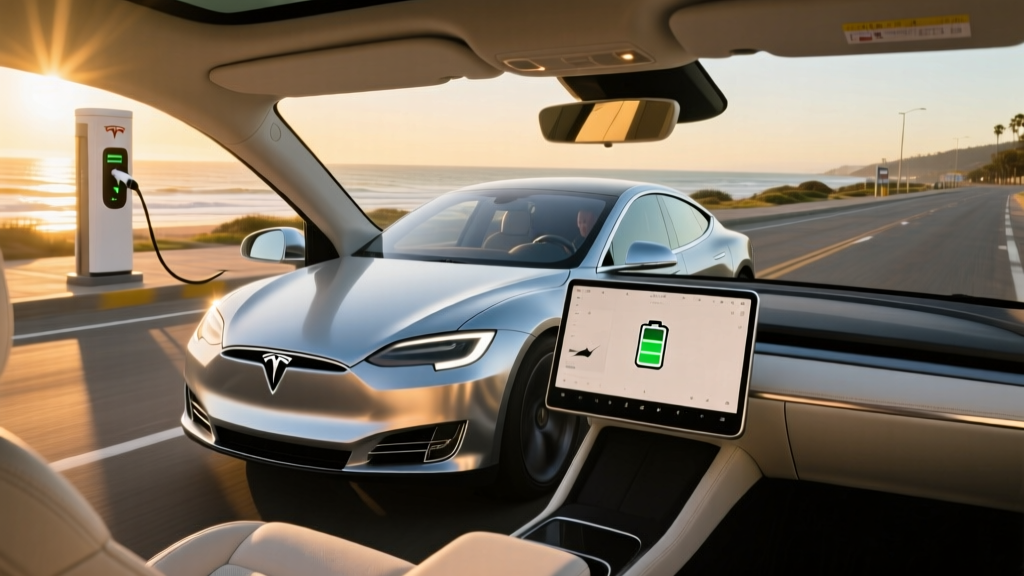
What makes the "Tesla cruise ship" metaphor stick is the Supercharger network. The 2026 Model S supports a peak 250 kW DC fast-charge rate on V3 Superchargers. In practice, a 10–80% session takes roughly 25–28 minutes, with the charge curve tapering noticeably above 60%. Sustained average power during that window hovers around 160–180 kW—not the headline 250 kW peak.
With Tesla's adoption of the NACS (North American Charging Standard) connector now universal across its lineup, the Model S plugs directly into Superchargers without an adapter. Tesla owners also benefit from built-in route planning that preconditions the battery before arrival at a stall—a feature that measurably improves charge speed in cold weather.
| Charging Level | Power | Speed / Time |
|---|---|---|
| Level 1 (120V) | ~1.4 kW | ~3–4 mi/hr |
| Level 2 (240V, 48A Wall Connector) | 11.5 kW | ~34 mi/hr |
| DC Fast (V3 Supercharger) | Peak 250 kW | 10–80% in ~25–28 min |
Home charging note: A full Level 2 install (Tesla Wall Connector, 60A circuit, 240V) typically costs $800–$2,000 including electrician labor and permits, depending on panel proximity. A full overnight charge from 20% to 90% takes roughly 7–8 hours.
Performance and Driving Dynamics
The Long Range AWD's dual-motor setup delivers 670 horsepower and a 3.1-second 0–60 mph time. That's sports-car acceleration in a sedan that seats five. The Plaid trim (1,020 hp, 1.99 sec 0–60) exists for those who want hypercar numbers, but the Long Range is the road-trip sweet spot—more range, lower price, and still absurdly quick.
Ride quality is where the "cruise ship" comparison gets tested. The adaptive air suspension soaks up highway imperpressions well, and the cabin is quiet at speed. However, some owners note that the yoke-style steering wheel (still standard on Model S) takes adjustment on long, straight interstate stretches. The traditional round wheel is available as a no-cost option.
Pricing, Trims, and Federal Tax Credit
The 2026 Model S starts at $74,990 (Long Range AWD), with the Plaid at $89,990. Destination and order fees add roughly $1,390.
Under current IRS §30D rules, the Model S does not qualify for the $7,500 federal tax credit because its MSRP exceeds the $55,000 sedan cap (the cap is $80,000 for SUVs/pickups/vans). Buyers with modified adjusted gross income above $150,000 (single) or $300,000 (joint) would also be excluded regardless. Point-of-sale transfer is available for qualifying vehicles, but the MSRP cap is the disqualifying factor here.
| Trim | Base MSRP | Federal Credit | Effective Price |
|---|---|---|---|
| Long Range AWD | $74,990 | $0 (sedan MSRP cap) | $74,990 |
| Plaid | $89,990 | $0 (sedan MSRP cap) | $89,990 |
State incentives vary widely. California's CVRP, Colorado's innovative motor vehicle credit, and other state programs may still apply—check your state energy office or a qualified tax professional for specifics.
Tech, Interior, and Standout Features
The Model S centers on a 17-inch touchscreen with Tesla's latest software stack. Wireless CarPlay and Android Auto are now supported (a long-requested addition). The 12.3-inch instrument cluster and rear 8-inch passenger screen round out the display array.
Autopilot comes standard, offering adaptive cruise and lane-centering. Full Self-Driving (Supervised) remains a $8,000 add-on. To be explicit: FSD is a SAE Level 2 driver-assistance system. The driver must remain engaged, hands on or near the wheel, at all times. It is not autonomous driving—only Level 4 services like Waymo operate without a human driver.
• Requires active driver supervision at all times.
• May not recognize construction zones, temporary lane markings, or debris.
• Performance degrades in heavy rain, snow, or fog.
• SAE Level 2 — not a self-driving system.
Other standout features: a 22-speaker audio system, HEPA air filtration (Bioweapon Defense Mode), a glass panoramic roof, and over-the-air updates that continue to add functionality years after purchase.
Cargo, Passenger Space, and Practicality
The Model S hatchback design provides 28 cubic feet of rear cargo space (seats up) and up to 79 cu ft with the 60/40 rear seats folded. The front trunk (frunk) adds 3.1 cu ft—enough for a charging cable kit and a small bag. Rear legroom is 35.4 inches, adequate for adults on long trips, though the sloping roofline limits headroom for passengers over 6 feet.
For families, two rear-facing child seats fit comfortably. The flat floor (no transmission tunnel) makes the middle seat more usable than in most sedans. Towing is not a strength: the Model S is not rated for towing, which eliminates it from the trailer-hauling use case.
Pros and Cons: The Verdict
- Best-in-class Supercharger network for stress-free road trips
- 402-mile EPA range; real-world ~340+ miles on highway
- 670 hp dual-motor AWD with 3.1-sec 0–60
- Spacious hatchback cargo layout (28 cu ft rear)
- Continuous OTA updates keep the car current
- 8-year/150,000-mile battery warranty
- No federal tax credit (exceeds $55K sedan MSRP cap)
- Starting at ~$75K, it's a premium investment
- Yoke steering divisive; round wheel optional but not default
- FSD (Supervised) costs $8,000 extra and remains Level 2
- 250 kW peak DC charge rate trails 800V competitors (Porsche, Hyundai)
Who Should Buy the Tesla Model S?
• You road-trip frequently and value Supercharger reliability over absolute range.
• You want a luxury sport sedan with genuine 4-seat comfort and hatchback versatility.
• You prioritize software, OTA updates, and tech-forward ownership.
Look elsewhere if:
• You need federal tax credit eligibility (consider the Model 3, which may qualify).
• You need towing capability (look at the Rivian R1S or Tesla Model X).
• You want 800V ultra-fast charging (Porsche Taycan or Hyundai Ioniq 5 charge faster peak-to-peak).
Frequently Asked Questions
What is the real-world range of the 2026 Tesla Model S?
EPA-rated at 402 miles, expect roughly 340–360 miles at highway speeds in mild weather and 280–310 miles in freezing temperatures. Preconditioning and moderate speeds help close the gap.
How fast does the Model S charge at home and on the road?
On a V3 Supercharger (250 kW peak), 10–80% takes about 25–28 minutes. At home on a Level 2 Wall Connector (11.5 kW), you'll add roughly 34 miles per hour of charging, or a near-full charge overnight.
Does the Model S qualify for the federal EV tax credit?
No. Under current IRS §30D rules, the Model S exceeds the $55,000 MSRP cap for sedans. State incentives may still apply.
Is the Model S worth it vs. the Lucid Air or Porsche Taycan?
The Model S wins on Supercharger network access and cargo versatility. The Lucid Air offers more EPA range (up to 516 mi) but less charging infrastructure. The Taycan charges faster (800V architecture) but has less range and no hatchback. Your priority—network, range, or charge speed—determines the winner.
Is Tesla's FSD actually self-driving?
No. FSD (Supervised) is an SAE Level 2 driver-assist system. You must remain fully engaged as the driver. It handles many highway and city scenarios but cannot replace an attentive human.
How long will the Model S battery last?
Tesla warranties the battery for 8 years or 150,000 miles (whichever comes first), guaranteeing at least 70% capacity retention. Real-world data from fueleconomy.gov and owner surveys suggest NMC packs in Teslas typically retain 85–90% capacity at 100,000 miles with proper charging habits (daily limit set to 80–90%).