Quick Verdict: The Cream Interior Is the Model Y's Most Polarizing Option
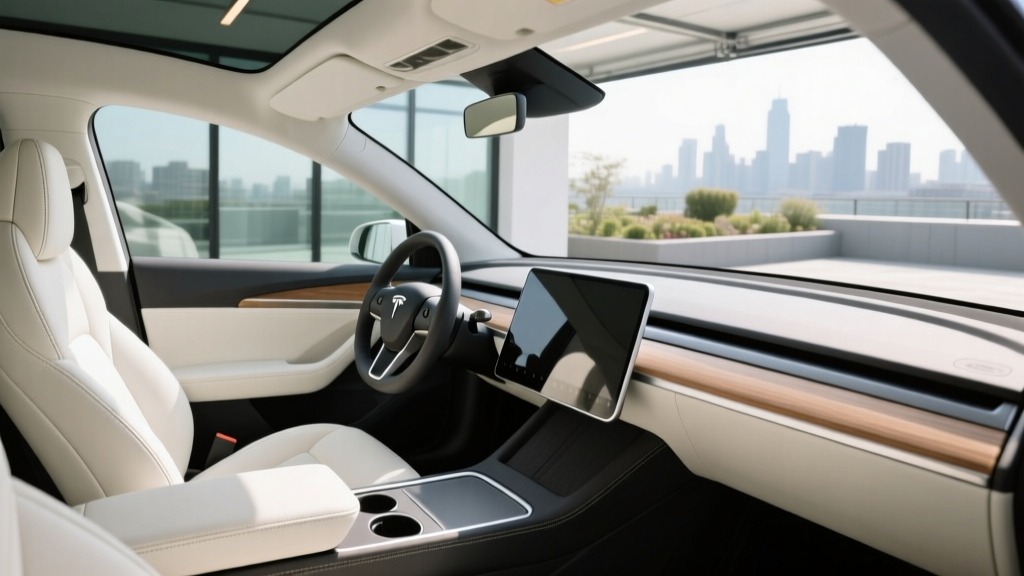
If you've spent any time browsing Tesla forums or configurator screenshots, you've seen the debate: black or cream? The Tesla cream interior — officially listed as "Black and White" on Tesla's order page — transforms the otherwise monochromatic Model Y cabin into something closer to a Scandinavian lounge. For 2026, the refreshed Model Y (the "Juniper" generation introduced in early 2025) carries this two-tone option forward, and it remains a $1,000 upgrade over the standard all-black cabin.
But aesthetics aside, the 2026 Model Y Long Range AWD is a serious EV contender. With an EPA-estimated 320 miles of range, a peak 250 kW DC fast-charging rate, and a starting MSRP of $44,990, it sits squarely in the sweet spot for family EV buyers. The cream interior adds visual space and a premium feel — but does it hold up to real-world use with kids, dogs, and denim? We'll cover that alongside the hard numbers every buyer needs.
Specs at a Glance: 2026 Tesla Model Y Long Range AWD
| Attribute | 2026 Model Y Long Range AWD |
|---|---|
| EPA Range | 320 miles |
| Battery (usable) | ~75 kWh, NMC (nickel manganese cobalt) |
| Drivetrain | Dual-motor AWD |
| Horsepower | 384 hp |
| 0–60 mph | 4.8 seconds |
| Peak DC Fast Charge | 250 kW |
| 10–80% DC Charge Time | ~27 minutes |
| Level 2 Charge Rate | 11.5 kW (~44 mi/hr) |
| Efficiency | 122 MPGe combined / 28 kWh/100 mi |
| Cargo Volume (rear seats up / down) | 30.2 / 72.1 cu ft |
| Rear Legroom | 41.6 in |
| Base MSRP | $44,990 |
| Cream Interior Option | +$1,000 |
| Battery & Drive Unit Warranty | 8 years / 120,000 miles |
Range and Efficiency: EPA Sticker vs. Real-World Driving
EPA Estimate: 320 miles
Real-World Expectation: ~270–290 miles on mixed highway driving (70–80 mph); expect ~230–250 miles in sub-freezing winter conditions with cabin heat active.
The 2026 Model Y Long Range AWD carries a 320-mile EPA rating, which fueleconomy.gov confirms. That number is achievable in moderate temperatures at city speeds with regenerative braking doing heavy lifting. However, highway driving at 75+ mph pushes energy consumption closer to 32–34 kWh/100 mi, dropping effective range to the 270–290 mile window.
Cold weather remains the great equalizer. NMC chemistry in the Model Y's ~75 kWh pack loses efficiency below freezing, and cabin heating draws significant power even with Tesla's heat pump. In our experience, 20°F days with highway driving compress range to roughly 230–250 miles. Preconditioning the battery while plugged in mitigates some of this loss, but buyers in northern climates should plan charging stops conservatively on winter road trips.
Efficiency-wise, the Model Y's 122 MPGe combined (28 kWh/100 mi) is competitive with the Hyundai Ioniq 5 (114 MPGe) and slightly behind the BMW iX xDrive50 (86 MPGe, but that's a heavier, larger vehicle). Tesla's thermal management and motor efficiency remain class-leading for the crossover segment.
Charging Speed: DC Fast, Level 2, and the Supercharger Advantage
| Charging Level | Power | Miles Added per Hour | Notes |
|---|---|---|---|
| Level 1 (120V household) | ~1.4 kW | ~5 mi/hr | Emergency/trickle only |
| Level 2 (240V home) | 11.5 kW | ~44 mi/hr | Full charge in ~7 hours |
| DC Fast Charge (peak) | 250 kW | Up to ~1,000 mi/hr (at peak) | 10–80% in ~27 min |
The Model Y Long Range accepts up to 250 kW at a V3 or V4 Tesla Supercharger. In practice, peak charge rate holds from roughly 10% to 35% State of Charge (SoC), then tapers progressively. The 10–80% session takes approximately 27 minutes under ideal battery-temperature conditions. Above 80%, the charge curve drops sharply — expect 80–100% to add another 15–20 minutes. Tesla's navigation system handles battery preconditioning automatically when you route to a Supercharger, which is essential for hitting peak rates.
For home charging, the Model Y's onboard charger maxes out at 11.5 kW (48 amps on a 60-amp circuit). A typical overnight session from 20% to 80% takes about 4.5–5 hours on a Tesla Wall Connector or equivalent Level 2 unit. Installation costs for a dedicated 60-amp circuit range from $500 to $2,000 depending on panel proximity and local permitting — budget for a licensed electrician to assess your 200-amp panel capacity.
The Model Y uses the NACS (North American Charging Standard) connector natively. This gives access to Tesla's Supercharger network — over 6,000 V3/V4 stalls in the U.S. — without adapters. Non-Tesla networks like Electrify America and EVgo are accessible via a CCS-to-NACS adapter (included with some vehicles or available for ~$200).
The Cream Interior: Materials, Durability, and Daily Life
Let's address the core question: how does the Tesla cream interior actually live after months of use?
The "Black and White" interior uses Tesla's vegan leather (a polyurethane-based synthetic) on the seats, door panels, and center console armrests. The material is smooth, moderately soft, and notably resistant to staining compared to genuine light-colored leather. Denim dye transfer — the bane of white leather seats — is less of a concern here, though not entirely absent with raw or dark unwashed denim over extended periods.
Tesla applies a stain-resistant coating to the seats, and most owners report that coffee spills, pen marks, and food smudges wipe clean with a damp microfiber cloth. However, the seat bolsters and piping edges do accumulate grime over time and require periodic deep cleaning. If you have toddlers in car seats, expect scuff marks on the lower bolsters that are difficult to fully remove.
Visually, the cream interior dramatically opens up the cabin. The white seats, white door panels, and piano-black center console create a contrast that makes the Model Y's already-minimalist interior feel airy and premium. It photographs exceptionally well and is the most popular choice among buyers who prioritize cabin aesthetics. The trade-off is maintenance awareness — you'll notice dirt sooner, which means cleaning more often.
For 2026, Tesla includes ventilated front seats and heated rear seats as standard on the Long Range trim, a welcome upgrade from prior model years. The panoramic glass roof remains standard, though Tesla has improved the infrared-reflective coating to reduce cabin heat soak in summer.
Performance and Driving Dynamics
The dual-motor AWD powertrain produces 384 horsepower and delivers a 4.8-second 0–60 mph time. That's quick for a family crossover, and the instant torque makes highway merging and city acceleration effortless. The Model Y's single-speed transmission means there's no shift shock — just linear, continuous pull.
Ride quality in the Juniper generation is noticeably improved over the pre-2025 Model Y. Tesla retuned the suspension, added acoustic glass, and improved sound deadening. The result is a quieter, more compliant ride, though it still leans sporty compared to a Hyundai Ioniq 5 or Kia EV6. The 2026 Model Y's steering is precise but heavy at low speeds — a characteristic Tesla trait that some drivers love and others find fatiguing in parking lots.
Regenerative braking remains strong and adjustable. Tesla's one-pedal driving mode allows most city driving without touching the brake pedal, though the blend between regen and friction braking can feel slightly abrupt compared to competitors with smoother transitions.
Tech, Autopilot, and the Driver-Assist Reality
SAE Automation Level: Level 2 (partial automation). Tesla Autopilot and Full Self-Driving (Supervised) require continuous driver engagement. You are responsible for the vehicle at all times. This is not self-driving.
The 2026 Model Y runs Tesla's latest software on a 15.4-inch center touchscreen. The interface remains the industry benchmark for responsiveness, over-the-air updates, and integrated trip planning. Apple CarPlay and Android Auto are still not supported natively — Tesla's ecosystem is self-contained, which frustrates some buyers but satisfies others who prefer the integrated navigation and media.
Standard Autopilot includes Traffic-Aware Cruise Control and Autosteer (lane centering). The optional Full Self-Driving (Supervised) package, currently $8,000, adds automated lane changes, traffic-light and stop-sign recognition, and city-street navigation. FSD has improved substantially in 2025–2026, but it still requires active supervision and makes occasional errors on construction zones, unprotected left turns, and poorly marked roads. NHTSA continues to monitor Tesla's Autopilot-related incidents, and buyers should treat FSD as a convenience feature, not a replacement for attention.
Other notable tech: Tesla's Sentry Mode (360° parking surveillance), Dog Mode (climate control for pets), and the Tesla app's remote preconditioning and location tracking are all included and best-in-class for this segment.
Pricing, Tax Credits, and Total Cost
| Item | Cost |
|---|---|
| 2026 Model Y Long Range AWD (base) | $44,990 |
| Cream (Black & White) Interior | +$1,000 |
| Destination Fee | +$1,390 |
| Paint (Pearl White Multi-Coat) | +$1,000 |
| As-Tested Price (with cream interior) | $48,380 |
| Federal Tax Credit (§30D, if eligible) | Up to $7,500 |
| Effective Price After Max Credit | ~$40,880 |
The 2026 Model Y qualifies for the IRS §30D federal tax credit, but eligibility is not automatic. Here's what you need to know:
- MSRP Cap: The Model Y is classified as an SUV, so the MSRP cap is $80,000. All trims clear this easily.
- Buyer Income Cap: Modified adjusted gross income must not exceed $150,000 (single), $225,000 (head of household), or $300,000 (married filing jointly).
- Battery Sourcing: The credit splits into two $3,750 halves — one for critical-mineral sourcing and one for battery-component manufacturing. Tesla's U.S. battery production (using Panasonic cells at the Nevada Gigafactory) has historically satisfied both requirements for the Model Y, but sourcing rules tighten annually. Verify current eligibility on fueleconomy.gov's credit lookup before purchasing.
- Point-of-Sale Transfer: As of 2024, you can transfer the credit to the dealer at purchase, reducing your out-of-pocket cost immediately rather than waiting for tax filing.
If you qualify for the full $7,500, the effective price of a cream-interior Model Y drops to roughly $40,880 — competitive with a well-equipped Toyota RAV4 Hybrid when you factor in fuel savings over five years.
Pros, Cons, and Who Should Buy
Pros
- 320-mile EPA range is ample for most road trips
- Supercharger network access (NACS native) remains the gold standard
- Cream interior elevates cabin feel significantly
- Class-leading software, OTA updates, and app integration
- Strong efficiency (122 MPGe) keeps charging costs low
- 8-year/120,000-mile battery warranty
Cons
- Cream interior requires more frequent cleaning
- No Apple CarPlay or Android Auto
- FSD (Supervised) is expensive and still requires full attention
- Ride quality improved but still firmer than rivals
- Tax credit eligibility depends on income and sourcing — not guaranteed
- Insurance premiums tend to be higher than segment average
Choose the Model Y with cream interior if: You prioritize cabin aesthetics, rely on the Supercharger network for road trips, can charge at home, and fall within §30D income limits. It's ideal for tech-forward commuters and small families who value range and software polish.
Consider alternatives (Ioniq 5, EV6, RAV4 PHEV) if: You need Apple CarPlay, prefer a softer ride, want guaranteed tax-credit eligibility without sourcing uncertainty, or can't install a Level 2 charger at home.
Frequently Asked Questions
What is the real-world range of the 2026 Tesla Model Y?
The EPA rates it at 320 miles, but expect 270–290 miles on highway-heavy trips at 70–80 mph, and 230–250 miles in freezing temperatures with cabin heat. Preconditioning while plugged in helps preserve range.
How fast does the Model Y charge at home and on the road?
At home on Level 2 (240V), it charges at 11.5 kW, adding about 44 miles per hour — a full overnight charge is realistic. On DC fast charging, it peaks at 250 kW at V3/V4 Superchargers, reaching 10–80% in approximately 27 minutes.
Does the 2026 Model Y qualify for the $7,500 federal tax credit?
It can, but eligibility depends on your income (under $150K single / $300K joint), the vehicle's MSRP (under $80K — the Model Y qualifies), and battery-sourcing compliance, which tightens yearly. Check fueleconomy.gov and consult a tax professional before relying on the credit.
Is the Tesla cream interior hard to keep clean?
The vegan leather is more stain-resistant than genuine white leather, and most spills wipe clean easily. However, seat bolster edges and piping will show dirt accumulation over time. If you have young children or wear dark raw denim frequently, expect to clean seats more often than with the all-black option.
Is the Model Y worth buying over the Hyundai Ioniq 5 or Kia EV6?
The Model Y wins on Supercharger network access, software ecosystem, and efficiency. The Ioniq 5 and EV6 offer 800V architecture (faster peak charging on compatible chargers), Apple CarPlay/Android Auto, and a slightly more comfortable ride. If you road-trip frequently, the Tesla charging network is a significant advantage. If you prioritize infotainment flexibility and ride comfort, test-drive the Korean alternatives.
What is the battery warranty on the 2026 Model Y?
Tesla covers the battery and drive unit for 8 years or 120,000 miles, whichever comes first, with a minimum 70% capacity retention guarantee over that period.