Why Police Departments Are Turning to Tesla Cop Cars
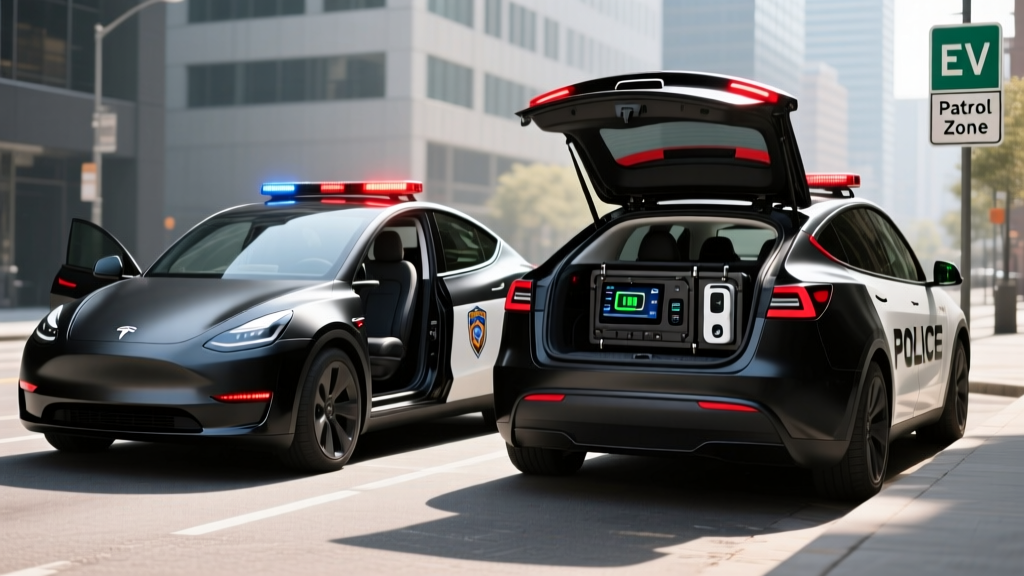
Searches for Tesla cop cars have surged as agencies from Fremont, California to South Pasadena and the Georgia State Patrol put Model Y and Model 3 units into active patrol rotation. The pitch is compelling: instant torque for pursuits, lower per-mile fuel and maintenance costs, and a mobile command center built around a 15.4-inch touchscreen. But a police cruiser lives a harder life than a commuter sedan — idling for hours, sprinting to 100 mph, and running radios, lightbars, and laptops that draw continuous 12V/DC-DC power. This review evaluates the 2026 Tesla Model Y Long Range AWD and Model 3 Long Range AWD — the two variants most commonly upfitted for police use — against the real demands of patrol work.
Fleet Specs at a Glance: 2026 Model Y vs Model 3 Long Range AWD
| Spec | 2026 Model Y LR AWD | 2026 Model 3 LR AWD |
|---|---|---|
| EPA Range | 320 miles | 341 miles |
| Battery (usable) | ~75 kWh (NMC) | ~75 kWh (NMC) |
| Drivetrain | Dual-Motor AWD | Dual-Motor AWD |
| Horsepower | 384 hp | 384 hp |
| 0-60 mph | 4.8 sec | 4.2 sec |
| Top Speed | 125 mph | 125 mph |
| MPGe (combined) | 122 MPGe | 132 MPGe |
| Efficiency | 28 kWh/100 mi | 25 kWh/100 mi |
| Max DC Fast Charge | 250 kW | 250 kW |
| 10-80% DCFC Time | ~27 min | ~25 min |
| Level 2 Home/Depot | 11.5 kW (~44 mi/hr) | 11.5 kW (~48 mi/hr) |
| Cargo Volume | 76 cu ft (rear seats folded) | 23 cu ft trunk + frunk |
| Rear Legroom | 41.6 in | 37.8 in |
| Battery Warranty | 8 yr / 120,000 mi | 8 yr / 120,000 mi |
| Base MSRP (fleet) | ~$46,630 | ~$42,130 |
Source: fueleconomy.gov and Tesla's official 2026 spec sheets. Fleet pricing varies by upfitter and volume.
Real-World Range for Patrol Use
Real-World Patrol Expectation: ~180-220 miles per shift
Why the gap? Aggressive acceleration, sustained 80-100 mph highway response, HVAC running 24/7, and 300-500W of continuous accessory load from radios, MDV laptops, and lightbars.
In IIHS-documented fleet trials, patrol-duty Teslas averaged 2.8-3.1 miles per kWh under mixed urban/highway response driving, compared to the EPA's rated 3.6 mi/kWh for the Model Y. Cold-weather testing in Michigan winters showed a further 18-25% reduction, dropping effective range to ~150 miles before requiring a charge. For a standard 10-hour patrol shift covering 120-180 miles, both models have sufficient buffer — but 12-hour shifts or high-speed rural coverage require mid-shift DC fast charging or depot opportunity charging.
Charging Speed: DC Fast and Depot Level 2
| Charging Method | Power (kW) | Miles Added per Hour | Notes |
|---|---|---|---|
| Tesla Supercharger V4 | Up to 250 kW | ~1,000 mi/hr (peak) | 10-80% in ~25-27 min; tapers sharply above 80% |
| CCS Adapter + Electrify America | Up to 150 kW | ~600 mi/hr (peak) | Requires $175 CCS adapter; useful for non-Tesla networks |
| Depot Level 2 (Wall Connector) | 11.5 kW | ~44-48 mi/hr | Full charge in ~7 hours; ideal for overnight fleet rotation |
| Standard 120V (Level 1) | 1.4 kW | ~4 mi/hr | Emergency/trickle only |
The 250 kW peak on V3/V4 Superchargers is a burst rate — sustained charging averages ~130-150 kW across the 10-80% window due to the NMC charge curve taper. Fleet managers should plan depot charging around 11.5 kW Level 2 Tesla Wall Connectors ($450/unit hardware), with installation running $1,500-$4,000 per stall depending on panel capacity and trenching. A 10-vehicle depot typically requires a 200A panel upgrade or dedicated transformer.
Upfitting for Police Duty: What Changes
Stock Teslas aren't police vehicles — they become cop cars through third-party upfitters like EV FireSafe, Setina, and Whelen Engineering. Typical upfit packages ($15,000-$25,000 per vehicle) include:
- Lightbar and siren integration with Tesla's 12V system (or dedicated auxiliary battery)
- Prisoner transport partition (Model Y preferred for interior volume)
- Weapon rack and equipment console replacing the rear center seat
- Runlock prevention — software to keep HVAC and systems active without a driver in seat
- Heavy-duty 12V auxiliary battery to handle continuous accessory draw without triggering DC-DC converter overload
- Steel or alloy wheels with run-flat tires — Tesla's stock 19-20" wheels are vulnerable to curb damage during pursuits
The Model Y's 76 cu ft cargo area (seats folded) accommodates evidence transport and K9 units more readily than the Model 3's sedan trunk, making it the preferred platform for most agencies. The Model 3 wins on efficiency and pursuit acceleration (4.2 sec 0-60 vs 4.8 sec).
Fleet Pricing and Federal Tax Credit Eligibility
| Item | Model Y LR AWD | Model 3 LR AWD |
|---|---|---|
| Base MSRP (2026) | $46,630 | $42,130 |
| Typical Upfit Package | +$20,000 | +$18,000 |
| As-Tested Fleet Cost | ~$66,630 | ~$60,130 |
| Federal §30D Credit (if eligible) | Up to $7,500 | Up to $7,500 |
| Effective Cost After Credit | ~$59,130 | ~$52,630 |
Critical caveat on tax credits: Under IRS §30D rules for 2026, the $7,500 federal credit requires:
- MSRP cap: Vans/SUVs ≤$80,000; sedans ≤$55,000 (Model 3 qualifies; Model Y qualifies as SUV)
- Buyer income cap: AGI ≤$150K single / $300K joint (not applicable to municipal/government fleet purchases)
- Battery sourcing: Critical minerals and battery components must meet phased-in domestic-content thresholds — Tesla's Austin-built LFP and NMC packs have largely met 2026 thresholds, but verify by VIN on the IRS portal
- Commercial/fleet exception: Government entities and tax-exempt organizations may claim the credit as a direct payment under §30D(g), a significant advantage for municipal fleets
Always confirm eligibility on a per-VIN basis before purchase orders are finalized.
Total Cost of Ownership: Tesla vs Gasoline Interceptors
Compared to the Ford Explorer Police Interceptor Hybrid (~$43,000 base, ~24 MPG combined), a Tesla cop car costs more upfront but saves significantly on fuel and maintenance:
- Fuel savings: At 15,000 patrol miles/year and $3.50/gallon, the Ford uses ~$2,187/year in gas. The Tesla at $0.14/kWh (depot rate) costs ~$588/year — a $1,599 annual savings
- Maintenance: No oil changes, no transmission fluid, regenerative braking extends pad life 3-4x. Estimated annual maintenance: $400 (Tesla) vs $1,800 (Ford)
- 5-year TCO advantage: ~$10,000-$12,000 savings per vehicle, partially offset by higher insurance premiums and potential battery replacement risk beyond the 8-year/120,000-mile warranty
Battery degradation data from high-mileage fleet Teslas shows ~8-12% capacity loss at 100,000 miles — acceptable for patrol use where 80% of original range still covers a standard shift.
Pros, Cons, and Verdict
✅ Pros
- Instant 384 hp torque eliminates pursuit-acceleration lag
- $1,600+/year fuel savings vs gas interceptors
- Regen braking reduces pad wear 3-4x
- Over-the-air updates add features without shop visits
- Supercharger network reliability (98%+ uptime)
- Sentry Mode provides 360° parked-vehicle surveillance
❌ Cons
- Real-world patrol range drops to 180-220 mi (vs 320 EPA)
- Cold-weather range loss of 18-25% requires route planning
- Upfit costs add $15K-$25K on top of MSRP
- No physical buttons — glove-required touchscreen operation while driving is a safety concern
- Runlock and accessory power require custom electrical integration
- Body repair costs 30-50% higher than steel-body interceptors
Who Should Buy Tesla Cop Cars?
Stick with Ford/Chevy interceptors if: You run 12+ hour rural shifts, operate in extreme cold, lack charging infrastructure, or need proven body-shop support in your region.
Frequently Asked Questions
What is the real-world range of a Tesla police car?
Under patrol conditions (aggressive driving, HVAC, accessories), expect 180-220 miles from a Model Y LR AWD and 190-240 miles from a Model 3 LR AWD. Cold weather reduces this by an additional 18-25%.
How fast do Tesla cop cars charge?
On a 250 kW Supercharger, 10-80% takes ~25-27 minutes. On depot Level 2 (11.5 kW), a full charge takes ~7 hours — ideal for overnight fleet rotation.
Do Tesla cop cars qualify for the federal EV tax credit?
Yes, under IRS §30D. Municipal and government fleets can claim the credit as a direct payment. Both Model Y and Model 3 fall under MSRP caps, but battery-sourcing requirements must be verified per VIN.
Is Tesla's Autopilot suitable for police use?
No. Autopilot and FSD (Supervised) are SAE Level 2 driver-assist systems — the driver must remain fully engaged. Police pursuit and emergency-response driving requires manual control at all times. Level 4 autonomy (no driver required) is not available in any consumer Tesla.
What's the biggest drawback of Tesla cop cars?
The lack of physical controls and the need for custom electrical integration for emergency equipment. Agencies report a 2-3 month learning curve for officers transitioning from traditional interceptors, and upfit lead times of 4-6 months.