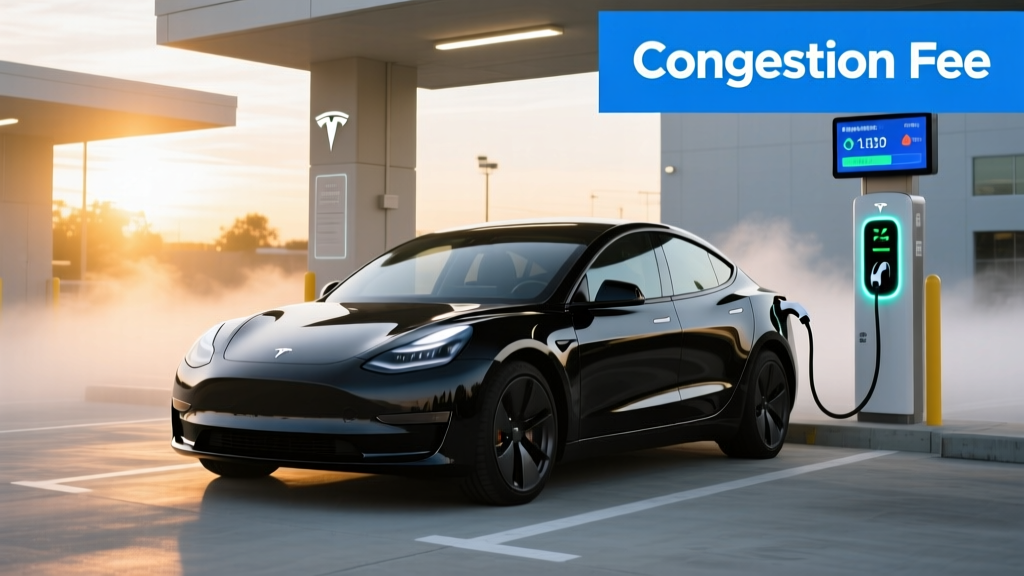
Urban drivers are increasingly facing a new cost of car ownership: congestion pricing. As cities like New York, London, and Stockholm implement tolls for entering busy downtown corridors, electric-vehicle owners — including Tesla drivers — are asking a pointed question: does a Tesla pay a congestion fee? The short answer is that it depends entirely on the city, the program's rules, and whether EVs receive exemptions or discounts. This guide breaks down what the Tesla congestion fee landscape looks like in 2026, how major congestion zones treat EVs, and whether owning a Tesla still makes financial sense when urban tolls enter the equation.
We'll also profile the 2026 Tesla Model Y Long Range AWD — the best-selling EV in America and the Tesla most likely to encounter urban congestion zones — with full specs, real-world range, charging data, pricing, and tax credit eligibility so you can calculate the true cost of ownership.
What Is a Congestion Fee and Why Does It Matter for Tesla Owners?
A congestion fee (also called congestion pricing or a low-emission zone charge) is a toll levied on vehicles entering designated high-traffic urban areas during peak hours. The goal is twofold: reduce gridlock and lower tailpipe emissions. Programs vary enormously in structure:
- Flat daily charges — pay once per day to enter the zone (London's ULEZ, for example).
- Time-based variable pricing — higher tolls during rush hour, lower or zero at night (New York's CBD tolling program).
- Emission-tiered pricing — zero-emission vehicles pay less or nothing; older gas cars pay more (Stockholm, Milan).
For Tesla owners, the critical variable is whether the local program exempts or discounts battery-electric vehicles. Because Teslas produce zero tailpipe emissions, many programs either waive the fee entirely or offer a steep discount — but this is far from universal, and rules are tightening as EV adoption grows.
Congestion Pricing Programs: How They Treat EVs in 2026
Here's a breakdown of major congestion-pricing programs and how they apply to Tesla and other battery-electric vehicles as of 2026:
| City / Program | Fee Structure | EV Exemption | Tesla Impact |
|---|---|---|---|
| New York City (MTA CBD Tolling) | $9 peak / $4.50 off-peak for passenger cars entering Manhattan below 60th St | No blanket EV exemption (as of 2025 launch) | Teslas pay the standard passenger-vehicle rate |
| London (ULEZ + Congestion Charge) | £15/day Congestion Charge + £12.50 ULEZ (expanded Greater London) | BEVs exempt from ULEZ; Congestion Charge Cleaner Vehicle Discount ended Dec 2025 | Teslas now pay the Congestion Charge but skip ULEZ |
| Stockholm | ~SEK 11–45 per passage, time-variable | BEV exemption (extended through 2026) | Teslas pay nothing |
| Singapore (ERP 2.0) | Distance- and time-based, GNSS-tracked | Partial EV rebates on ERP charges | Teslas receive reduced rates |
| Milan (Area C) | €5 per entry on weekdays | BEVs exempt | Teslas pay nothing |
The trend is clear: European cities that pioneered congestion pricing are gradually phasing out EV exemptions as electric adoption rises and revenue needs grow. London's removal of the Cleaner Vehicle Discount in late 2025 was a watershed moment. New York never offered one. If you're buying a Tesla specifically to avoid congestion fees, verify your city's current rules — they can change with a single council vote.
2026 Tesla Model Y Long Range AWD: Full Profile
The 2026 Tesla Model Y remains America's best-selling EV and the Tesla most frequently driven into urban congestion zones. The refreshed "Juniper" generation, which launched in early 2025, brought a quieter cabin, updated interior materials, a rear light bar, and slightly improved efficiency. Here's the complete spec breakdown for the Long Range AWD variant:
| Specification | 2026 Model Y Long Range AWD |
|---|---|
| EPA Range | 320 miles |
| Battery Capacity | ~78 kWh usable, NMC chemistry |
| Drivetrain | Dual-motor AWD |
| Horsepower | 384 hp (combined) |
| 0–60 mph | 4.8 seconds |
| Max DC Fast Charge | 250 kW peak (V3 Supercharger) |
| 10–80% DC Charge | ~25 minutes (with preconditioning) |
| Level 2 Home Charging | 11.5 kW (44 mi/hr at 48A) |
| Efficiency | 122 MPGe combined / 28 kWh/100 mi |
| Cargo Volume | 30.2 cu ft (rear seats up) / 72.0 cu ft (folded) |
| Rear Legroom | 40.5 inches |
| Battery Warranty | 8 years / 120,000 miles (70% retention) |
| Base MSRP | $48,990 (before destination) |
Charging Speed and Infrastructure: The Tesla Advantage
Charging speed is where Tesla still holds a meaningful edge over most competitors, and it's a top concern for EV buyers. The Model Y Long Range supports 250 kW peak DC fast charging on Tesla's V3 Superchargers, adding up to ~160 miles of range in 15 minutes under ideal conditions. The charge curve tapers significantly above 80% State of Charge (SoC) — a 10–80% session takes roughly 25 minutes, but 80–100% can add another 20+ minutes. This is why Tesla's navigation system typically routes you to charge only to 80% on road trips.
| Charging Level | Power (kW) | Rate | Notes |
|---|---|---|---|
| Level 1 (120V outlet) | ~1.4 kW | ~4 mi/hr | Emergency / overnight trickle only |
| Level 2 (240V, 48A) | 11.5 kW | ~44 mi/hr | Home Wall Connector — full charge in ~7 hrs |
| DC Fast (V3 Supercharger) | 250 kW peak | ~160 mi in 15 min | 10–80% in ~25 min with preconditioning |
| DC Fast (CCS adapter) | ~150–175 kW typical | ~120 mi in 15 min | Non-Tesla networks via included NACS-to-CCS adapter |
For home charging, the Tesla Wall Connector on a 60-amp circuit (48A continuous) delivers 11.5 kW — enough to fully replenish the 78 kWh battery in about 7 hours. Most owners who charge overnight at home never visit a public charger except on road trips. Installation costs for a Level 2 home setup typically run $800–$2,500 depending on panel capacity and conduit distance; a 200-amp panel upgrade (if needed) adds $1,500–$3,000.
Tesla's Supercharger network now exceeds 6,500 stations and 70,000+ connectors in North America, and it's increasingly open to non-Tesla EVs via the NACS standard. For urban Tesla owners dealing with congestion fees, reliable home charging is the real cost advantage — electricity at $0.14/kWh national average means a full charge costs roughly $11, versus $45–$60 for an equivalent tank of gas.
Pricing, Tax Credits, and the Congestion Fee Equation
The 2026 Tesla Model Y Long Range AWD starts at $48,990 (plus $1,390 destination), bringing the total to $50,380 before options. Add Full Self-Driving (Supervised) at $8,000 or the more common Basic Autopilot (included), and your as-tested price lands between $50,380 and $60,000+.
| Cost Factor | Amount |
|---|---|
| Base MSRP (Long Range AWD) | $48,990 |
| Destination Fee | $1,390 |
| Federal §30D Tax Credit (if eligible) | –$7,500 (point-of-sale transfer available) |
| Effective Price After Credit | ~$42,880 |
| Annual NYC Congestion Fee (est. 250 workday trips) | +$2,250/year (peak rate) |
- Vehicle MSRP cap: SUVs/vans/pickups must be ≤$80,000 (Model Y qualifies at $50,380).
- Buyer income cap: AGI ≤$150,000 (single) / $225,000 (head of household) / $300,000 (joint). Verify via IRS.gov §30D.
- Battery sourcing: Critical minerals and battery components must meet phased-in domestic/free-trade sourcing thresholds. Tesla's supply chain has largely complied, but verify at the point of sale — eligibility can shift quarterly.
- Point-of-sale transfer: You can transfer the credit to the dealer for an immediate price reduction rather than claiming it on your tax return.
Consult a tax professional. Rules are subject to legislative change.
Does the Congestion Fee Erase Tesla's Cost Advantage?
Let's model a New York City commuter driving a Model Y Long Range into Manhattan's congestion zone 250 days per year at the $9 peak rate:
- Annual congestion fee: $2,250
- Annual electricity cost (12,000 mi at $0.14/kWh, 28 kWh/100mi): ~$470
- Comparable gas car fuel cost (12,000 mi at 25 MPG, $3.60/gal): ~$1,728
- Gas car congestion fee (same zone): $2,250
- Net annual savings for Tesla vs. gas car: ~$3,508 (fuel savings) — the congestion fee applies equally to both.
In New York's program, EVs don't get a discount — but they also don't pay a premium. The Tesla's fuel-cost savings alone dwarf the congestion toll. In cities like Stockholm or Milan where EVs are fully exempt, the Tesla saves you the congestion fee plus fuel costs — a double advantage.
Performance, Tech, and Daily Livability
The Model Y Long Range AWD delivers 384 hp and a 4.8-second 0–60 mph time — brisk for a family crossover and more than adequate for highway merging and passing. The dual-motor AWD system provides confident traction in rain and light snow, though dedicated winter tires are recommended for sustained sub-freezing climates.
Inside, the Juniper-refreshed cabin features a 15.4-inch center touchscreen, ventilated front seats, a rear-seat entertainment screen, ambient lighting, and significantly improved sound insulation over the pre-2025 model. Tesla's infotainment remains one of the most responsive in the industry, with native navigation that integrates Supercharger routing and battery preconditioning automatically.
Driver Assistance: Basic Autopilot (adaptive cruise + lane centering) is standard. Enhanced Autopilot ($6,000) adds automatic lane changes and Navigate on Autopilot. Full Self-Driving (Supervised) at $8,000 adds traffic-light recognition and city-street autosteering — but it remains a SAE Level 2 system requiring constant driver supervision. It is not autonomous driving.
Cargo space is generous: 30.2 cu ft behind the second row and 72.0 cu ft with seats folded — competitive with the Hyundai Ioniq 5 (27.2 / 59.3 cu ft) and slightly less than the Ford Mustang Mach-E (29.7 / 59.7 cu ft). The front trunk (frunk) adds 4.1 cu ft of secure storage.
Model Y vs. Key Competitors: Is It Worth Buying?
The Model Y competes in the most crowded EV segment in America. Here's how it stacks up against the two strongest alternatives:
| Spec | Tesla Model Y LR AWD | Hyundai Ioniq 5 Limited AWD | Ford Mustang Mach-E Premium AWD ER |
|---|---|---|---|
| EPA Range | 320 mi | 290 mi | 300 mi |
| Battery | 78 kWh NMC | 77.4 kWh NMC | 91 kWh NMC |
| Max DC Charge | 250 kW | 350 kW (800V) | 150 kW |
| 10–80% Time | ~25 min | ~18 min | ~45 min |
| 0–60 mph | 4.8 sec | 4.5 sec | 5.1 sec |
| MPGe (combined) | 122 | 110 | 101 |
| Base MSRP (comparable trim) | $48,990 | $54,200 | $52,995 |
| Federal Credit | $7,500 (if eligible) | $7,500 (if eligible) | $7,500 (if eligible) |
The Ioniq 5 charges faster (350 kW on 800V architecture) but has slightly less range and a higher starting price. The Mach-E offers a larger battery but charges significantly slower and trails on efficiency. The Model Y's combination of range, Supercharger network access, efficiency, and cargo space remains hard to beat at its price point — especially after the $7,500 credit.
✅ Pros
- Class-leading efficiency (122 MPGe)
- Supercharger network reliability
- Strong cargo capacity (72 cu ft max)
- Over-the-air updates improve the car over time
- Lowest price in segment after tax credit
❌ Cons
- DC charge speed trails Ioniq 5 / EV6 (no 800V)
- No Apple CarPlay or Android Auto
- FSD costs extra and remains Level 2 only
- Firm ride quality on rough urban roads
- Service center wait times in some metro areas
Who Should Buy the Model Y — and Who Shouldn't?
Choose the Model Y Long Range if:
- You commute into a congestion zone and want to minimize per-mile energy cost (the congestion fee applies equally to gas cars, so EV fuel savings still dominate).
- You take regular road trips and value the Supercharger network's reliability.
- You need family-friendly cargo space without stepping up to a 3-row SUV.
- You want the lowest effective price in the segment after the §30D credit.
Look elsewhere if:
- Fastest possible DC charging is your top priority (consider the Ioniq 5 or Kia EV6 with 800V).
- You require Apple CarPlay / Android Auto integration.
- You prefer a traditional dealership service experience over Tesla's mobile/service-center model.
- You need 3-row seating (consider the Kia EV9 or Tesla Model X).
Frequently Asked Questions
Do Teslas pay congestion fees in New York City?
Yes. New York's MTA congestion pricing program (launched January 2025) charges all passenger vehicles the same rate regardless of powertrain. As of 2026, the peak toll is $9 for entering Manhattan below 60th Street. There is no EV exemption. Teslas pay the same rate as gas-powered cars.
Do Teslas get a congestion fee discount in London?
Partially. Teslas (as zero-emission BEVs) are exempt from London's Ultra Low Emission Zone (ULEZ) charge. However, the Congestion Charge Cleaner Vehicle Discount ended in December 2025, so Teslas now pay the full £15/day Congestion Charge in central London.
Is the Tesla Model Y eligible for the $7,500 federal tax credit in 2026?
The Model Y qualifies on MSRP (under the $80,000 SUV cap) and Tesla's battery sourcing has generally met §30D requirements. However, buyer income caps ($150K single / $300K joint) and quarterly sourcing-rule changes mean eligibility is not guaranteed for every buyer. Verify current eligibility on IRS.gov or via the dealer's point-of-sale transfer process.
What is the real-world range of the 2026 Tesla Model Y Long Range?
The EPA rates it at 320 miles. Real-world highway driving at 70–75 mph yields approximately 265–285 miles. In cold weather (below 30°F), expect 220–240 miles. City driving with regenerative braking can match or exceed the EPA figure. Source: fueleconomy.gov.
Does Tesla charge its own congestion fee or surcharge?
No. Tesla does not impose any proprietary congestion fee on its owners. The term "Tesla congestion fee" refers to municipal congestion pricing programs that Tesla vehicles may be subject to — the same tolls that apply to all vehicles entering designated urban zones.
How much does it cost to charge a Model Y at home vs. a Supercharger?
At the national average residential electricity rate of ~$0.14/kWh, a full 78 kWh charge costs about $11 (roughly $0.035/mile). Supercharger pricing varies by location and time of day but typically ranges from $0.25–$0.45/kWh, making a full charge $20–$35 ($0.065–$0.11/mile). Both are significantly cheaper than gasoline at ~$0.14/mile for a 25 MPG car.
What's the battery warranty on the 2026 Model Y?
Tesla covers the battery and drive unit for 8 years or 120,000 miles (whichever comes first), with a guaranteed minimum 70% capacity retention. If the battery degrades below 70% State of Health within the warranty period, Tesla will repair or replace it. Long-term fleet data suggests NMC batteries in Teslas typically retain 85–90% capacity at 100,000 miles under normal use.