Why Tesla's Concept Cars Still Matter in 2026
Tesla has a long history of revealing vehicles years — sometimes a decade — before they reach production. The original Roadster was teased in 2006 and shipped in 2008. The Cybertruck debuted as a concept in November 2019 and didn't reach driveways until late 2023. For buyers and enthusiasts tracking concept cars Tesla has showcased, the pattern is clear: treat every unveil as a directional statement, not a purchase opportunity.
As of early 2026, Tesla has several announced or concept-stage vehicles that have not yet entered volume production. This guide breaks down each one with the most current preliminary specs, realistic timelines, and what they mean for your next EV purchase decision. Nothing below is currently available to order as a finished, deliverable consumer vehicle unless explicitly noted.
The Announced Lineup: What Tesla Has Shown
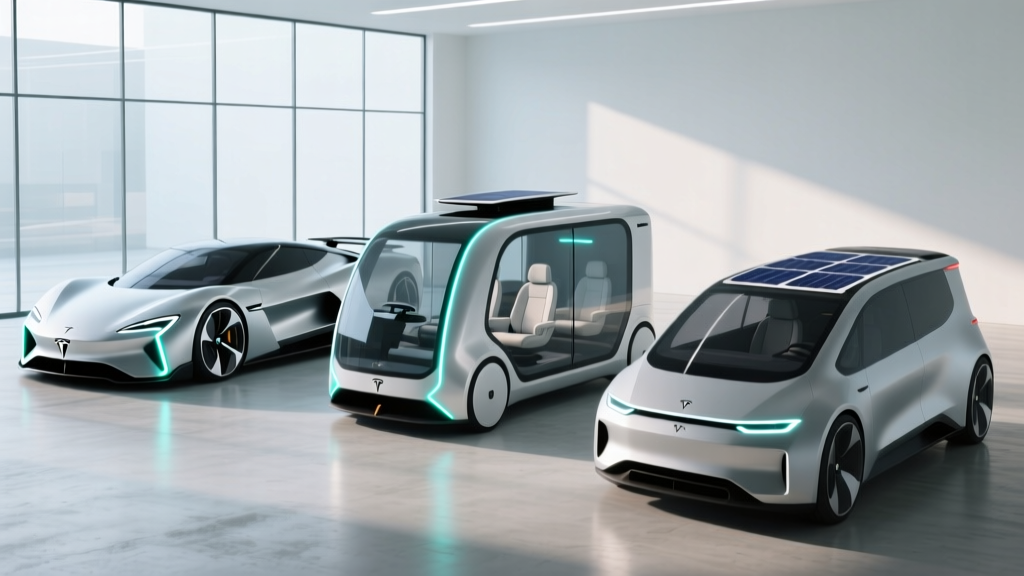
Tesla's pipeline of concept and announced vehicles spans four distinct categories: a next-generation affordable platform, a dedicated robotaxi, a halo sports car, and a potential compact utility vehicle. Here's what we know — and more importantly, what we don't.
| Model | Status | Est. Range | Est. Price | Platform |
|---|---|---|---|---|
| Next-Gen (Model 2 / Redwood) | Announced, pre-production | ~250–300 mi (est.) | ~$25,000 (target) | Next-gen unboxed |
| Cybercab (Robotaxi) | Concept unveiled Oct 2024 | ~200–250 mi (est.) | <$30,000 (target, fleet) | Next-gen unboxed |
| Roadster 2.0 | Announced 2017, delayed repeatedly | ~620 mi (claimed) | ~$200,000+ (est.) | Dedicated sports |
| Compact Utility (speculative) | Unconfirmed | TBD | TBD | Next-gen (rumored) |
Next-Gen Affordable Platform ("Model 2" / Redwood)
This is the concept car Tesla watchers care about most. Often referred to internally as "Redwood" and colloquially as the "Model 2," this vehicle represents Tesla's bid to compete directly with the Chevrolet Equinox EV, Volvo EX30, and upcoming affordable entries from legacy automakers.
What We Know So Far
Tesla has confirmed a next-generation vehicle platform designed around a radically simplified manufacturing process the company calls "unboxed" production. Rather than assembling a vehicle on a traditional line, major sub-assemblies are built independently and joined at the end — reducing factory footprint by roughly 40% and cutting production cost significantly.
Based on supply-chain reporting and Tesla's own investor-day disclosures, the target specifications include:
- Battery: Likely ~50–60 kWh usable capacity, with LFP (lithium iron phosphate) chemistry for base trims to control cost and improve cycle life
- Estimated range: 250–300 miles EPA (preliminary, dependent on battery pack configuration)
- Charging: Expected to support 150–200 kW DC fast charging via NACS connector, with a projected 10–80% time of approximately 20–25 minutes
- Drivetrain: Single-motor RWD base, dual-motor AWD optional
- Target MSRP: ~$25,000 before incentives
Tax Credit Potential
At a ~$25,000 base MSRP, this vehicle would fall well under the IRS §30D MSRP cap of $55,000 for sedans/hatchbacks. If Tesla sources battery materials and final assembly to meet current critical-mineral and battery-component requirements, buyers could qualify for up to $7,500 — potentially bringing the effective price below $18,000. However, income caps ($150,000 single / $300,000 joint AGI) and point-of-sale transfer rules apply. Always verify eligibility with a tax professional and the latest IRS guidance before purchase.
Timeline Reality Check
Tesla initially suggested production could begin as early as late 2025. As of early 2026, the company has redirected significant engineering resources toward AI and robotics. Industry analysts expect volume production no earlier than late 2026 or 2027, with initial availability potentially limited to specific markets. This vehicle is not currently available to order.
Cybercab: Tesla's Purpose-Built Robotaxi Concept
Unveiled in October 2024 at Warner Bros. Studios, the Cybercab is a two-passenger vehicle with no steering wheel or pedals — designed exclusively for autonomous ride-hailing. Tesla CEO Elon Musk stated the target price would be under $30,000, with operating costs potentially below $0.20 per mile.
Preliminary Specifications
Because the Cybercab is a concept-stage vehicle intended primarily for fleet operation, consumer-facing specs are limited. Based on the unveil and subsequent disclosures:
- Battery: Estimated ~40–50 kWh (sufficient for urban duty cycles)
- Estimated range: 200–250 miles (adequate for 10–14 hours of city driving before recharging)
- Charging: Wireless inductive charging planned for fleet depots; DC fast-charge capability TBD
- Autonomy: Designed for SAE Level 4 operation in geofenced areas — no driver input required within approved zones
- Interior: Two seats, large central touchscreen, no manual controls
When — and Whether — You Could Own One
Tesla has indicated the Cybercab will initially serve Tesla's own ride-hailing network, not individual buyers. A consumer version is possible but unconfirmed. Production timing is listed as 2026–2027, though Tesla's track record with announced timelines warrants skepticism. Regulatory approval for steering-wheel-free vehicles on public roads remains a significant hurdle at both federal (NHTSA) and state levels.
Roadster 2.0: The Concept Car That Won't Quit
Announced in November 2017, the second-generation Tesla Roadster has become the most delayed concept car in Tesla's history. The claimed specifications, if ever realized, would make it the fastest production car ever built.
Claimed Specifications (Preliminary — Unverified)
| Spec | Claimed Figure | Credibility Assessment |
|---|---|---|
| 0–60 mph | 1.9 seconds (base) / 1.1 sec (SpaceX package) | Possible with AWD EV torque; SpaceX cold-gas thrusters unproven in production |
| Top Speed | 250+ mph | Requires extreme aero and thermal management |
| Range | 620 miles (claimed) | Would require ~200 kWh pack — heavy, costly, unprecedented in production |
| Battery | ~200 kWh (estimated) | Likely NMC chemistry for energy density |
| Drivetrain | Tri-motor AWD | Consistent with Tesla's Plaid architecture |
| Price | $200,000 (base) / $250,000 (Founders Series) | Founders Series requires $50,000 reservation deposit |
The Roadster 2.0 is not in production and has no confirmed delivery date. Tesla has periodically updated the design — most notably adding the optional "SpaceX package" with cold-gas thrusters for improved acceleration and cornering. Whether this vehicle ever ships in volume, ships in limited numbers as a halo product, or is quietly shelved remains an open question in 2026.
Tax Credit Outlook
Even if the Roadster 2.0 reaches production, it will not qualify for the §30D federal tax credit. The MSRP cap for sedans/sports cars is $55,000, and the buyer income cap ($150,000 single filer) would exclude most purchasers at this price point regardless.
What These Concepts Mean for Current Tesla Buyers
If you're shopping for a Tesla today, the concept pipeline shouldn't paralyze your decision — but it should inform it. Here's how to think about timing:
- You need a vehicle in the next 6 months
- The current Model 3 or Model Y meets your range, space, and budget requirements
- You value access to the mature Supercharger network (now open to NACS-equipped vehicles from Ford, GM, Rivian, and others)
- A sub-$30,000 EV is your target and you can wait 12–24 months
- You're considering a robotaxi business model (Cybercab fleet ownership is speculative and unproven)
- You want the next-gen manufacturing cost advantages to potentially drive down prices across Tesla's lineup
How Tesla's Concepts Compare to Available EVs Today
While Tesla's concept cars remain in development, competitors have shipped real vehicles that target similar segments. Here's how the Tesla concepts stack up against what you can actually buy in 2026:
| Vehicle | Status | EPA Range | Base MSRP | Tax Credit |
|---|---|---|---|---|
| Tesla Next-Gen (concept) | Not available | ~250–300 mi (est.) | ~$25,000 (target) | Unknown |
| Chevrolet Equinox EV | Available now | 319 mi (EPA) | $33,600 | Up to $7,500 |
| Volvo EX30 | Available now | 264 mi (EPA) | $36,145 | Check eligibility |
| Hyundai Ioniq 5 | Available now | 303 mi (EPA) | $42,600 | Up to $7,500 |
| Tesla Model 3 (current) | Available now | 363 mi (EPA, Long Range) | $38,990 | Up to $7,500 |
Data sourced from fueleconomy.gov and manufacturer specifications. Tax credit eligibility depends on MSRP caps, buyer income, battery sourcing, and final assembly requirements per IRS §30D rules.
Pros and Cons of Waiting for Tesla Concept Cars
- Potentially significantly lower purchase price ($25K target for next-gen)
- Next-gen manufacturing may yield better cost-per-mile economics
- Cybercab could open a ride-hailing revenue stream (if regulations allow)
- Roadster 2.0, if built, would be a generational performance machine
- No confirmed production dates — delays are the norm, not the exception
- Competitors are shipping real vehicles with proven specs today
- Tesla's strategic focus has shifted heavily toward AI/robotics over vehicle launches
- Tax credit rules may change before these vehicles ship
- Reservation deposits (e.g., Roadster Founders Series at $50K) carry financial risk
Frequently Asked Questions
Can I buy any of Tesla's concept cars right now?
No. As of early 2026, the Next-Gen affordable vehicle, Cybercab, and Roadster 2.0 are all in pre-production or concept stage. None are available for consumer purchase. The only Tesla vehicles currently in production and available to order are the Model 3, Model Y, Model S, Model X, and Cybertruck.
What is the real-world range we can expect from Tesla's next-gen affordable car?
If the EPA estimate lands around 280 miles, expect roughly 220–240 miles in real-world highway driving and 180–200 miles in cold weather (below 32°F). These are estimates based on typical EV efficiency losses — actual figures will depend on the final battery capacity, chemistry (LFP vs. NMC), and vehicle weight.
How fast will the Tesla next-gen car charge?
Based on preliminary reports, the next-gen platform is expected to support 150–200 kW DC fast charging. At that rate, a 10–80% charge would take approximately 20–25 minutes. Home Level 2 charging at 11.5 kW (48A) would add roughly 35–45 miles per hour of charging. These figures are estimates pending official specifications.
Will Tesla's concept cars qualify for the $7,500 federal EV tax credit?
It depends. The next-gen affordable car at ~$25,000 would clear the MSRP cap ($55,000 for non-SUVs). However, eligibility also requires meeting battery-sourcing and critical-mineral requirements under §30D, and the buyer must fall within income limits ($150,000 single / $300,000 joint). The Roadster 2.0 at $200,000+ would not qualify. Always check the latest IRS guidance before purchasing.
Is the Cybercab something I could own personally?
Tesla has described the Cybercab primarily as a fleet vehicle for its planned ride-hailing network. Personal ownership has not been ruled out but is not the primary use case. Additionally, operating a driverless vehicle requires regulatory approval that varies by state and is still evolving under NHTSA oversight.
Is it worth waiting for Tesla's next-gen car vs. buying a competitor now?
If you need a vehicle within 6–12 months and find a current EV that meets your range, space, and budget needs — such as the Chevy Equinox EV at $33,600 with 319 miles of EPA range — waiting is a gamble. Tesla's next-gen car could be an outstanding value at $25,000, but the timeline is uncertain and competitors are delivering proven products today with available tax credits.
How reliable are Tesla's concept car timelines?
Historically, Tesla's announced timelines have been optimistic. The Cybertruck was unveiled in 2019 with a 2021 production target; it began deliveries in late 2023. The Roadster 2.0 was announced in 2017 with a 2020 target and still hasn't shipped. Factor in at least 12–24 months of buffer beyond any announced date.