The Tesla Concept Landscape in 2026: Hype vs. Hardware
Search "Tesla concept" and you'll find a tangle of renderings, Elon Musk timelines, and speculative YouTube thumbnails. For buyers trying to make an actual electrified-vehicle decision, the signal-to-noise ratio is brutal. This guide cuts through it: we separate Tesla concepts that are announced and in limited production from those still in development, then ground everything in the models you can order and take delivery of right now.
Tesla's current lineup — Model 3, Model Y, Model S, Model X, and Cybertruck — remains the only way to put a Tesla badge in your driveway. The much-discussed Cybercab (unveiled October 2024) and the long-promised next-generation Roadster are the two concepts most likely to reach customers, but neither is available for consumer purchase as of early 2026. Below, we break down what's known, what's preliminary, and how Tesla's current lineup stacks up for buyers who don't want to wait.
Announced Tesla Concepts: Cybercab, Roadster, and the $25K Question
Cybercab (Robotaxi)
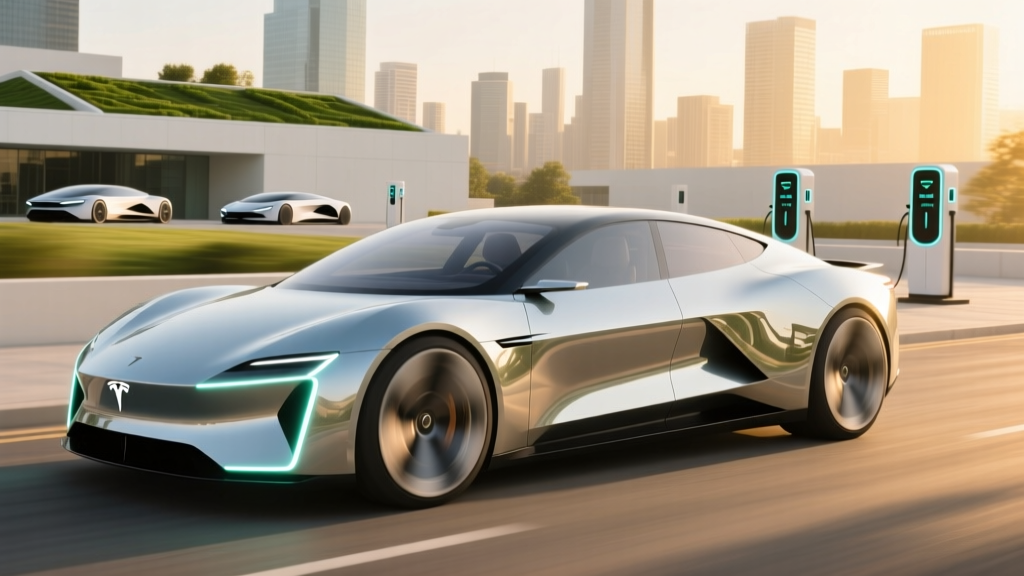
Unveiled at the "We, Robot" event in October 2024, the Cybercab is a two-seat, steering-wheel-free vehicle designed for Tesla's planned autonomous ride-hailing network. Tesla has stated production would begin no earlier than 2026, initially limited to supervised deployment in select U.S. markets pending regulatory approval. The Cybercab is not available for consumer purchase. Preliminary specs cited by Tesla include a target cost below $30,000 per unit (for fleet operators) and an operating cost under $0.20 per mile — but these are manufacturer claims, not independently verified figures.
Next-Generation Roadster
Originally announced in 2017 with a claimed 0-60 mph time of 1.9 seconds and 620-mile range, the Roadster has been repeatedly delayed. As of 2026, Tesla lists it on its website but provides no firm production date. All published specs remain preliminary and should be treated as targets, not guarantees. Tesla CEO Elon Musk indicated in 2024 that the design would include a "SpaceX package" with cold-gas thrusters — a claim that has not been independently validated.
The "$25,000 Tesla" / Next-Gen Compact
Tesla has referenced a lower-cost vehicle built on a next-generation platform for years. Recent reporting suggests this effort has been partially absorbed into the Cybercab program and into cost reductions on existing Model 3/Y variants. As of early 2026, no standalone sub-$30,000 Tesla consumer vehicle has been formally announced with a production timeline.
What You Can Actually Buy: 2026 Tesla Lineup Specs
Rather than wait on concepts, here is the full spec breakdown of every Tesla currently available for order and delivery. All figures reflect the latest model-year data from fueleconomy.gov and Tesla's official configuration pages.
| Spec | Model 3 LR AWD | Model Y LR AWD | Cybertruck AWD | Model S LR |
|---|---|---|---|---|
| EPA Range | 341 mi | 320 mi | 318 mi | 402 mi |
| Battery (usable) | ~75 kWh (NMC) | ~75 kWh (NMC) | ~123 kWh (NMC) | ~95 kWh (NMC) |
| Peak DC Charge | 250 kW | 250 kW | 350 kW (800V) | 250 kW |
| 10–80% DC Time | ~25 min | ~25 min | ~15 min | ~30 min |
| Level 2 Rate | 11.5 kW (~44 mi/hr) | 11.5 kW (~44 mi/hr) | 19.2 kW (~52 mi/hr) | 11.5 kW (~34 mi/hr) |
| 0–60 mph | 4.2 sec | 4.8 sec | 3.9 sec | 3.1 sec |
| Horsepower | 346 hp | 384 hp | 600 hp | 670 hp |
| Drivetrain | Dual Motor AWD | Dual Motor AWD | Dual Motor AWD | Dual Motor AWD |
| MPGe (combined) | 131 MPGe | 117 MPGe | 76 MPGe | 120 MPGe |
| Cargo Volume | 23 cu ft (trunk+frunk) | 76 cu ft (max) | ~121 cu ft (vault+frunk) | 28 cu ft (trunk+frunk) |
| Base MSRP | $47,740 | $48,990 | $79,990 | $74,990 |
Charging Infrastructure: Tesla's Biggest Advantage
The Supercharger network remains Tesla's strongest competitive moat. With over 6,500 Superchargers across North America and growing, Tesla owners enjoy the most reliable DC fast-charging ecosystem available. Non-Tesla EVs are now gaining access to Superchargers via the NACS (North American Charging Standard) connector or adapters, but Tesla vehicles still benefit from seamless plug-and-charge integration and vehicle-native routing that preconditions the battery for optimal charge speed.
| Charging Level | Power (kW) | Miles Added/Hour | Best For |
|---|---|---|---|
| Level 1 (120V household) | 1.4 kW | 3–5 mi/hr | Overnight trickle, emergencies |
| Level 2 (240V home, 48A) | 11.5 kW | ~34–44 mi/hr | Daily home charging |
| DC Fast (V3 Supercharger) | Up to 250 kW | ~170 mi in 15 min | Road trips |
| DC Fast (V4 / Cybertruck 800V) | Up to 350 kW | ~200 mi in 15 min | Cybertruck, future models |
Charging curve reality: Peak kW ratings are not sustained. A Model 3 Long Range hitting a V3 Supercharger at low SoC may peak near 250 kW but will taper to ~150 kW by 50% and below 60 kW past 80%. The 10–80% time of ~25 minutes reflects this taper. Charging from 80–100% can add another 20+ minutes — plan your road-trip stops around the 10–80% window for efficiency.
kW vs. kWh refresher: kW (kilowatts) measures power — how fast energy flows into the battery during charging. kWh (kilowatt-hours) measures energy capacity — the total amount of energy the battery stores. Think of kW as the width of a hose and kWh as the size of the tank.
Pricing, Tax Credits, and Total Cost
Tesla pricing has fluctuated frequently. Below are base MSRPs as listed on Tesla's configurator in early 2026, before any incentives. Destination fees add approximately $1,390.
| Model / Trim | Base MSRP | §30D Credit Eligible? | Est. After Credit |
|---|---|---|---|
| Model 3 RWD | $38,990 | Yes (up to $7,500) | ~$31,490 |
| Model 3 Long Range AWD | $47,740 | Yes (up to $7,500) | ~$40,240 |
| Model Y Long Range AWD | $48,990 | Yes (up to $7,500) | ~$41,490 |
| Cybertruck AWD | $79,990 | Yes (up to $7,500) | ~$72,490 |
| Model S Long Range | $74,990 | Yes (up to $7,500) | ~$67,490 |
| Model X Long Range | $79,990 | Yes (up to $7,500) | ~$72,490 |
-
Federal §30D Tax Credit Requirements (2026):
- MSRP Cap: Vans/SUVs/pickups ≤ $80,000; sedans ≤ $55,000. (Model S at $74,990 qualifies under sedan cap; Cybertruck at $79,990 qualifies under pickup cap.)
- Buyer Income Cap: AGI ≤ $150,000 (single), $225,000 (head of household), $300,000 (joint).
- Battery Sourcing: Credit splits into two halves ($3,750 each) — one for critical minerals, one for battery component manufacturing. Sourcing requirements tighten annually; verify current-year rules at irs.gov.
- Point-of-Sale Transfer: Eligible buyers can transfer the credit to the dealer at purchase, reducing the upfront price rather than waiting for a tax refund.
- Final Assembly: Vehicle must undergo final assembly in North America (all U.S.-built Teslas qualify).
Important: Tax credit eligibility depends on your individual tax situation, the specific vehicle's battery sourcing at time of delivery, and current IRS rules. Consult a tax professional and check irs.gov before relying on credit availability.
Driver-Assist Tech: Autopilot and FSD (Supervised)
Every new Tesla ships with Basic Autopilot (traffic-aware cruise control and lane centering). Full Self-Driving (Supervised) adds automated lane changes, Navigate on Autopilot, autosteer on city streets, and Smart Summon. As of 2026, FSD costs $8,000 as a one-time purchase or $99/month.
- It does not make the vehicle self-driving. You are the responsible driver at all times.
- It does not handle all road conditions — construction zones, unmapped roads, severe weather, and complex intersections require immediate human takeover.
- It is not a Level 3 or Level 4 system. NHTSA and SAE classify it as Level 2, requiring continuous driver supervision.
- NHTSA has investigated multiple incidents involving Autopilot/FSD. Check nhtsa.gov for the latest safety data and recalls.
On the infotainment side, Tesla's 15.4-inch center touchscreen handles navigation, media, climate, and vehicle settings. There is no Apple CarPlay or Android Auto — Tesla's native system is the only option. The Model 3 Highland refresh and current Model Y Juniper update have improved ride quality, added ventilated seats, and introduced ambient lighting and a rear-seat touchscreen.
Warranty, Battery Longevity, and Ownership Costs
Tesla's warranty structure is straightforward but not class-leading:
- Basic Vehicle: 4 years / 50,000 miles
- Battery & Drive Unit: 8 years / 120,000 miles (Model 3/Y Long Range, Model S/X) or 8 years / 100,000 miles (Model 3 RWD with LFP battery)
- Battery capacity retention: Tesla warrants that the battery will retain at least 70% of original capacity during the warranty period.
Tesla uses NMC (nickel manganese cobalt) chemistry in Long Range and Performance models, offering higher energy density for maximum range. The Model 3 RWD uses LFP (lithium iron phosphate) chemistry, which is more durable over charge cycles and can be charged to 100% regularly without degradation concerns — but has lower energy density, resulting in less range. LFP batteries also perform worse in extreme cold.
Real-world battery degradation data from fleet studies and owner reports suggest Tesla NMC packs lose approximately 10–12% capacity over the first 100,000 miles, with the curve flattening significantly thereafter. LFP packs show slower degradation but with a slightly steeper initial drop. Out-of-warranty battery replacement costs range from $12,000–$20,000 depending on the model, though most packs are lasting well beyond warranty limits.
Who Should Buy a Tesla in 2026 — and Who Shouldn't
- You want access to the most reliable, widespread DC fast-charging network (Superchargers) for road trips.
- You value over-the-air software updates that add features post-purchase.
- You want a tech-forward cabin with minimal physical buttons and strong app integration.
- You live in an area with good Supercharger density and can install a Level 2 home charger.
- You need Apple CarPlay/Android Auto — Tesla doesn't support either.
- You want a traditional dealership experience with in-person service centers nearby (Tesla's mobile-ranger and service-center model works well in metros but can be frustrating in rural areas).
- You want physical buttons for climate and volume controls.
- You need a proven Level 4 robotaxi today — Waymo operates in select cities now; Tesla's Cybercab is not yet available.
- Best-in-class Supercharger network access
- Strong efficiency (kWh/mi) across the lineup
- Over-the-air updates improve the car over time
- Spacious cargo areas (especially Model Y and Cybertruck)
- Federal tax credit eligibility on all current models
- No Apple CarPlay or Android Auto
- FSD (Supervised) is expensive and still requires full driver attention
- Service infrastructure is thin outside major metros
- Minimalist interior not for everyone (no stalks on refreshed models)
- Cybertruck efficiency and real-world range lag behind its EPA sticker
Frequently Asked Questions
What is the real-world range of Tesla's current EVs?
EPA estimates are a starting point, not a guarantee. The Model 3 Long Range AWD is rated at 341 miles EPA, but expect ~270–290 miles on a highway road trip in warm weather and ~240–260 miles in freezing temperatures. The Model Y Long Range (320 mi EPA) delivers roughly 260–280 miles real-world highway. The Cybertruck, despite a 318-mile EPA rating, often delivers 240–260 miles in mixed driving due to its heavy weight and poor aerodynamics. Always budget range with a 20% buffer for unexpected detours or weather.
How fast does a Tesla charge at home and on the road?
At home on a 240V Level 2 charger (11.5 kW), a Model 3 or Model Y adds roughly 34–44 miles of range per hour — an overnight session easily replenishes a full day's driving. On a V3 Supercharger (250 kW peak), expect a 10–80% charge in about 25 minutes for Model 3/Y, though the Cybertruck with its 800-volt architecture can do 10–80% in roughly 15 minutes on a compatible V4 Supercharger at up to 350 kW. Remember: peak charge rates only apply at low state of charge; speed tapers significantly above 60%.
How much does a Tesla cost after federal tax credits?
If you meet all IRS §30D requirements — income caps, MSRP caps, and battery sourcing rules — you can reduce the price by up to $7,500. A Model 3 RWD at $38,990 drops to ~$31,490; a Model Y Long Range at $48,990 drops to ~$41,490. The credit can be transferred at point of sale, reducing your upfront cost. However, eligibility depends on your AGI and the vehicle's battery component sourcing at the time of delivery — verify both before committing.
Is a Tesla worth buying vs. competitors like Hyundai Ioniq 5, Ford Mustang Mach-E, or BMW i4?
Tesla's advantages remain the Supercharger network, software ecosystem, and efficiency. Competitors like the Hyundai Ioniq 5 (with 800V charging and a more conventional interior) and the BMW i4 (luxury feel, CarPlay support) are compelling alternatives. The Mach-E offers a more traditional crossover experience. If Supercharger access is your top priority and you're comfortable with Tesla's minimalist cabin and service model, a Tesla is still a strong pick. If you value interior refinement, physical controls, or broader service networks, test-drive the competition.
Does every Tesla qualify for the $7,500 federal EV tax credit?
All current Tesla models qualify for up to $7,500 under §30D based on MSRP and North American assembly, but your personal eligibility depends on your adjusted gross income (≤$150K single, ≤$300K joint) and whether the specific vehicle's battery meets critical-mineral and component-sourcing thresholds for the delivery year. These thresholds tighten annually. Always confirm at irs.gov and with a tax professional before assuming the full credit.
When will the Tesla Cybercab or Roadster be available to buy?
Neither is available for consumer purchase as of 2026. The Cybercab is intended for Tesla's autonomous fleet operations, not individual ownership, and requires regulatory approval for driverless deployment. The Roadster remains listed on Tesla's website with no confirmed production date. If you need a Tesla now, the current lineup is what's orderable — don't delay a purchase waiting on concepts with shifting timelines.